Read before you choose
Astaroth
Memory and the Secret
This 13-page sample includes an introduction, a historical passage, a workshop, one complete practice and references. It retains the original book’s page numbers: the gaps reflect the selection.
Download PDF · 6.6 MBNo registration · Selectable text in the PDF
Cover

Read the text on this page
themethodfiles.com THE METHOD FILES ASTAROTH Memory and the Secret HISTORY ∙ SYMBOLS ∙ TWELVE OPERATIONSAbout this reading sample
Read the text on this page
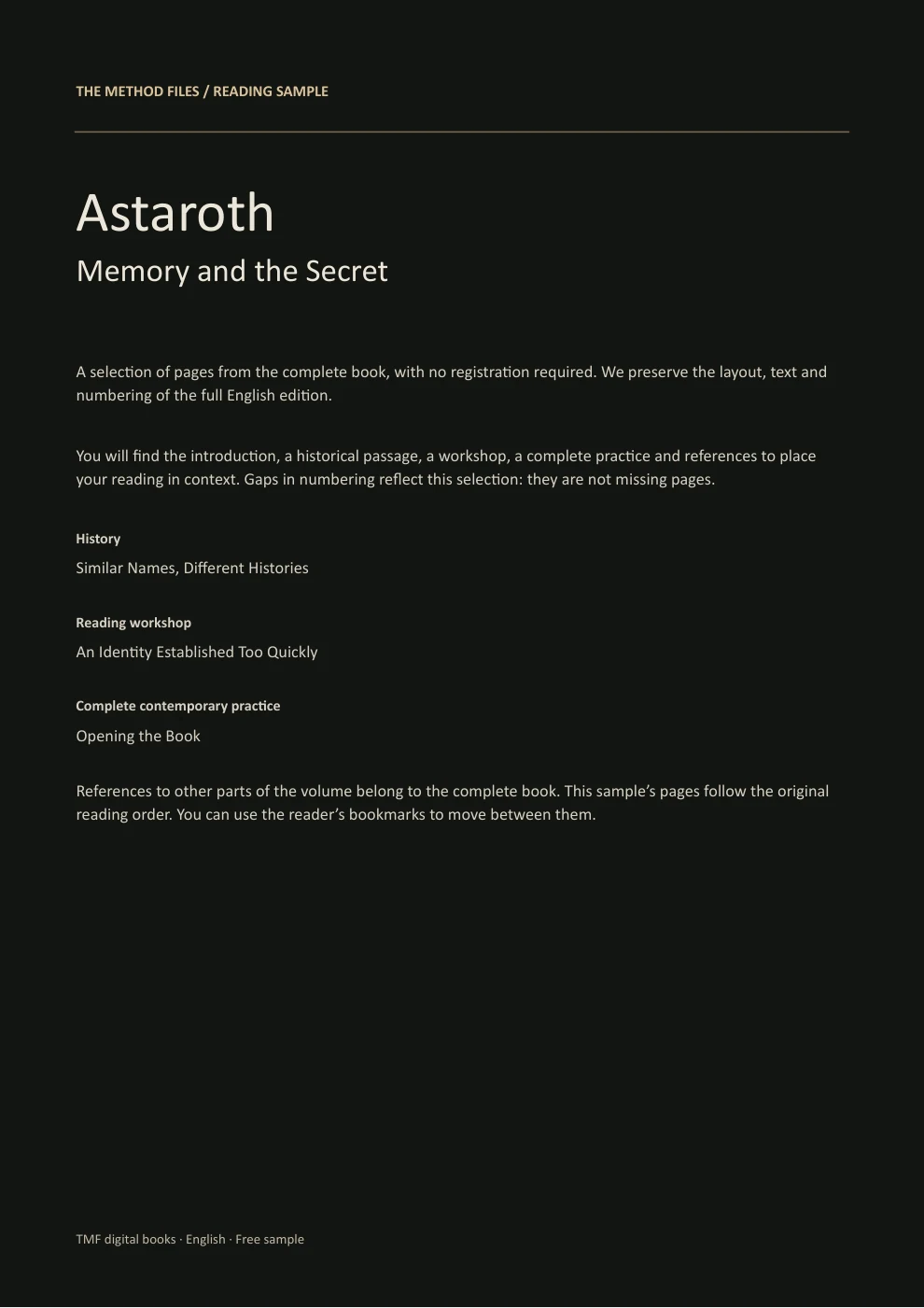
THE METHOD FILES / READING SAMPLE Astaroth Memory and the Secret A selection of pages from the complete book, with no registration required. We preserve the layout, text and numbering of the full English edition. You will find the introduction, a historical passage, a workshop, a complete practice and references to place your reading in context. Gaps in numbering reflect this selection: they are not missing pages. History Similar Names, Different Histories Reading workshop An Identity Established Too Quickly Complete contemporary practice Opening the Book References to other parts of the volume belong to the complete book. This sample’s pages follow the original reading order. You can use the reader’s bookmarks to move between them. TMF digital books ∙ English ∙ Free sampleRead the source. Recognise the creation. · page 6 of the book

Read the text on this page
THE METHOD FILES themethodfiles.com 006 NOTE ON METHOD Read the source. Recognise the creation. DOCUMENT A passage, image or object that can be located. When a source attributes powers or recounts apparitions, we set out what that text claims, without turning it into a verified fact. RECEPTION The transformation of a name or figure in another book, period or artistic language. Differences in rank, appearance and function are retained and explained. INTERPRETATION The reading proposed in these pages. It is distinguished from the words of a source and can be revised without altering the document from which it begins. CONTEMPORARY CEREMONY All the operations in this volume are original compositions. Each identifies the motifs it takes from the sources and specifies its own objects, words, closing and record. PRINCIPLE FOR PRACTICE Participation is voluntary and may end at any time. No supernatural result is promised. The operations concern one’s own attention, devotion and conduct; they do not authorise control over other people. The original formulas were written in Spanish; English translations are provided here. Terms from other languages are explained in context or in the glossary.Memory and the Secret · page 7 of the book

Read the text on this page
THE METHOD FILES themethodfiles.com 007 INTRODUCTION Memory and the Secret Astaroth brings together two powers worth keeping under examination: knowing something and claiming to know it. The catalogues attribute to the figure answers about the past, present and future, discovery of secrets and teaching of arts. Those attributions explain the figure's appeal. They also require questions about how an answer is recognised, how a source is retained and what happens when speakers become their own authority. This book follows the figure through similar names, demonological descriptions, different hierarchies and material supports. The resemblance to Astarte is studied without automatically merging an ancient goddess with a duke of the grimoires. Wellcome manuscript 983 and the printed edition of 1916 allow us to observe that a name can change rank and sign without disappearing. The difference is not a malfunction to conceal; it is part of the figure's history. The twelve ceremonies develop a relationship with knowledge through defined acts: opening a book, distinguishing times, delimiting a question, studying, remembering, copying, archiving, declaring, reserving, comparing, correcting and committing. The invocation of Astaroth sustains that sequence, but no spoken word dispenses with the work it announces. Each operation ends in a concrete trace and a record open to review. Devotional practice and documentary study can coexist without becoming confused. An inner experience deserves a faithful description; a historical claim needs a witness. Accepting both criteria allows work with secrecy without manufacturing authority, and with memory without making it an untouchable version of the past. The volume is designed for returning to its pages, confronting them and noting corrections: a book of knowledge must allow its readers to learn to challenge it.Similar Names, Different Histories · page 9 of the book

Read the text on this page
THE METHOD FILES themethodfiles.com 009 HISTORY ∙ 01 Similar Names, Different Histories Astaroth must be studied within the texts that name the figure. The closeness to Astarte invites comparison of traditions, but does not allow an ancient goddess, a biblical mention and a duke from demonological catalogues to be interchanged as though they were a single record. In 1 Kings 11:5, Astarte or Ashtoreth appears, depending on the translation, as goddess of the Sidonians. Later demonologists write from other religious frameworks. A Christian classification may turn others' gods into demons and reorganise their names. The result informs us about that author and context. Reconstructing each step of the transformation would require specific witnesses; a spelling resemblance does not, on its own, supply the entire chain. The 1863 edition of the Dictionnaire infernal shows the problem particularly clearly. Beside Astaroth is a very brief entry on Astarte, subordinating her to its demonological scheme. That presentation is a document of reception, rather than a neutral description of ancient worship. It is therefore not adopted here as a certain genealogy. This grimoire is dedicated to the Astaroth of the grimoire traditions studied. References to Astarte serve to mark a boundary in reading. The figure on the cover, the book it holds and its contemplative gesture are a contemporary interpretation, rather than the restoration of a statue or a lost historical portrait. Sources: B1 ∙ B2 ∙ B6An Identity Established Too Quickly · page 10 of the book

Read the text on this page
THE METHOD FILES themethodfiles.com 010 CASES AND READING WORKSHOPS An Identity Established Too Quickly A record combines Astarte, Ashtoreth and Astaroth within a single biography. It supplies only the resemblance of the names. That resemblance may begin an investigation, but does not in itself establish continuity of worship, gender or functions. Divide the record into three entries and assign to each the witness cited in the chapter. Write which relationship you can document and which step remains unsupported. Do not fill the interval with an imagined history of transformation. Write a four‐sentence presentation allowing comparison without fusion. It must mention a name, a context and a limitation. Check that readers can return to B1 or B3 to recognise the information you use. Three entries with their witnesses Comparison and limit of the conclusion01 · OPENING THE BOOK · page 63 of the book

Read the text on this page
THE METHOD FILES themethodfiles.com 063 OPERATION 01 ∙ BASIS AND PREPARATION 01 ∙ Opening the Book To establish a study question and dedicate an attentive reading to it. The invocation opens a bounded session, rather than a promise of infallible revelation. Astaroth appears in the catalogues as a figure capable of teaching and answering. This opening places that motif in a specific relationship with a text. The chosen book does not function as an oracle and is not opened at random: a passage is sought that can answer a previously formulated question. The invocation dedicates attention, and reading performs the work. The title, edition and page are spoken or noted before interpretation. That gesture acknowledges that a voice arrives through a support and transmission. The lamp sets apart a time for study; the notebook retains both understanding and difficulty. The ceremony can be devotional without requiring the text to contain a personal message prepared for its reader. MATERIALS Accessible book or text, lamp, notebook and pencil. PREPARATION Select a short passage. Write its reference and a specific question. Reserve a line to note what the text cannot answer. Do not choose other people's private information. Select between two and five pages, or a short unit that does not leave a sentence outside its immediate context. Write a question the text can address. ‘What rank does Astaroth receive in this witness?’ is locatable; ‘what does the universe want to tell me today?’ does not belong to the same kind of reading. Check that you can identify the author or other person responsible, title and location of the passage. Provenance of the motif: B3‐B4: knowledge and sciences; contemporary sequence.01 · Sequence and closing · page 64 of the book

Read the text on this page
THE METHOD FILES themethodfiles.com 064 OPERATION 01 ∙ OPENING THE BOOK 01 ∙ Sequence and closing 01 ∙ OPEN Turn on the lamp, open the book and read its title. State the question aloud once. Then speak the formula without adding demands for signs. When reading the title, also acknowledge a translation's mediation if you use one. The complete bibliographic record need not be recited, but must be in the notebook. Leave a short silence before beginning the passage. 02 ∙ READ Read the complete passage. Note one claim by the author, one observation of your own and one uncertainty, identifying each category. If you copy exact words, indicate that they are a quotation. Mark a word whose meaning needs context. Return to the preceding and following sentences before seeking an external explanation. If you consult another work, record that a second voice has entered the session. 03 ∙ ANSWER Write a provisional answer of three sentences. Link at least one to a locatable passage and retain an open question for another session. Each sentence in the provisional answer must serve a function: what the text claims, what you understand from it and what remains to be checked. Avoid letting the third sentence repeat the first in a more confident tone. ORIGINAL SPANISH FORMULA (ENGLISH TRANSLATION) Astaroth, name of knowledge and the guarded word: before this book I open a question. May my attention be patient and my judgement open to correction. I receive the work of reading; I do not confuse the desire for an answer with the answer itself. CLOSING Say: ‘The reading concludes; the question retains its measure’. Close the book and turn off the lamp. Read the formula at the point indicated in the sequence. The closing completes the session even if there is no special experience.01 · Reading and record · page 65 of the book

Read the text on this page
THE METHOD FILES themethodfiles.com 065 OPERATION 01 ∙ READING AND RECORD 01 ∙ Reading and record MEANING OF THE OPERATION Opening a book ceremonially may change the attention with which it is read, but does not change its pages' contents. A coincidence with a personal concern may be meaningful to you while remaining outside the author's intention. Retain both layers. On returning to the session, you should be able to distinguish the information obtained from the experience accompanying its reading. EXAMPLE OF APPLICATION Example: you ask whether Astaroth is always a duke. The Goetic entry confirms that rank in one witness, but does not answer for all the others. The provisional answer changes from ‘Astaroth is a duke’ to ‘The Goetia consulted presents him as a duke’. The pending question leads to MS 983. The ceremony has produced a more precise claim and a next investigation, without requiring additional revelation. VARIANT If reading a digital text, retain its title, responsible author or editor and stable link, together with the consultation date. You may use a printed sheet only for the record. Avoid accumulating tabs during the session: open another source when a specific uncertainty justifies it. QUESTIONS FOR THE RECORD 1. Which question could the passage answer? 2. What changed on reading the context? 3. Which sentence remains provisional? SPECIFIC FIELDS Reference; question; claim read; interpretation; pending uncertainty. The examples are fictional situations intended to help explain the practice; they are not presented as evidence of efficacy.Motif and composition · 1 · page 114 of the book

Read the text on this page
THE METHOD FILES themethodfiles.com 114 OPERATIONS 01‐06 Motif and composition ∙ 1 01 ∙ OPENING THE BOOK Documented motif: B3‐B4: knowledge and sciences; contemporary sequence. Contemporary development: Establish a study question and dedicate an attentive reading to it. The invocation opens a bounded session, rather than a promise of infallible revelation. 02 ∙ THE THREE TIMES Documented motif: B3‐B4: answers concerning the three times; original non‐predictive reading. Contemporary development: Distinguish what is documented about the past, what is observable in the present and the possibilities of the future. 03 ∙ THE CIRCLE OF DISTANCE Documented motif: B3‐B4: ring and proximity; contemporary epistemological interpretation. Contemporary development: Sustain a question without immediately accepting the first attractive answer. 04 ∙ THE DEDICATION OF THE ARTS Documented motif: B3‐B4: liberal sciences; original dedication to study. Contemporary development: Dedicate a session to a chosen discipline, following the general attribution of liberal sciences. 05 ∙ THE WITNESS OF MEMORY Documented motif: B3 and B6: Astaroth as informant; original ceremony of memory. Contemporary development: Compare a personal memory with a preserved witness, without requiring them to coincide. 06 ∙ READING THE CHARACTER Documented motif: B7: MS 983, image 12. Original observation of a historical document. Contemporary development: Study a documented character with attention to its name, boundaries and physical medium. Each sequence, its arrangement of objects and its formula are original. Sources are identified and discussed in “Sources consulted”.Sources consulted · 1 · page 118 of the book

Read the text on this page
THE METHOD FILES themethodfiles.com 118 B1 B2 B3 B4 TEXTS AND WITNESSES ∙ 1 Sources consulted ∙ 1 1 Kings 11:5. Mention of the goddess of the Sidonians; distinguished from later demonological catalogues. The verse is read within the religious criticism of Solomon's reign. Mention of the goddess does not amount to a demonological entry. The forms of the name are preserved according to the witness and are not merged because they look alike. View the document Johann Weyer, Pseudomonarchia daemonum (1577), no.28. Historical text in Joseph H. Peterson's digital edition. Entry 28 is used to study the duke, his abilities and his relationship with later descriptions. The catalogue number is kept separate from that of the Goetia. The comparison does not assume absolute identity in every detail. View the document Goetia, no.29. Transcription of Sloane MS 3825 by J. H. Peterson; transcribed text CC BY 4.0. Modern figures not reproduced. Entry 29 documents rank, appearance, ring, answers and teaching. The modern transcription facilitates consultation, but its notes must be distinguished from the historical text. The volume's operations are original compositions, rather than reproductions of a complete Goetic rite. View the document The Lesser Key of Solomon, L. W. de Laurence edition, Chicago, 1916. Entry 29 and opening plates. The printed book is used as an editorial witness and its plate as a visual document. Character 29 is located on the left in the first row. The set is preserved without redrawing its lines or correcting them for symmetry. View the document Accessed: September 2026. Paraphrases and commentary are the author’s own. Modern notes are distinguished from historical texts.Sources consulted · 2 · page 119 of the book

Read the text on this page
THE METHOD FILES themethodfiles.com 119 B5 B6 B7 TEXTS AND WITNESSES ∙ 2 Sources consulted ∙ 2 Grimorium verum, digital edition by J. H. Peterson. Comparison of powers and characters; historical procedures are not reproduced as instructions. Consulted to compare the three higher powers, relationships and forms of the name. The imprint stating 1517 is treated as an attribution made by the printed book. Historical procedures are not transferred without examination into instructions for practice. View the document Collin de Plancy, Dictionnaire infernal, Paris: H. Plon, 1863, p.56. Entries “Astaroth” and “Astarté”. Page 56 allows the graphic reception and editorial proximity of the entries to be studied. The book distinguishes the compiler's voice from the earlier witnesses he brings together. Astaroth's image is kept in its page context. View the document Wellcome Collection, MS 983, L’art magique. Complete reproductions and institutional shelfmark; digital numbering distinguished from foliation. The shelfmark identifies the copy and digital numbering locates the reproductions. Images 10 and 12 are central to rank and characters; neighbouring pages preserve context. The annotations on the endpaper are not treated here as an indisputable date of copying. View the document Accessed: September 2026. Paraphrases and commentary are the author’s own. Modern notes are distinguished from historical texts. Wellcome's current catalogue entry for MS 983 proposes [1709?]. The question mark expresses tentative dating; it is not adopted as a certain date of copying.Continue reading

Read the text on this page
THE METHOD FILES / READING SAMPLE Astaroth Memory and the Secret Your reading can continue. The complete book contains 124 pages, reading workshops and 12 contemporary operations, with their sources and references. You can follow the historical journey without performing the practices. If you decide to explore them, you will find contemporary compositions identified as such, with preparation, a central sequence and closing. Digital book in PDF, in English. It does not include tutoring or access to TMF courses. Exercises are completed in a notebook or using the PDF reader’s annotation tools. Explore the complete book themethodfiles.com/libros‐digitales/astaroth/ TMF digital books ∙ English ∙ Free sample
Continue whenever you wish