Read before you choose
Azazel
The Forbidden Teaching
This 16-page sample includes an introduction, a historical passage, a workshop, one complete practice and references. It retains the original book’s page numbers: the gaps reflect the selection.
Download PDF · 6.3 MBNo registration · Selectable text in the PDF
Cover

Read the text on this page
themethodfiles.com THE METHOD FILES AZAZEL The Forbidden Teaching HISTORY ∙ SYMBOLS ∙ TWELVE OPERATIONSAbout this reading sample
Read the text on this page
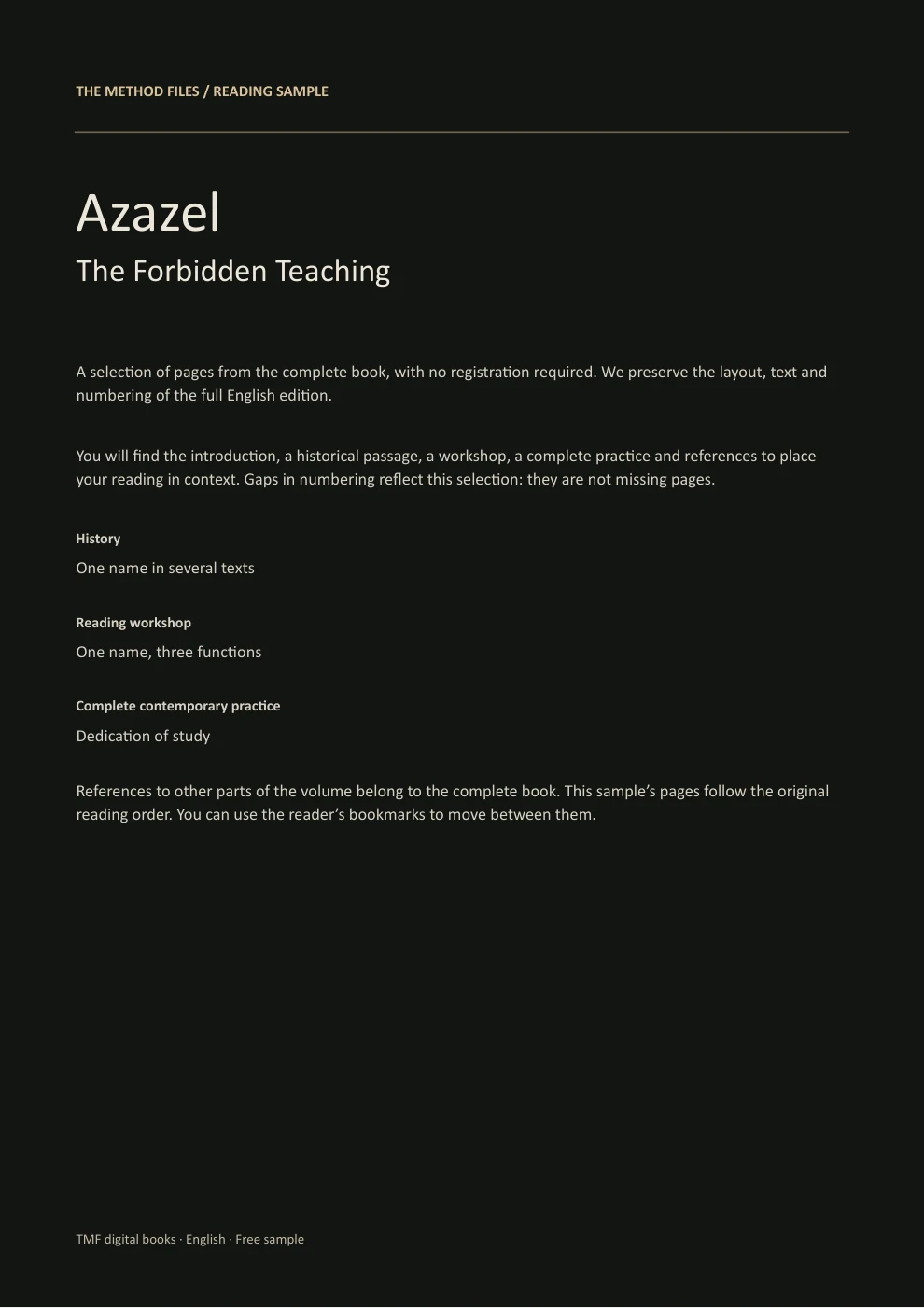
THE METHOD FILES / READING SAMPLE Azazel The Forbidden Teaching A selection of pages from the complete book, with no registration required. We preserve the layout, text and numbering of the full English edition. You will find the introduction, a historical passage, a workshop, a complete practice and references to place your reading in context. Gaps in numbering reflect this selection: they are not missing pages. History One name in several texts Reading workshop One name, three functions Complete contemporary practice Dedication of study References to other parts of the volume belong to the complete book. This sample’s pages follow the original reading order. You can use the reader’s bookmarks to move between them. TMF digital books ∙ English ∙ Free sampleRead the source. Recognise the creation. · page 7 of the book

Read the text on this page
THE METHOD FILES themethodfiles.com 007 NOTE ON METHOD Read the source. Recognise the creation. DOCUMENT A passage, image or object that can be located. When a source attributes powers or recounts apparitions, we set out what that text claims, without turning it into a verified fact. RECEPTION The transformation of a name or figure in another book, period or artistic language. Differences in rank, appearance and function are retained and explained. INTERPRETATION The reading proposed in these pages. It is distinguished from the words of a source and can be revised without altering the document from which it begins. CONTEMPORARY CEREMONY All the operations in this volume are original compositions. Each identifies the motifs it takes from the sources and specifies its own objects, words, closing and record. PRINCIPLE FOR PRACTICE Participation is voluntary and may end at any time. No supernatural result is promised. The operations concern one’s own attention, devotion and conduct; they do not authorise control over other people. The original formulas were written in Spanish; English translations are provided here. Terms from other languages are explained in context or in the glossary.The forbidden teaching · page 8 of the book

Read the text on this page
THE METHOD FILES themethodfiles.com 008 INTRODUCTION The forbidden teaching This book begins with a productive difficulty: a recognisable name does not guarantee an identical character in all its appearances. Reading Azazel requires attention to the function he fulfils in each text, the scene surrounding him and the language through which one tradition interprets another. Comparison gains precision when it preserves those differences. Leviticus places the name within a ritual sequence. Enoch develops a narrative of teachings, harm and punishment. The Apocalypse of Abraham presents an intervention within a visionary framework. Milton and later occultist classifications add other functions. None of these sources is used here as a key that automatically resolves the others. The images maintain the same discipline. A page from Charles documents an edition; Blake depicts Enoch; a cosmetics container provides material context. The relationship with the subject is explained without transforming every piece into a historical image of Azazel. The second part proposes twelve present‐day ceremonies. Their focus is responsibility in learning: formulating a question, limiting a promise, preserving a reference, preparing a petition or correcting an explanation. Each sequence identifies its starting motif and develops words and gestures of its own. Readers can study the sources, practise a single operation or follow a route; the book does not turn these options into compulsory grades.One name in several texts · page 10 of the book

Read the text on this page
THE METHOD FILES themethodfiles.com 010 HISTORY ∙ 01 One name in several texts Azazel appears in sources that do not fulfil the same function. Leviticus 16 places him in the language of an atonement rite; 1 Enoch connects him with teachings and punishment; the Apocalypse of Abraham presents him as an adversary in a visionary scene. The name allows questions to be connected, but does not turn these works into consecutive chapters of a biography. This volume’s starting point is to maintain each text’s identity before proposing an interpretation that brings them together. ‘The forbidden teaching’ comes from the prominence given to the transmission of knowledge in 1 Enoch 8‐10. The expression does not mean that all learning is condemned or that Azazel is the only teacher mentioned. Nor does it allow the narrative’s perspective to be replaced by that of a modern hero of intellectual freedom. The text associates his teachings with corruption and violence. A present‐day reading may challenge that association, but must acknowledge that it is arguing with the source, not translating its approval. The central problem will be responsibility for learning and transmitting. Who teaches, what changes when a technique circulates, and who bears its consequences? The present‐ day ceremonies work with these questions through study, the choice of boundaries and revisable commitment. They do not reproduce a historical rite of invocation to Azazel or present a newly written formula as historical. The volume’s seriousness depends on readers being able to locate the source and then identify clearly where the contemporary proposal begins. Sources: A1; A2; A3One name, three functions · page 11 of the book

Read the text on this page
THE METHOD FILES themethodfiles.com 011 CASES AND READING WORKSHOPS One name, three functions A reading card brings Leviticus, Enoch and the Apocalypse of Abraham together under a single description: ‘teacher of forbidden arts’. That phrase identifies an Enochic motif, but erases the other scenes. The exercise consists of recovering the differences before formulating a comparison. Write the title of each work and an action that the chapter attributes to the name or places in its surroundings. Do not fill the Leviticus column with Enoch’s weapons or Abraham’s with Milton’s standard. When a description is missing, preserve that absence. Write a comparative sentence naming the texts. It must explain what allows them to be connected and what prevents them from being treated as consecutive episodes. The outcome will be a more precisely bounded question, not a biography that no source tells on its own. Functions distinguished by source Comparison and boundaryPreparing the table · page 67 of the book

Read the text on this page
THE METHOD FILES themethodfiles.com 067 BEFORE THE CEREMONY Preparing the table Choose a table that allows a source, a commitment sheet and the record to be separated. The corpus uses books, cards, a cloth, an envelope or a small mirror. Each object has a described function; it needs no added consecrations or extraordinary provenance. Before beginning, identify the text from which the motif comes. If you are working with Enoch, note the chapter; if using an image, retain its author and date. The card bearing Azazel’s name belongs to present‐day practice and does not replace the documentary reference. Formulate a specific learning task and decide how the session ends. A well‐bounded question allows the outcome to be recognised: a revised synthesis, a prepared petition or a condition of use. The commitment must not cover more time or responsibility than you can explain. Read the entire sequence, including the closing. During the act, record doubts without obliging yourself to resolve them all. Afterwards put away the materials and separate the ceremony from the study, communication or repair you have decided to undertake. AN INTENTION AND AN END Before you begin, write down what you will do and how you will know you have finished. Afterwards, complete the record with facts, impressions and decisions in separate fields.The form of the ceremony · page 68 of the book

Read the text on this page
THE METHOD FILES themethodfiles.com 068 WORD ∙ GESTURE ∙ CLOSING The form of the ceremony DEDICATION The opening presents a question and a source. Azazel’s name places the act within this corpus; it does not turn unknown knowledge into an answer received. The subsequent work retains its own method. DISTINCTION The sheets separate facts, expectations, consequences and commitments. The arrangement of objects helps recognise these differences, which must remain understandable once the table is cleared. FORMULA AND DECISION The words are original compositions. They are spoken in a natural voice or read silently when the variation permits. The final decision needs a reason that can be written down and reviewed. TRANSMISSION AND CLOSING The ceremony ends before a petition is sent or a teaching shared. The record preserves the prepared version, its provenance and outstanding questions. Actual communication takes place afterwards and allows a response. The twelve sequences and their formulas are original compositions. Each operation identifies its documentary motif.01 · DEDICATION OF STUDY · page 70 of the book
Read the text on this page
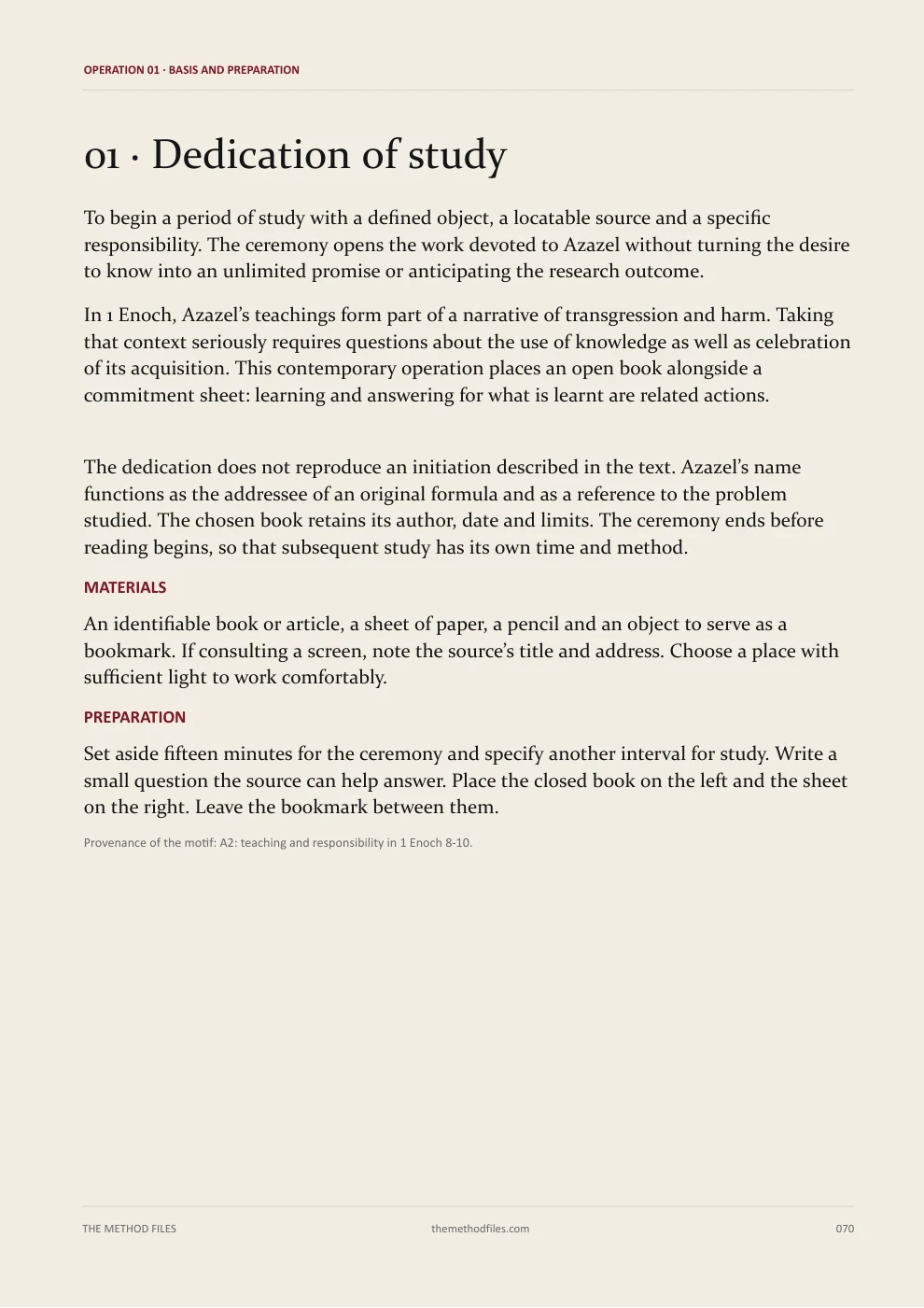
THE METHOD FILES themethodfiles.com 070 OPERATION 01 ∙ BASIS AND PREPARATION 01 ∙ Dedication of study To begin a period of study with a defined object, a locatable source and a specific responsibility. The ceremony opens the work devoted to Azazel without turning the desire to know into an unlimited promise or anticipating the research outcome. In 1 Enoch, Azazel’s teachings form part of a narrative of transgression and harm. Taking that context seriously requires questions about the use of knowledge as well as celebration of its acquisition. This contemporary operation places an open book alongside a commitment sheet: learning and answering for what is learnt are related actions. The dedication does not reproduce an initiation described in the text. Azazel’s name functions as the addressee of an original formula and as a reference to the problem studied. The chosen book retains its author, date and limits. The ceremony ends before reading begins, so that subsequent study has its own time and method. MATERIALS An identifiable book or article, a sheet of paper, a pencil and an object to serve as a bookmark. If consulting a screen, note the source’s title and address. Choose a place with sufficient light to work comfortably. PREPARATION Set aside fifteen minutes for the ceremony and specify another interval for study. Write a small question the source can help answer. Place the closed book on the left and the sheet on the right. Leave the bookmark between them. Provenance of the motif: A2: teaching and responsibility in 1 Enoch 8‐10.01 · Sequence and closing · page 71 of the book

Read the text on this page
THE METHOD FILES themethodfiles.com 071 OPERATION 01 ∙ DEDICATION OF STUDY 01 ∙ Sequence and closing 01 ∙ NAMING THE QUESTION Read the title, author and question. Explain aloud what you hope to learn and what lies outside this session. If the question requires more sources than are available, narrow it. Write down what information would allow you to recognise that you understand the matter better. 02 ∙ ACCEPTING RESPONSIBILITY FOR USE Open the book at the chosen passage and place the bookmark in the margin, without obscuring the text. Speak the formula. On the sheet, write a responsible use of what is learnt and a condition under which you would need to consult someone more experienced before applying it. 03 ∙ GIVING THE COMMITMENT A MEASURE Note when you will study and what outcome you will leave in writing: a synthesis, a comparison or a revised question. Avoid promising to master an entire subject. Read the complete commitment and check that you can fulfil it with the resources and time you actually have. ORIGINAL SPANISH FORMULA (ENGLISH TRANSLATION) Azazel, name that questions the price of learning, I name you before this book. I present my question and agree to examine how its answer will be used. May my desire to know admit method, boundary and responsibility. I dedicate this time to understanding and will preserve the provenance of whatever I come to assert. CLOSING Close the book with the bookmark inside and place the sheet on top. Say: ‘The dedication ends; study begins at the written time.’ Note the session’s end. You may begin reading after a brief pause, as a distinct and verifiable activity. Read the formula at the indicated point. The closing completes the session and separates the act from subsequent tasks.01 · Reading and record · page 72 of the book

Read the text on this page
THE METHOD FILES themethodfiles.com 072 OPERATION 01 ∙ READING AND RECORD 01 ∙ Reading and record MEANING OF THE OPERATION The commitment has value when it can be reviewed. Changing a question on finding new information is part of study. Responsibility is not reduced to a general prohibition either: it needs a possible use, boundary and consultation. The gesture of opening the book acknowledges that the source may contradict the expectations brought to it. EXAMPLE OF APPLICATION Someone wants to study a symbol. They choose a museum catalogue entry, ask about its date and provenance and commit to distinguishing those facts from their personal interpretation. The expected outcome is a half‐page note with a link and two outstanding questions. VARIANT To study a practical skill, use a manual and a stored tool. The tool remains out of use during the ceremony. Write down what instruction and preparation you need before beginning the ordinary exercise. QUESTIONS AND FIELDS FOR THE RECORD What question did I dedicate? What source did I choose? What responsibility did I assume? Note the study interval, the expected outcome and, after reading, the difference between what was expected and what was learnt. The examples are fictional situations intended to help explain the practice; they are not presented as evidence of efficacy.Sources consulted · 1 · page 124 of the book

Read the text on this page
THE METHOD FILES themethodfiles.com 124 A1 A2 A3 A4 TEXTS AND WITNESSES ∙ 1 Sources consulted ∙ 1 Leviticus 16. Hebrew text and JPS 1917 English translation, Mechon Mamre. The allocation by lots, confession and sending into the wilderness are consulted within the chapter’s rite. The name and its interpretation are not resolved through automatic equivalence with Enoch’s narratives. View the document 1 Enoch 6‐16. R. H. Charles’s translation, 1913, reproduced by CCEL. Principal source for the Watchers’ pact, teachings, harm, punishment and mediation. The episodes are distinguished from one another; Semjaza does not disappear from the narrative to turn Azazel into the sole author of every action. View the document G. H. Box, with J. I. Landsman. The Apocalypse of Abraham, 1918, chs.13‐14, pp.51‐55. Historical translation consulted for the bird, Azazel’s intervention and the language of garment and destiny. The text and editorial notes occupy different levels. Names’ spellings are preserved according to the source where relevant. View the document R. H. Charles. The Book of Enoch, 1912. Edition with introduction and commentary. Facsimile used to observe how an edition presents translation, chapters and notes. The plates reproduce complete pages; Charles’s commentary is identified as editorial work of its time. View the document Accessed: September 2026. Paraphrases and commentary are the author’s own. Modern notes are distinguished from historical texts.Sources consulted · 2 · page 125 of the book

Read the text on this page
THE METHOD FILES themethodfiles.com 125 A5 The Met. Glass cosmetic flask (kohl tube). Inv.X.21.174. A6 A7 William Blake. Enoch, 1806-1807. The Met, inv.2013.146. A8 TEXTS AND WITNESSES ∙ 2 Sources consulted ∙ 2 Roman container of Syrian provenance, from the fourth century AD. It provides material context for discussing cosmetics. It does not document a cult of Azazel or in itself demonstrate a literary passage’s origin. View the document John Milton. Paradise Lost, book I. Text of the ten‐book edition, Project Gutenberg no.20. Poetic reception of Azazel as standard‐bearer. His function is studied within a seventeenth‐century Christian epic, distinguished from Leviticus and Enochic literature. View the document Visual reception of Enoch and the arts. The figure is not identified as Azazel. The institutional catalogue entry allows authorship, technique, date and reproduction conditions to be specified. View the document Heinrich Cornelius Agrippa. De occulta philosophia, III,24. Historical English translation in Esoteric Archives. Evidence of the classification of names and spiritual authorities. Used to study reception and differences between systems, without turning graphic similarities between names into demonstrated identities. View the document Accessed: September 2026. Paraphrases and commentary are the author’s own. Modern notes are distinguished from historical texts.Images and rights · 1 · page 126 of the book

Read the text on this page
THE METHOD FILES themethodfiles.com 126 PLATES 01‐04 Images and rights ∙ 1 01 ∙ THE PAGE OF THE TEACHINGS R. H. Charles, The Book of Enoch, Oxford, Clarendon Press, 1912, p.19. Cornell copy digitised in Internet Archive. Historical edition in the public domain. View the document 02 ∙ THE BEGINNING OF THE PUNISHMENT R. H. Charles, The Book of Enoch, 1912, p.22. Cornell University Library; digitised in Internet Archive. Public domain. View the document 03 ∙ ENOCH, THE NARRATIVE’S SCRIBE R. H. Charles, The Book of Enoch, 1912, p.28. Cornell University Library; digitised in Internet Archive. Public domain. View the document 04 ∙ THE PETITION AND ITS LIMITS R. H. Charles, The Book of Enoch, 1912, p.29. Cornell University Library; digitised in Internet Archive. Public domain. View the document PRINCIPLE OF REPRODUCTION Pages and works are preserved in full. Rescaling does not redraw signs or reconstruct missing parts. The links identify the object or copy and allow you to consult its details and conditions of use. CC0 and Public Domain Mark identify the conditions stated by the institutions; they do not attribute authorship of the works to this book.Images and rights · 2 · page 127 of the book

Read the text on this page
THE METHOD FILES themethodfiles.com 127 PLATES 05‐08 Images and rights ∙ 2 05 ∙ THE BIRD NAMED AZAZEL G. H. Box, with J. I. Landsman, The Apocalypse of Abraham, London, SPCK, 1918, p.52. Copy digitised in Internet Archive. Public domain. View the document 06 ∙ WORD, SILENCE AND DESTINY G. H. Box, with J. I. Landsman, The Apocalypse of Abraham, 1918, p.54. Historical copy digitised in Internet Archive. Public domain. View the document 07 ∙ ENOCH ACCORDING TO WILLIAM BLAKE The Metropolitan Museum of Art, New York. Enoch. Inv.2013.146. Purchase, Joseph Pulitzer and Brooke Russell Astor Bequests and 2005 Benefit Fund, 2013. Public‐domain image, Open Access programme (CC0). View the document 08 ∙ A COSMETICS CONTAINER The Metropolitan Museum of Art, New York. Glass cosmetic flask (kohl tube). Inv.X.21.174. Museum Accession. Public‐domain image, Open Access programme (CC0). View the document COVER Cover: contemporary illustration created with artificial intelligence assistance for The Method Files, 2026. It does not reproduce a historical object. Typefaces: Constantia and Calibri, embedded for digital reading. CC0 and Public Domain Mark identify the conditions stated by the institutions; they do not attribute authorship of the works to this book.Continue reading

Read the text on this page
THE METHOD FILES / READING SAMPLE Azazel The Forbidden Teaching Your reading can continue. The complete book contains 129 pages, reading workshops and 12 contemporary operations, with their sources and references. You can follow the historical journey without performing the practices. If you decide to explore them, you will find contemporary compositions identified as such, with preparation, a central sequence and closing. Digital book in PDF, in English. It does not include tutoring or access to TMF courses. Exercises are completed in a notebook or using the PDF reader’s annotation tools. Explore the complete book themethodfiles.com/libros‐digitales/azazel/ TMF digital books ∙ English ∙ Free sample
Continue whenever you wish