Read before you choose
Hecate
The Keys and the Threshold
This 16-page sample includes an introduction, a historical passage, a workshop, one complete practice and references. It retains the original book’s page numbers: the gaps reflect the selection.
Download PDF · 6.2 MBNo registration · Selectable text in the PDF
Cover
Read the text on this page
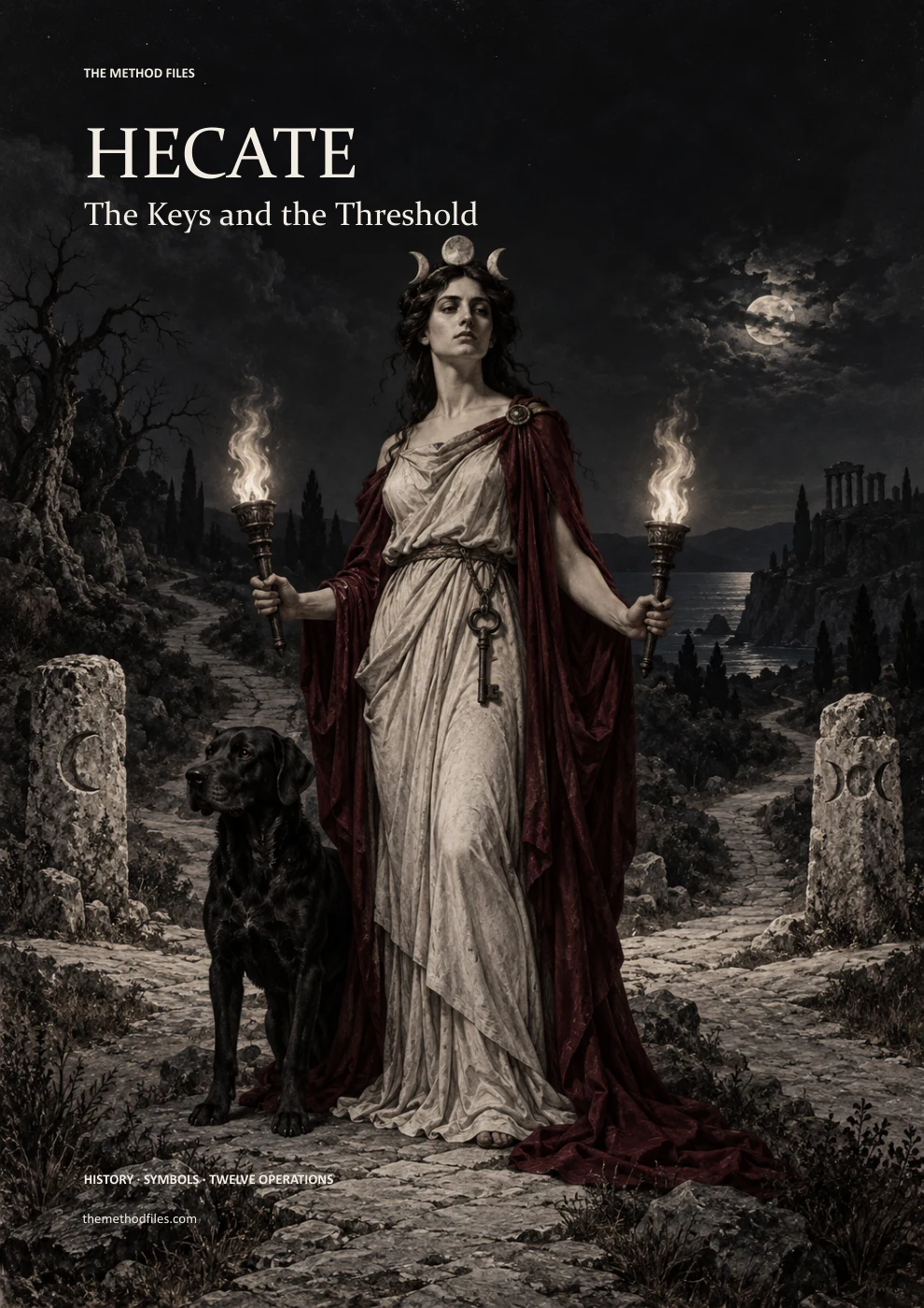
themethodfiles.com THE METHOD FILES HECATE The Keys and the Threshold HISTORY ∙ SYMBOLS ∙ TWELVE OPERATIONSAbout this reading sample
Read the text on this page
THE METHOD FILES / READING SAMPLE Hecate The Keys and the Threshold A selection of pages from the complete book, with no registration required. We preserve the layout, text and numbering of the full English edition. You will find the introduction, a historical passage, a workshop, a complete practice and references to place your reading in context. Gaps in numbering reflect this selection: they are not missing pages. History Hecate's Honours Reading workshop An Honour within a Poem Complete contemporary practice The Greeting of the Threshold References to other parts of the volume belong to the complete book. This sample’s pages follow the original reading order. You can use the reader’s bookmarks to move between them. TMF digital books ∙ English ∙ Free sampleRead the source. Recognise the creation. · page 6 of the book
Read the text on this page
THE METHOD FILES themethodfiles.com 006 NOTE ON METHOD Read the source. Recognise the creation. DOCUMENT A passage, image or object that can be located. When a source attributes powers or recounts apparitions, we set out what that text claims, without turning it into a verified fact. RECEPTION The transformation of a name or figure in another book, period or artistic language. Differences in rank, appearance and function are retained and explained. INTERPRETATION The reading proposed in these pages. It is distinguished from the words of a source and can be revised without altering the document from which it begins. CONTEMPORARY CEREMONY All the operations in this volume are original compositions. Each identifies the motifs it takes from the sources and specifies its own objects, words, closing and record. PRINCIPLE FOR PRACTICE Participation is voluntary and may end at any time. No supernatural result is promised. The operations concern one’s own attention, devotion and conduct; they do not authorise control over other people. The original formulas were written in Spanish; English translations are provided here. Terms from other languages are explained in context or in the glossary.The Keys and the Threshold · page 7 of the book
Read the text on this page
THE METHOD FILES themethodfiles.com 007 INTRODUCTION The Keys and the Threshold Hecate may appear beside a doorway, at a crossroads, with torches, in a triple figure or within a nocturnal invocation. None of those images alone can contain her history. Hesiod grants her honours in very broad fields; the Hymn to Demeter places her in a search and a return; Hellenistic literature relates her to magic; preserved objects show different visual solutions. This volume follows that plurality. It does not organise Hecate as a demon of the Solomonic catalogues or make her antiquity depend on modern interpretations. Her inclusion in a grimoire collection is a decision of format here. The content preserves the difference between a Greek goddess, her cults and her later receptions. That difference matters when choosing words with which to honour her. The twelve ceremonies form a contemporary devotional proposal. They work with opening, listening, choice, gratitude, safeguarding, offering, memory, care, contemplation, praise, return and commitment. Each brings a documentary reference together with everyday objects and an English translation of an original Spanish formula. The key remains a key; light may come from a lamp; the threshold may be represented on the table. The act's form is deliberate and does not require reconstructing ancient conditions the book cannot demonstrate. Historical reading and practice accompany one another throughout the sequence. Commentaries explain why a motif has been chosen and where the source transmitting it ends. Records preserve what was experienced without turning an emotion or coincidence into an obligation. Honouring Hecate can be a sober and profound act: opening with intention, attending to where one is, and closing so that care continues beyond the ceremony.Hecate's Honours · page 9 of the book
Read the text on this page
THE METHOD FILES themethodfiles.com 009 HISTORY ∙ 01 Hecate's Honours In the Theogony, Hecate is the daughter of Asteria and Perses. The passage developing her honours does not present her solely as an underworld figure. Zeus recognises her share in earth, sea and sky, and the poem describes her intervention in very diverse activities of human life. Assemblies, judgements, battles, competitions, horses, fishing and flocks appear on that horizon. Hecate may favour, but her intervention is not described as an automatic obligation in response to any request. The text insists on her will. At the end, it also presents her as nurturer of the young who come to daylight. That breadth changes the starting point of a present‐day practice. It allows care, effort and shared life to be honoured alongside roads and night. It requires recognising that one of our main ancient sources offers more than one register, rather than denying other traditions. The Three Realms ceremony takes earth, sea and sky as motifs of attention and gratitude. Its vessels and words are new. The poem does not contain that domestic sequence. Similarly, dedicating a small act of care to Hecate draws inspiration from a textual honour without claiming to restore a lost ancient liturgy. Sources: H1 ∙ Theogony 404‐452An Honour within a Poem · page 10 of the book
Read the text on this page
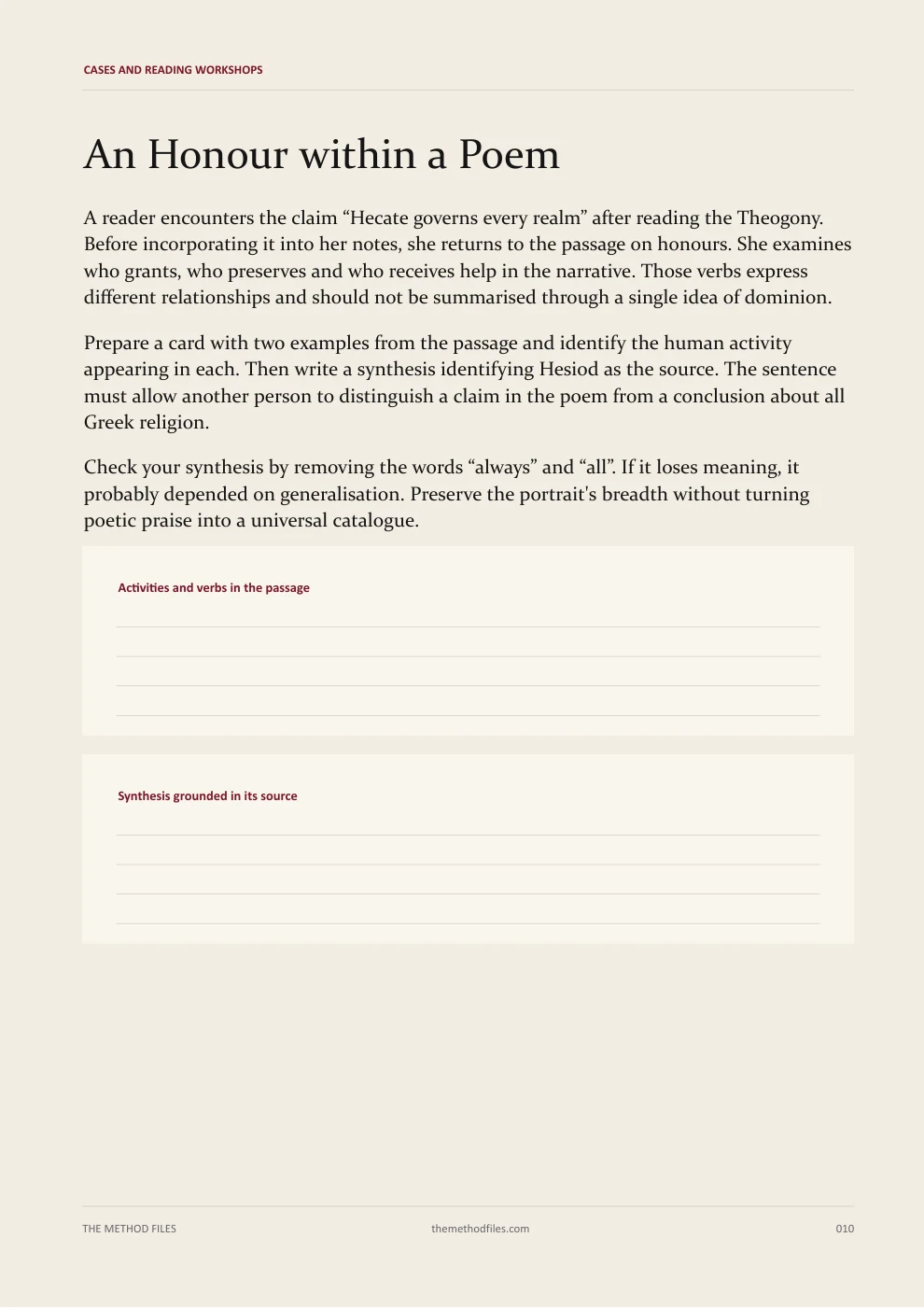
THE METHOD FILES themethodfiles.com 010 CASES AND READING WORKSHOPS An Honour within a Poem A reader encounters the claim “Hecate governs every realm” after reading the Theogony. Before incorporating it into her notes, she returns to the passage on honours. She examines who grants, who preserves and who receives help in the narrative. Those verbs express different relationships and should not be summarised through a single idea of dominion. Prepare a card with two examples from the passage and identify the human activity appearing in each. Then write a synthesis identifying Hesiod as the source. The sentence must allow another person to distinguish a claim in the poem from a conclusion about all Greek religion. Check your synthesis by removing the words “always” and “all”. If it loses meaning, it probably depended on generalisation. Preserve the portrait's breadth without turning poetic praise into a universal catalogue. Activities and verbs in the passage Synthesis grounded in its sourcePreparing the table · page 62 of the book
Read the text on this page
THE METHOD FILES themethodfiles.com 062 BEFORE THE CEREMONY Preparing the table Choose a domestic place where you can finish the session without unnecessary interruptions. Arrange one or two electric lamps according to the ceremony, clean water and the indicated objects. A key must be yours and retain its ordinary use; you need not leave it in a public place or alter a lock. Read the indicated historical passage and then the contemporary formula. Their functions differ: the first documents a motif and the second allows the proposed act to be performed. You may address Hecate devotionally or read the ceremony as a symbolic practice of attention. Neither case requires provoking an extraordinary experience. The formulas were originally written in Spanish. Names or epithets in another language are accompanied by their meaning. Lamps represent light without an open flame. No animal remains, uncertainly identified plants or substances for ingestion or inhalation are used. Before beginning, decide how you will remove the objects and what you will do with any food offering. At the end, speak the farewell, switch off the lights and return everything to its place. Closing returns the space to ordinary life. Record what happened simply; you may conclude even if you felt only calm, distraction or nothing special. AN INTENTION AND AN END Before you begin, write down what you will do and how you will know you have finished. Afterwards, complete the record with facts, impressions and decisions in separate fields.The form of the ceremony · page 63 of the book
Read the text on this page
THE METHOD FILES themethodfiles.com 063 WORD ∙ GESTURE ∙ CLOSING The form of the ceremony GREETING AND PLACE The space is prepared so the act can begin and end without unnecessarily interrupting shared life. A table, a light and a key of your own may suffice. The greeting names Hecate and the session's motif. The represented door or road need not become a reconstruction of an ancient sanctuary. PRAISE, REQUEST AND DEDICATION Praise recognises attributes; asking expresses an intention; dedication offers a task or time. The three forms may coexist, but are not identical. The corpus's formulas explain their motif and were originally written in Spanish and are presented here in English translation. A request establishes no debt on the goddess's part and imposes no obligation to interpret later events as answers. THE OFFERING HAS A DESTINATION When food or water is used, what will be done with it afterwards is decided beforehand. Ordinary hygienic conditions are maintained, and leaving remains in public or natural spaces is avoided. In these compositions, offering attention and gratitude may accompany later use of the food. That decision is not presented as reproducing a complete ancient liturgy. FAREWELL AND RETURN The lamp is switched off, the key returns to its place and the table resumes its use. Farewell recognises an ending; it does not break the possibility of returning voluntarily. The record distinguishes acts, emotions and interpretations. If the session was silent or simple, it need not be prolonged to obtain a more intense experience. Care continues through the chosen concrete action. The twelve sequences are contemporary compositions. Their documentary motifs are identified in each operation.01 · THE GREETING OF THE THRESHOLD · page 65 of the book
Read the text on this page
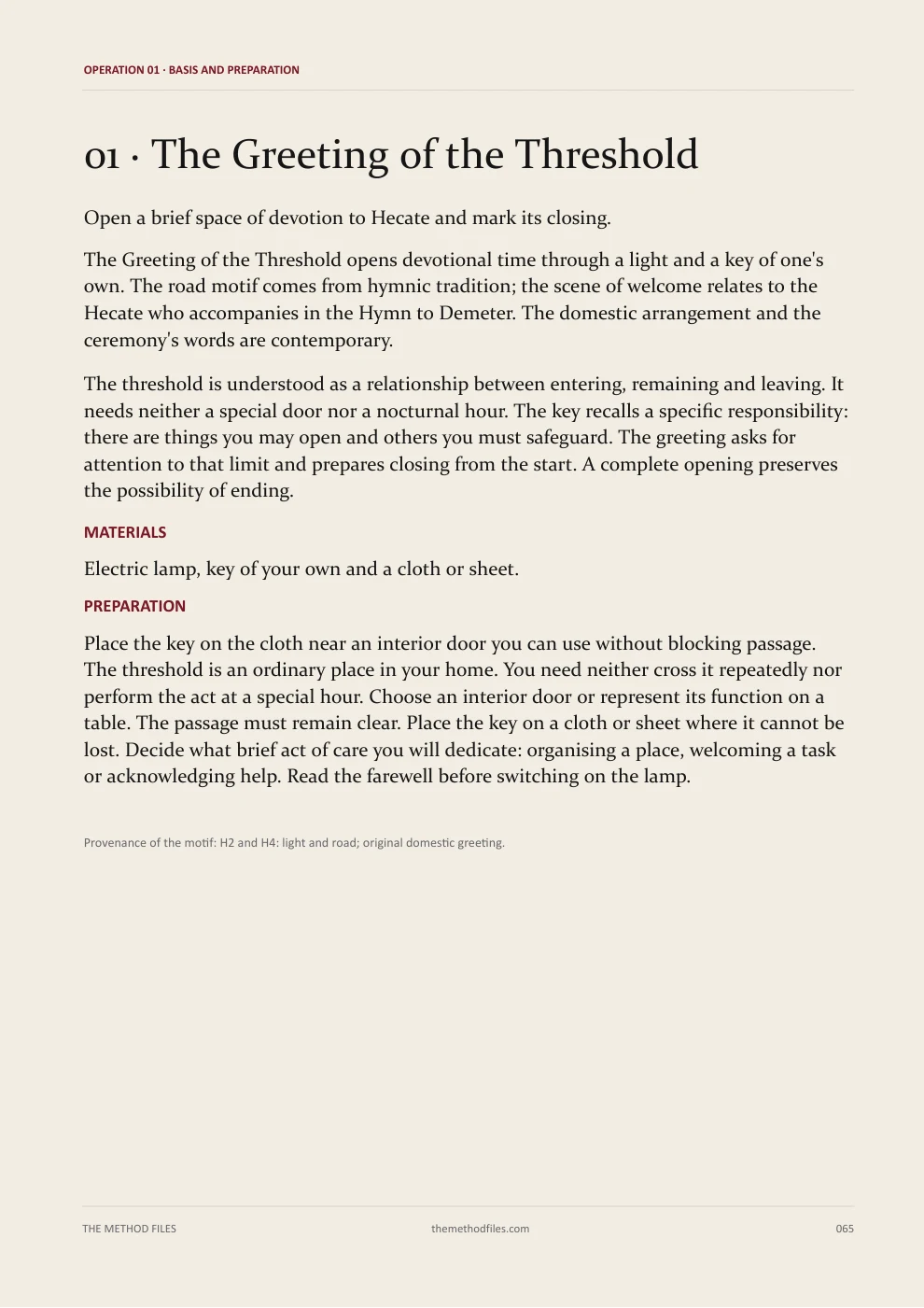
THE METHOD FILES themethodfiles.com 065 OPERATION 01 ∙ BASIS AND PREPARATION 01 ∙ The Greeting of the Threshold Open a brief space of devotion to Hecate and mark its closing. The Greeting of the Threshold opens devotional time through a light and a key of one's own. The road motif comes from hymnic tradition; the scene of welcome relates to the Hecate who accompanies in the Hymn to Demeter. The domestic arrangement and the ceremony's words are contemporary. The threshold is understood as a relationship between entering, remaining and leaving. It needs neither a special door nor a nocturnal hour. The key recalls a specific responsibility: there are things you may open and others you must safeguard. The greeting asks for attention to that limit and prepares closing from the start. A complete opening preserves the possibility of ending. MATERIALS Electric lamp, key of your own and a cloth or sheet. PREPARATION Place the key on the cloth near an interior door you can use without blocking passage. The threshold is an ordinary place in your home. You need neither cross it repeatedly nor perform the act at a special hour. Choose an interior door or represent its function on a table. The passage must remain clear. Place the key on a cloth or sheet where it cannot be lost. Decide what brief act of care you will dedicate: organising a place, welcoming a task or acknowledging help. Read the farewell before switching on the lamp. Provenance of the motif: H2 and H4: light and road; original domestic greeting.01 · Sequence and closing · page 66 of the book
Read the text on this page
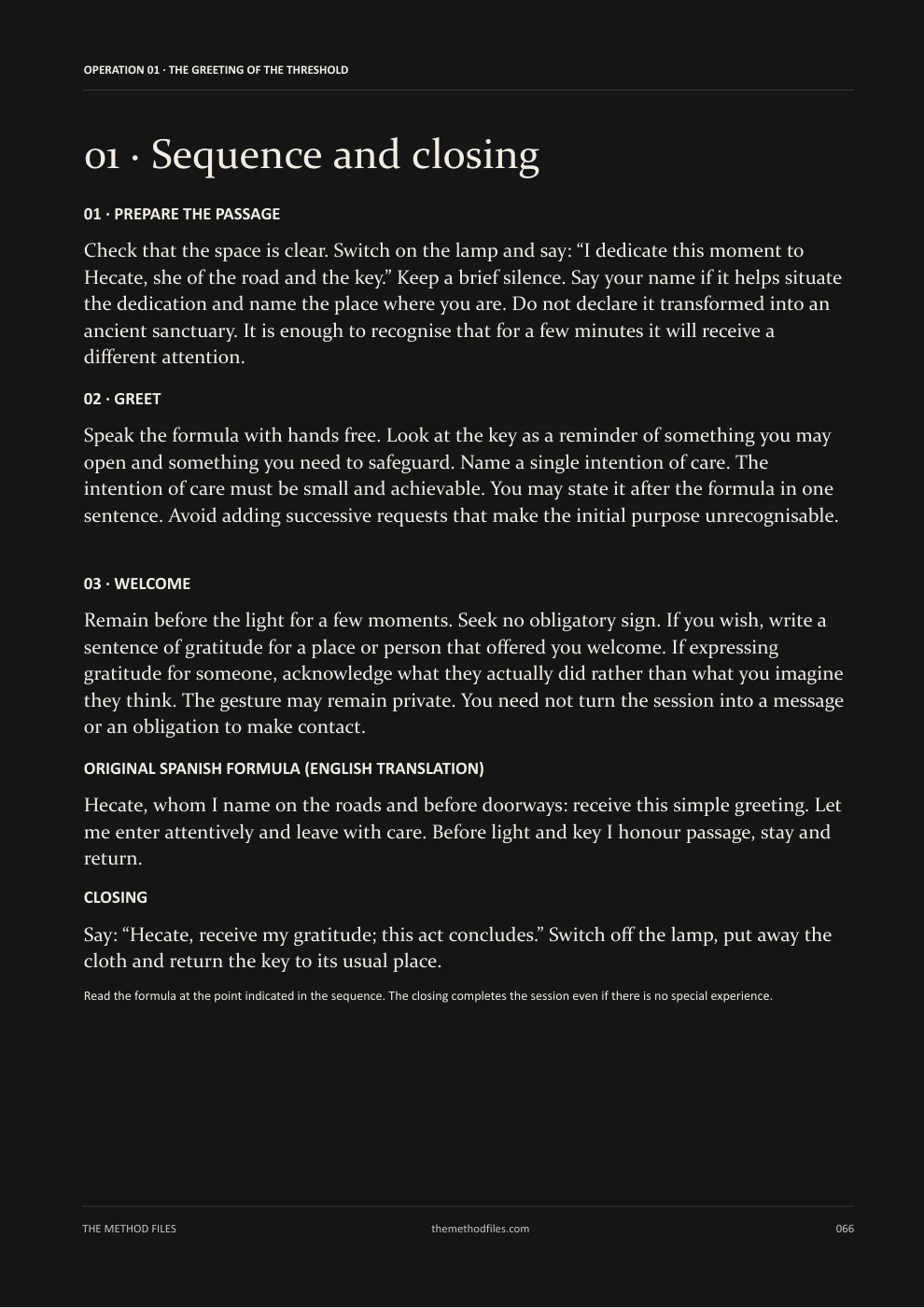
THE METHOD FILES themethodfiles.com 066 OPERATION 01 ∙ THE GREETING OF THE THRESHOLD 01 ∙ Sequence and closing 01 ∙ PREPARE THE PASSAGE Check that the space is clear. Switch on the lamp and say: “I dedicate this moment to Hecate, she of the road and the key.” Keep a brief silence. Say your name if it helps situate the dedication and name the place where you are. Do not declare it transformed into an ancient sanctuary. It is enough to recognise that for a few minutes it will receive a different attention. 02 ∙ GREET Speak the formula with hands free. Look at the key as a reminder of something you may open and something you need to safeguard. Name a single intention of care. The intention of care must be small and achievable. You may state it after the formula in one sentence. Avoid adding successive requests that make the initial purpose unrecognisable. 03 ∙ WELCOME Remain before the light for a few moments. Seek no obligatory sign. If you wish, write a sentence of gratitude for a place or person that offered you welcome. If expressing gratitude for someone, acknowledge what they actually did rather than what you imagine they think. The gesture may remain private. You need not turn the session into a message or an obligation to make contact. ORIGINAL SPANISH FORMULA (ENGLISH TRANSLATION) Hecate, whom I name on the roads and before doorways: receive this simple greeting. Let me enter attentively and leave with care. Before light and key I honour passage, stay and return. CLOSING Say: “Hecate, receive my gratitude; this act concludes.” Switch off the lamp, put away the cloth and return the key to its usual place. Read the formula at the point indicated in the sequence. The closing completes the session even if there is no special experience.01 · Reading and record · page 67 of the book
Read the text on this page
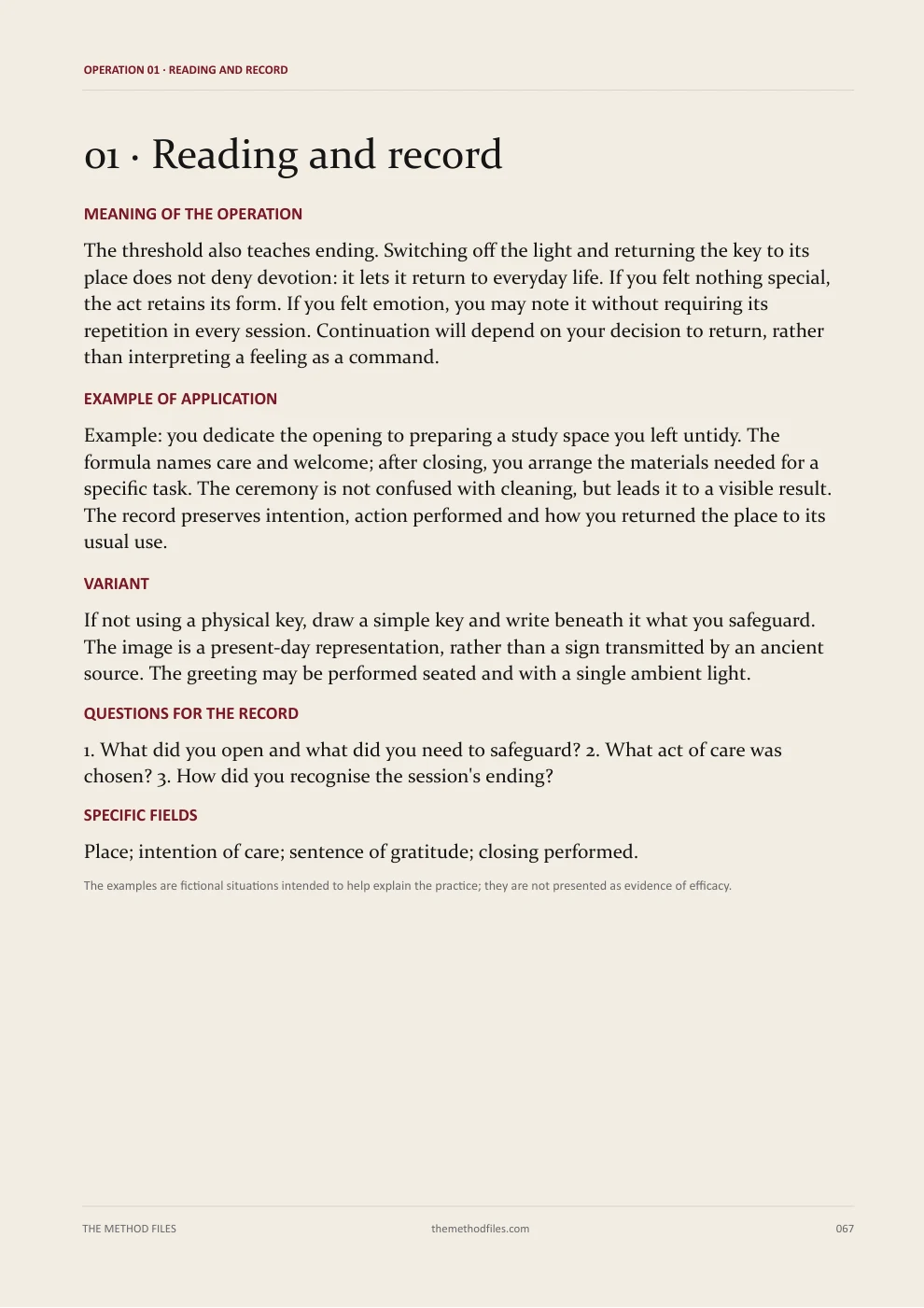
THE METHOD FILES themethodfiles.com 067 OPERATION 01 ∙ READING AND RECORD 01 ∙ Reading and record MEANING OF THE OPERATION The threshold also teaches ending. Switching off the light and returning the key to its place does not deny devotion: it lets it return to everyday life. If you felt nothing special, the act retains its form. If you felt emotion, you may note it without requiring its repetition in every session. Continuation will depend on your decision to return, rather than interpreting a feeling as a command. EXAMPLE OF APPLICATION Example: you dedicate the opening to preparing a study space you left untidy. The formula names care and welcome; after closing, you arrange the materials needed for a specific task. The ceremony is not confused with cleaning, but leads it to a visible result. The record preserves intention, action performed and how you returned the place to its usual use. VARIANT If not using a physical key, draw a simple key and write beneath it what you safeguard. The image is a present‐day representation, rather than a sign transmitted by an ancient source. The greeting may be performed seated and with a single ambient light. QUESTIONS FOR THE RECORD 1. What did you open and what did you need to safeguard? 2. What act of care was chosen? 3. How did you recognise the session's ending? SPECIFIC FIELDS Place; intention of care; sentence of gratitude; closing performed. The examples are fictional situations intended to help explain the practice; they are not presented as evidence of efficacy.Sources consulted · 1 · page 119 of the book
Read the text on this page
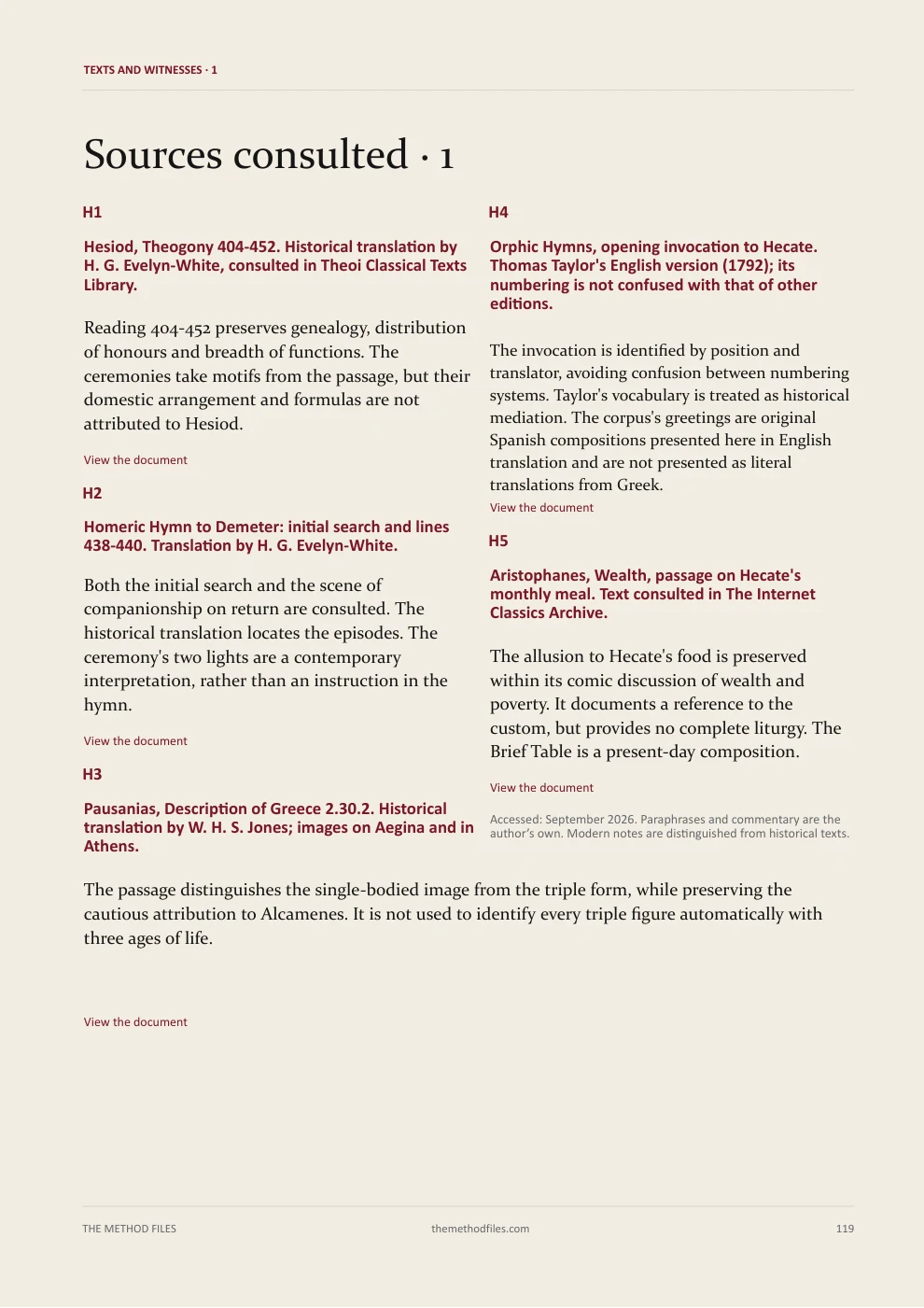
THE METHOD FILES themethodfiles.com 119 H1 H2 H3 H4 H5 TEXTS AND WITNESSES ∙ 1 Sources consulted ∙ 1 Hesiod, Theogony 404‐452. Historical translation by H. G. Evelyn‐White, consulted in Theoi Classical Texts Library. Reading 404‐452 preserves genealogy, distribution of honours and breadth of functions. The ceremonies take motifs from the passage, but their domestic arrangement and formulas are not attributed to Hesiod. View the document Homeric Hymn to Demeter: initial search and lines 438‐440. Translation by H. G. Evelyn‐White. Both the initial search and the scene of companionship on return are consulted. The historical translation locates the episodes. The ceremony's two lights are a contemporary interpretation, rather than an instruction in the hymn. View the document Pausanias, Description of Greece 2.30.2. Historical translation by W. H. S. Jones; images on Aegina and in Athens. The passage distinguishes the single‐bodied image from the triple form, while preserving the cautious attribution to Alcamenes. It is not used to identify every triple figure automatically with three ages of life. View the document Orphic Hymns, opening invocation to Hecate. Thomas Taylor's English version (1792); its numbering is not confused with that of other editions. The invocation is identified by position and translator, avoiding confusion between numbering systems. Taylor's vocabulary is treated as historical mediation. The corpus's greetings are original Spanish compositions presented here in English translation and are not presented as literal translations from Greek. View the document Aristophanes, Wealth, passage on Hecate's monthly meal. Text consulted in The Internet Classics Archive. The allusion to Hecate's food is preserved within its comic discussion of wealth and poverty. It documents a reference to the custom, but provides no complete liturgy. The Brief Table is a present‐day composition. View the document Accessed: September 2026. Paraphrases and commentary are the author’s own. Modern notes are distinguished from historical texts.Sources consulted · 2 · page 120 of the book
Read the text on this page
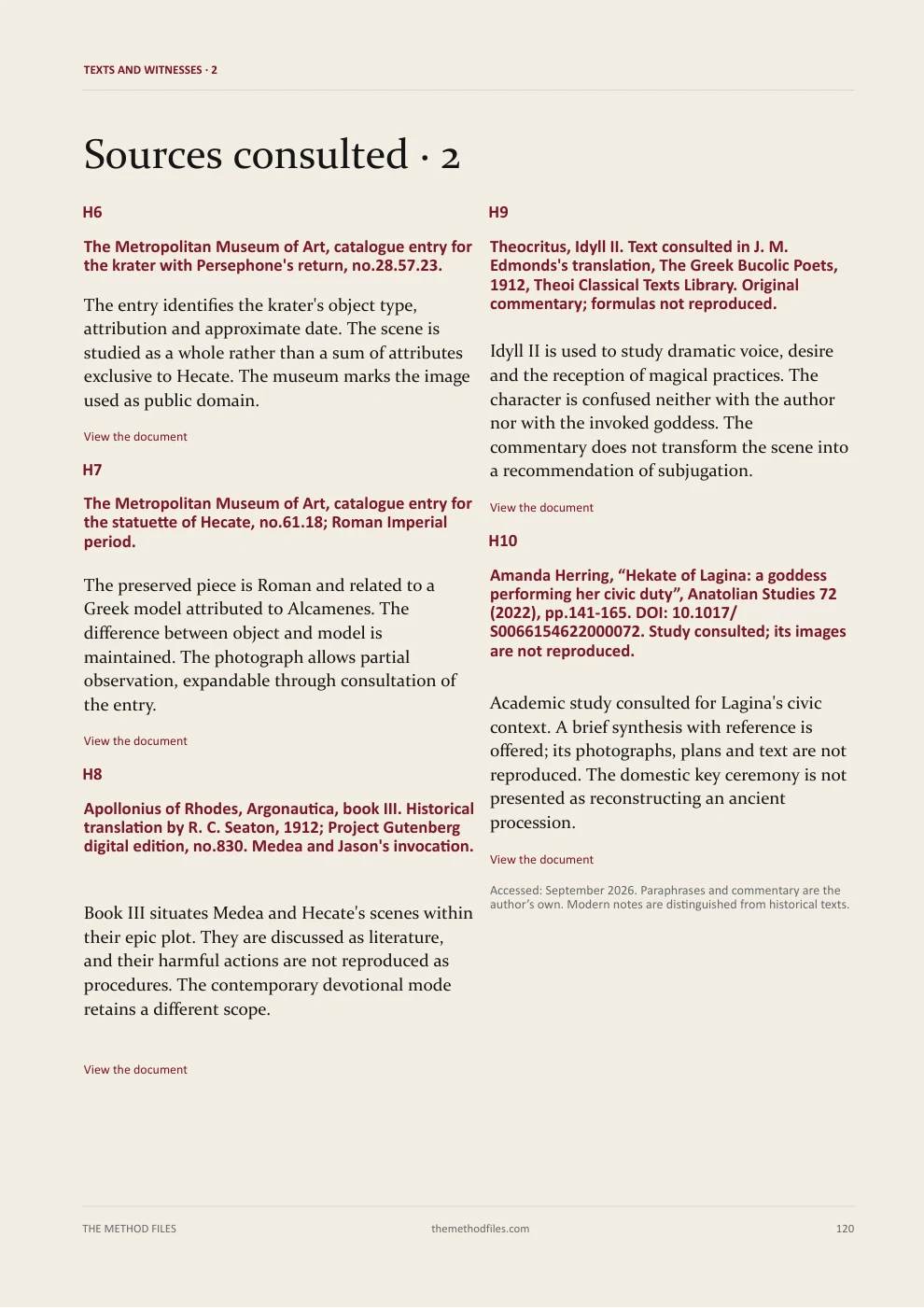
THE METHOD FILES themethodfiles.com 120 H6 H7 H8 H9 H10 TEXTS AND WITNESSES ∙ 2 Sources consulted ∙ 2 The Metropolitan Museum of Art, catalogue entry for the krater with Persephone's return, no.28.57.23. The entry identifies the krater's object type, attribution and approximate date. The scene is studied as a whole rather than a sum of attributes exclusive to Hecate. The museum marks the image used as public domain. View the document The Metropolitan Museum of Art, catalogue entry for the statuette of Hecate, no.61.18; Roman Imperial period. The preserved piece is Roman and related to a Greek model attributed to Alcamenes. The difference between object and model is maintained. The photograph allows partial observation, expandable through consultation of the entry. View the document Apollonius of Rhodes, Argonautica, book III. Historical translation by R. C. Seaton, 1912; Project Gutenberg digital edition, no.830. Medea and Jason's invocation. Book III situates Medea and Hecate's scenes within their epic plot. They are discussed as literature, and their harmful actions are not reproduced as procedures. The contemporary devotional mode retains a different scope. View the document Theocritus, Idyll II. Text consulted in J. M. Edmonds's translation, The Greek Bucolic Poets, 1912, Theoi Classical Texts Library. Original commentary; formulas not reproduced. Idyll II is used to study dramatic voice, desire and the reception of magical practices. The character is confused neither with the author nor with the invoked goddess. The commentary does not transform the scene into a recommendation of subjugation. View the document Amanda Herring, “Hekate of Lagina: a goddess performing her civic duty”, Anatolian Studies 72 (2022), pp.141‐165. DOI: 10.1017/ S0066154622000072. Study consulted; its images are not reproduced. Academic study consulted for Lagina's civic context. A brief synthesis with reference is offered; its photographs, plans and text are not reproduced. The domestic key ceremony is not presented as reconstructing an ancient procession. View the document Accessed: September 2026. Paraphrases and commentary are the author’s own. Modern notes are distinguished from historical texts.Images and rights · 1 · page 121 of the book
Read the text on this page
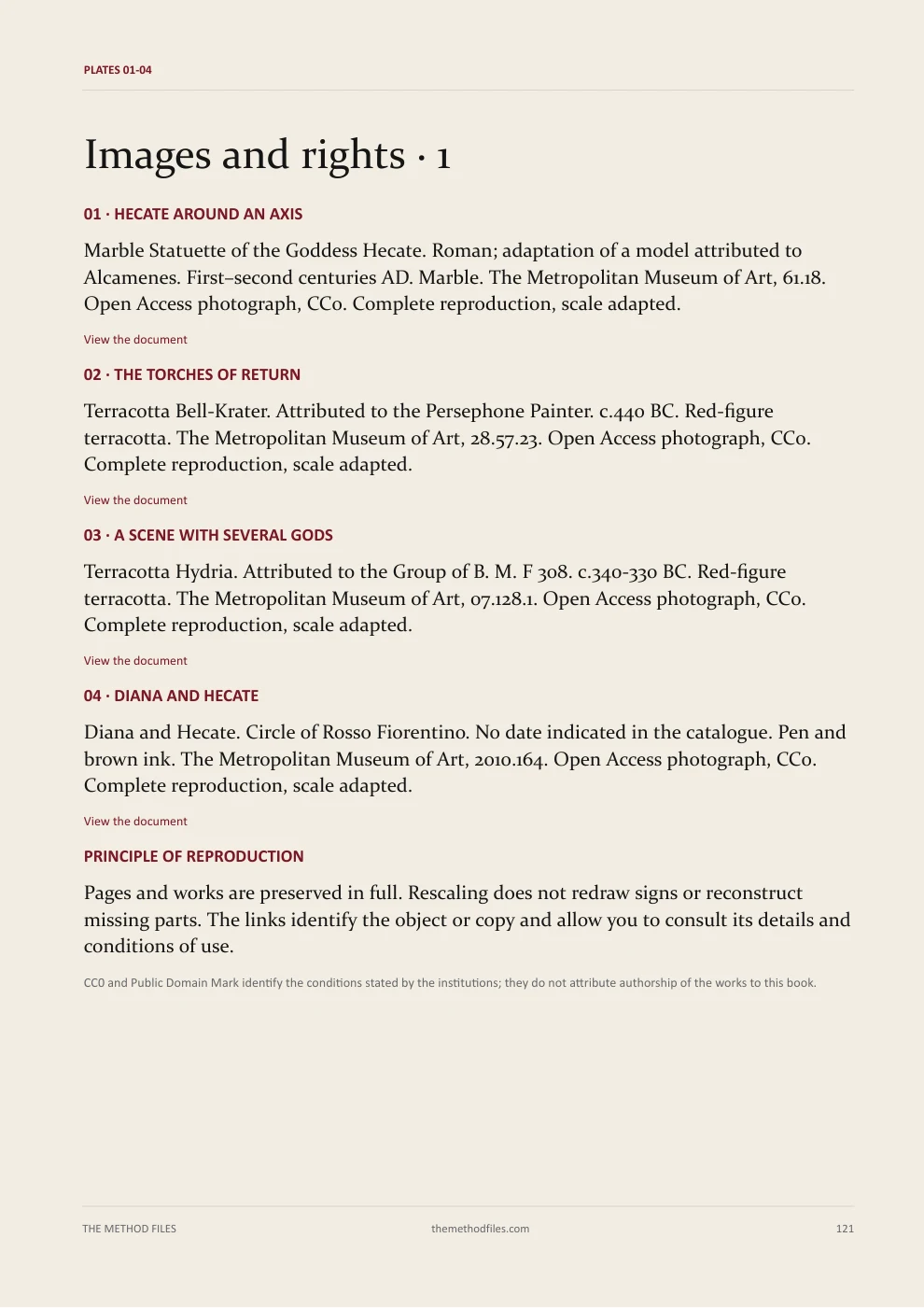
THE METHOD FILES themethodfiles.com 121 PLATES 01‐04 Images and rights ∙ 1 01 ∙ HECATE AROUND AN AXIS Marble Statuette of the Goddess Hecate. Roman; adaptation of a model attributed to Alcamenes. First–second centuries AD. Marble. The Metropolitan Museum of Art, 61.18. Open Access photograph, CC0. Complete reproduction, scale adapted. View the document 02 ∙ THE TORCHES OF RETURN Terracotta Bell‐Krater. Attributed to the Persephone Painter. c.440 BC. Red‐figure terracotta. The Metropolitan Museum of Art, 28.57.23. Open Access photograph, CC0. Complete reproduction, scale adapted. View the document 03 ∙ A SCENE WITH SEVERAL GODS Terracotta Hydria. Attributed to the Group of B. M. F 308. c.340‐330 BC. Red‐figure terracotta. The Metropolitan Museum of Art, 07.128.1. Open Access photograph, CC0. Complete reproduction, scale adapted. View the document 04 ∙ DIANA AND HECATE Diana and Hecate. Circle of Rosso Fiorentino. No date indicated in the catalogue. Pen and brown ink. The Metropolitan Museum of Art, 2010.164. Open Access photograph, CC0. Complete reproduction, scale adapted. View the document PRINCIPLE OF REPRODUCTION Pages and works are preserved in full. Rescaling does not redraw signs or reconstruct missing parts. The links identify the object or copy and allow you to consult its details and conditions of use. CC0 and Public Domain Mark identify the conditions stated by the institutions; they do not attribute authorship of the works to this book.Images and rights · 2 · page 122 of the book
Read the text on this page
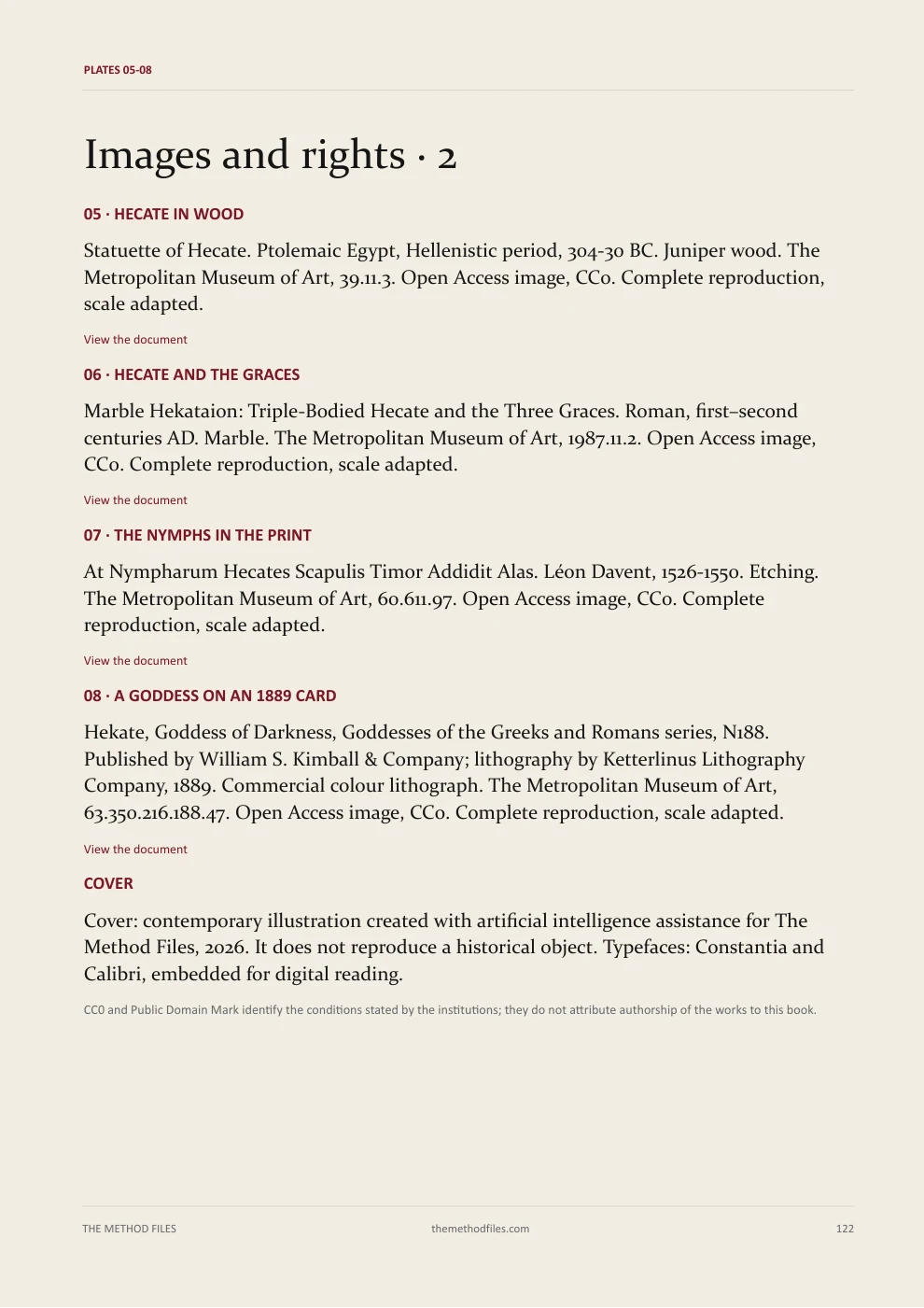
THE METHOD FILES themethodfiles.com 122 PLATES 05‐08 Images and rights ∙ 2 05 ∙ HECATE IN WOOD Statuette of Hecate. Ptolemaic Egypt, Hellenistic period, 304‐30 BC. Juniper wood. The Metropolitan Museum of Art, 39.11.3. Open Access image, CC0. Complete reproduction, scale adapted. View the document 06 ∙ HECATE AND THE GRACES Marble Hekataion: Triple‐Bodied Hecate and the Three Graces. Roman, first–second centuries AD. Marble. The Metropolitan Museum of Art, 1987.11.2. Open Access image, CC0. Complete reproduction, scale adapted. View the document 07 ∙ THE NYMPHS IN THE PRINT At Nympharum Hecates Scapulis Timor Addidit Alas. Léon Davent, 1526‐1550. Etching. The Metropolitan Museum of Art, 60.611.97. Open Access image, CC0. Complete reproduction, scale adapted. View the document 08 ∙ A GODDESS ON AN 1889 CARD Hekate, Goddess of Darkness, Goddesses of the Greeks and Romans series, N188. Published by William S. Kimball & Company; lithography by Ketterlinus Lithography Company, 1889. Commercial colour lithograph. The Metropolitan Museum of Art, 63.350.216.188.47. Open Access image, CC0. Complete reproduction, scale adapted. View the document COVER Cover: contemporary illustration created with artificial intelligence assistance for The Method Files, 2026. It does not reproduce a historical object. Typefaces: Constantia and Calibri, embedded for digital reading. CC0 and Public Domain Mark identify the conditions stated by the institutions; they do not attribute authorship of the works to this book.Continue reading
Read the text on this page
THE METHOD FILES / READING SAMPLE Hecate The Keys and the Threshold Your reading can continue. The complete book contains 124 pages, reading workshops and 12 contemporary operations, with their sources and references. You can follow the historical journey without performing the practices. If you decide to explore them, you will find contemporary compositions identified as such, with preparation, a central sequence and closing. Digital book in PDF, in English. It does not include tutoring or access to TMF courses. Exercises are completed in a notebook or using the PDF reader’s annotation tools. Explore the complete book themethodfiles.com/libros‐digitales/hecate/ TMF digital books ∙ English ∙ Free sample
Continue whenever you wish