Read before you choose
Leviathan
The Abyss and Sovereignty
This 16-page sample includes an introduction, a historical passage, a workshop, one complete practice and references. It retains the original book’s page numbers: the gaps reflect the selection.
Download PDF · 6.6 MBNo registration · Selectable text in the PDF
Cover
Read the text on this page
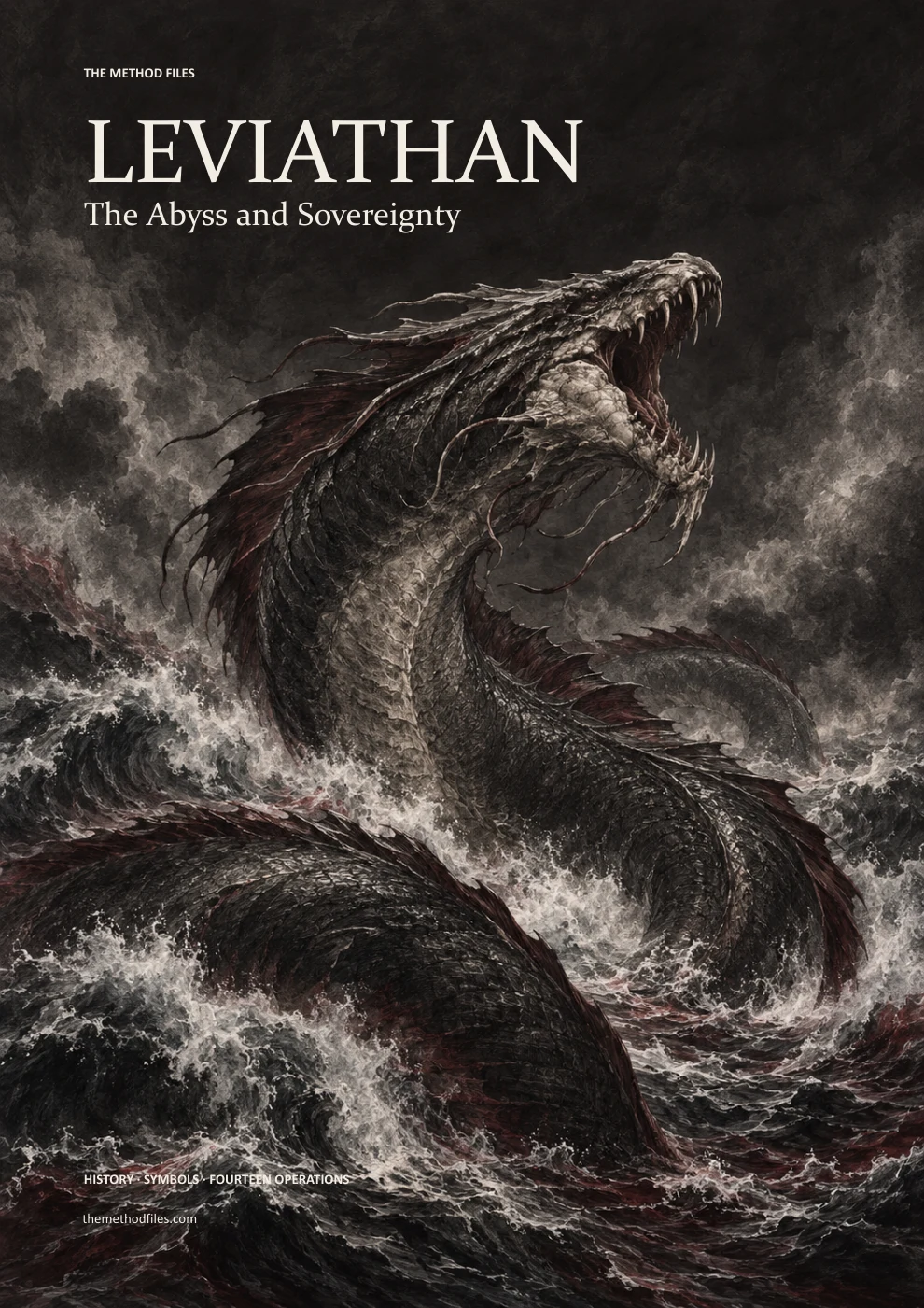
themethodfiles.com THE METHOD FILES LEVIATHAN The Abyss and Sovereignty HISTORY ∙ SYMBOLS ∙ FOURTEEN OPERATIONSAbout this reading sample

Read the text on this page
THE METHOD FILES / READING SAMPLE Leviathan The Abyss and Sovereignty A selection of pages from the complete book, with no registration required. We preserve the layout, text and numbering of the full English edition. You will find the introduction, a historical passage, a workshop, a complete practice and references to place your reading in context. Gaps in numbering reflect this selection: they are not missing pages. History Leviathan: name and limits Reading workshop A profile with too many names Complete contemporary practice Opening the Sea References to other parts of the volume belong to the complete book. This sample’s pages follow the original reading order. You can use the reader’s bookmarks to move between them. TMF digital books ∙ English ∙ Free sampleSources and scope · page 6 of the book

Read the text on this page
THE METHOD FILES themethodfiles.com 006 The Method Files · 2026 SOURCES AND SCOPE Sources and scope The volume Leviathan. The Abyss and Sovereignty. History, images with provenance, a letter square and fourteen contemporary operations. Written and published by The Method Files. Sources, translations and practice Each attestation is identified by its edition, passage or provenance record. The translations marked as editorial were prepared for the original Spanish volume and are presented here in English. The formulas, sequences, durations and record templates are contemporary compositions in this collection. Consulting a source does not imply reproducing its ritual or having its author's endorsement. The images The four interior plates reproduce historical works identified in their captions and credits. The square is an explicitly declared typographic reconstruction. The cover is a contemporary interpretation of the sea creature, created with artificial intelligence assistance; it is not an ancient attestation. Scope of the operations This book proposes personal esoteric practice. Impressions may hold meaning for the reader; on their own they do not establish a presence or guarantee external effects. The operations exclude blood, sacrifices, self‐harm and coercion. They are undertaken with rest, sobriety and the ability to end the session by one's own decision. Pages to use You may print the pages containing the square, pact and notebook for your personal practice. Preparation, the expected outcome and review have an explicit place in the method. An ambiguous result or the absence of an effect is also recorded.Before descending · page 7 of the book
Read the text on this page
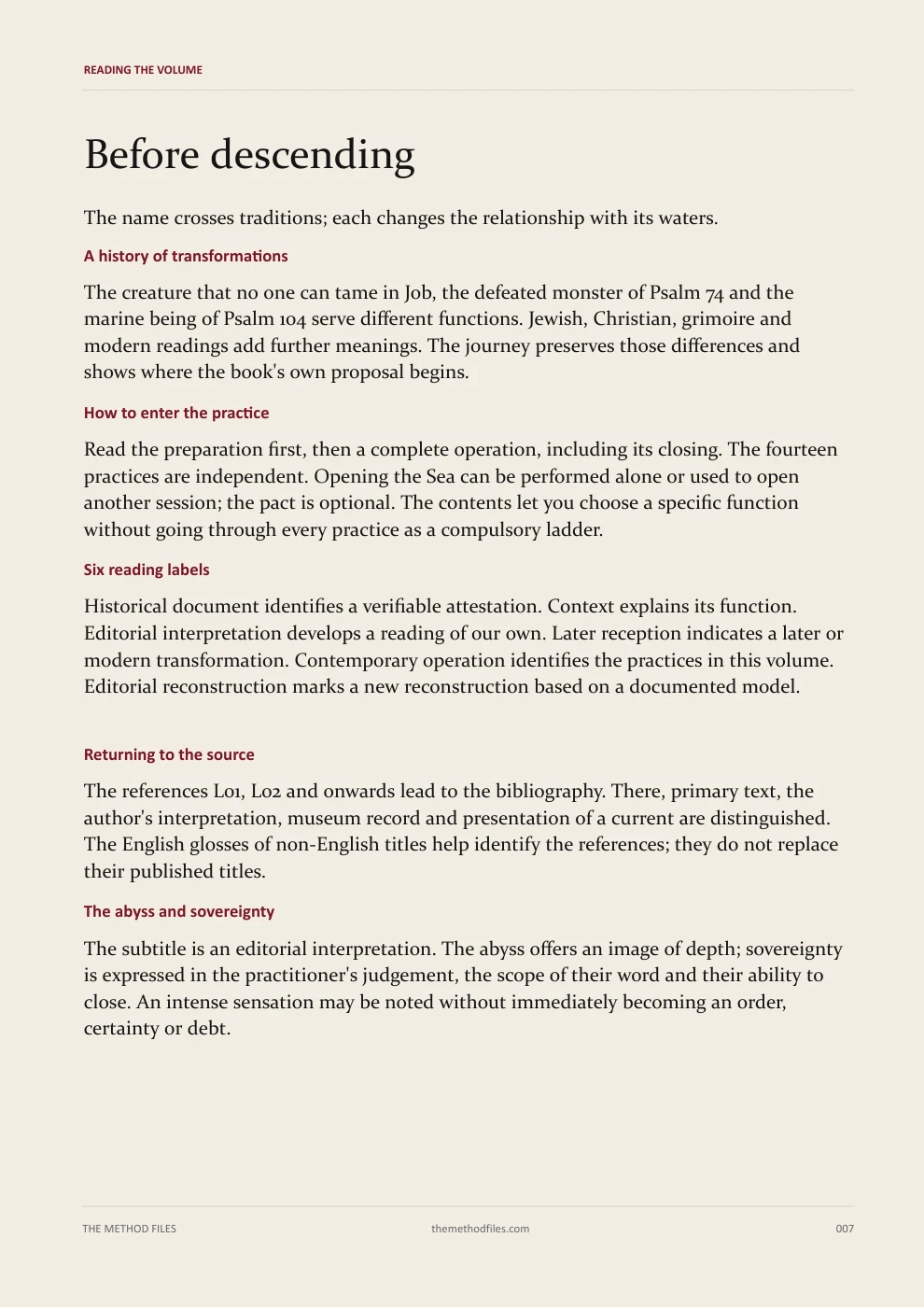
THE METHOD FILES themethodfiles.com 007 READING THE VOLUME Before descending The name crosses traditions; each changes the relationship with its waters. A history of transformations The creature that no one can tame in Job, the defeated monster of Psalm 74 and the marine being of Psalm 104 serve different functions. Jewish, Christian, grimoire and modern readings add further meanings. The journey preserves those differences and shows where the book's own proposal begins. How to enter the practice Read the preparation first, then a complete operation, including its closing. The fourteen practices are independent. Opening the Sea can be performed alone or used to open another session; the pact is optional. The contents let you choose a specific function without going through every practice as a compulsory ladder. Six reading labels Historical document identifies a verifiable attestation. Context explains its function. Editorial interpretation develops a reading of our own. Later reception indicates a later or modern transformation. Contemporary operation identifies the practices in this volume. Editorial reconstruction marks a new reconstruction based on a documented model. Returning to the source The references L01, L02 and onwards lead to the bibliography. There, primary text, the author's interpretation, museum record and presentation of a current are distinguished. The English glosses of non‐English titles help identify the references; they do not replace their published titles. The abyss and sovereignty The subtitle is an editorial interpretation. The abyss offers an image of depth; sovereignty is expressed in the practitioner's judgement, the scope of their word and their ability to close. An intense sensation may be noted without immediately becoming an order, certainty or debt.Leviathan: name and limits · page 8 of the book
Read the text on this page
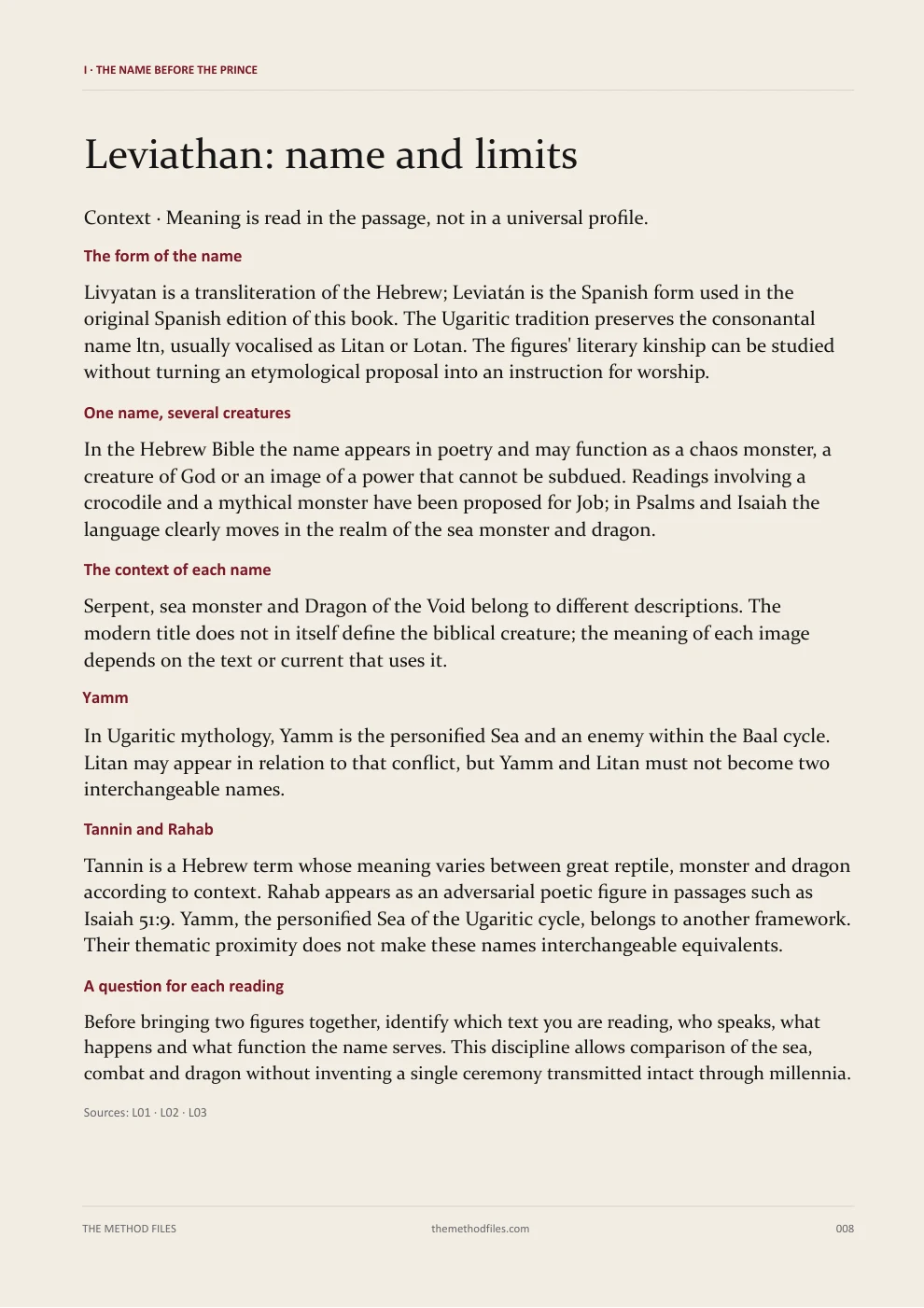
THE METHOD FILES themethodfiles.com 008 Yamm I ∙ THE NAME BEFORE THE PRINCE Leviathan: name and limits Context ∙ Meaning is read in the passage, not in a universal profile. The form of the name Livyatan is a transliteration of the Hebrew; Leviatán is the Spanish form used in the original Spanish edition of this book. The Ugaritic tradition preserves the consonantal name ltn, usually vocalised as Litan or Lotan. The figures' literary kinship can be studied without turning an etymological proposal into an instruction for worship. One name, several creatures In the Hebrew Bible the name appears in poetry and may function as a chaos monster, a creature of God or an image of a power that cannot be subdued. Readings involving a crocodile and a mythical monster have been proposed for Job; in Psalms and Isaiah the language clearly moves in the realm of the sea monster and dragon. The context of each name Serpent, sea monster and Dragon of the Void belong to different descriptions. The modern title does not in itself define the biblical creature; the meaning of each image depends on the text or current that uses it. In Ugaritic mythology, Yamm is the personified Sea and an enemy within the Baal cycle. Litan may appear in relation to that conflict, but Yamm and Litan must not become two interchangeable names. Tannin and Rahab Tannin is a Hebrew term whose meaning varies between great reptile, monster and dragon according to context. Rahab appears as an adversarial poetic figure in passages such as Isaiah 51:9. Yamm, the personified Sea of the Ugaritic cycle, belongs to another framework. Their thematic proximity does not make these names interchangeable equivalents. A question for each reading Before bringing two figures together, identify which text you are reading, who speaks, what happens and what function the name serves. This discipline allows comparison of the sea, combat and dragon without inventing a single ceremony transmitted intact through millennia. Sources: L01 ∙ L02 ∙ L03A profile with too many names · page 9 of the book

Read the text on this page
THE METHOD FILES themethodfiles.com 009 CASES AND READING WORKSHOPS A profile with too many names A reading profile groups Leviathan, Yamm, Rahab and tannin under the heading “names of the same spirit”. The thematic proximity seems sufficient until you try to locate a sentence establishing all those equivalences. The problem lies in presenting comparison as demonstrated identity, rather than in comparing. Return to the previous section and write beside each term its language or tradition and the function described there. Yamm belongs to the Ugaritic cycle; tannin is a term of variable scope; Rahab has poetic uses. The list already reveals differences that a universal profile had concealed. Rewrite the initial claim, retaining only what you can support. One solution would be to speak of figures and vocabulary related to the sea and conflict, studied in different contexts. Then choose two names and explain what further information you would need to establish a more precise relationship between them. A comparison I can support Information I still needThe space and the water · page 57 of the book
Read the text on this page
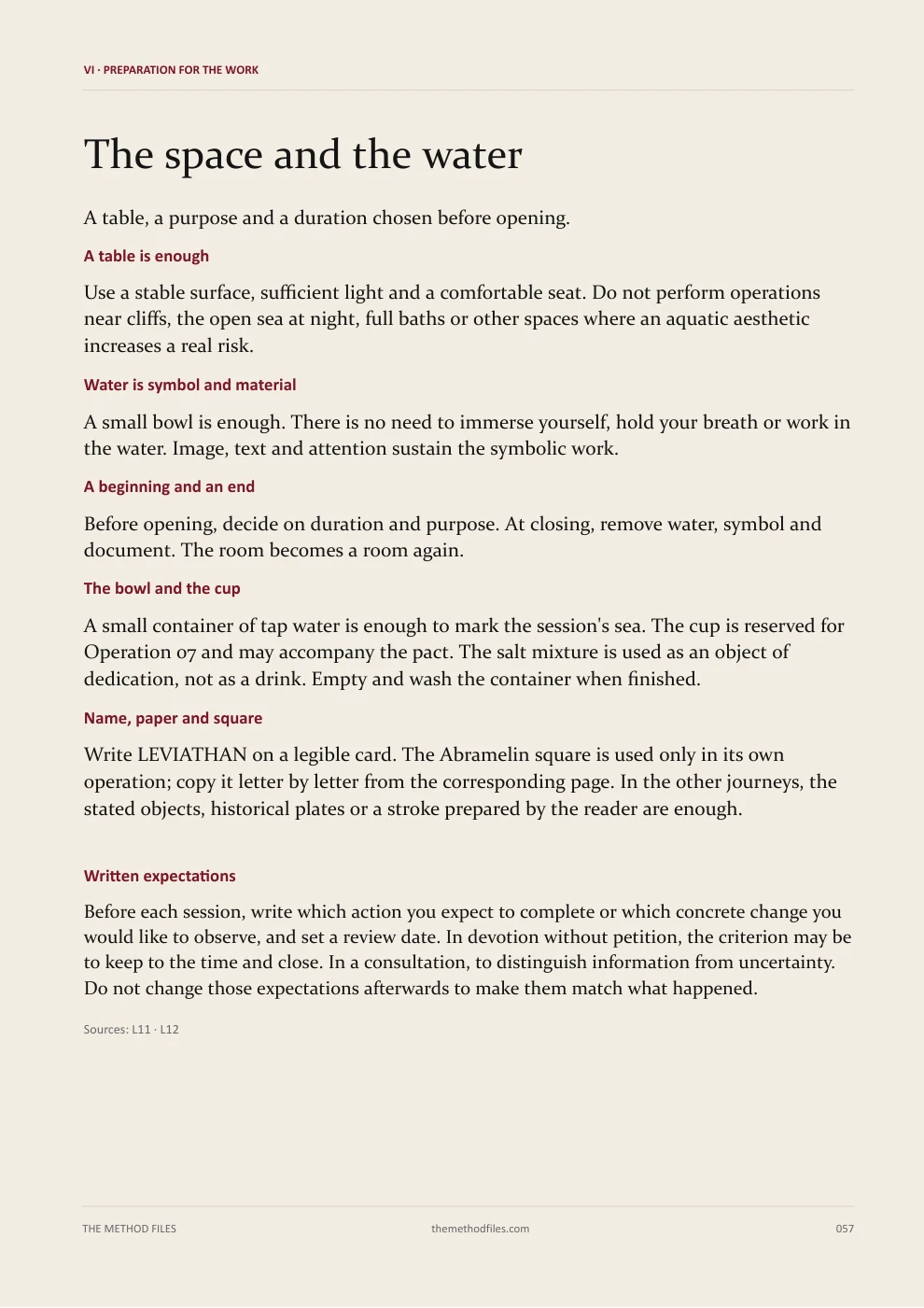
THE METHOD FILES themethodfiles.com 057 VI ∙ PREPARATION FOR THE WORK The space and the water A table, a purpose and a duration chosen before opening. A table is enough Use a stable surface, sufficient light and a comfortable seat. Do not perform operations near cliffs, the open sea at night, full baths or other spaces where an aquatic aesthetic increases a real risk. Water is symbol and material A small bowl is enough. There is no need to immerse yourself, hold your breath or work in the water. Image, text and attention sustain the symbolic work. A beginning and an end Before opening, decide on duration and purpose. At closing, remove water, symbol and document. The room becomes a room again. The bowl and the cup A small container of tap water is enough to mark the session's sea. The cup is reserved for Operation 07 and may accompany the pact. The salt mixture is used as an object of dedication, not as a drink. Empty and wash the container when finished. Name, paper and square Write LEVIATHAN on a legible card. The Abramelin square is used only in its own operation; copy it letter by letter from the corresponding page. In the other journeys, the stated objects, historical plates or a stroke prepared by the reader are enough. Written expectations Before each session, write which action you expect to complete or which concrete change you would like to observe, and set a review date. In devotion without petition, the criterion may be to keep to the time and close. In a consultation, to distinguish information from uncertainty. Do not change those expectations afterwards to make them match what happened. Sources: L11 ∙ L12Opening the Sea · page 65 of the book
Read the text on this page
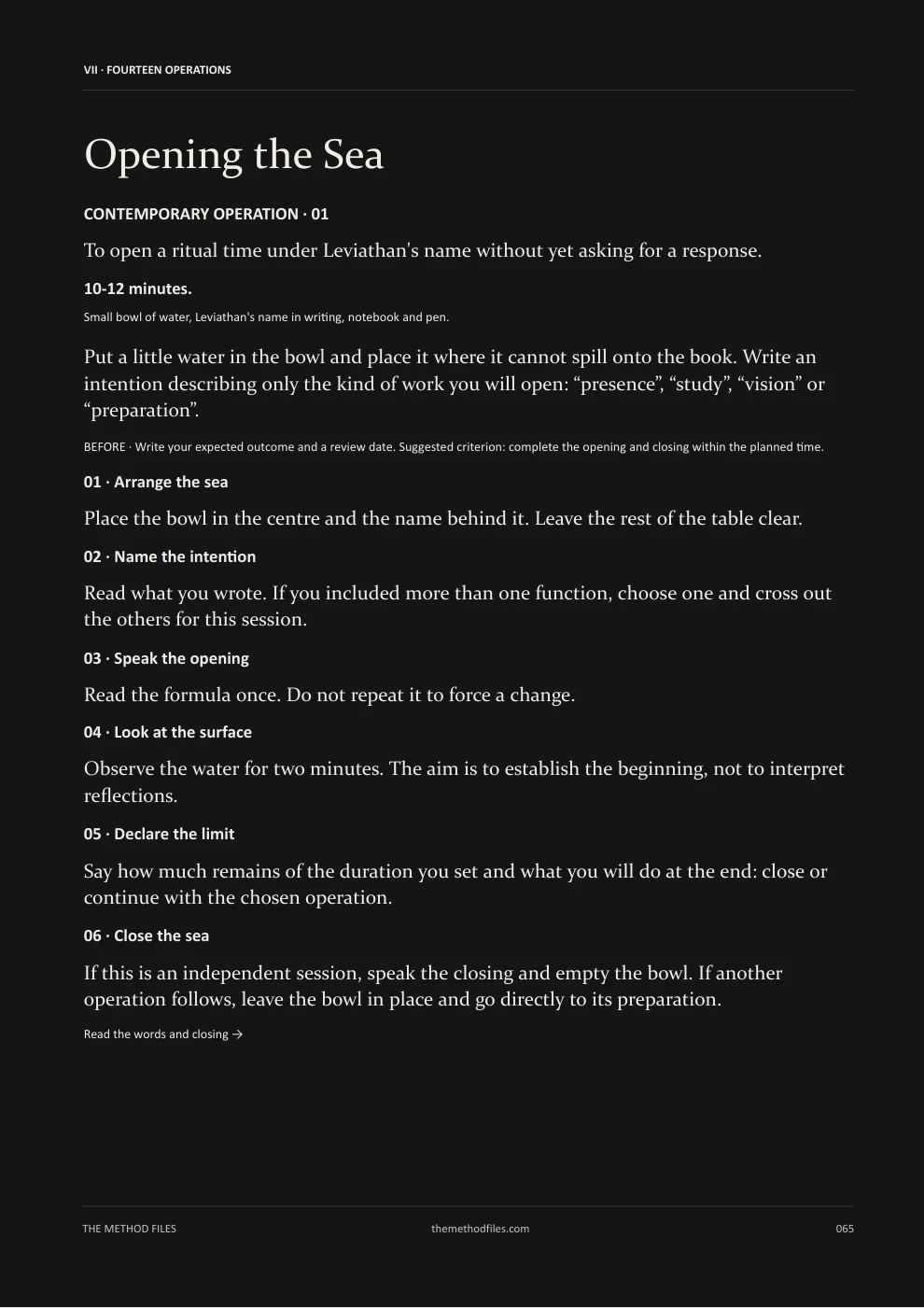
THE METHOD FILES themethodfiles.com 065 VII ∙ FOURTEEN OPERATIONS Opening the Sea CONTEMPORARY OPERATION ∙ 01 To open a ritual time under Leviathan's name without yet asking for a response. 10‐12 minutes. Small bowl of water, Leviathan's name in writing, notebook and pen. Put a little water in the bowl and place it where it cannot spill onto the book. Write an intention describing only the kind of work you will open: “presence”, “study”, “vision” or “preparation”. BEFORE ∙ Write your expected outcome and a review date. Suggested criterion: complete the opening and closing within the planned time. 01 ∙ Arrange the sea Place the bowl in the centre and the name behind it. Leave the rest of the table clear. 02 ∙ Name the intention Read what you wrote. If you included more than one function, choose one and cross out the others for this session. 03 ∙ Speak the opening Read the formula once. Do not repeat it to force a change. 04 ∙ Look at the surface Observe the water for two minutes. The aim is to establish the beginning, not to interpret reflections. 05 ∙ Declare the limit Say how much remains of the duration you set and what you will do at the end: close or continue with the chosen operation. 06 ∙ Close the sea If this is an independent session, speak the closing and empty the bowl. If another operation follows, leave the bowl in place and go directly to its preparation. Read the words and closing →Operation 01 · Words and closing · page 66 of the book
Read the text on this page
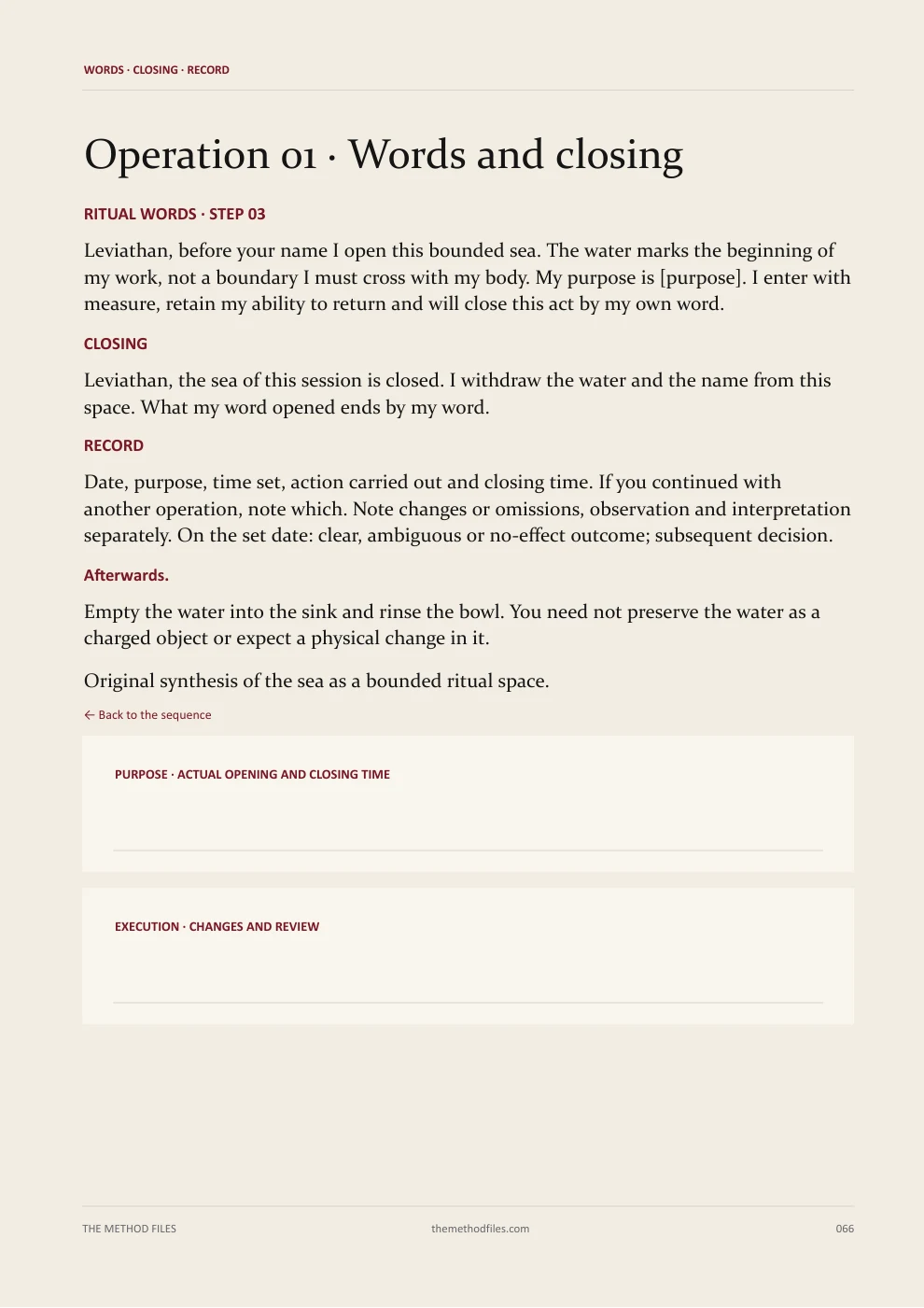
THE METHOD FILES themethodfiles.com 066 WORDS ∙ CLOSING ∙ RECORD Operation 01 ∙ Words and closing RITUAL WORDS ∙ STEP 03 Leviathan, before your name I open this bounded sea. The water marks the beginning of my work, not a boundary I must cross with my body. My purpose is [purpose]. I enter with measure, retain my ability to return and will close this act by my own word. CLOSING Leviathan, the sea of this session is closed. I withdraw the water and the name from this space. What my word opened ends by my word. RECORD Date, purpose, time set, action carried out and closing time. If you continued with another operation, note which. Note changes or omissions, observation and interpretation separately. On the set date: clear, ambiguous or no‐effect outcome; subsequent decision. Afterwards. Empty the water into the sink and rinse the bowl. You need not preserve the water as a charged object or expect a physical change in it. Original synthesis of the sea as a bounded ritual space. ← Back to the sequence PURPOSE ∙ ACTUAL OPENING AND CLOSING TIME EXECUTION ∙ CHANGES AND REVIEWAn opening that grows longer · page 67 of the book
Read the text on this page
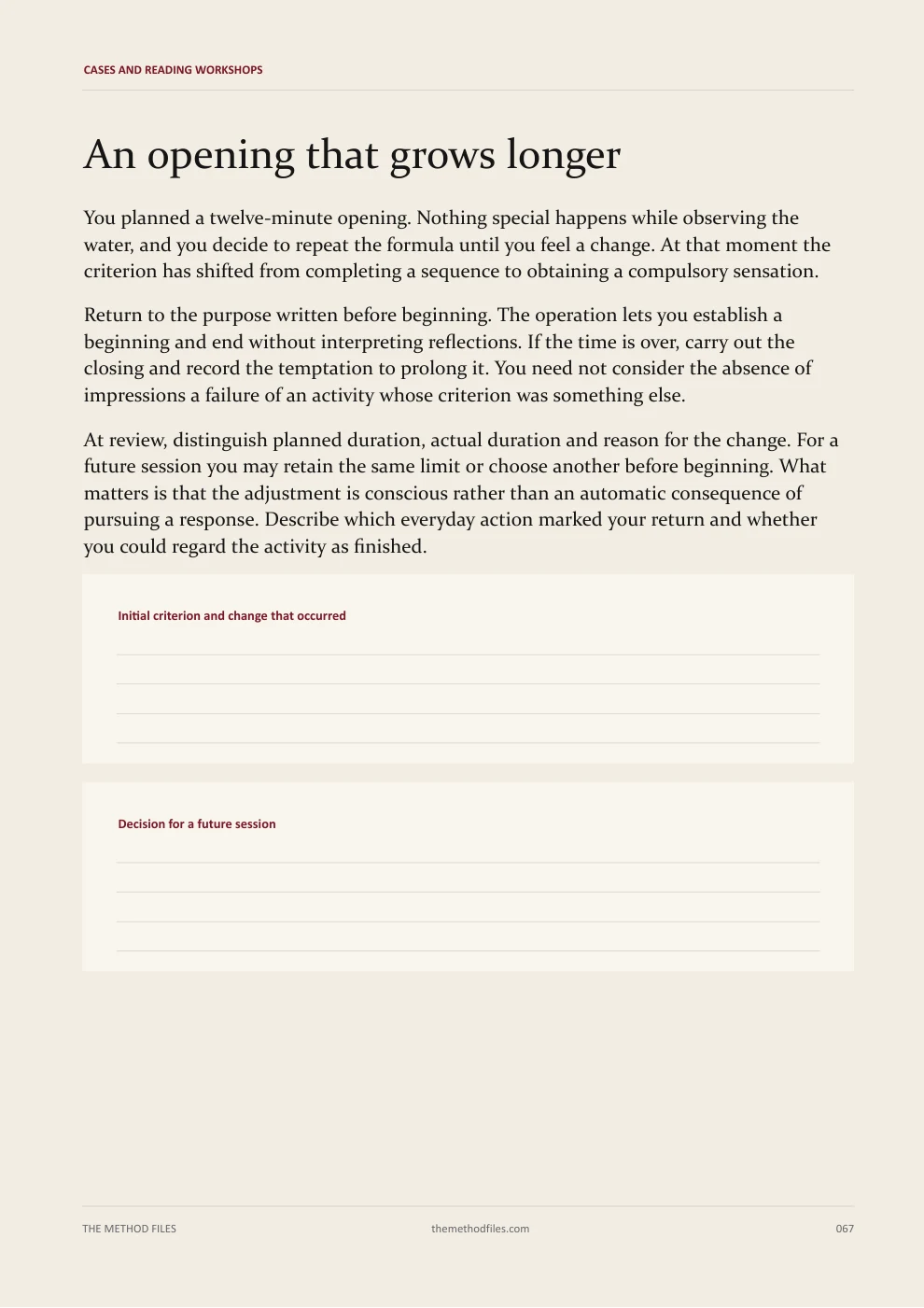
THE METHOD FILES themethodfiles.com 067 CASES AND READING WORKSHOPS An opening that grows longer You planned a twelve‐minute opening. Nothing special happens while observing the water, and you decide to repeat the formula until you feel a change. At that moment the criterion has shifted from completing a sequence to obtaining a compulsory sensation. Return to the purpose written before beginning. The operation lets you establish a beginning and end without interpreting reflections. If the time is over, carry out the closing and record the temptation to prolong it. You need not consider the absence of impressions a failure of an activity whose criterion was something else. At review, distinguish planned duration, actual duration and reason for the change. For a future session you may retain the same limit or choose another before beginning. What matters is that the adjustment is conscious rather than an automatic consequence of pursuing a response. Describe which everyday action marked your return and whether you could regard the activity as finished. Initial criterion and change that occurred Decision for a future sessionProvenance of the fourteen operations · page 113 of the book

Read the text on this page
THE METHOD FILES themethodfiles.com 113 OP. 01 02 03 04 05 06 07 IX ∙ SOURCES AND PROVENANCE Provenance of the fourteen operations Every sequence and formula in the corpus is a contemporary composition. Operation Source and original contribution Opening the Sea Original synthesis of the sea as a bounded ritual space. Invocation of the Name Original contemporary invocation; no pact or compulsory direction. The Fleeing Serpent Isaiah 27:1 provides the epithets; the journey is original. Before the Untameable Job 40:25‐41:26 provides the limit of control; original rite. The Play of the Sea Psalm 104:25‐26 inspires the movement; original observance. The West of the Waters Water/West: modern context. Original petition and sequence. The Cup of the Depths Water and salt: Connolly's context. Original dedication.Bibliography · 1 · page 116 of the book

Read the text on this page
THE METHOD FILES themethodfiles.com 116 SOURCES AND FURTHER READING Bibliography ∙ 1 L01. Cho, Paul K.‐K. “Myth as Story and Metaphor in the Hebrew Bible”. The Bible and Interpretation, byline dated June 2019. Section II: KTU 1.5 I, 1‐3 and Isaiah 27:1. Author's article consulted. The comparative formula is presented here in an English rendering of the editorial Spanish translation; it is not presented as consultation of an original tablet. View the document L02. Job 3:8; 40:25‐41:26. New American Bible, Revised Edition (NABRE), USCCB. Text and notes consulted. Job 40:28 corresponds to 41:4 in the King James Version. An explanation in Spanish is offered in the original edition, not a complete reproduction of the English translation. View the document L03. Isaiah 27:1; see also 51:9. NABRE, USCCB. Text for the fleeing serpent, the twisting serpent and judgement; comparison with L01. View the document L04. Psalm 104:25‐26. NABRE, USCCB. Text and note. This version translates the play phrase as God's relationship with Leviathan; the volume notes the variant “play there”. View the document L05. Psalm 74:12‐15. NABRE, USCCB. Passage on the sea and Leviathan's heads. It does not specify seven heads. View the document L06. First Book of Enoch 60:7‐10. R. H. Charles, trans., The Book of Enoch. London: S.P.C.K., 1917; tenth impression, 1962; p. 77. Project Gutenberg, eBook 77935. Translation consulted for the two monsters and their domains. The printed edition reproduces Charles's 1912 translation; its introduction is not adopted as the current state of research. View the documentBibliography · 2 · page 117 of the book

Read the text on this page
THE METHOD FILES themethodfiles.com 117 SOURCES AND FURTHER READING Bibliography ∙ 2 L07. Babylonian Talmud, Bava Batra 74b‐75a. William Davidson / Koren‐Steinsaltz digital edition, Sefaria. Passages on male and female, banquet, skin and light. Synthesis originally written in Spanish, presented here in English translation; the distinction from 1 Enoch is retained. View the document L08. Isidore of Seville. Etymologiae (Etymologies), VIII.11.27‐28. W. M. Lindsay, ed. Oxford: Clarendon Press, 1911. Latin text at LacusCurtius. The phrase serpens de aquis is at VIII.11.27. English rendering of the editorial Spanish translation. The historical etymological explanation is attributed to Isidore. View the document L09. Gregory the Great. Moralia in Iob (Moral Commentary on Job), Book XXXIV, especially 6.11, 16.31 and 23.47. Historical English translation, Lectionary Central. Text consulted for the enemy, the agitated sea and pride. Reference by chapters and paragraphs avoids confusing biblical numbering. View the document L10. Collin de Plancy, Jacques. Dictionnaire infernal (Infernal Dictionary), 6th ed. Paris: Henri Plon, 1863, p. 406, “Léviathan” entry. Entry consulted and checked against the transcription of the printed edition. The mention of Wierus is attributed to the dictionary. View the document L11. Mathers, S. L. MacGregor, trans. The Book of the Sacred Magic of Abra‐Melin the Mage. London: John M. Watkins, 1898. Book II, list of spirits; III.III, square 3 and notes. Digital edition by Joseph H. Peterson. Version and notes consulted. The 64 letters and Mathers's uncertainty about numbering are retained. Variants from other attestations are not merged. View the documentBibliography · 3 · page 118 of the book

Read the text on this page
THE METHOD FILES themethodfiles.com 118 SOURCES AND FURTHER READING Bibliography ∙ 3 L12. Connolly, S. Modern Demonolatry. Digital copy distributed by Demonolatry.org; pp. 11, 55 and 69‐70. Consultation of correspondences and the Basic Rite to Leviathan. The Binsfeld table is recorded as a modern attribution. The volume's operations do not reproduce these rites. View the document L13. Steph. “Water North ‐ Water West?” Demonolatry.org, 13 January 2020. Article consulted on variation in directional correspondences; the opinion is attributed to its author. View the document L14. Steph. “Liturgy to Leviathan”. Demonolatry.org, 21 September 2021. Prayer consulted as an attestation of modern devotion. Its ritual text is not reproduced. View the document L15. Byrd, Daniel. “Leviathan’s Compass”. The Black Flame / Church of Satan, 9 May 2016. Institutional article on West and the Satanist altar. Contextual reference for the modern correspondence. View the document L16. The Unicode Consortium. The Unicode Standard, version 17.0. Alchemical Symbols, U+1F700‐U+1F77F; character U+1F70F. Technical identification of the black sulphur symbol. It is not a source on the origin of the modern designation “Leviathan cross”. View the documentBibliography · 4 · page 119 of the book

Read the text on this page
THE METHOD FILES themethodfiles.com 119 SOURCES AND FURTHER READING Bibliography ∙ 4 L17. De Guaita, Stanislas. La Clef de la Magie Noire (The Key to Black Magic). Paris: Chamuel, 1897. Pair of pentagrams reproduced on Wikimedia Commons; link to the digitised copy. Visual document consulted. The selected reproduction preserves both pentagrams; no modern institutional logo is reproduced. View the document L18. Blake, William. Job’s Despair, 1825. Book of Job, plate 8. National Gallery of Art, Washington, 1943.3.1810. Institutional record and image consulted. Rosenwald Collection. Image reused under CC0. View the document L19. Blake, William. Behemoth and Leviathan, 1825. Book of Job, plate 15. National Gallery of Art, Washington, 1941.1.240. Institutional record and image consulted. Gift of W.G. Russell Allen. Reuse under CC0. View the document L20. Doré, Gustave (drawing), and H. Pisan (engraving, according to signature). Destruction of Leviathan, 1865. Digital reproduction on Wikimedia Commons, 2288 × 2890 pixel file. Plate and record consulted. Work and reproduction identified as public domain. View the document L21. Temple of Ascending Flame. “About Us”, presentation of the Temple's archetypes, n.d. Institutional presentation of the Dragon of the Void as modern context. The journey in Operation 12 is original to The Method Files. View the document L22. Mason, Asenath. “Oraculum Leviathan” (Oracle of Leviathan), official presentation of the deck, n.d. Author's record consulted. Identifies Bill Duvendack as author of the accompanying book. Consultation of that complete manual is not claimed. View the documentContinue reading
Read the text on this page
THE METHOD FILES / READING SAMPLE Leviathan The Abyss and Sovereignty Your reading can continue. The complete book contains 122 pages, reading workshops and 14 contemporary operations, with their sources and references. You can follow the historical journey without performing the practices. If you decide to explore them, you will find contemporary compositions identified as such, with preparation, a central sequence and closing. Digital book in PDF, in English. It does not include tutoring or access to TMF courses. Exercises are completed in a notebook or using the PDF reader’s annotation tools. Explore the complete book themethodfiles.com/libros‐digitales/leviatan/ TMF digital books ∙ English ∙ Free sample
Continue whenever you wish