Read before you choose
Lucifer
The Star and the Fall
This 11-page sample includes an introduction, a historical passage, a workshop, one complete practice and references. It retains the original book’s page numbers: the gaps reflect the selection.
Download PDF · 9.7 MBNo registration · Selectable text in the PDF
Cover
Read the text on this page
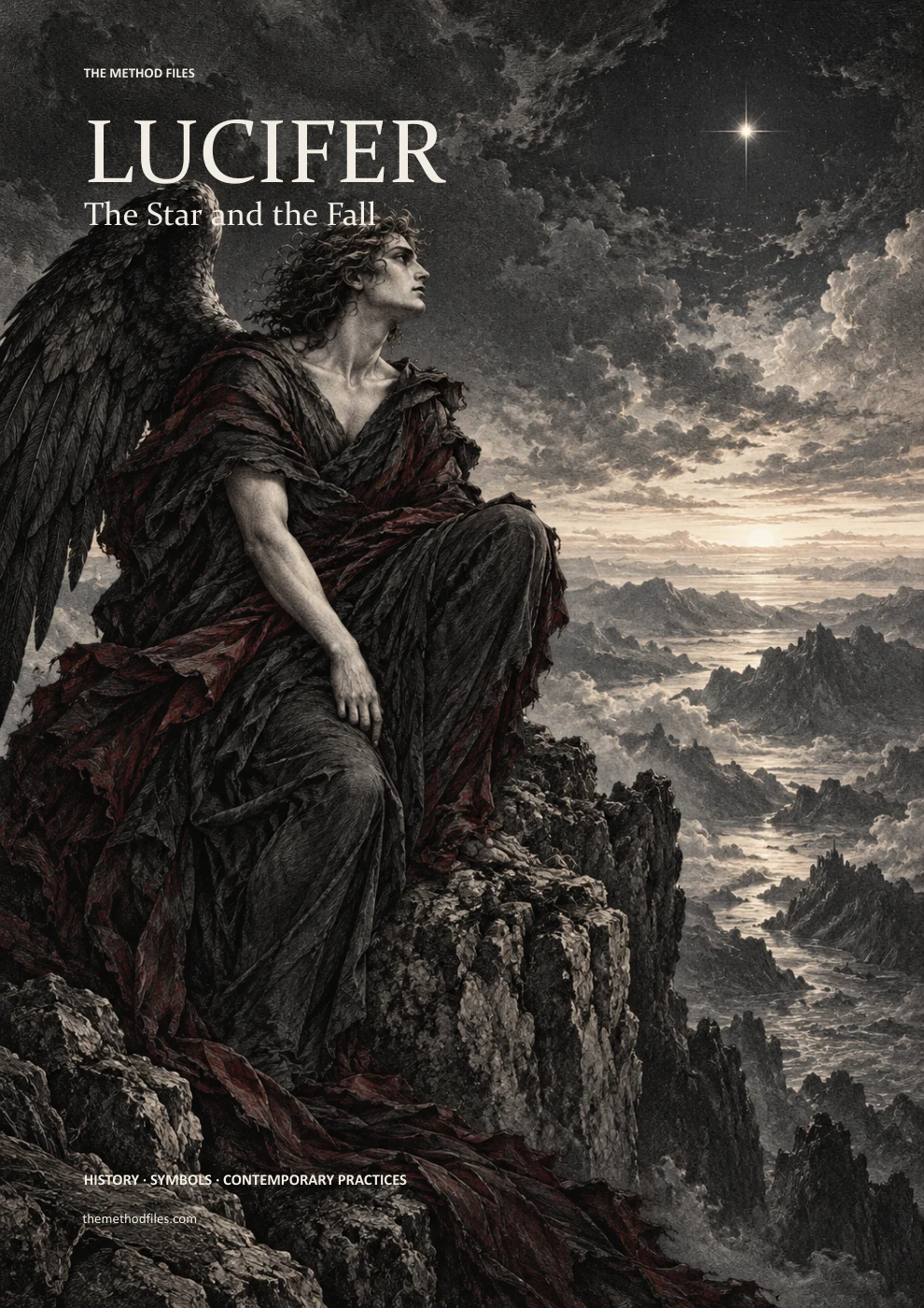
themethodfiles.com THE METHOD FILES LUCIFER The Star and the Fall HISTORY ∙ SYMBOLS ∙ CONTEMPORARY PRACTICESAbout this reading sample
Read the text on this page
THE METHOD FILES / READING SAMPLE Lucifer The Star and the Fall A selection of pages from the complete book, with no registration required. We preserve the layout, text and numbering of the full English edition. You will find the introduction, a historical passage, a workshop, a complete practice and references to place your reading in context. Gaps in numbering reflect this selection: they are not missing pages. History The name and the light Reading workshop Reading a word within its sentence Complete contemporary practice Greeting the light‐bearer References to other parts of the volume belong to the complete book. This sample’s pages follow the original reading order. You can use the reader’s bookmarks to move between them. TMF digital books ∙ English ∙ Free sampleHow to read this book · page 5 of the book
Read the text on this page
LUCIFER THE METHOD FILES themethodfiles.com 005 How to read this book History, symbols and eleven original ceremonies dedicated to Lucifer, including a pact. You may follow the whole pathway or return to whichever practice you need. First, learn The opening chapters explain where the name comes from, what the grimoires say and how to recognise his seals. Lucifer does not appear in the same way in every book: knowing these differences helps you avoid confusing him with other figures. Then, practise Each ceremony has a purpose, simple materials, words to read and a farewell. Always read the complete sequence before you begin. You do not need to perform every ceremony or follow a scale of commitments. What kind of text you are reading “Historical document” identifies a source; “later reception” situates its new readings. The contemporary operations are original compositions by The Method Files, informed by specific antecedents. The scope of the practice The eleven ceremonies are original syntheses, rather than historical rites with alterations. Procedures requiring blood, sacrifice or harm are excluded. Nor are practices offered for subjugating other people. Beliefs are presented as beliefs: no ceremony guarantees an apparition or a supernatural result. Text and images The interior brings together documented reproductions and identified contemporary diagrams. The credits distinguish the provenance of the images and their function in the reading. © The Method Files, 2026. Text and contemporary practices by The Method Files. Reproduced works retain their attributions and conditions of use. Cover: contemporary illustration created with artificial intelligence assistance.The name and the light · page 7 of the book

Read the text on this page
THE METHOD FILES themethodfiles.com 007 I / THE NAME AND ITS HISTORY The name and the light HISTORICAL DOCUMENT Lucifer means “light‐bearer”. Its history begins in the dawn sky, before reaching the stories about angels and spirits. James Basire ∙ Transit room at Hartwell. Engraving; no date given in the record. Wellcome Collection, 46262i. Public Domain Mark. Observation of Venus; not a ritual scene. The morning star The Romans could call Venus Lucifer when it was visible before sunrise. Cicero records this usage in De natura deorum. When the planet appeared after sunset, it received another name. The Greek name In the same passage, Cicero connects Lucifer with Phosphoros, the Greek name for the light‐bearer. Eosphoros expresses a related idea: the dawn‐ bearer. The relationship between the words does not make all the stories told about them identical. What changes for the reader If you encounter “lucifer” in a Latin text, first look at what it is describing. It may refer to a star rather than the character of a grimoire. Cicero ∙ De natura deorum II, 20, 53 ∙ Wellcome, 46262i From the name to its context The reproduction documents a space for observing Venus. Its function in this chapter is to place the name in an astronomical context. It does not allow a ritual calendar to be deduced. Compare that function with that of the passage from Cicero before proposing a symbolic relationship of your own.Reading a word within its sentence · page 8 of the book
Read the text on this page
THE METHOD FILES themethodfiles.com 008 READING WORKSHOP Reading a word within its sentence An isolated word may seem familiar yet fulfil an unexpected function in a sentence. The exercise is to restore the name to its context before associating it with a character, doctrine or practice. Work with the passage from Cicero cited in “The name and the light”. Record the author, work, book and section. Then locate the term being translated and the object to which it refers. If you use a translation, also identify the translator. Your note should distinguish what you read in that translation from an observation of your own about the Latin. A summary such as “Lucifer belongs to astronomy” would be too broad if applied to every work. A more precise formulation would be “In this passage, the name is used for Venus before dawn”. The second sentence limits its scope to the evidence supporting it. It does not eliminate later uses: it avoids introducing them before they have been studied. Write two summaries of the same passage. Use a deliberate generalisation in the first; introduce the necessary limits in the second. Underline the difference between them. Check that the correction does not add a date, an authorial intention or a ritual relationship that the passage consulted does not establish. Original exercise by The Method Files. You may write your answers on this sheet or in your notebook. An overly broad summary A summary limited by the passageGreeting the light-bearer · page 55 of the book

Read the text on this page
THE METHOD FILES themethodfiles.com 055 RITUAL WORK / 01 Greeting the light‐bearer CEREMONY 01 ∙ CONTEMPORARY OPERATION To open a time of devotion to Lucifer through a greeting. It includes neither a request for favours nor a subsequent commitment. Suggested duration 10 minutes Materials The text and a notebook. An image of the star, if you wish. Expectations Note why you choose a salutation, the ten minutes planned and what you expect to observe during the silence. Before you begin Choose a quiet time. Dawn may accompany the light motif, but it is not a compulsory hour. Read the farewell too before beginning. OPENING ∙ WORDS TO SPEAK Lucifer, light‐bearer, to you I address this greeting. Before the name that heralds the dawn, I open this time of devotion. Receive my words as I pronounce them. I call no other figure under your name. I remain before the book, attentive to light and silence, without demanding a sign. Original composition by The Method Files ∙ See “Provenance of the eleven ceremonies”.Greeting the light-bearer · page 56 of the book
Read the text on this page
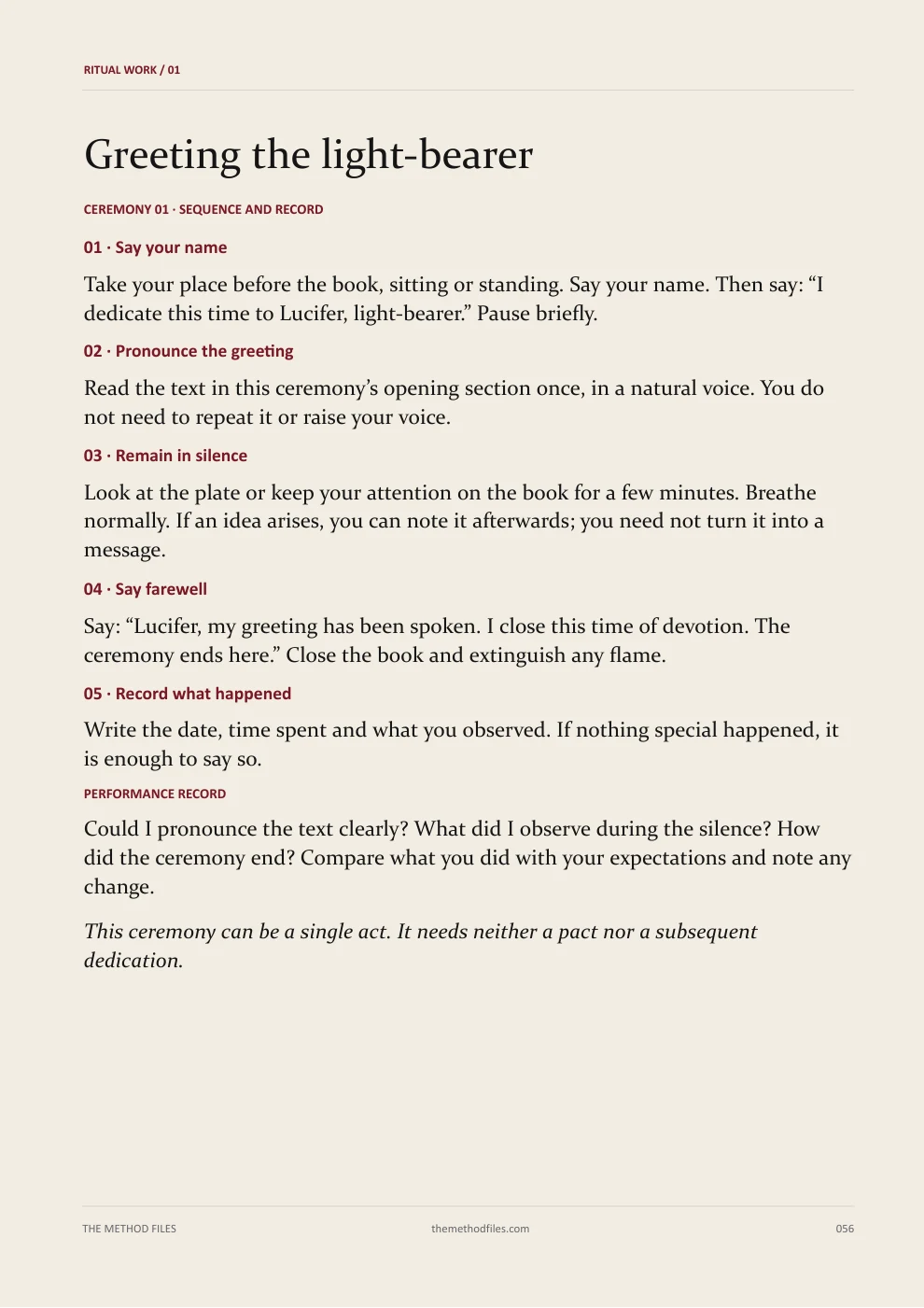
THE METHOD FILES themethodfiles.com 056 RITUAL WORK / 01 Greeting the light‐bearer CEREMONY 01 ∙ SEQUENCE AND RECORD 01 ∙ Say your name Take your place before the book, sitting or standing. Say your name. Then say: “I dedicate this time to Lucifer, light‐bearer.” Pause briefly. 02 ∙ Pronounce the greeting Read the text in this ceremony’s opening section once, in a natural voice. You do not need to repeat it or raise your voice. 03 ∙ Remain in silence Look at the plate or keep your attention on the book for a few minutes. Breathe normally. If an idea arises, you can note it afterwards; you need not turn it into a message. 04 ∙ Say farewell Say: “Lucifer, my greeting has been spoken. I close this time of devotion. The ceremony ends here.” Close the book and extinguish any flame. 05 ∙ Record what happened Write the date, time spent and what you observed. If nothing special happened, it is enough to say so. PERFORMANCE RECORD Could I pronounce the text clearly? What did I observe during the silence? How did the ceremony end? Compare what you did with your expectations and note any change. This ceremony can be a single act. It needs neither a pact nor a subsequent dedication.Recognising a sufficient session · page 57 of the book
Read the text on this page
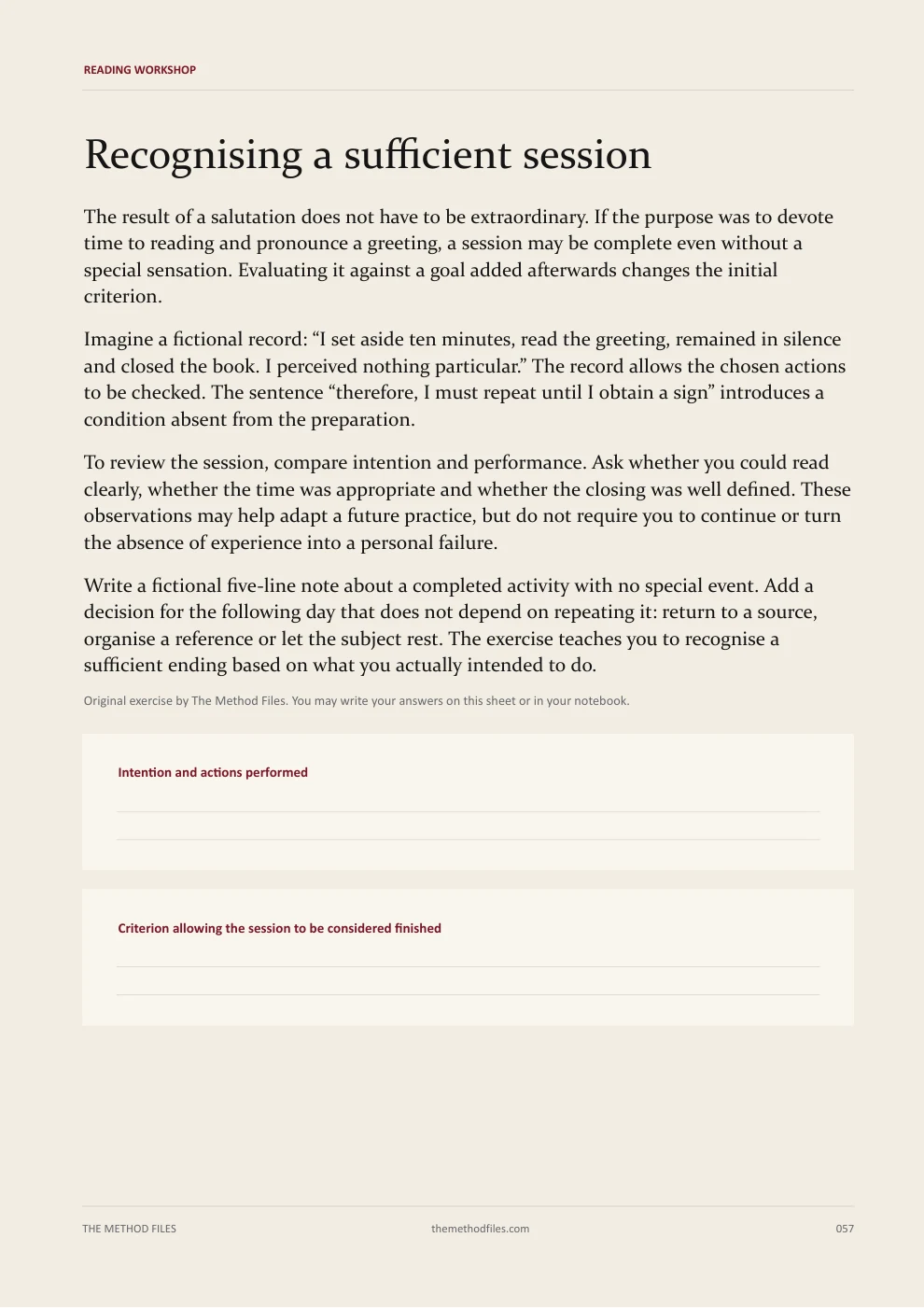
THE METHOD FILES themethodfiles.com 057 READING WORKSHOP Recognising a sufficient session The result of a salutation does not have to be extraordinary. If the purpose was to devote time to reading and pronounce a greeting, a session may be complete even without a special sensation. Evaluating it against a goal added afterwards changes the initial criterion. Imagine a fictional record: “I set aside ten minutes, read the greeting, remained in silence and closed the book. I perceived nothing particular.” The record allows the chosen actions to be checked. The sentence “therefore, I must repeat until I obtain a sign” introduces a condition absent from the preparation. To review the session, compare intention and performance. Ask whether you could read clearly, whether the time was appropriate and whether the closing was well defined. These observations may help adapt a future practice, but do not require you to continue or turn the absence of experience into a personal failure. Write a fictional five‐line note about a completed activity with no special event. Add a decision for the following day that does not depend on repeating it: return to a source, organise a reference or let the subject rest. The exercise teaches you to recognise a sufficient ending based on what you actually intended to do. Original exercise by The Method Files. You may write your answers on this sheet or in your notebook. Intention and actions performed Criterion allowing the session to be considered finishedProvenance of the eleven ceremonies · page 107 of the book
Read the text on this page
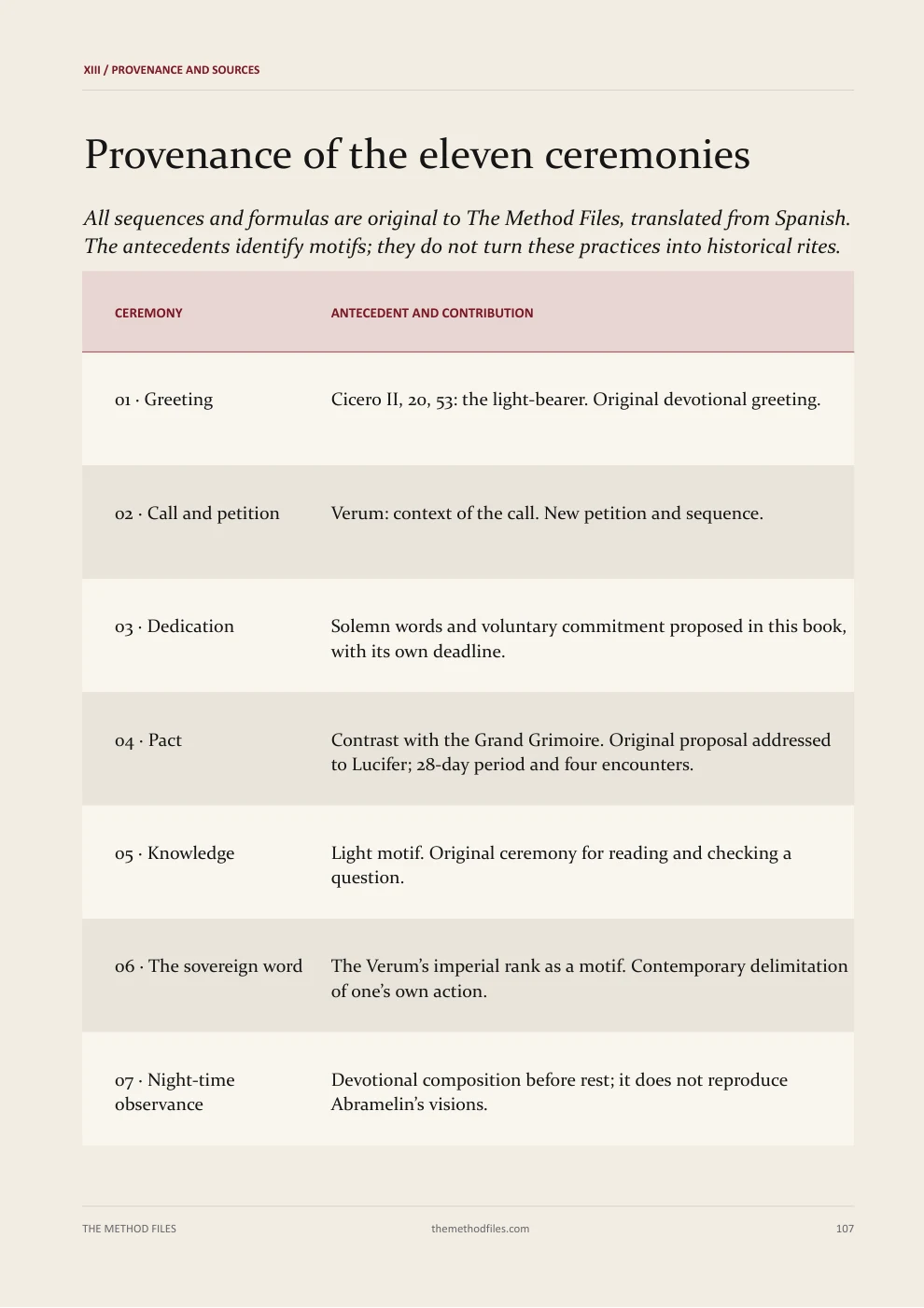
THE METHOD FILES themethodfiles.com 107 XIII / PROVENANCE AND SOURCES Provenance of the eleven ceremonies All sequences and formulas are original to The Method Files, translated from Spanish. The antecedents identify motifs; they do not turn these practices into historical rites. CEREMONY ANTECEDENT AND CONTRIBUTION 01 ∙ Greeting Cicero II, 20, 53: the light‐bearer. Original devotional greeting. 02 ∙ Call and petition Verum: context of the call. New petition and sequence. 03 ∙ Dedication Solemn words and voluntary commitment proposed in this book, with its own deadline. 04 ∙ Pact Contrast with the Grand Grimoire. Original proposal addressed to Lucifer; 28‐day period and four encounters. 05 ∙ Knowledge Light motif. Original ceremony for reading and checking a question. 06 ∙ The sovereign word The Verum’s imperial rank as a motif. Contemporary delimitation of one’s own action. 07 ∙ Night‐time observance Devotional composition before rest; it does not reproduce Abramelin’s visions.Historical sources · page 109 of the book

Read the text on this page
THE METHOD FILES themethodfiles.com 109 Nova Vulgata Milton · Paradise Lost Grimorium Verum Abramelin · Mathers, 1898 Le Grand Grimoire Grimoire du Pape Honorius Wellcome Collection · MS.983 Trithemius · Steganographia XIII / PROVENANCE AND SOURCES Historical sources Passages used and witnesses compared. Cited pages refer to each digital edition unless this volume is specified. Cicero ∙ De natura deorum II, 20, 53. Venus before dawn. H. Rackham’s translation in LacusCurtius. View the document Biblical texts Isaiah 14:4, 12‐15, USCCB context and notes. Latin use of lucifer in the Nova Vulgata. View the document Isaiah 14:12. The Latin name in the passage of the fallen morning star. View the document Nova Vulgata ∙ 2 Peter 1:19. Luminous use of lucifer within a Christian context. View the document Origen ∙ De principiis I, 5, 5. Christian reading of Isaiah and Luke. New Advent digital edition. View the document Books I and IX: fall and temptation. Book XII: expulsion from Eden. Project Gutenberg, text 26. View the document J. H. Peterson’s digital edition. Ranks, characters, materials, conjuration and farewell. Includes a reference to Arsenal MS 2795. View an archived copy II, XIV‐XV and XIX: princes. III, III, 2: LUCIFER square. Esoteric Archives. View an archived copy Renault, Paris, 1845, transcribed by Peterson. Second book: pact with Lucifuge. Another textual unit: Centum Regnum. View an archived copy Edition transmitted with a 1760 imprint, compared by Peterson. Weekly series, pp. 34‐42. View an archived copy L’art magique. Catalogue and digitisation. The reading of 1709 as a date is proposed with qualification. View the document Book I, conjuration of Dorothiel. Parallel identified by Peterson in the Verum’s call to Lucifer. View an archived copyContinue reading
Read the text on this page
THE METHOD FILES / READING SAMPLE Lucifer The Star and the Fall Your reading can continue. The complete book contains 113 pages, reading workshops and 11 contemporary operations, with their sources and references. You can follow the historical journey without performing the practices. If you decide to explore them, you will find contemporary compositions identified as such, with preparation, a central sequence and closing. Digital book in PDF, in English. It does not include tutoring or access to TMF courses. Exercises are completed in a notebook or using the PDF reader’s annotation tools. Explore the complete book themethodfiles.com/libros‐digitales/lucifer/ TMF digital books ∙ English ∙ Free sample
Continue whenever you wish