Read before you choose
Satan
The Adversary and the Will
This 11-page sample includes an introduction, a historical passage, a workshop, one complete practice and references. It retains the original book’s page numbers: the gaps reflect the selection.
Download PDF · 5.7 MBNo registration · Selectable text in the PDF
Cover

Read the text on this page
themethodfiles.com THE METHOD FILES SATAN The Adversary and the Will HISTORY ∙ SYMBOLS ∙ SIXTEEN OPERATIONSAbout this reading sample
Read the text on this page
THE METHOD FILES / READING SAMPLE Satan The Adversary and the Will A selection of pages from the complete book, with no registration required. We preserve the layout, text and numbering of the full English edition. You will find the introduction, a historical passage, a workshop, a complete practice and references to place your reading in context. Gaps in numbering reflect this selection: they are not missing pages. History Before the proper name Reading workshop Recognising a function before a name Complete contemporary practice Greeting the Adversary References to other parts of the volume belong to the complete book. This sample’s pages follow the original reading order. You can use the reader’s bookmarks to move between them. TMF digital books ∙ English ∙ Free sampleA word with a history · page 6 of the book
Read the text on this page
THE METHOD FILES themethodfiles.com 006 THE METHOD FILES · 2026 PRELIMINARIES A word with a history One name, several contexts Satan does not enter every source in the same way. This volume follows the adversary of the biblical narratives, the literary character and the figures of later movements. Documentary reading precedes sixteen original ceremonies, whose voice may be adopted symbolically or devotionally. Six ways of reading Historical document identifies the witness; Context locates its period and function; Editorial interpretation proposes a reading. Later reception follows a figure’s transformations. Contemporary operation indicates a practice composed in the present. Editorial reconstruction identifies a recomposition, such as the letter square. Text and translation Biblical paraphrases refer to the Reina‐Valera Antigua, except for the note on Numbers. Brief translations of inscriptions and literature are editorial. Each S reference points to the bibliography; contents page numbers link to their sections. The proper names of signs are retained. Scope of the practice The formulas express invitation, acknowledgement and petition. Dedication retains a beginning, an endpoint and a way out. Experience is recorded without being taken as external proof or a guarantee of results. Limits, materials and conditions are explained before the corpus. Editorial credits Selection, editing, editorial translations and ritual composition: The Method Files. Historical works retain their authorship. Covers are contemporary editorial interpretations. Typography: Constantia and Calibri. Independent digital publication. www.themethodfiles.com Cover created with artificial intelligence assistance for The Method Files, 2026.Before the proper name · page 7 of the book
Read the text on this page
THE METHOD FILES themethodfiles.com 007 I ∙ THE ADVERSARY AND HIS TEXTS Before the proper name Historical document ∙ Opposition, function and interpretation. Opposition in Numbers In Numbers 22, God’s angel stands in Balaam’s path. The philological note in the United States Conference of Catholic Bishops edition explains that the Hebrew term used for this opposition is satan. The adversary in this scene is therefore a messenger of God, not an infernal sovereign opposing him. Reading the function In Job and Zechariah, a figure appears who comes before the divine realm and opposes a human being. Translating him as ‘the adversary’ or ‘the accuser’ helps reveal a function that the habit of always writing ‘Satan’ may obscure. The translation choice does not remove the differences between the narratives. A real debate Ryan E. Stokes questions whether the image of a heavenly prosecutor adequately explains the earliest witnesses on its own. His interpretation emphasises the role of attacker or executor of divine judgement. This is an identifiable scholarly proposal, not a definition that closes all discussion. What changes in invocation In a contemporary ceremony, the name may become a personal, devotional address. That use belongs to the present of the practice. It does not demonstrate that those who wrote Balaam’s episode performed invocations to Satan or shared a modern Satanic theology. Sources: S01 ∙ S02 ∙ S03 ∙ S12Recognising a function before a name · page 8 of the book
Read the text on this page
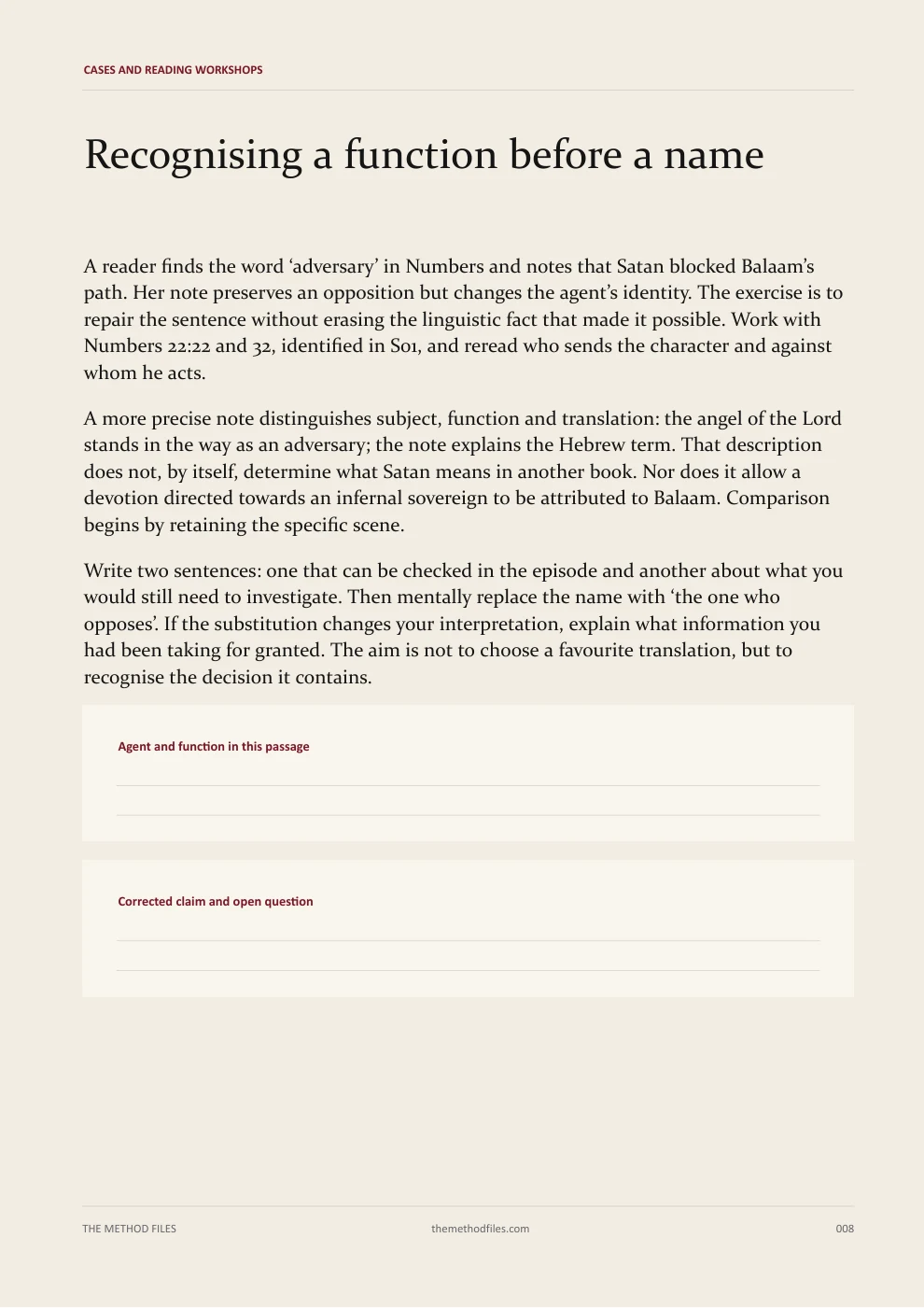
THE METHOD FILES themethodfiles.com 008 CASES AND READING WORKSHOPS Recognising a function before a name A reader finds the word ‘adversary’ in Numbers and notes that Satan blocked Balaam’s path. Her note preserves an opposition but changes the agent’s identity. The exercise is to repair the sentence without erasing the linguistic fact that made it possible. Work with Numbers 22:22 and 32, identified in S01, and reread who sends the character and against whom he acts. A more precise note distinguishes subject, function and translation: the angel of the Lord stands in the way as an adversary; the note explains the Hebrew term. That description does not, by itself, determine what Satan means in another book. Nor does it allow a devotion directed towards an infernal sovereign to be attributed to Balaam. Comparison begins by retaining the specific scene. Write two sentences: one that can be checked in the episode and another about what you would still need to investigate. Then mentally replace the name with ‘the one who opposes’. If the substitution changes your interpretation, explain what information you had been taking for granted. The aim is not to choose a favourite translation, but to recognise the decision it contains. Agent and function in this passage Corrected claim and open questionGreeting the Adversary · page 58 of the book
Read the text on this page
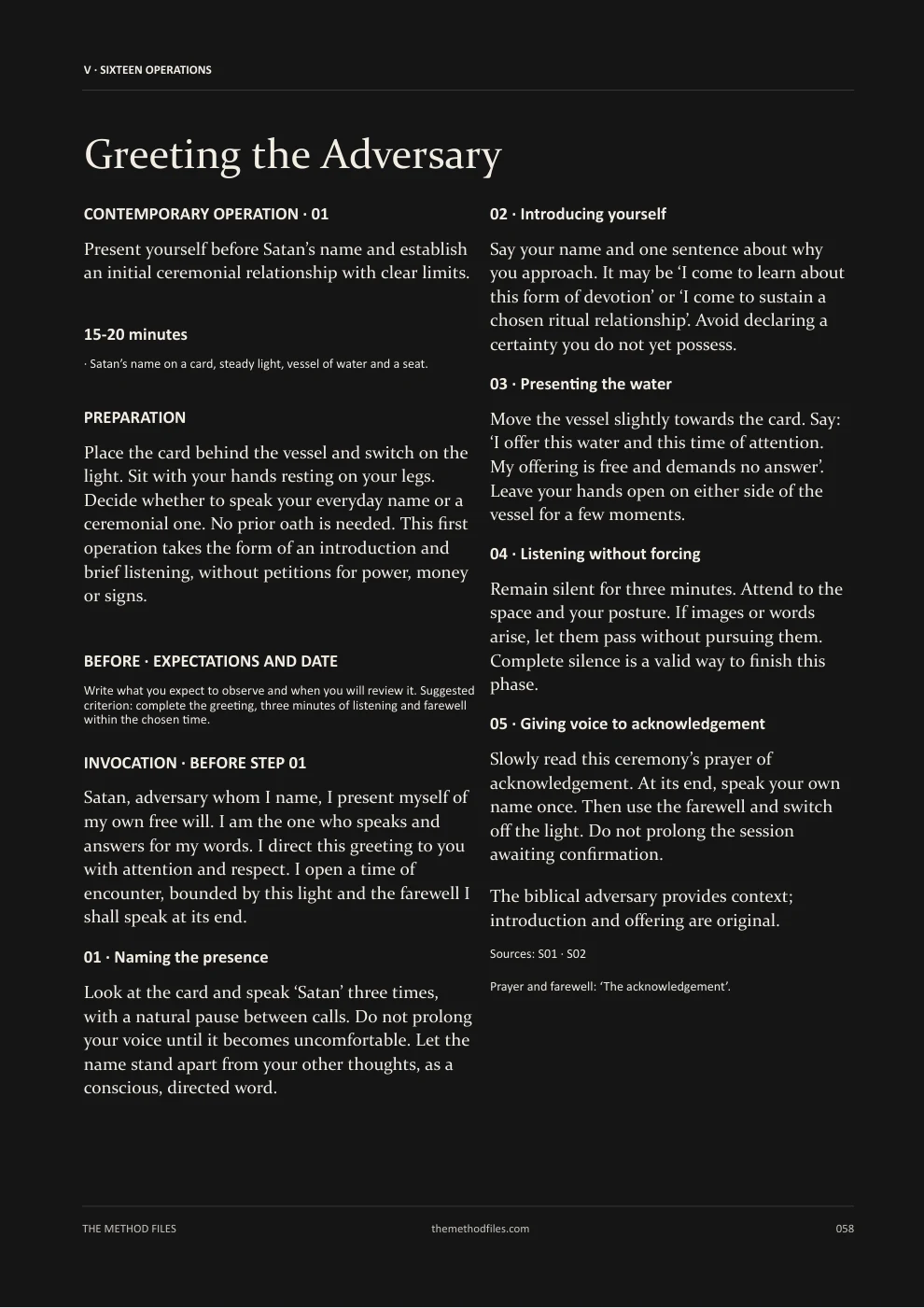
THE METHOD FILES themethodfiles.com 058 V ∙ SIXTEEN OPERATIONS Greeting the Adversary CONTEMPORARY OPERATION ∙ 01 Present yourself before Satan’s name and establish an initial ceremonial relationship with clear limits. 15‐20 minutes ∙ Satan’s name on a card, steady light, vessel of water and a seat. PREPARATION Place the card behind the vessel and switch on the light. Sit with your hands resting on your legs. Decide whether to speak your everyday name or a ceremonial one. No prior oath is needed. This first operation takes the form of an introduction and brief listening, without petitions for power, money or signs. BEFORE ∙ EXPECTATIONS AND DATE Write what you expect to observe and when you will review it. Suggested criterion: complete the greeting, three minutes of listening and farewell within the chosen time. INVOCATION ∙ BEFORE STEP 01 Satan, adversary whom I name, I present myself of my own free will. I am the one who speaks and answers for my words. I direct this greeting to you with attention and respect. I open a time of encounter, bounded by this light and the farewell I shall speak at its end. 01 ∙ Naming the presence Look at the card and speak ‘Satan’ three times, with a natural pause between calls. Do not prolong your voice until it becomes uncomfortable. Let the name stand apart from your other thoughts, as a conscious, directed word. 02 ∙ Introducing yourself Say your name and one sentence about why you approach. It may be ‘I come to learn about this form of devotion’ or ‘I come to sustain a chosen ritual relationship’. Avoid declaring a certainty you do not yet possess. 03 ∙ Presenting the water Move the vessel slightly towards the card. Say: ‘I offer this water and this time of attention. My offering is free and demands no answer’. Leave your hands open on either side of the vessel for a few moments. 04 ∙ Listening without forcing Remain silent for three minutes. Attend to the space and your posture. If images or words arise, let them pass without pursuing them. Complete silence is a valid way to finish this phase. 05 ∙ Giving voice to acknowledgement Slowly read this ceremony’s prayer of acknowledgement. At its end, speak your own name once. Then use the farewell and switch off the light. Do not prolong the session awaiting confirmation. The biblical adversary provides context; introduction and offering are original. Sources: S01 ∙ S02 Prayer and farewell: ‘The acknowledgement’.The acknowledgement · page 59 of the book
Read the text on this page
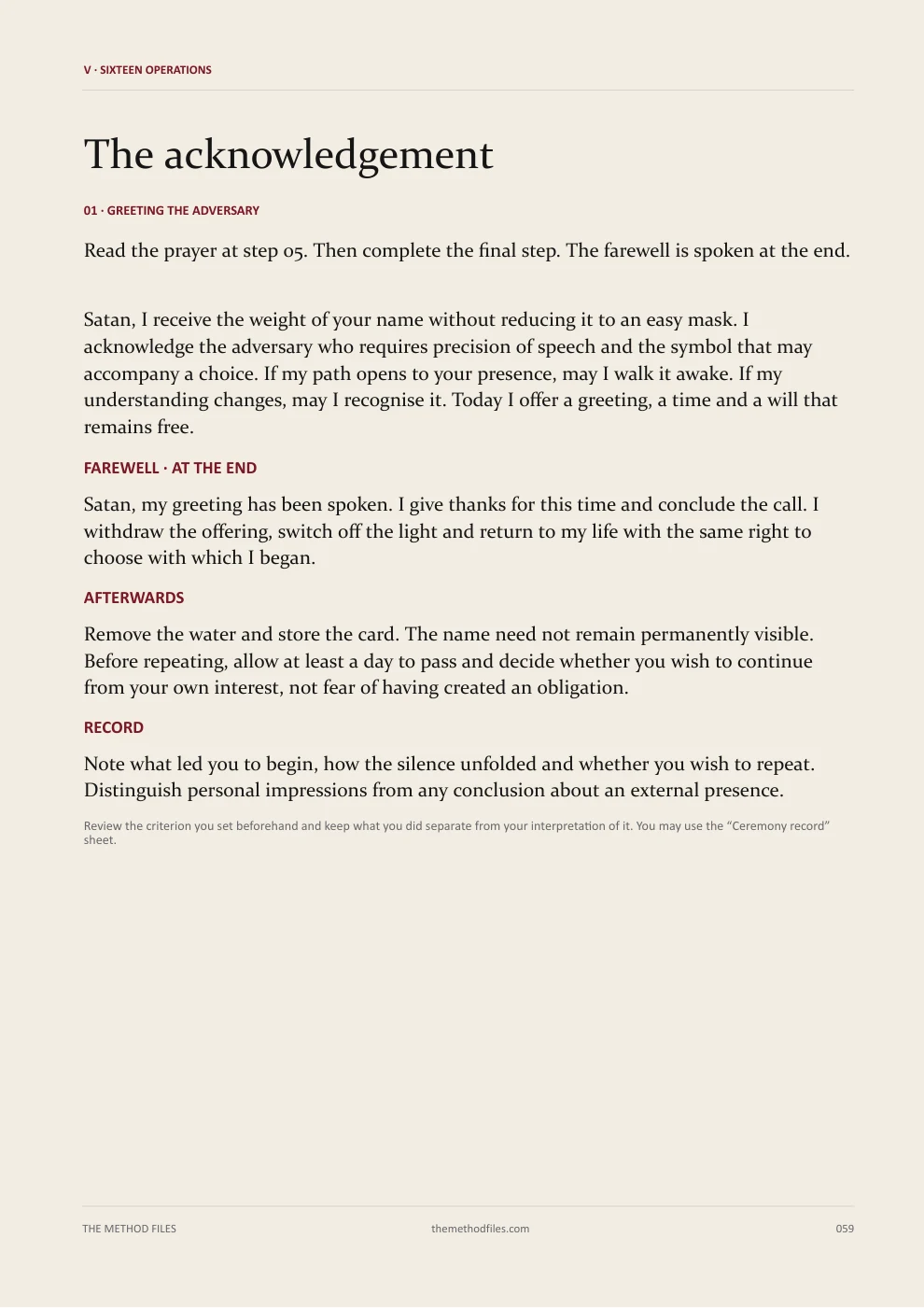
THE METHOD FILES themethodfiles.com 059 V ∙ SIXTEEN OPERATIONS The acknowledgement 01 ∙ GREETING THE ADVERSARY Read the prayer at step 05. Then complete the final step. The farewell is spoken at the end. Satan, I receive the weight of your name without reducing it to an easy mask. I acknowledge the adversary who requires precision of speech and the symbol that may accompany a choice. If my path opens to your presence, may I walk it awake. If my understanding changes, may I recognise it. Today I offer a greeting, a time and a will that remains free. FAREWELL ∙ AT THE END Satan, my greeting has been spoken. I give thanks for this time and conclude the call. I withdraw the offering, switch off the light and return to my life with the same right to choose with which I began. AFTERWARDS Remove the water and store the card. The name need not remain permanently visible. Before repeating, allow at least a day to pass and decide whether you wish to continue from your own interest, not fear of having created an obligation. RECORD Note what led you to begin, how the silence unfolded and whether you wish to repeat. Distinguish personal impressions from any conclusion about an external presence. Review the criterion you set beforehand and keep what you did separate from your interpretation of it. You may use the “Ceremony record” sheet.A first encounter without a promise · page 60 of the book
Read the text on this page
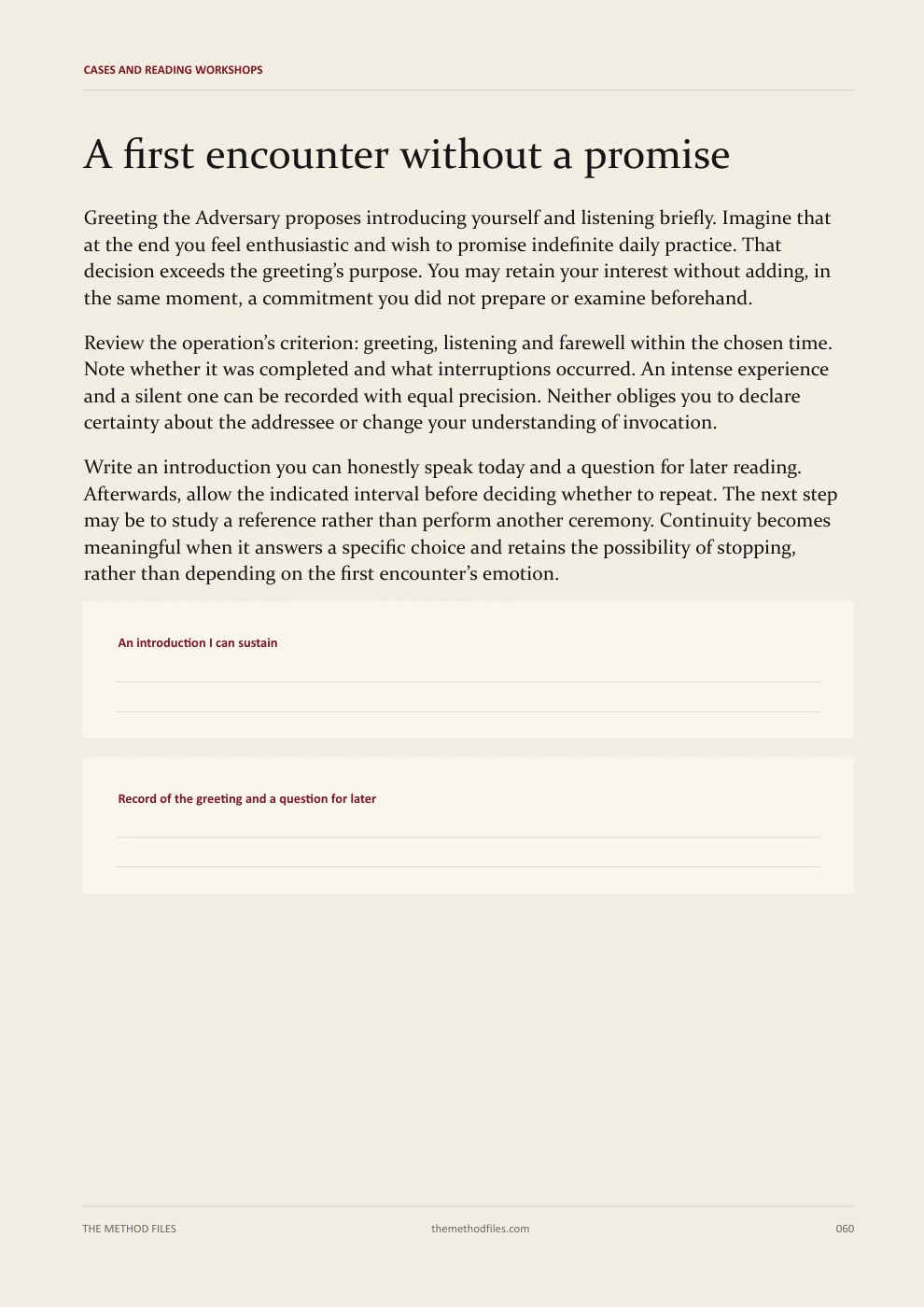
THE METHOD FILES themethodfiles.com 060 CASES AND READING WORKSHOPS A first encounter without a promise Greeting the Adversary proposes introducing yourself and listening briefly. Imagine that at the end you feel enthusiastic and wish to promise indefinite daily practice. That decision exceeds the greeting’s purpose. You may retain your interest without adding, in the same moment, a commitment you did not prepare or examine beforehand. Review the operation’s criterion: greeting, listening and farewell within the chosen time. Note whether it was completed and what interruptions occurred. An intense experience and a silent one can be recorded with equal precision. Neither obliges you to declare certainty about the addressee or change your understanding of invocation. Write an introduction you can honestly speak today and a question for later reading. Afterwards, allow the indicated interval before deciding whether to repeat. The next step may be to study a reference rather than perform another ceremony. Continuity becomes meaningful when it answers a specific choice and retains the possibility of stopping, rather than depending on the first encounter’s emotion. An introduction I can sustain Record of the greeting and a question for laterProvenance of the operations · page 113 of the book
Read the text on this page
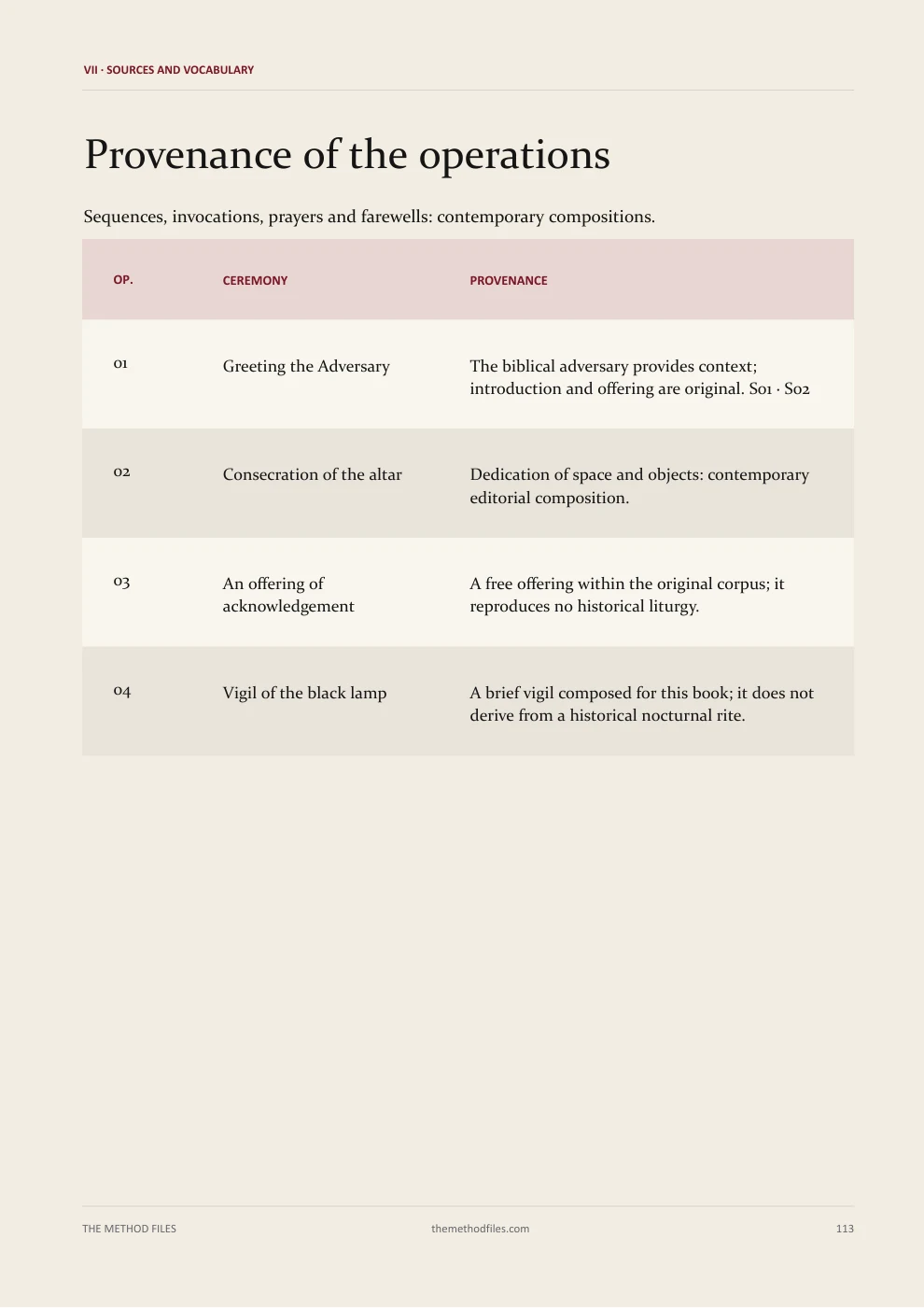
THE METHOD FILES themethodfiles.com 113 OP. 01 02 03 04 VII ∙ SOURCES AND VOCABULARY Provenance of the operations Sequences, invocations, prayers and farewells: contemporary compositions. CEREMONY PROVENANCE Greeting the Adversary The biblical adversary provides context; introduction and offering are original. S01 ∙ S02 Consecration of the altar Dedication of space and objects: contemporary editorial composition. An offering of acknowledgement A free offering within the original corpus; it reproduces no historical liturgy. Vigil of the black lamp A brief vigil composed for this book; it does not derive from a historical nocturnal rite.Biblical texts and Judaism · page 118 of the book
Read the text on this page
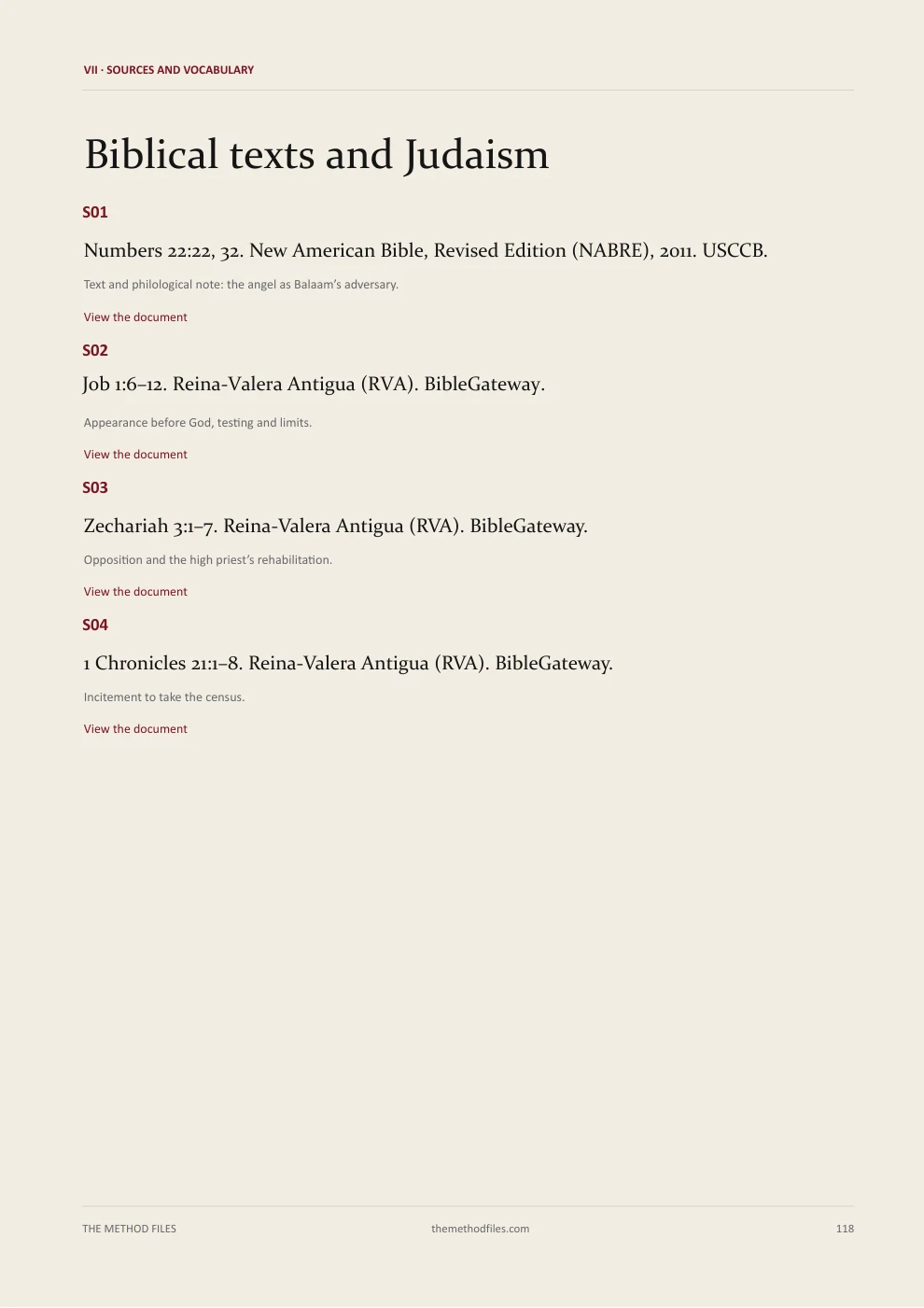
THE METHOD FILES themethodfiles.com 118 S01 S02 Job 1:6–12. Reina-Valera Antigua (RVA). BibleGateway. S03 S04 VII ∙ SOURCES AND VOCABULARY Biblical texts and Judaism Numbers 22:22, 32. New American Bible, Revised Edition (NABRE), 2011. USCCB. Text and philological note: the angel as Balaam’s adversary. View the document Appearance before God, testing and limits. View the document Zechariah 3:1–7. Reina‐Valera Antigua (RVA). BibleGateway. Opposition and the high priest’s rehabilitation. View the document 1 Chronicles 21:1–8. Reina‐Valera Antigua (RVA). BibleGateway. Incitement to take the census. View the documentContinue reading
Read the text on this page
THE METHOD FILES / READING SAMPLE Satan The Adversary and the Will Your reading can continue. The complete book contains 126 pages, reading workshops and 16 contemporary operations, with their sources and references. You can follow the historical journey without performing the practices. If you decide to explore them, you will find contemporary compositions identified as such, with preparation, a central sequence and closing. Digital book in PDF, in English. It does not include tutoring or access to TMF courses. Exercises are completed in a notebook or using the PDF reader’s annotation tools. Explore the complete book themethodfiles.com/libros‐digitales/satanas/ TMF digital books ∙ English ∙ Free sample
Continue whenever you wish