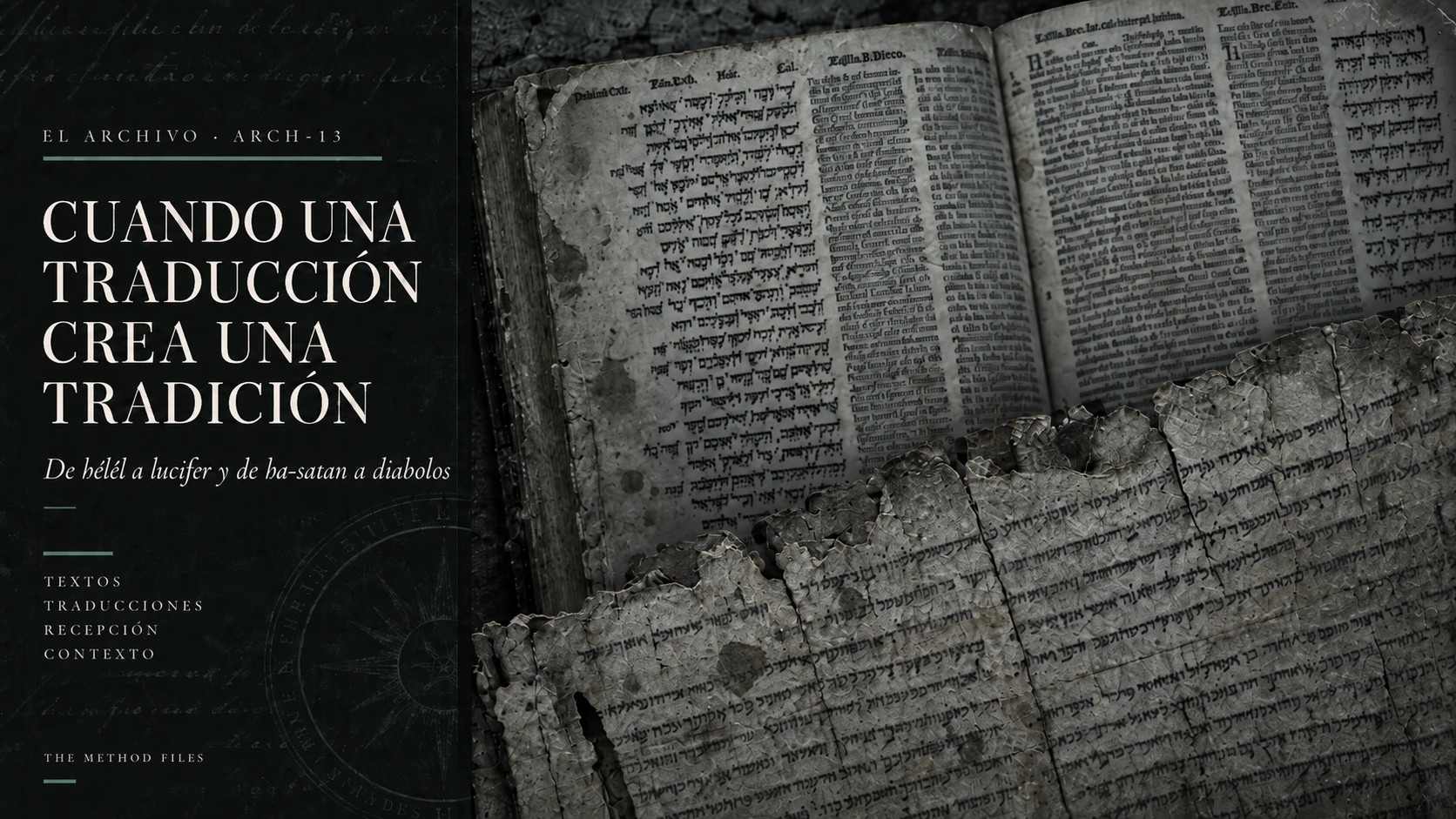
THE ARCHIVE · ARCH-13
WHEN A TRANSLATION CREATES A TRADITION
From hélél to lucifer and from ha-satan to diabolos
THE METHOD FILES
THE ARCHIVE
From hêlēl to lucifer and from ha-satan to diabolos: what changes when a text moves into another language.
A word travels across centuries, changes language and returns to us seeming to have meant the same thing all along. This happens with some of the best-known terms in Western demonology. Lucifer, Satan, demon and Belial seem like stable names, each born already attached to the figure we recognise today. The sources reveal a less comfortable process. Hebrew, Greek and Latin do not always provide neutral equivalents. Every translation selects a possible reading, and that choice may then be repeated by commentators, liturgy, new translations and readers. Over time, a word that once denoted an image, role or category may come to be understood as a proper name or original definition. This article does not argue that translators single-handedly invented the Devil or demons. It investigates something more precise: what can happen when a translation outlives the context that produced it and becomes an active layer of tradition.
THE ARGUMENT
Translation is more than copying a word
A translation does not, by itself, create a doctrine, an entity or centuries of interpretation. But it is not invisible either. It may select an equivalent, reinforce a judgement or establish a verbal image. Repeated over generations, that choice becomes part of how a community reads the text.
We will therefore follow the same sequence throughout this article: original text, translation, exegesis and reception. Skipping a layer produces overly simple explanations. Collapsing them into one produces myths about how texts developed.
CASE I · ISAIAH 14
Before it was a name, lucifer was a word
The most famous case begins in Isaiah 14. The chapter itself introduces the poem as a taunt directed at the king of Babylon. Verse 12 contains the Hebrew expression hêlēl ben-shaḥar, rendered in the modern JPS tradition as ‘Shining One, son of Dawn’. The scene uses the image of a luminous figure associated with dawn who seeks to rise and is brought down.
The Greek translation of Isaiah uses heōsphoros. NETS renders it ‘Day Star’. The astral image continues, although the language changes. In Latin, the tradition preserves lucifer, fili aurorae.
Here lies the point that popular explanations often lose: lucifer was not inherently a diabolical word. Lewis & Short’s historical dictionary records it as ‘light-bringing’ and as a name for the morning star, Venus. The Nova Vulgata itself uses lucifer positively again in 2 Peter 1:19, with the image of light arising in the heart.
The Latin translation therefore did not automatically turn a Hebrew word into the Devil’s personal name. It put an ordinary Latin word into circulation within that passage. The decisive transformation comes later, when Christian readers apply the fall in Isaiah to a power opposing God.
Origen already interprets Isaiah 14 within a discussion of hostile powers and their fall in De Principiis. This places the identification within the history of exegesis. The documentary chain is longer than the formula ‘Lucifer was Satan’s original name’ allows.
WHAT THE SOURCE ACTUALLY SAYS
Hebrew: hêlēl ben-shaḥar within a song against the king of Babylon. Greek: heōsphoros, an astral reformulation. Latin: lucifer, an ordinary word for the morning star. Christian reception: Lucifer can become the designation of a fallen figure.
These layers are related, but not interchangeable. Isaiah need not already contain the whole later Christian biography for that biography to be constructed from the passage afterwards.
CASE II · JOB AND ZECHARIAH
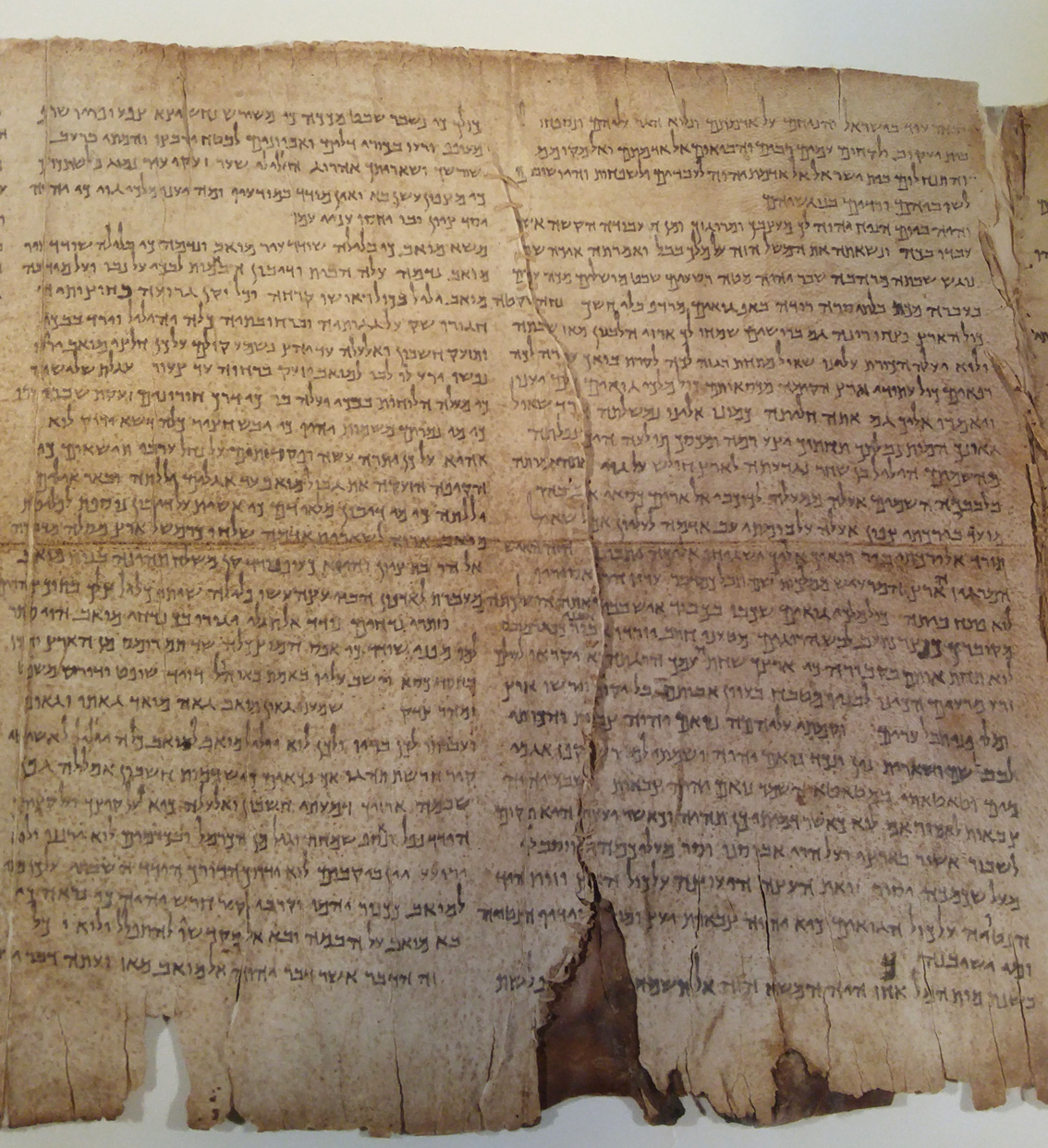
From adversary to diabolos
The second case is less well known but equally important methodologically. Job 1:6 contains ha-satan. The JPS translation renders it ‘the Adversary’ and places him among the divine beings presenting themselves before YHWH. The term functions within a particular scene, not as a complete biography of the later Christian Satan.
The Septuagint uses ho diabolos. NETS translates it as ‘the slanderer’. The semantic field changes: the Hebrew adversary reaches the Greek reader through a word associated with accusation or slander. The Greek version of Zechariah 3 repeats the pattern: the figure standing at the high priest’s right to oppose him is again ‘the slanderer’.
Here too, however, we should pause before constructing a linear history. Numbers 22:22 retains satan in a functional sense: YHWH’s messenger stands in the road as an adversary. The Hebrew term is therefore not confined from the outset to a single proper name.
P. L. Day’s research examines precisely these heavenly uses of satan in Numbers, Job, Zechariah and 1 Chronicles. Thomas J. Farrar adds a crucial qualification: there was no standard, uniform Jewish satanology during the Second Temple period, and ‘Satan’ is not clearly attested as a personal name before the New Testament.
This prevents us from telling the story as a straight line: Hebrew adversary → Greek translation → Christian Devil. Between those points lie plural traditions, different adversarial figures, shifts in terminology and later processes of consolidation.
WHAT TRANSLATION CAN DO
Using diabolos may reinforce the profile of accuser or slanderer for a Greek reader. That choice matters. What cannot be demonstrated is that the Septuagint ‘invented the Devil’ in a single act of translation.
CASE III · PSALM 96
When ‘idols’ becomes ‘demons’
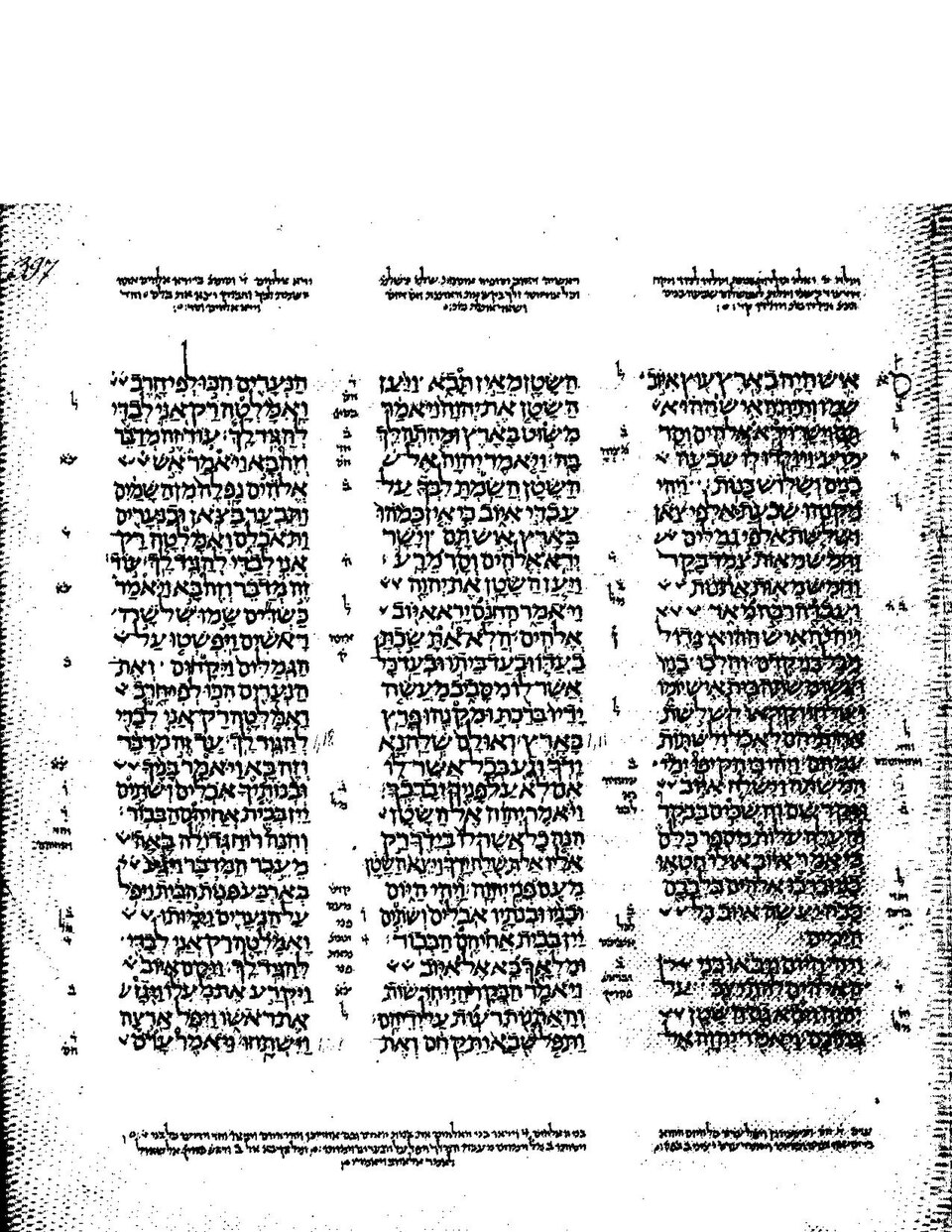
The third case offers the clearest lexical contrast in this article. The Hebrew Psalm 96:5 uses elilim. JPS renders it ‘mere idols’: the gods of the peoples are idols.
Psalm 95(96):5 in the Septuagint says something different. NETS translates it as ‘all the gods of the nations are demons’. Where the Hebrew reading offers idols, the Greek offers daimones.
Here we can speak of a visible semantic shift produced by translation. A category expressed as idols in the Hebrew text appears in Greek through vocabulary that later readers can understand in terms of demons.
Yet even this example does not justify an all-encompassing theory. Deuteronomy 32:17 already contains shedim in the Hebrew tradition. Not all the demons of the Septuagint therefore arise from translating another category as daimones. Greek Isaiah itself also uses the vocabulary of daimones in other contexts that must be studied within that translator’s particular technique.
Annette Yoshiko Reed has identified precisely the problem of treating all the daimones in the Septuagint as though they formed a single intermediate stage towards New Testament demonology. Her approach requires us to distinguish dates, books and translation tendencies, and compare them with contemporary Hebrew and Aramaic material.
This check changes the conclusion. The translation of Psalm 96 may demonise a particular category lexically. It does not demonstrate that all Greek translators shared one demonology, or that later Christian demonology arose solely from those choices.
A CONTROL CASE · BELIAL
Translation does not explain everything
Belial prevents this article’s argument from becoming another oversimplification. If every later figure could be explained by one translated word, Belial should offer a neat chain. He does not.
The Hebrew beliyya‘al and its constructions receive different treatments in Greek translation. Andrés Piquer Otero has studied these variants, noting, for example, the use of loimos in Samuel. The later tradition, however, arrives at forms such as Belial or Beliar associated with a personified figure.
The Encyclopedia of Ancient History summarises this dual history: the Hebrew term relates to ideas of wickedness or worthlessness, while later personification develops Belial into a leader of the forces of darkness outside the Hebrew Bible. The Nova Vulgata preserves Beliar in 2 Corinthians 6:15, in the opposition between Christ and Beliar.
Qumran, the pseudepigrapha and later reception are part of that transformation. Reducing it to ‘a translation turned a word into a demon’ would repeat the very mistake this article seeks to correct.
For a detailed study of Belial, see ‘Belial: when a word became a king’. Here he demonstrates the limit of a linguistic explanation: translation can participate in a tradition without being its sole cause.
THE MECHANISM
Four layers we must not confuse
The three main cases, checked against Belial, allow us to establish a simple method for reading these problems.
1 · TEXT. Which word appears in the witness we are reading, and what is its immediate context?
2 · TRANSLATION. Which equivalent did the translator choose, and what nuance does it introduce or leave out?
3 · EXEGESIS. How did commentators and communities subsequently interpret that choice?
4 · RECEPTION. What came to seem original after centuries of repetition?
Translation is an active layer because it can open some possibilities of reading and close others. Exegesis and reception, however, determine which possibilities become the dominant tradition.
MYTH VS SOURCE
‘A mistranslation invented the demon’
This phrase appeals because it compresses centuries of history into a single cause. It also falls far short of what the sources show.
Jerome did not ‘invent Lucifer’ simply by using a Latin word. Isaiah did not explicitly call Satan Lucifer. The Septuagint did not create the Devil through a single translation of ha-satan. Nor do all the daimones in Greek translations constitute a uniform demonological doctrine.
What we can demonstrate is more interesting: some translations chose words that subsequently proved extraordinarily fertile. Lucifer could denote a star and end up functioning as a name. Diabolos could characterise the adversary through the language of accusation. Daimones could replace ‘idols’ in a psalm and enable new readings.
The mistake is not studying these shifts. It is treating them as sole causes and moving backwards from later tradition to the ancient text as though everything had been there from the start.
ARCHIVE CONNECTIONS
Following words beyond their translation
LUCIFER BEFORE HE BECAME THE DEVIL
‘Lucifer before he became the Devil’ traces the history of Lucifer as a figure. This article adds the linguistic mechanism: hêlēl, heōsphoros and lucifer are not three equivalent proper names from the outset.
SATAN WAS NOT ALWAYS “SATAN”
Follow the path from ha-satan and diabolos to the later formation of Satan without imposing a uniform development on every text.
BELIAL: WHEN A WORD BECAME A KING
Belial shows the limits of the argument: translation, personification and reception can interact without being reducible to a single lexical choice.
FROM THE PSEUDOMONARCHIA TO THE GOETIA: THE LIST CHANGED
The same principle applies at another level: copying, translating and transmitting are not neutral operations. A text can change while appearing to remain the same.
CONCLUSION
A word can outlive its own context
When a translation succeeds, it can become invisible. The reader no longer sees the translator’s decision: they see a word that appears always to have been there.
This happened in different ways with lucifer, diabolos and daimones. None of these cases demonstrates that a translator invented an entity or doctrine single-handedly. They demonstrate something more precise: a translated word can provide material for new readings, which can become so established that they seem original.
THE ARCHIVE therefore asks more than ‘what does this word mean?’. It also asks: in which language, in which text, who translated it, what interpretation followed, and which part of that interpretation are we projecting backwards?
The method has four stages: original, translation, commentary and reception. Keeping that order means Lucifer ceases automatically to be Satan’s primordial name, ha-satan ceases to seem a fixed identity from the outset, and the daimones in the Septuagint cease to form a uniform army that never existed as such.
A translation can create tradition. Only the full history, however, tells us which part it created, which it inherited and which was added by its later readers.
CONTINUE
Following words through each figure’s history
To follow these linguistic transformations in particular figures, explore the articles on Lucifer, Satan and Belial. The Public Editions then offer a route into each volume of the collection.
The Public Edition offers further reading; the Illustrated Editions then expand each volume’s documentary, visual and practical context. This article ends here because its purpose is to explain how a reading is constructed, not to replace the articles on individual figures.
FURTHER READING
From the translated name to the collection
Continue with the documentary articles on Lucifer, Satan and Belial. The Public Editions then introduce the collection, and the Library brings the illustrated volumes together.
LESSONS AND SOURCES
Translation leaves documentary traces too
This article compares linguistic layers and reception without conflating the source text, translation, exegesis and later tradition. Studies offers a method for reading these mediations as part of transmission, rather than as automatic equivalences.
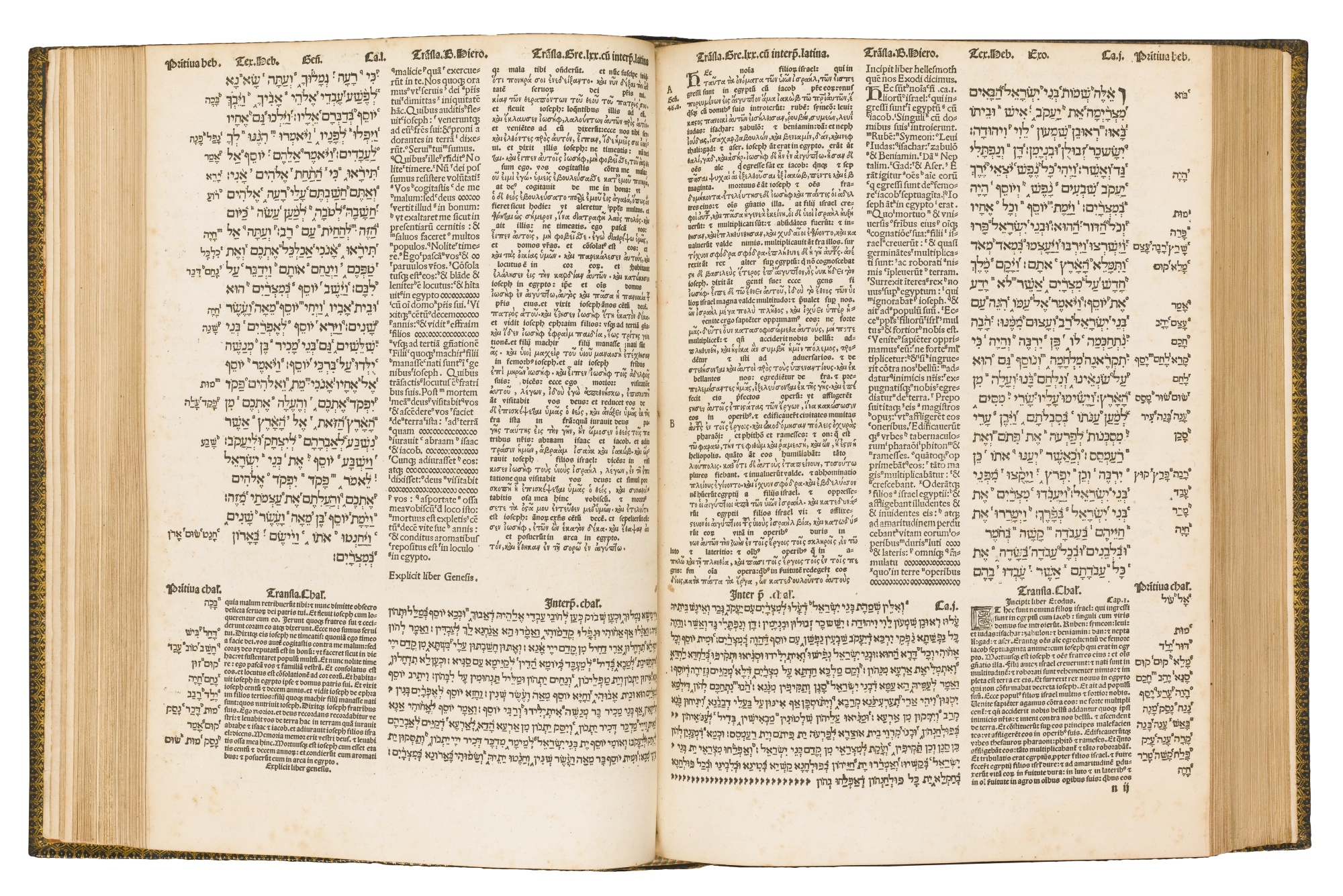
- MANUSCRIPTS, EDITIONS AND TRANSMISSION: distinguish witness, edition, translation and reproduction before comparing readings.
- WHAT A SOURCE CAN ACTUALLY ESTABLISH: state what a variant can demonstrate and what it does not allow us to extrapolate.
- TRADITION, INTERPRETATION AND CONTEMPORARY PRACTICE: distinguish historical documentation, later reception and modern interpretation.
The final bibliography allows you to check the biblical passages, translations and studies cited. For each reference, distinguish the source text, the translation consulted and the study proposing an interpretation.
SOURCES CONSULTED
Texts and studies used
- Isaiah 14:12 · Sefaria / JPS: Hebrew hêlēl ben-shaḥar and the modern translation ‘Shining One, son of Dawn’.
- Isaiah 14 · NETS: Greek version and the translation ‘Day Star’; a reference for the Isaiah translator’s technique.
- Nova Vulgata · Isaiah 14:12: Latin tradition ‘lucifer, fili aurorae’.
- Lewis & Short · lucifer: Historical dictionary for the Latin meaning of lucifer as light-bringer / morning star.
- Nova Vulgata · 2 Peter 1:19: Positive use of lucifer in the Latin New Testament.
- Origen · De Principiis I: Early Christian reception of Isaiah 14 within an account of fallen and opposing powers.
- Matthew J. Albanese · Translation Technique and Literary Structures in Greek Isaiah 13:1–14:23: Academic study specifically addressing the Isaiah passage used in this article.
- Job 1:6 · Sefaria / JPS: ha-satan translated as ‘the Adversary’.
- Job · NETS: ho diabolos and the translation ‘the slanderer’.
- P. L. Day · An Adversary in Heaven: Study of heavenly uses of satan in the Hebrew Bible.
- Thomas J. Farrar · New Testament Satanology…: Scholarly qualification of a linear, uniform account of the development of satanology.
- Psalm 96:5 · Sefaria / JPS: Hebrew elilim and the translation ‘mere idols’.
- Psalms · NETS: Psalm 95(96):5: ‘all the gods of the nations are demons’.
- Annette Yoshiko Reed · When did Daimones become Demons?: Methodological caution against treating all the daimones in the Septuagint as one proto-Christian stage.
- Andrés Piquer Otero · Notas filológicas sobre los hijos de Belial y la Septuaginta: Study of Greek renderings of beliyya‘al.
- Guinevere T. Woolstenhulme · Belial/Beliar: Reference work on the Hebrew term and later personification.
- Nova Vulgata · 2 Corinthians 6:15: Preserves the form Beliar in the contrast with Christ.
Source records
Explore the references, their limitations and their uses in other readings. The article’s full bibliography is retained in the text above.
Isaiah 14:12 · Sefaria / JPS ↗Isaiah 14 · NETS ↗Nova Vulgata — Isaiah 14 ↗Lewis and Short — lucifer ↗Nova Vulgata — 2 Peter 1:19 ↗De Principiis ↗Matthew J. Albanese · Translation Technique and Literary Structures in Greek Isaiah 13:1–14:23 ↗Job 1:6 · Sefaria / JPS ↗Job · NETS ↗P. L. Day · An Adversary in Heaven ↗Thomas J. Farrar · New Testament Satanology… ↗Psalm 96:5 · Sefaria / JPS ↗Psalms · NETS ↗Annette Yoshiko Reed · When did Daimones become Demons? ↗Andrés Piquer Otero · Notas filológicas sobre los hijos de Belial y la Septuaginta ↗Guinevere T. Woolstenhulme · Belial/Beliar ↗2 Corinthians 6:15 ↗Study this subject further
These related lessons let you explore the article’s questions through activities and study resources.
Cite this article
Published in The Method Files’ Archive.
WHEN A TRANSLATION CREATES A TRADITION. The Archive · The Method Files. https://themethodfiles.com/en/studies/archive/when-a-translation-creates-a-tradition/
Include your access date; the copy button adds it automatically. To cite a historical source, use its own reference in the article’s bibliography.
Explore the six free lessons · Explore the Studies programme