Read before you choose
Belial
The Throne and Disobedience
This 12-page sample includes an introduction, a historical passage, a workshop, one complete practice and references. It retains the original book’s page numbers: the gaps reflect the selection.
Download PDF · 5.8 MBNo registration · Selectable text in the PDF
Cover

Read the text on this page
themethodfiles.com THE METHOD FILES BELIAL The Throne and Disobedience HISTORY ∙ SYMBOLS ∙ FOURTEEN OPERATIONSAbout this reading sample
Read the text on this page
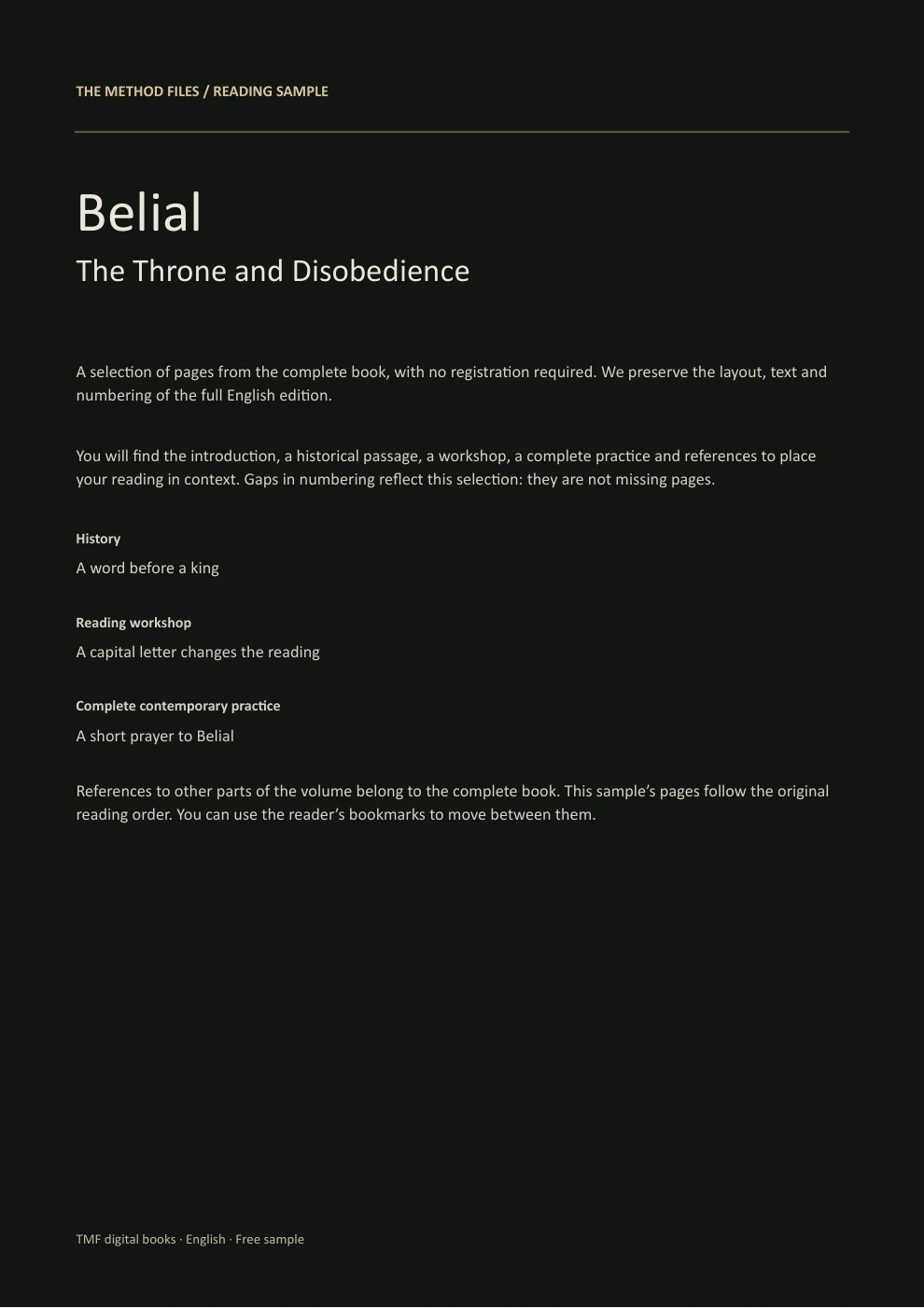
THE METHOD FILES / READING SAMPLE Belial The Throne and Disobedience A selection of pages from the complete book, with no registration required. We preserve the layout, text and numbering of the full English edition. You will find the introduction, a historical passage, a workshop, a complete practice and references to place your reading in context. Gaps in numbering reflect this selection: they are not missing pages. History A word before a king Reading workshop A capital letter changes the reading Complete contemporary practice A short prayer to Belial References to other parts of the volume belong to the complete book. This sample’s pages follow the original reading order. You can use the reader’s bookmarks to move between them. TMF digital books ∙ English ∙ Free sampleAbout this book · page 6 of the book
Read the text on this page
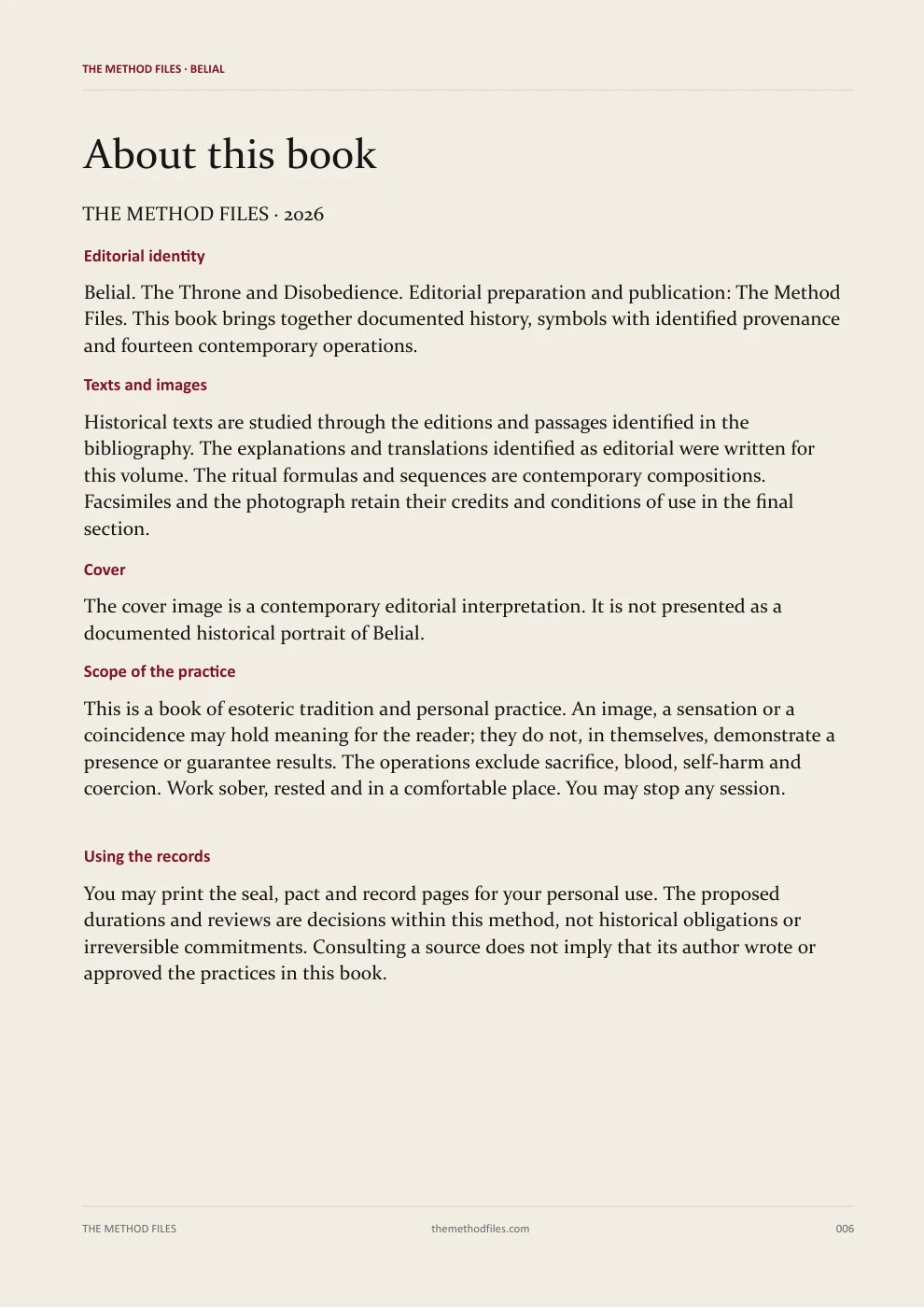
THE METHOD FILES · BELIAL THE METHOD FILES themethodfiles.com 006 THE METHOD FILES · 2026 About this book Editorial identity Belial. The Throne and Disobedience. Editorial preparation and publication: The Method Files. This book brings together documented history, symbols with identified provenance and fourteen contemporary operations. Texts and images Historical texts are studied through the editions and passages identified in the bibliography. The explanations and translations identified as editorial were written for this volume. The ritual formulas and sequences are contemporary compositions. Facsimiles and the photograph retain their credits and conditions of use in the final section. Cover The cover image is a contemporary editorial interpretation. It is not presented as a documented historical portrait of Belial. Scope of the practice This is a book of esoteric tradition and personal practice. An image, a sensation or a coincidence may hold meaning for the reader; they do not, in themselves, demonstrate a presence or guarantee results. The operations exclude sacrifice, blood, self‐harm and coercion. Work sober, rested and in a comfortable place. You may stop any session. Using the records You may print the seal, pact and record pages for your personal use. The proposed durations and reviews are decisions within this method, not historical obligations or irreversible commitments. Consulting a source does not imply that its author wrote or approved the practices in this book.A word before a king · page 9 of the book
Read the text on this page
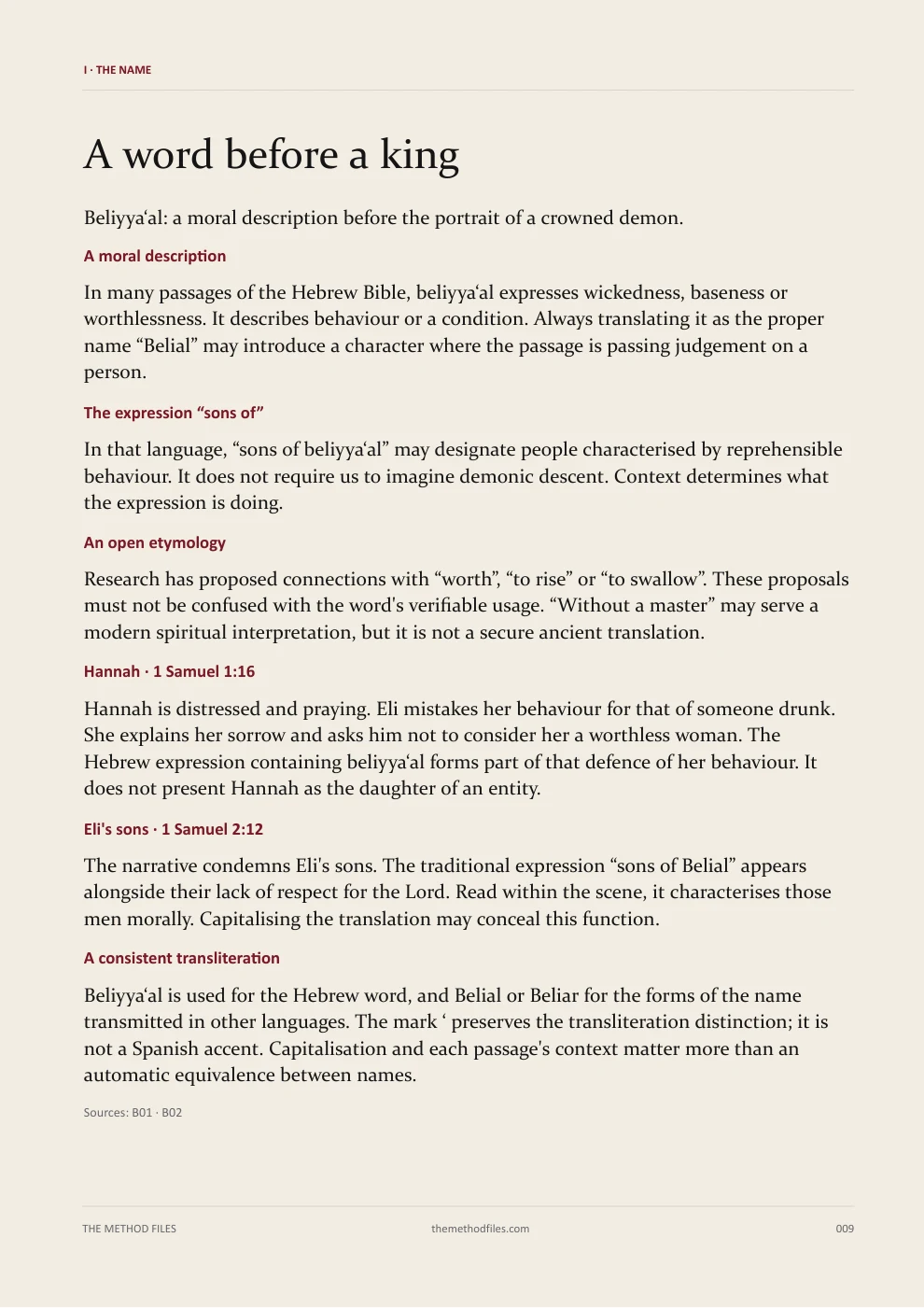
THE METHOD FILES themethodfiles.com 009 I ∙ THE NAME A word before a king Beliyya‘al: a moral description before the portrait of a crowned demon. A moral description In many passages of the Hebrew Bible, beliyya‘al expresses wickedness, baseness or worthlessness. It describes behaviour or a condition. Always translating it as the proper name “Belial” may introduce a character where the passage is passing judgement on a person. The expression “sons of” In that language, “sons of beliyya‘al” may designate people characterised by reprehensible behaviour. It does not require us to imagine demonic descent. Context determines what the expression is doing. An open etymology Research has proposed connections with “worth”, “to rise” or “to swallow”. These proposals must not be confused with the word's verifiable usage. “Without a master” may serve a modern spiritual interpretation, but it is not a secure ancient translation. Hannah ∙ 1 Samuel 1:16 Hannah is distressed and praying. Eli mistakes her behaviour for that of someone drunk. She explains her sorrow and asks him not to consider her a worthless woman. The Hebrew expression containing beliyya‘al forms part of that defence of her behaviour. It does not present Hannah as the daughter of an entity. Eli's sons ∙ 1 Samuel 2:12 The narrative condemns Eli's sons. The traditional expression “sons of Belial” appears alongside their lack of respect for the Lord. Read within the scene, it characterises those men morally. Capitalising the translation may conceal this function. A consistent transliteration Beliyya‘al is used for the Hebrew word, and Belial or Beliar for the forms of the name transmitted in other languages. The mark ‘ preserves the transliteration distinction; it is not a Spanish accent. Capitalisation and each passage's context matter more than an automatic equivalence between names. Sources: B01 ∙ B02A capital letter changes the reading · page 10 of the book
Read the text on this page
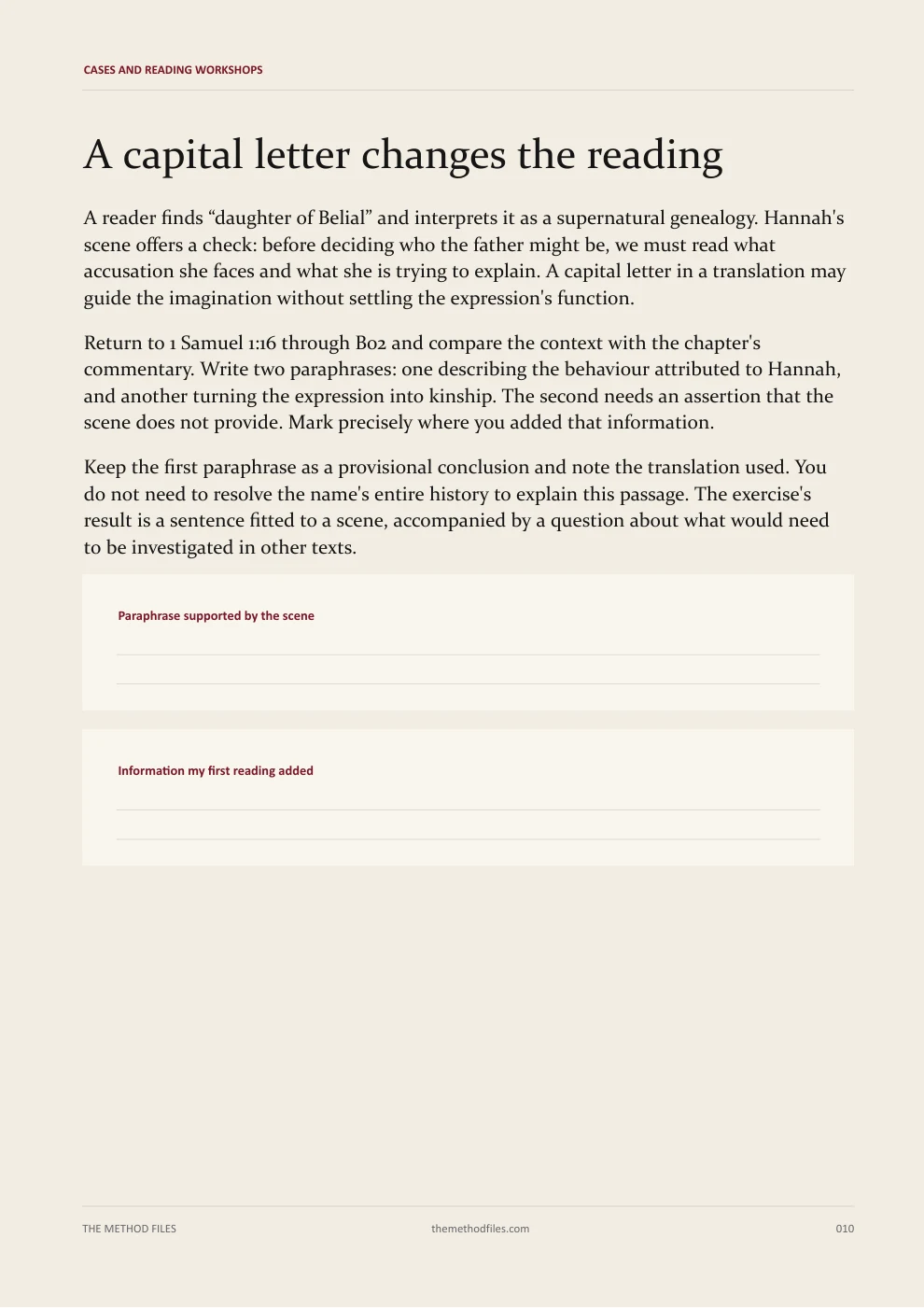
THE METHOD FILES themethodfiles.com 010 CASES AND READING WORKSHOPS A capital letter changes the reading A reader finds “daughter of Belial” and interprets it as a supernatural genealogy. Hannah's scene offers a check: before deciding who the father might be, we must read what accusation she faces and what she is trying to explain. A capital letter in a translation may guide the imagination without settling the expression's function. Return to 1 Samuel 1:16 through B02 and compare the context with the chapter's commentary. Write two paraphrases: one describing the behaviour attributed to Hannah, and another turning the expression into kinship. The second needs an assertion that the scene does not provide. Mark precisely where you added that information. Keep the first paraphrase as a provisional conclusion and note the translation used. You do not need to resolve the name's entire history to explain this passage. The exercise's result is a sentence fitted to a scene, accompanied by a question about what would need to be investigated in other texts. Paraphrase supported by the scene Information my first reading addedA short prayer to Belial · page 66 of the book

Read the text on this page
THE METHOD FILES themethodfiles.com 066 V ∙ RITUAL CORPUS A short prayer to Belial CONTEMPORARY OPERATION ∙ 02 Dedicating a prayer for steadiness to Belial, without an extensive ceremony. 5 minutes ∙ Electric candle or fixed light, notebook and pen; a flame candle as a variant. Keep enough light to read. If using a flame, keep it separate from paper in a stable holder. Choose a specific need you can accompany with an action. 01 ∙ Formulate the need Before lighting the candle, write one sentence: “I need steadiness to…”. Choose an everyday task, not control over a person. Keep the notebook separate from the holder. 02 ∙ Light Switch on the electric candle or chosen light. If using a flame candle, check its stability and keep your face and hands away. The light accompanies the prayer; no object is burned. 03 ∙ Direct the prayer Read the original formula on the next page. When you reach the space for the request, say your sentence slowly. Do not add commitments you have not considered beforehand. 04 ∙ Keep silence Remain silent for one minute. You can look at the table instead of fixing your eyes on the flame. Recognise the specific effort your request needs and choose a first step. 05 ∙ Give thanks and conclude Give thanks in your own words and say the closing words. If you used a flame candle, wait for the holder to cool before moving it. The words, farewell and record follow. Read both parts before you begin.A short prayer to Belial · Words and closing · page 67 of the book

Read the text on this page
THE METHOD FILES themethodfiles.com 067 V ∙ RITUAL CORPUS A short prayer to Belial ∙ Words and closing EDITORIAL FORMULA ∙ READ AT STEP 03 “Belial, whom this tradition links with Earth, I direct my words towards steadiness. May my attention find a foundation and my effort a direction. I ask for clarity for [request]. Whatever I decide to sustain, I will accompany with my actions.” CLOSING “I have expressed my request. I bring this prayer to an end and return to what I can do.” Switch off the chosen light. If you used a flame, confirm that the wick is extinguished before clearing away. RECORD Note the request and the first step you chose. The next day, record whether you carried it out. Do not interpret a flame's movement, a draught or the consumption of wax as an obligation. Inspired by Connolly's short prayer, p. 64; words and timings are our own. Sources: B20 Specific request First step and next‐day checkSteadiness for a small action · page 68 of the book

Read the text on this page
THE METHOD FILES themethodfiles.com 068 CASES AND READING WORKSHOPS Steadiness for a small action A prayer asks for steadiness, but the person has not chosen where to exercise it. The term can sound convincing while remaining too broad. To give it a practical form, connect it with an everyday task you can perform without controlling others. Describe a short action you have been postponing: organising a folder, writing a question or reserving reading time. Write down when you will do it and which likely obstacle you can reduce. Prayer may accompany that decision; it does not replace the preparation needed to carry it out. The next day, record whether you carried out the step and what happened. If you did not, avoid enlarging the promise to compensate for disappointment. Review the task's size, the chosen time and the obstacle. A request for steadiness may translate into honest simplification. The record must preserve both the completed action and the attempt needing different organisation. Action, time and obstacle Outcome and adjustment of the taskProvenance of the operations · page 117 of the book
Read the text on this page
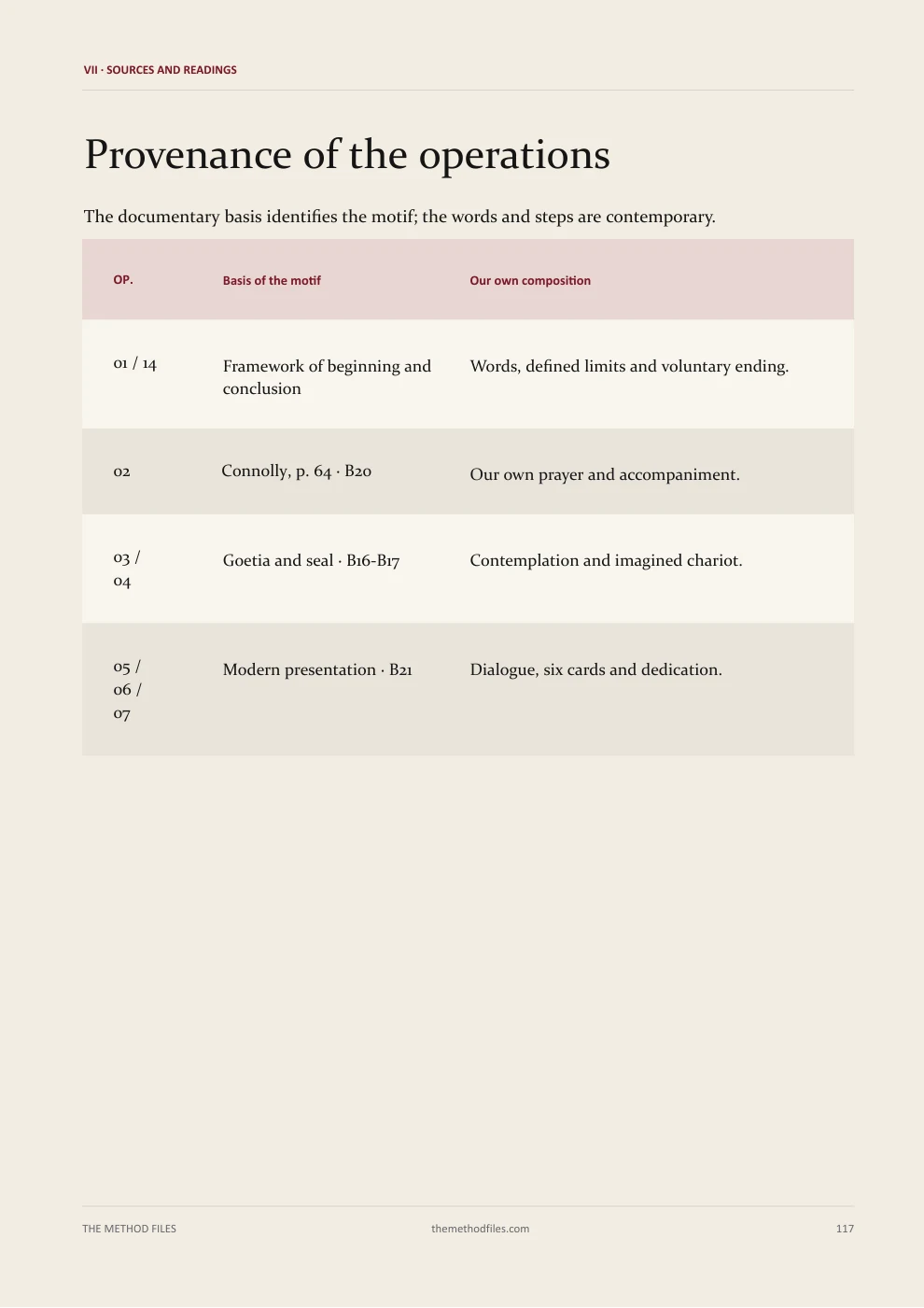
THE METHOD FILES themethodfiles.com 117 OP. 01 / 14 02 Connolly, p. 64 · B20 03 / 04 05 / 06 / 07 VII ∙ SOURCES AND READINGS Provenance of the operations The documentary basis identifies the motif; the words and steps are contemporary. Basis of the motif Our own composition Framework of beginning and conclusion Words, defined limits and voluntary ending. Our own prayer and accompaniment. Goetia and seal ∙ B16‐B17 Contemplation and imagined chariot. Modern presentation ∙ B21 Dialogue, six cards and dedication.Texts and ancient context · page 120 of the book
Read the text on this page
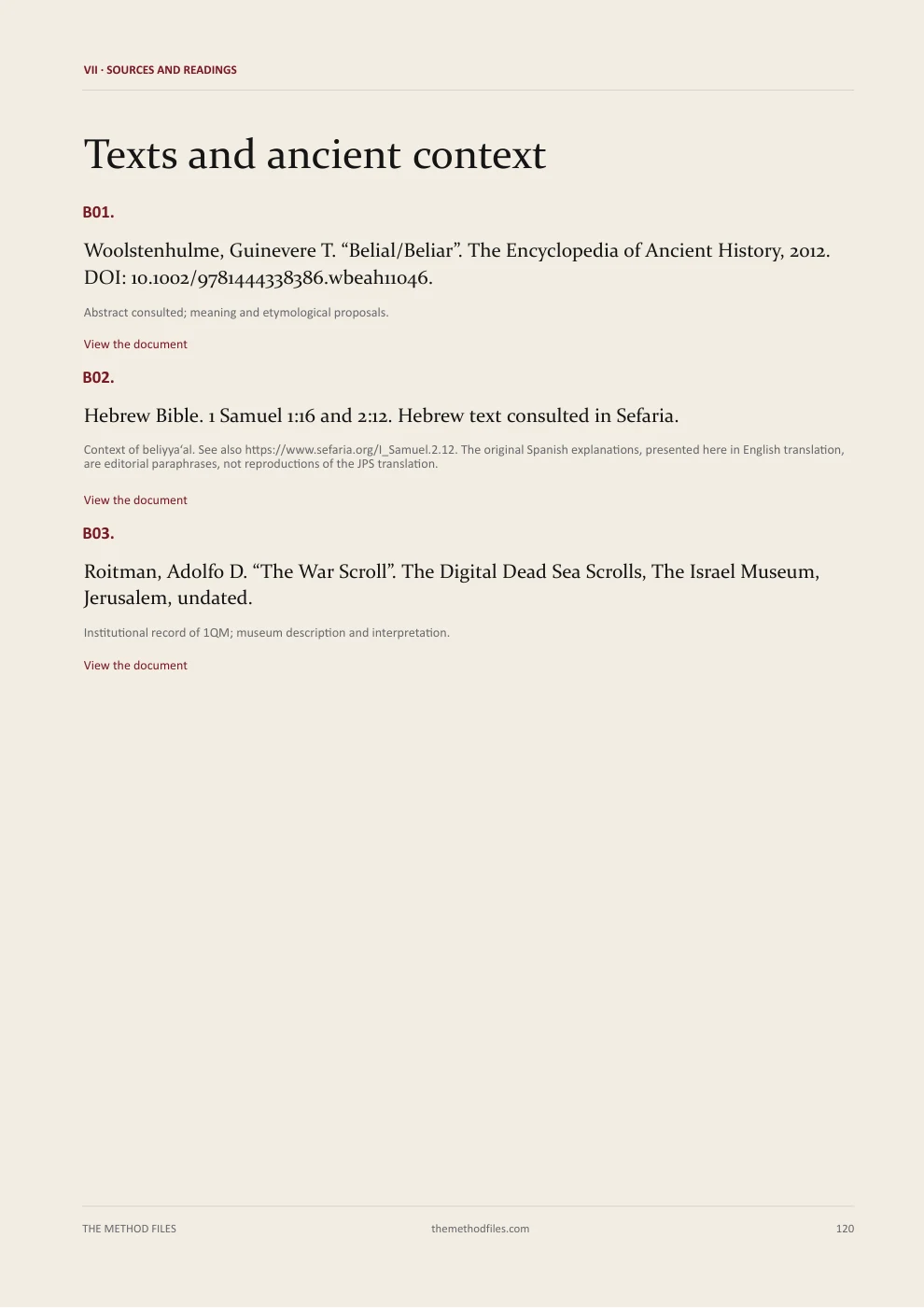
THE METHOD FILES themethodfiles.com 120 B01. B02. B03. VII ∙ SOURCES AND READINGS Texts and ancient context Woolstenhulme, Guinevere T. “Belial/Beliar”. The Encyclopedia of Ancient History, 2012. DOI: 10.1002/9781444338386.wbeah11046. Abstract consulted; meaning and etymological proposals. View the document Hebrew Bible. 1 Samuel 1:16 and 2:12. Hebrew text consulted in Sefaria. Context of beliyya‘al. See also https://www.sefaria.org/I_Samuel.2.12. The original Spanish explanations, presented here in English translation, are editorial paraphrases, not reproductions of the JPS translation. View the document Roitman, Adolfo D. “The War Scroll”. The Digital Dead Sea Scrolls, The Israel Museum, Jerusalem, undated. Institutional record of 1QM; museum description and interpretation. View the documentIconography and modern reception · page 126 of the book
Read the text on this page
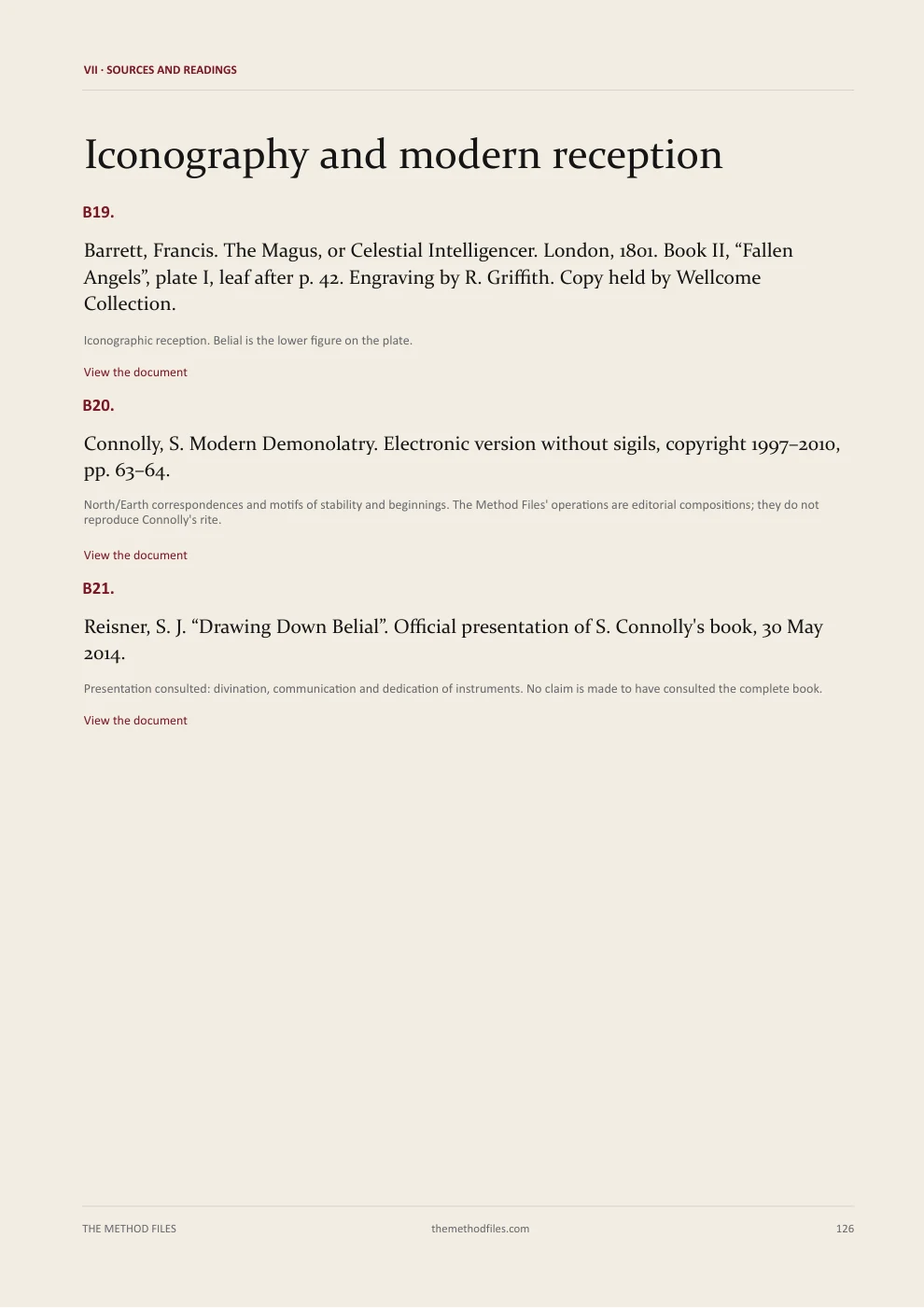
THE METHOD FILES themethodfiles.com 126 B19. B20. B21. VII ∙ SOURCES AND READINGS Iconography and modern reception Barrett, Francis. The Magus, or Celestial Intelligencer. London, 1801. Book II, “Fallen Angels”, plate I, leaf after p. 42. Engraving by R. Griffith. Copy held by Wellcome Collection. Iconographic reception. Belial is the lower figure on the plate. View the document Connolly, S. Modern Demonolatry. Electronic version without sigils, copyright 1997–2010, pp. 63–64. North/Earth correspondences and motifs of stability and beginnings. The Method Files' operations are editorial compositions; they do not reproduce Connolly's rite. View the document Reisner, S. J. “Drawing Down Belial”. Official presentation of S. Connolly's book, 30 May 2014. Presentation consulted: divination, communication and dedication of instruments. No claim is made to have consulted the complete book. View the documentContinue reading
Read the text on this page
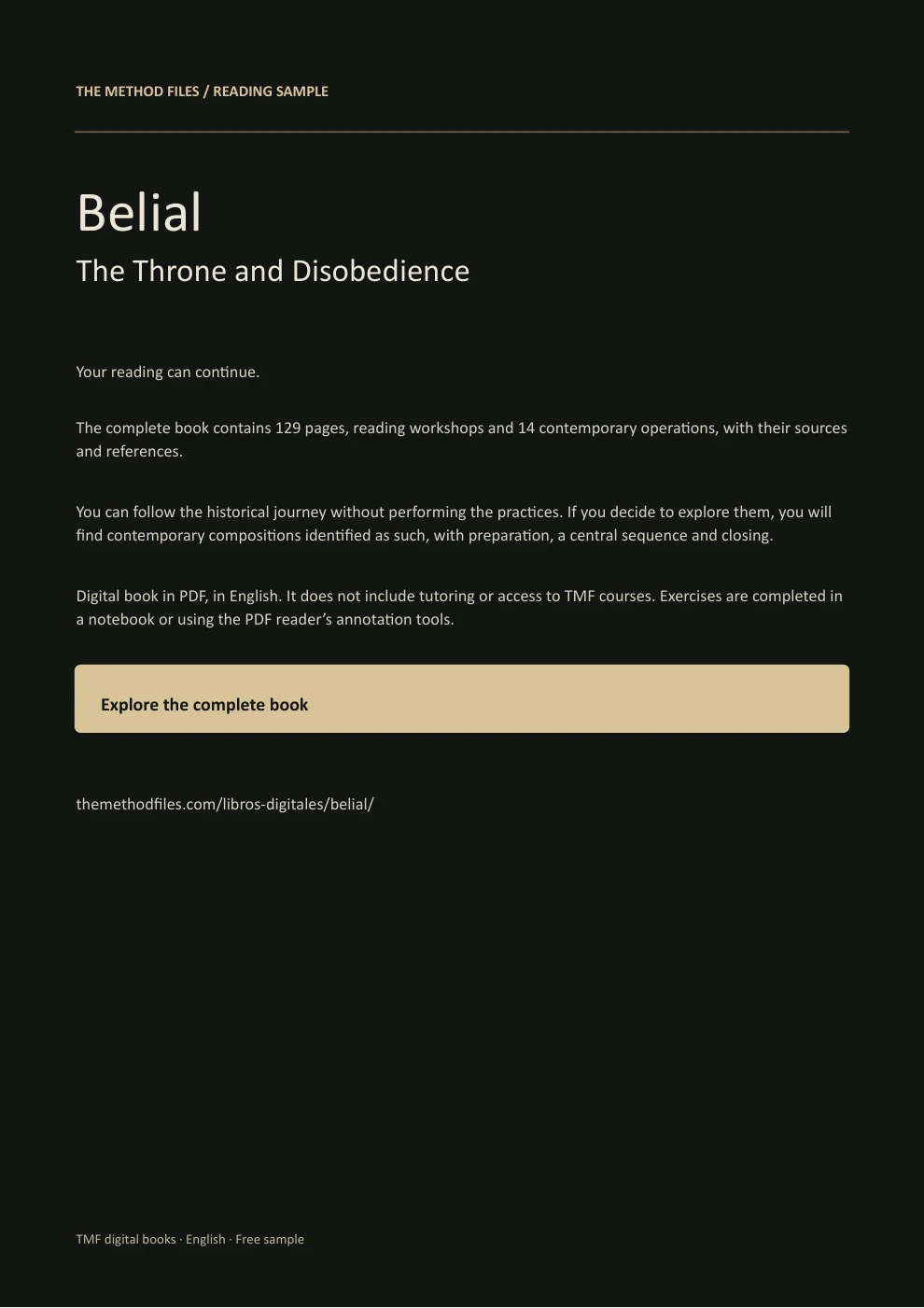
THE METHOD FILES / READING SAMPLE Belial The Throne and Disobedience Your reading can continue. The complete book contains 129 pages, reading workshops and 14 contemporary operations, with their sources and references. You can follow the historical journey without performing the practices. If you decide to explore them, you will find contemporary compositions identified as such, with preparation, a central sequence and closing. Digital book in PDF, in English. It does not include tutoring or access to TMF courses. Exercises are completed in a notebook or using the PDF reader’s annotation tools. Explore the complete book themethodfiles.com/libros‐digitales/belial/ TMF digital books ∙ English ∙ Free sample
Continue whenever you wish