Read before you choose
Asmodeus
Desire and Measure
This 13-page sample includes an introduction, a historical passage, a workshop, one complete practice and references. It retains the original book’s page numbers: the gaps reflect the selection.
Download PDF · 6.3 MBNo registration · Selectable text in the PDF
Cover

Read the text on this page
themethodfiles.com THE METHOD FILES ASMODEUS Desire and Measure HISTORY ∙ SYMBOLS ∙ TWELVE OPERATIONSAbout this reading sample
Read the text on this page
THE METHOD FILES / READING SAMPLE Asmodeus Desire and Measure A selection of pages from the complete book, with no registration required. We preserve the layout, text and numbering of the full English edition. You will find the introduction, a historical passage, a workshop, a complete practice and references to place your reading in context. Gaps in numbering reflect this selection: they are not missing pages. History A Name That Changes Worlds Reading workshop One Name, Three Contexts Complete contemporary practice The Declaration of Desire References to other parts of the volume belong to the complete book. This sample’s pages follow the original reading order. You can use the reader’s bookmarks to move between them. TMF digital books ∙ English ∙ Free sampleRead the source. Recognise the creation. · page 6 of the book
Read the text on this page
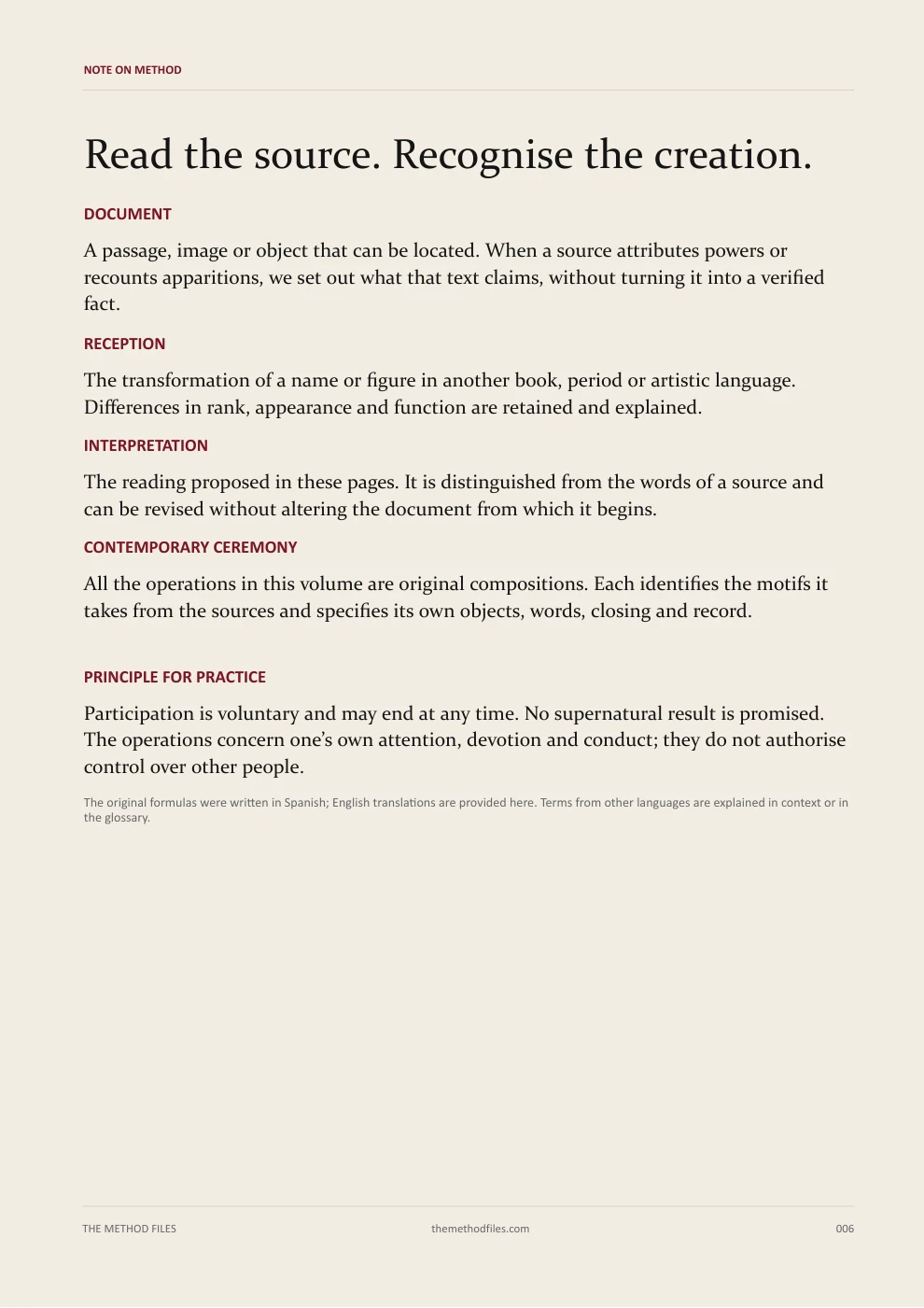
THE METHOD FILES themethodfiles.com 006 NOTE ON METHOD Read the source. Recognise the creation. DOCUMENT A passage, image or object that can be located. When a source attributes powers or recounts apparitions, we set out what that text claims, without turning it into a verified fact. RECEPTION The transformation of a name or figure in another book, period or artistic language. Differences in rank, appearance and function are retained and explained. INTERPRETATION The reading proposed in these pages. It is distinguished from the words of a source and can be revised without altering the document from which it begins. CONTEMPORARY CEREMONY All the operations in this volume are original compositions. Each identifies the motifs it takes from the sources and specifies its own objects, words, closing and record. PRINCIPLE FOR PRACTICE Participation is voluntary and may end at any time. No supernatural result is promised. The operations concern one’s own attention, devotion and conduct; they do not authorise control over other people. The original formulas were written in Spanish; English translations are provided here. Terms from other languages are explained in context or in the glossary.Desire and Measure · page 7 of the book
Read the text on this page
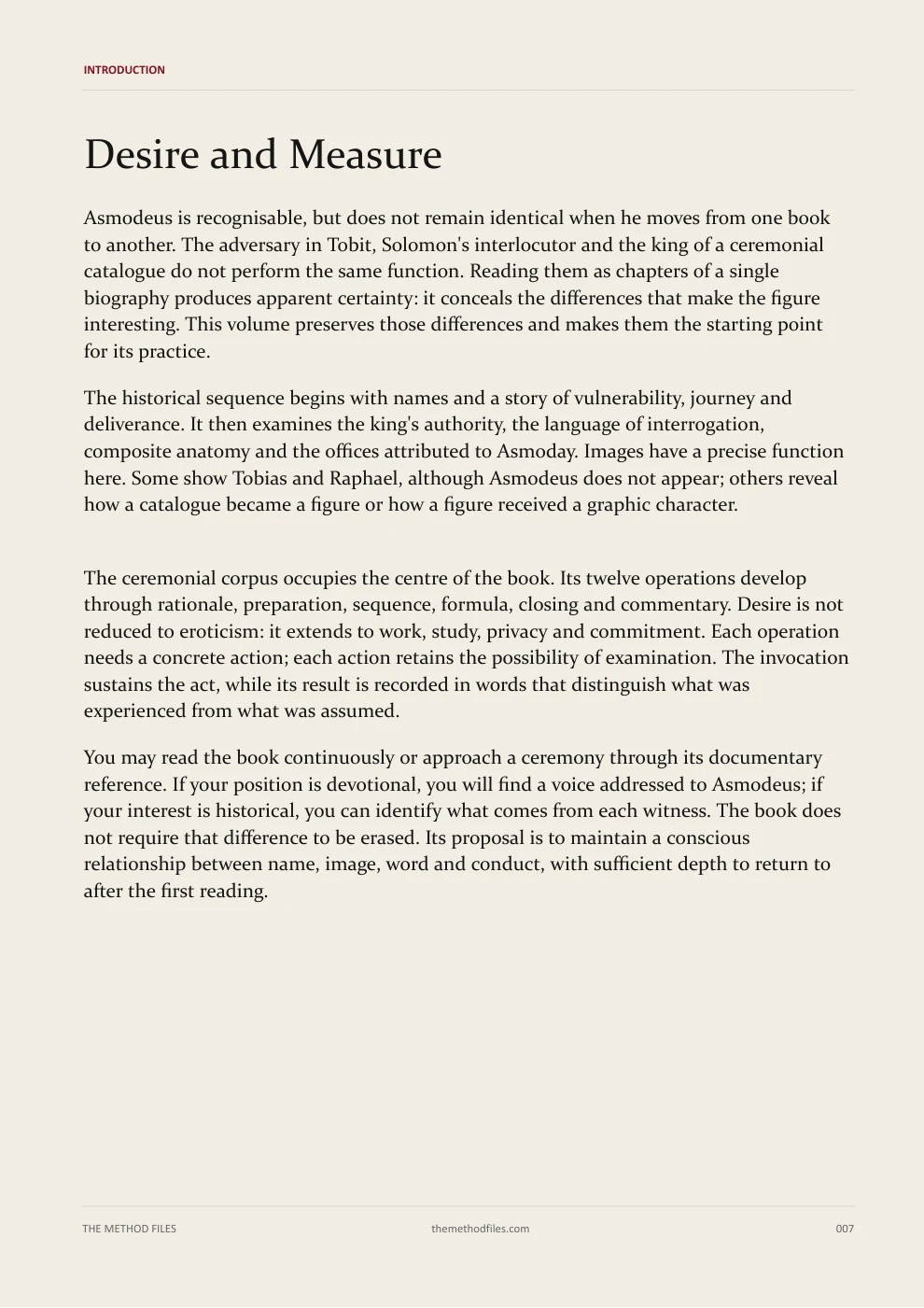
THE METHOD FILES themethodfiles.com 007 INTRODUCTION Desire and Measure Asmodeus is recognisable, but does not remain identical when he moves from one book to another. The adversary in Tobit, Solomon's interlocutor and the king of a ceremonial catalogue do not perform the same function. Reading them as chapters of a single biography produces apparent certainty: it conceals the differences that make the figure interesting. This volume preserves those differences and makes them the starting point for its practice. The historical sequence begins with names and a story of vulnerability, journey and deliverance. It then examines the king's authority, the language of interrogation, composite anatomy and the offices attributed to Asmoday. Images have a precise function here. Some show Tobias and Raphael, although Asmodeus does not appear; others reveal how a catalogue became a figure or how a figure received a graphic character. The ceremonial corpus occupies the centre of the book. Its twelve operations develop through rationale, preparation, sequence, formula, closing and commentary. Desire is not reduced to eroticism: it extends to work, study, privacy and commitment. Each operation needs a concrete action; each action retains the possibility of examination. The invocation sustains the act, while its result is recorded in words that distinguish what was experienced from what was assumed. You may read the book continuously or approach a ceremony through its documentary reference. If your position is devotional, you will find a voice addressed to Asmodeus; if your interest is historical, you can identify what comes from each witness. The book does not require that difference to be erased. Its proposal is to maintain a conscious relationship between name, image, word and conduct, with sufficient depth to return to after the first reading.A Name That Changes Worlds · page 9 of the book
Read the text on this page
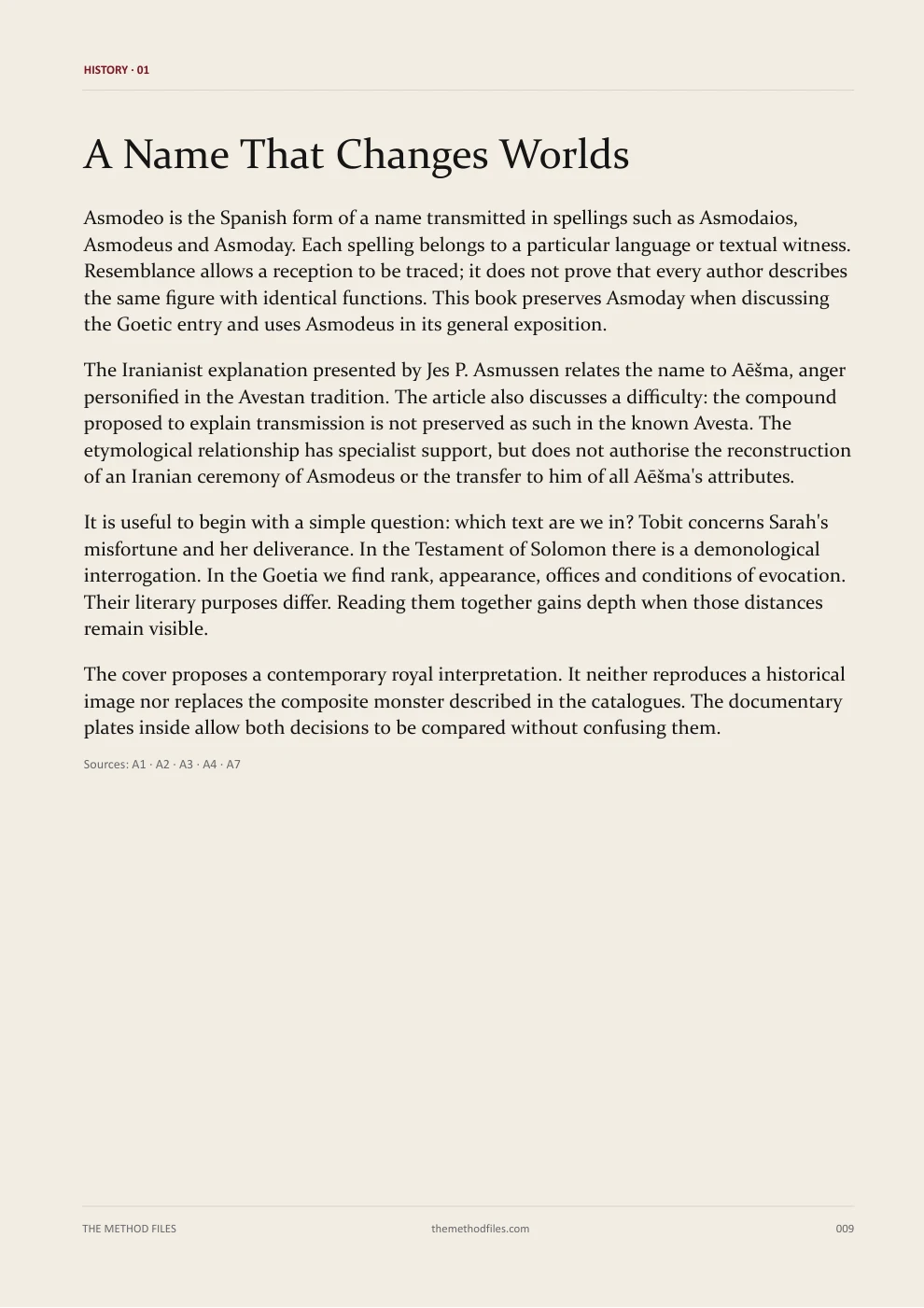
THE METHOD FILES themethodfiles.com 009 HISTORY ∙ 01 A Name That Changes Worlds Asmodeo is the Spanish form of a name transmitted in spellings such as Asmodaios, Asmodeus and Asmoday. Each spelling belongs to a particular language or textual witness. Resemblance allows a reception to be traced; it does not prove that every author describes the same figure with identical functions. This book preserves Asmoday when discussing the Goetic entry and uses Asmodeus in its general exposition. The Iranianist explanation presented by Jes P. Asmussen relates the name to Aēšma, anger personified in the Avestan tradition. The article also discusses a difficulty: the compound proposed to explain transmission is not preserved as such in the known Avesta. The etymological relationship has specialist support, but does not authorise the reconstruction of an Iranian ceremony of Asmodeus or the transfer to him of all Aēšma's attributes. It is useful to begin with a simple question: which text are we in? Tobit concerns Sarah's misfortune and her deliverance. In the Testament of Solomon there is a demonological interrogation. In the Goetia we find rank, appearance, offices and conditions of evocation. Their literary purposes differ. Reading them together gains depth when those distances remain visible. The cover proposes a contemporary royal interpretation. It neither reproduces a historical image nor replaces the composite monster described in the catalogues. The documentary plates inside allow both decisions to be compared without confusing them. Sources: A1 ∙ A2 ∙ A3 ∙ A4 ∙ A7One Name, Three Contexts · page 10 of the book

Read the text on this page
THE METHOD FILES themethodfiles.com 010 CASES AND READING WORKSHOPS One Name, Three Contexts A record card presents the Asmodeus of Tobit, Solomon's interlocutor and the Goetic Asmoday as though all the passages described a single scene. The related name has concealed the changes of literary genre. Write three entries with the work, the form of the name and the narrative function. Do not add abilities found only in the catalogue to the story of Tobit. Keep the differences between narrative, interrogation and ceremonial description visible. Write an introduction that allows comparison without constructing a continuous biography. Identify one shared motif and one difference that must not be erased. Preserve references A1, A2 and A4 beside each detail so that you can return to the passages. Three contexts with their functions Comparison that preserves differences01 · THE DECLARATION OF DESIRE · page 65 of the book

Read the text on this page
THE METHOD FILES themethodfiles.com 065 OPERATION 01 ∙ BASIS AND PREPARATION 01 ∙ The Declaration of Desire Give precise form to a desire of your own before turning it into a request. The ceremony separates what depends on you from what requires another person's decision. This opening works with desire before it becomes a promise or request. Its documentary horizon is the conflict of relationships appearing in Tobit and the Testament of Solomon. The ceremony does not imitate the demon's action in those stories: it composes a contemporary response to the force that disorders things when it declares itself owner of another will. Light marks the act's time, the sheet allows review, and the envelope preserves without sealing off. You may address Asmodeus as a devotional recipient or speak his name as the ceremony's symbolic focus. In either case, the declaration must remain readable the following day without depending on the moment's intensity. A precise intention may include doubt: wanting something does not oblige you already to know how to achieve it. MATERIALS Electric lamp, a sheet and a pencil; an empty envelope. PREPARATION Write a one‐sentence intention. Replace any command over another person with an action of your own: speaking clearly, accepting an answer, creating a work. Leave room below for revision. Place the envelope on the left and the pencil on the right; that arrangement belongs to this ceremony. Before switching on the lamp, write a second sentence beginning “I am willing to…”. It must name your own action and a limit. Compare the two sentences: if the first asks much and the second undertakes nothing, preparation is still incomplete. Set aside any object that leads you to turn another person into a mute representation of your will. Provenance of the motif: A1 and A2: desire and discord; original composition, not a rite from Tobit.01 · Sequence and closing · page 66 of the book

Read the text on this page
THE METHOD FILES themethodfiles.com 066 OPERATION 01 ∙ THE DECLARATION OF DESIRE 01 ∙ Sequence and closing 01 ∙ OPEN Switch on the lamp and say your name. Read the intention without embellishment. If you cannot formulate it in a way that allows others a free response, stop the act here and rewrite it. Leave a space of silence after saying your name. Do not use it to seek an answer: allow the intention to be formulated before adding explanations. If you need to correct it, preserve the first version, crossed out with a single line so that it remains legible. 02 ∙ DISTINGUISH Draw two columns: “depends on me” and “does not depend on me”. Distribute the necessary conditions between them. Touch only the first column with the pencil and speak the formula. Include other people's time, priorities and right not to respond among the conditions outside your control. Learning, asking or withdrawing may appear in your own column. The difference must remain visible on paper. 03 ∙ GIVE FORM Choose a small action and a date. Write them at the bottom. Fold the sheet inwards and put it in the envelope without sealing it permanently. The chosen action need not fulfil the whole desire. It must produce progress you can describe. Also write what information would make you change your purpose; a mature declaration retains the possibility of review. ORIGINAL SPANISH FORMULA (ENGLISH TRANSLATION) Asmodeus, name of desire and strength: before this light I declare what I want. Let my word be exact and my will know its scope. What belongs to others retains its freedom; what falls to me receives a form today. CLOSING Say: “The declaration ends; my responsibility remains.” Switch off the lamp. Open the envelope on the chosen date to review the action, without demanding external signs. Read the formula at the point indicated in the sequence. The closing completes the session even if there is no special experience.01 · Reading and record · page 67 of the book

Read the text on this page
THE METHOD FILES themethodfiles.com 067 OPERATION 01 ∙ READING AND RECORD 01 ∙ Reading and record MEANING OF THE OPERATION The operation's strength lies in moving from absolute desire to a situated statement. If the intention seems less grand but more achievable after invocation, the change is no failure. You have given it a sustainable form. Avoid repeating the ceremony that same day to obtain a more convincing feeling: new intensity does not replace the agreed action. Return to the sheet when the date arrives, record what happened and then decide whether the request still makes sense. EXAMPLE OF APPLICATION Application example: someone wants to show their work and writes “I want them to recognise my worth.” Separating conditions reveals that they can finish a piece, choose where to present it and accept an assessment different from the one expected. They rewrite: “This week I will prepare a selection that represents my craft well.” The ceremony guarantees no recognition; it leaves a declaration that can be fulfilled and an external response retaining its independence. VARIANT If you do not wish to keep an envelope, fold the sheet and place it inside the book. For a devotional practice, add brief gratitude in your own words at closing. Do not add a future obligation that was not planned at the start. QUESTIONS FOR THE RECORD 1. What part of the desire changed when you wrote it? 2. What depends on another person's response? 3. What concrete fact will you review? SPECIFIC FIELDS Initial intention; change in wording; chosen action; date and actual result. The examples are fictional situations intended to help explain the practice; they are not presented as evidence of efficacy.Motif and composition · 1 · page 116 of the book
Read the text on this page
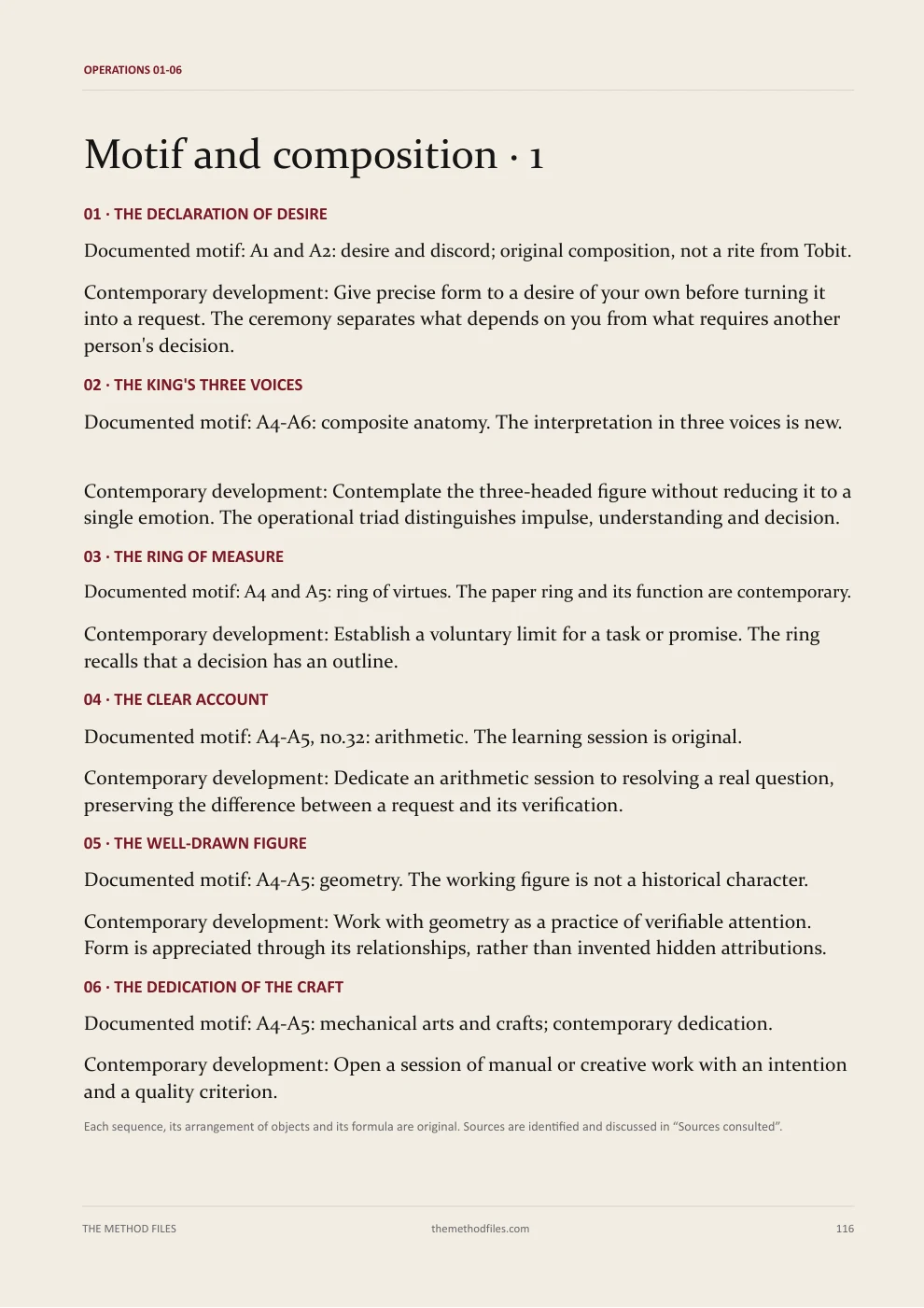
THE METHOD FILES themethodfiles.com 116 OPERATIONS 01‐06 Motif and composition ∙ 1 01 ∙ THE DECLARATION OF DESIRE Documented motif: A1 and A2: desire and discord; original composition, not a rite from Tobit. Contemporary development: Give precise form to a desire of your own before turning it into a request. The ceremony separates what depends on you from what requires another person's decision. 02 ∙ THE KING'S THREE VOICES Documented motif: A4‐A6: composite anatomy. The interpretation in three voices is new. Contemporary development: Contemplate the three‐headed figure without reducing it to a single emotion. The operational triad distinguishes impulse, understanding and decision. 03 ∙ THE RING OF MEASURE Documented motif: A4 and A5: ring of virtues. The paper ring and its function are contemporary. Contemporary development: Establish a voluntary limit for a task or promise. The ring recalls that a decision has an outline. 04 ∙ THE CLEAR ACCOUNT Documented motif: A4‐A5, no.32: arithmetic. The learning session is original. Contemporary development: Dedicate an arithmetic session to resolving a real question, preserving the difference between a request and its verification. 05 ∙ THE WELL‐DRAWN FIGURE Documented motif: A4‐A5: geometry. The working figure is not a historical character. Contemporary development: Work with geometry as a practice of verifiable attention. Form is appreciated through its relationships, rather than invented hidden attributions. 06 ∙ THE DEDICATION OF THE CRAFT Documented motif: A4‐A5: mechanical arts and crafts; contemporary dedication. Contemporary development: Open a session of manual or creative work with an intention and a quality criterion. Each sequence, its arrangement of objects and its formula are original. Sources are identified and discussed in “Sources consulted”.Sources consulted · 1 · page 120 of the book

Read the text on this page
THE METHOD FILES themethodfiles.com 120 A1 A2 A3 A4 TEXTS AND WITNESSES ∙ 1 Sources consulted ∙ 1 Tobit, chapters 3, 6 and 8. Story of Sarah, Tobias, Raphael and Asmodeus. Passage references; original account. Consulting the chapters together preserves Sarah, Tobias and Raphael within the story. This book recounts the episodes in its own words without turning the narrated actions into a recipe. Mentions of other chapters must be checked in their place, rather than deduced from a summary. View the document Testament of Solomon, §§21‐25. Translation by F. C. Conybeare (1898); digital edition by Joseph H. Peterson. The sections concerning the encounter with Asmodeus are used to study name, authority and offices. The historical translation and modern notes are different layers. Attribution of the text to Solomon is not taken as identifying a historical author. View the document Johann Weyer, Pseudomonarchia daemonum (1577), no.35: Sydonay / Asmoday. Historical text consulted in J. H. Peterson's digital edition. The Sydonay / Asmoday passage allows comparison of name, rank, anatomy and arts. Number 35 identifies its position in the catalogue consulted. It is neither turned into a ritual correspondence nor used as a mandatory number of repetitions. View the document Goetia, no.32. Transcription of British Library, Sloane MS 3825, by J. H. Peterson; transcription CC BY 4.0. Its modern drawings are not reproduced. The transcription allows the manuscript passage to be located and text distinguished from editorial commentary. It is consulted to compare entry 32. The digital edition's modern drawings are not reproduced as plates. View the document Accessed: September 2026. Paraphrases and commentary are the author’s own. Modern notes are distinguished from historical texts.Sources consulted · 2 · page 121 of the book

Read the text on this page
THE METHOD FILES themethodfiles.com 121 A5 A6 A7 TEXTS AND WITNESSES ∙ 2 Sources consulted ∙ 2 The Lesser Key of Solomon. L. W. de Laurence edition, Chicago, 1916, entry 32. Public‐domain digital copy. The 1916 printed book offers a printed textual witness and a historical plate of characters. The complete page is preserved to identify number 32 within the series. Printing date is not confused with composition of the transmitted corpus. View the document J.‐A.‐S. Collin de Plancy, Dictionnaire infernal, Paris: H. Plon, 1863, pp.54‐55. Library of Congress copy. Pages 54 and 55 allow the entry's beginning and continuation to be followed. Images near other dictionary entries retain their attribution. The reference to Lesage is treated as part of the reception collected by the compiler. View the document Jes P. Asmussen, “Aēšma”, Encyclopaedia Iranica, I/5, pp.479‐480. Reference for the etymological discussion. Specialist reference for discussion of the name Aēšma and its relationship to Asmodeus. Used with linguistic scope. The book does not deduce from etymology an unbroken continuity of cults or a doctrine common to every later source. View the document Accessed: September 2026. Paraphrases and commentary are the author’s own. Modern notes are distinguished from historical texts.Continue reading
Read the text on this page
THE METHOD FILES / READING SAMPLE Asmodeus Desire and Measure Your reading can continue. The complete book contains 126 pages, reading workshops and 12 contemporary operations, with their sources and references. You can follow the historical journey without performing the practices. If you decide to explore them, you will find contemporary compositions identified as such, with preparation, a central sequence and closing. Digital book in PDF, in English. It does not include tutoring or access to TMF courses. Exercises are completed in a notebook or using the PDF reader’s annotation tools. Explore the complete book themethodfiles.com/libros‐digitales/asmodeo/ TMF digital books ∙ English ∙ Free sample
Continue whenever you wish