Read before you choose
Beelzebub
The Prince and the Swarm
This 13-page sample includes an introduction, a historical passage, a workshop, one complete practice and references. It retains the original book’s page numbers: the gaps reflect the selection.
Download PDF · 6.2 MBNo registration · Selectable text in the PDF
Cover
Read the text on this page
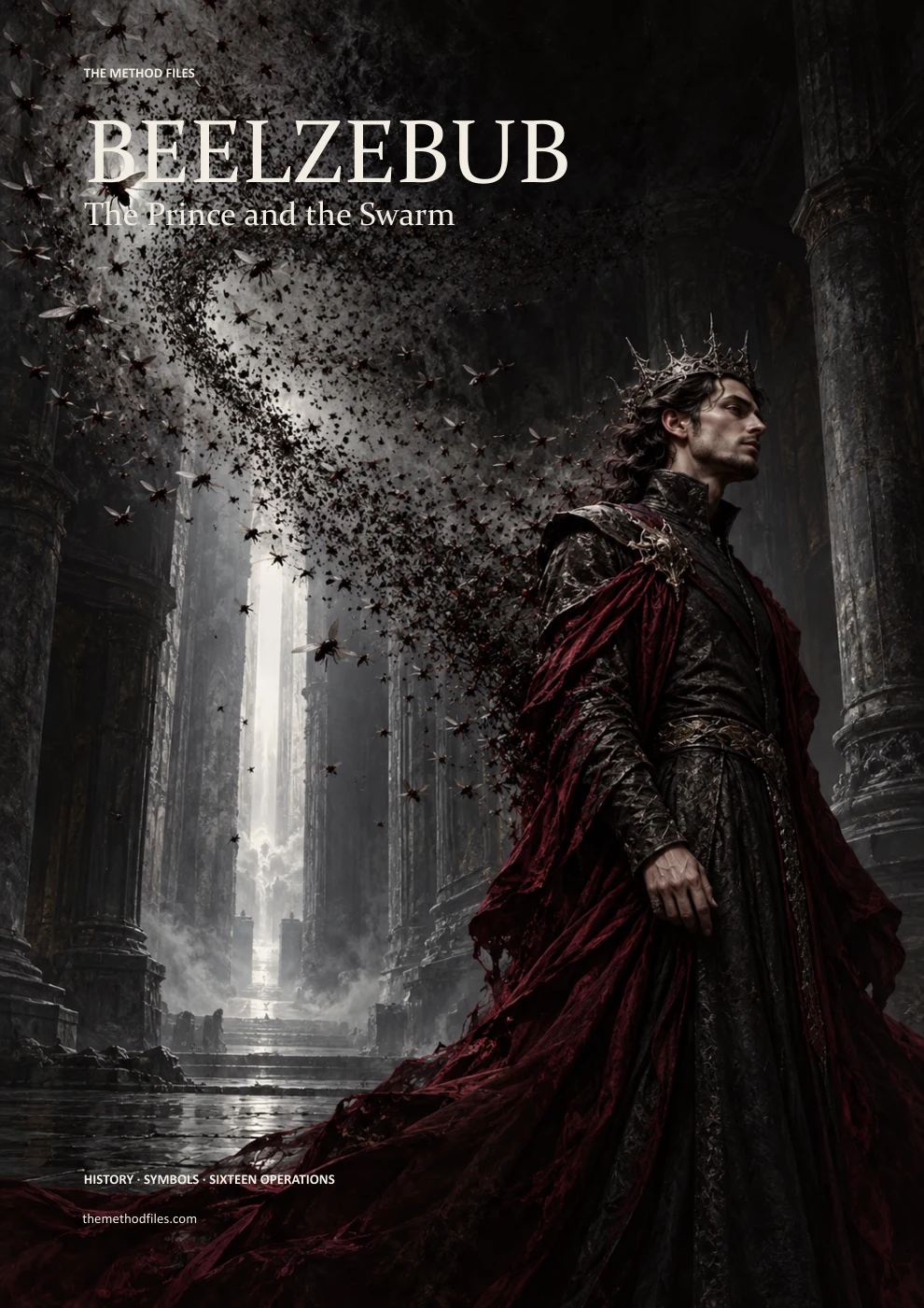
themethodfiles.com THE METHOD FILES BEELZEBUB The Prince and the Swarm HISTORY ∙ SYMBOLS ∙ SIXTEEN OPERATIONSAbout this reading sample
Read the text on this page
THE METHOD FILES / READING SAMPLE Beelzebub The Prince and the Swarm A selection of pages from the complete book, with no registration required. We preserve the layout, text and numbering of the full English edition. You will find the introduction, a historical passage, a workshop, a complete practice and references to place your reading in context. Gaps in numbering reflect this selection: they are not missing pages. History The name and Ekron Reading workshop A resemblance is not a biography Complete contemporary practice Greeting to the Prince References to other parts of the volume belong to the complete book. This sample’s pages follow the original reading order. You can use the reader’s bookmarks to move between them. TMF digital books ∙ English ∙ Free sampleBefore calling the Prince · page 6 of the book
Read the text on this page
THE METHOD FILES themethodfiles.com 006 I ∙ HISTORY AND WITNESSES Before calling the Prince The name, the history and the limit of practice Beelzebub does not reach us from a single tradition. The name passes through a biblical narrative set in Ekron, a still‐open linguistic debate, the Gospels, Solomonic demonology, early modern Christian classifications, European grimoires and contemporary occult currents. Each layer uses the name differently. This book preserves the differences instead of fabricating a continuous biography that no source can demonstrate. This volume's practice is built on that distinction. When an operation takes an idea from a historical document, it indicates what is attested and what is a contemporary ceremonial composition. A source may document a name, hierarchy, form of appearance or the existence of a conjuration without preserving a rite suitable for repetition today. In those cases, the document is studied, and the new ceremony acknowledges its present‐day date. The sixteen operations are intended for a devotional or symbolic reading of Beelzebub. They do not promise inevitable manifestations or turn subjective experience into proof of a supernatural fact. Practitioners may understand the invoked presence according to their own religious, philosophical or symbolic position. The shared requirement is different: knowing what is being done, why it is done and how it ends. The collection excludes blood, animal sacrifice, self‐harm and harm to others. Some historical grimoires contain procedures depending on those elements. Here they are not replaced by ink, wine, wax or another invented ingredient to pretend the historical rite remains intact. When a procedure depends on what we have excluded, its existence is documented and it is left outside practice. Beelzebub will not be reduced to a single label either. “Lord of the Flies”, “Prince”, “exarch of the demons”, Binsfeld's gluttony, the Grimorium Verum's characters and Abramelin's court belong to different contexts. Readers will find a map for recognising them before entering the ritual work. Numbers in square brackets refer to the volume's bibliography. Unless a short historical fragment is expressly identified, the ritual formulas are original compositions by The Method Files, written in Spanish and presented here in English translation. Historical fragments are accompanied by translations; where a fragment is already in English, its Spanish rendering is retained and labelled.The name and Ekron · page 7 of the book
Read the text on this page
THE METHOD FILES themethodfiles.com 007 I ∙ HISTORY AND WITNESSES The name and Ekron 01 ∙ Before Beelzebub Baal, zbl and the danger of starting too early The name's genealogy often begins at Ugarit because Ugaritic texts call Baal by formulas containing zbl, a term that can function as a princely title. The comparison is philologically important: it helps explain why many scholars have connected Baal‐zebul with a title of the “Prince Baal” type. But a linguistic relationship does not authorise turning the Ugaritic Baal into Beelzebub under another name. Ugarit's texts belong to an earlier religious world and describe their own deities, conflicts and titles. [2] The correct starting point is therefore twofold. On one hand, Ugarit demonstrates that zbl can appear joined to Baal in a princely title. On the other, this book's Beelzebub is not documented until we find the form Baalzebub in the narrative of 2 Kings 1. Between these facts lies a possible, disputed relationship, not automatic biographical identity. This distinction protects the rest of the volume. It prevents every Canaanite image from retrospectively becoming a portrait of Beelzebub and every attribute of Baal from being incorporated into modern practice without justification. It also allows something more interesting to be recognised: Beelzebub's name is constructed through translations, polemics and reinterpretations. Its history does not lose force by acknowledging those transformations; it gains precision. 02 ∙ Baalzebub, god of Ekron The name's first direct anchor 2 Kings 1 presents Ahaziah after a fall. The king sends messengers to consult Baalzebub, god of Ekron, to learn whether he will recover. The narrative is hostile to that consultation: Elijah intercepts the messengers, and the question becomes a religious denunciation because Israel's king has sought an answer from a deity of Ekron. [1] For our purpose, the central fact is limited but sound. Baalzebub appears associated with a consultation about the future course of an illness.A resemblance is not a biography · page 8 of the book
Read the text on this page
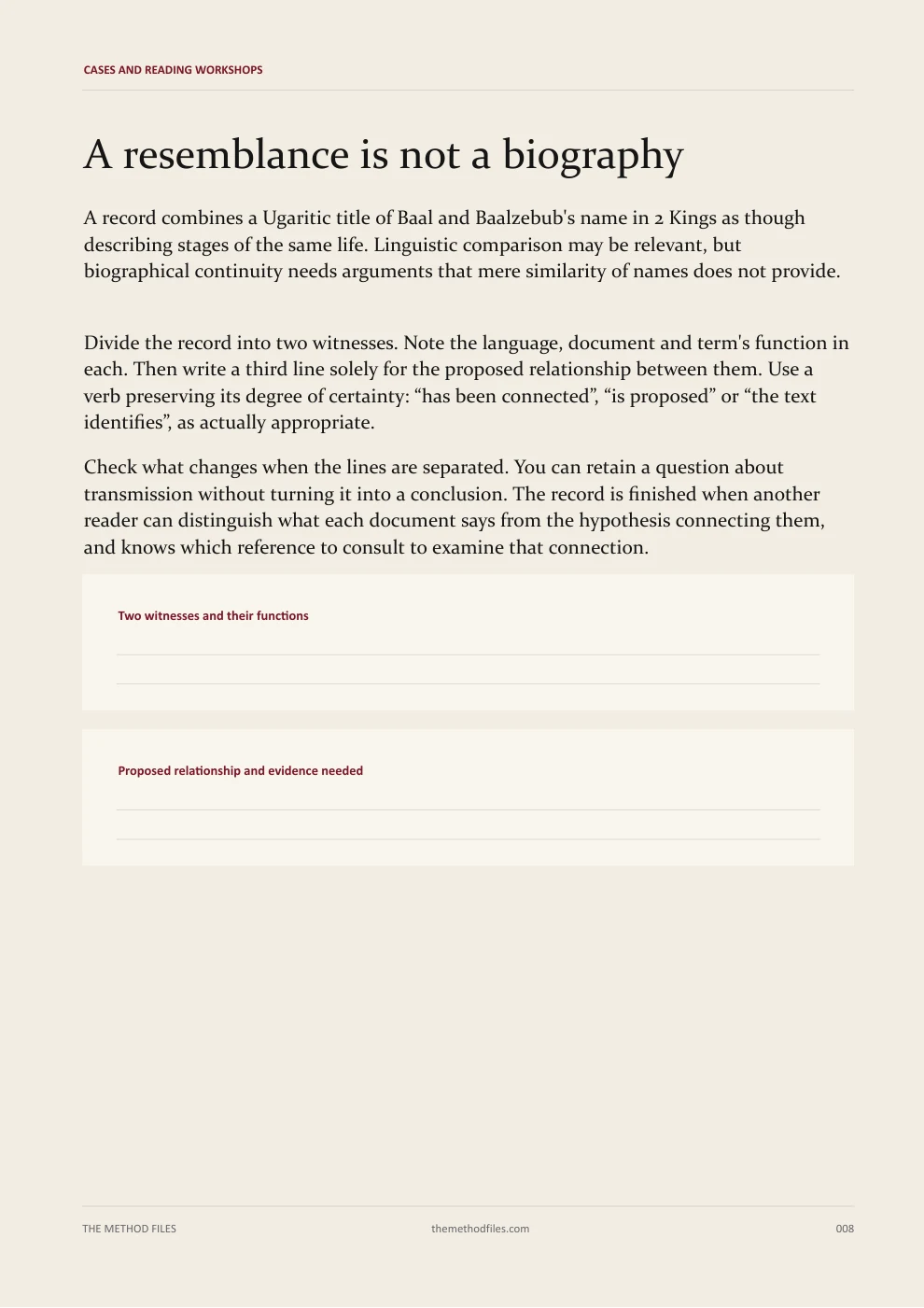
THE METHOD FILES themethodfiles.com 008 CASES AND READING WORKSHOPS A resemblance is not a biography A record combines a Ugaritic title of Baal and Baalzebub's name in 2 Kings as though describing stages of the same life. Linguistic comparison may be relevant, but biographical continuity needs arguments that mere similarity of names does not provide. Divide the record into two witnesses. Note the language, document and term's function in each. Then write a third line solely for the proposed relationship between them. Use a verb preserving its degree of certainty: “has been connected”, “is proposed” or “the text identifies”, as actually appropriate. Check what changes when the lines are separated. You can retain a question about transmission without turning it into a conclusion. The record is finished when another reader can distinguish what each document says from the hypothesis connecting them, and knows which reference to consult to examine that connection. Two witnesses and their functions Proposed relationship and evidence neededThe consultation the narrative preserves · page 9 of the book
Read the text on this page
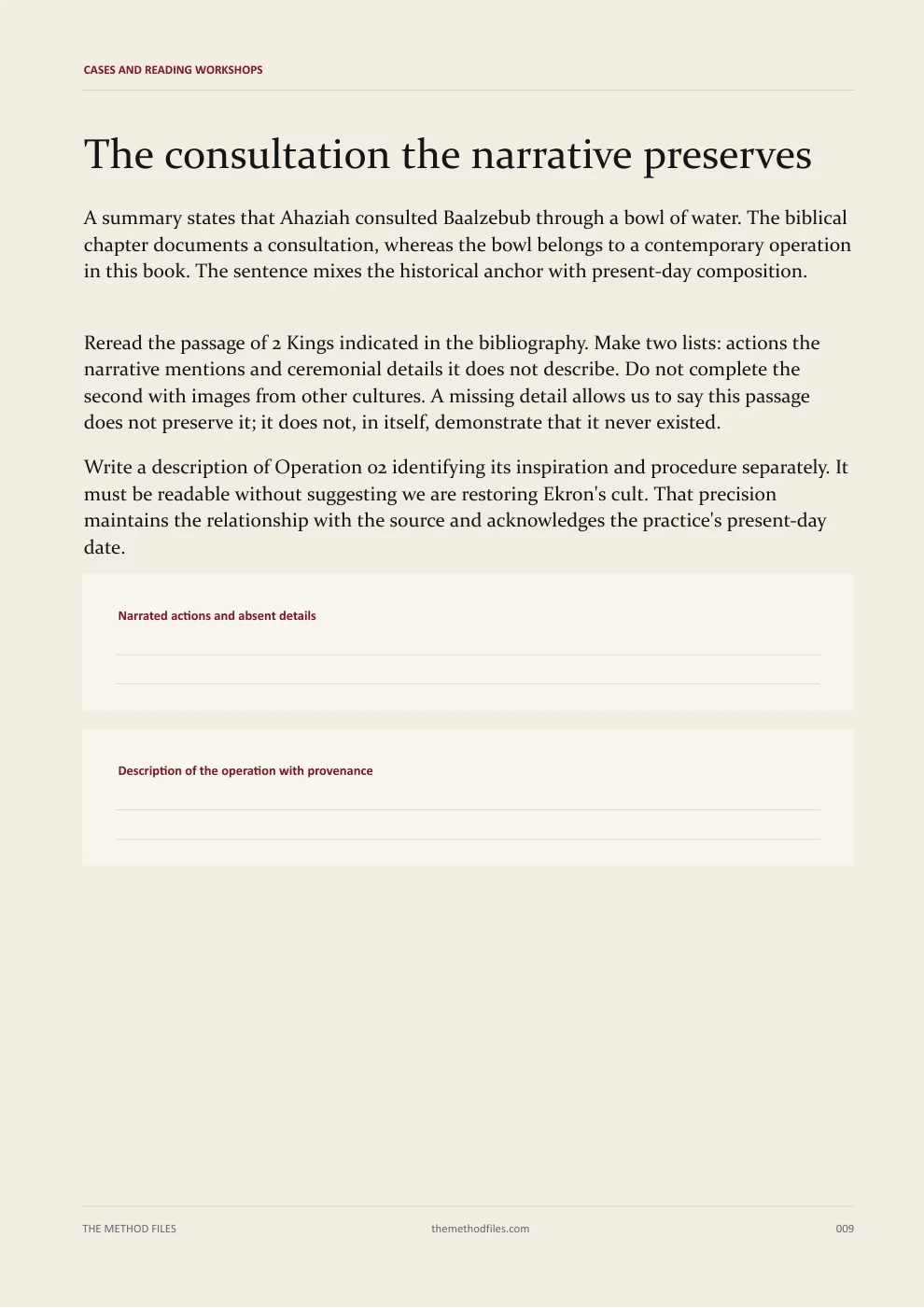
THE METHOD FILES themethodfiles.com 009 CASES AND READING WORKSHOPS The consultation the narrative preserves A summary states that Ahaziah consulted Baalzebub through a bowl of water. The biblical chapter documents a consultation, whereas the bowl belongs to a contemporary operation in this book. The sentence mixes the historical anchor with present‐day composition. Reread the passage of 2 Kings indicated in the bibliography. Make two lists: actions the narrative mentions and ceremonial details it does not describe. Do not complete the second with images from other cultures. A missing detail allows us to say this passage does not preserve it; it does not, in itself, demonstrate that it never existed. Write a description of Operation 02 identifying its inspiration and procedure separately. It must be readable without suggesting we are restoring Ekron's cult. That precision maintains the relationship with the source and acknowledges the practice's present‐day date. Narrated actions and absent details Description of the operation with provenanceHow to follow an operation · page 62 of the book
Read the text on this page
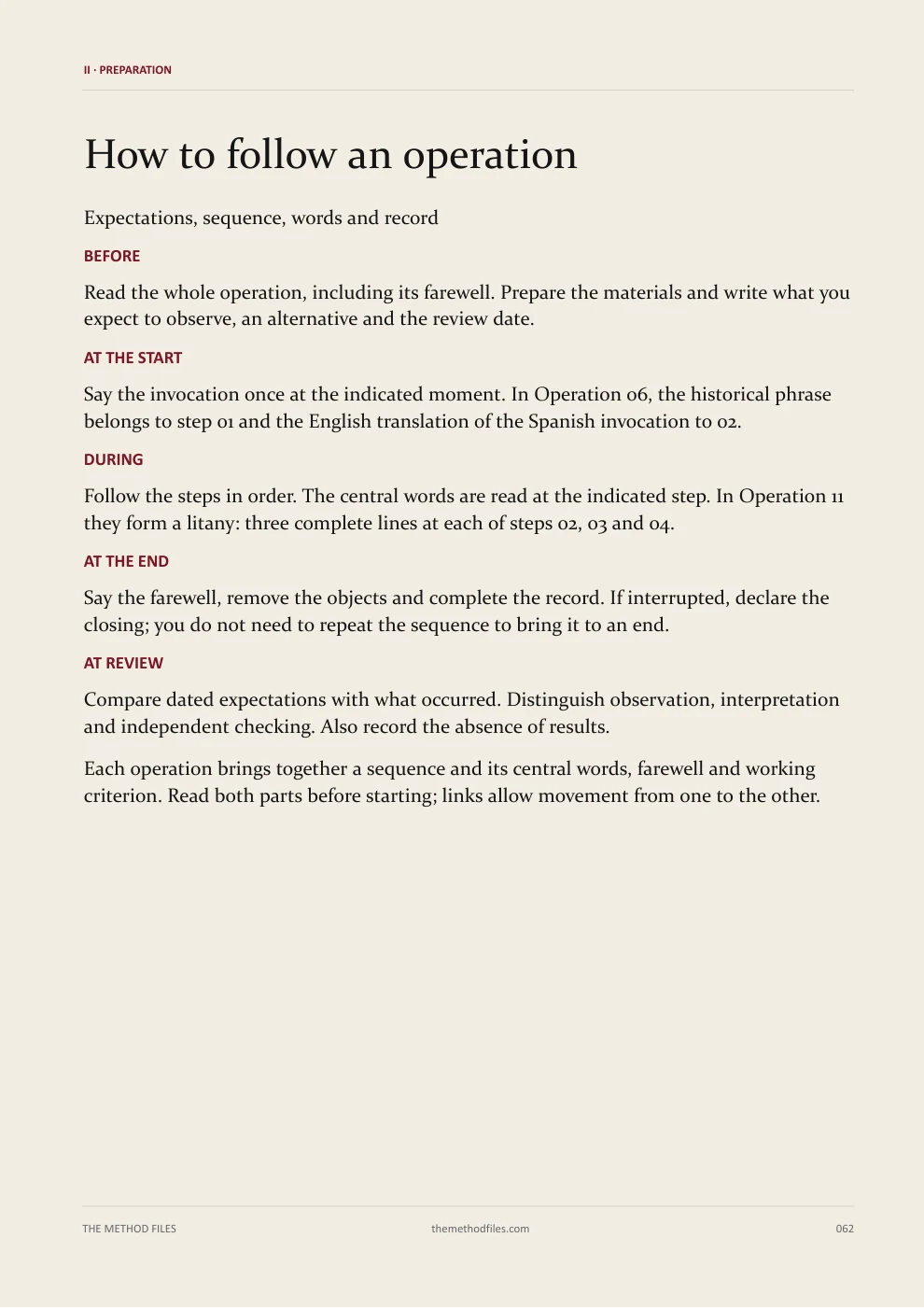
THE METHOD FILES themethodfiles.com 062 II ∙ PREPARATION How to follow an operation Expectations, sequence, words and record BEFORE Read the whole operation, including its farewell. Prepare the materials and write what you expect to observe, an alternative and the review date. AT THE START Say the invocation once at the indicated moment. In Operation 06, the historical phrase belongs to step 01 and the English translation of the Spanish invocation to 02. DURING Follow the steps in order. The central words are read at the indicated step. In Operation 11 they form a litany: three complete lines at each of steps 02, 03 and 04. AT THE END Say the farewell, remove the objects and complete the record. If interrupted, declare the closing; you do not need to repeat the sequence to bring it to an end. AT REVIEW Compare dated expectations with what occurred. Distinguish observation, interpretation and independent checking. Also record the absence of results. Each operation brings together a sequence and its central words, farewell and working criterion. Read both parts before starting; links allow movement from one to the other.Greeting to the Prince · page 64 of the book
Read the text on this page
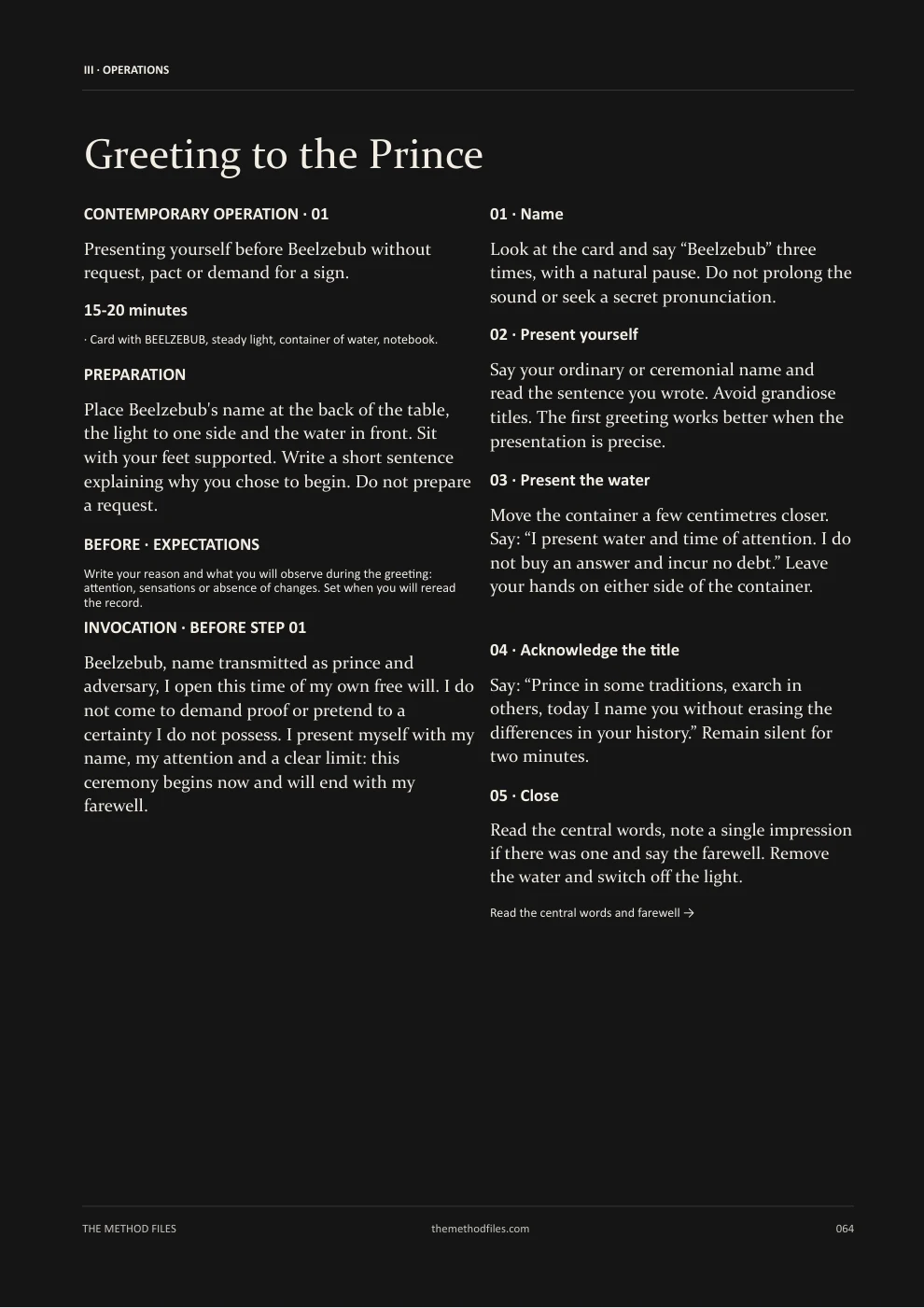
THE METHOD FILES themethodfiles.com 064 III ∙ OPERATIONS Greeting to the Prince CONTEMPORARY OPERATION ∙ 01 Presenting yourself before Beelzebub without request, pact or demand for a sign. 15‐20 minutes ∙ Card with BEELZEBUB, steady light, container of water, notebook. PREPARATION Place Beelzebub's name at the back of the table, the light to one side and the water in front. Sit with your feet supported. Write a short sentence explaining why you chose to begin. Do not prepare a request. BEFORE ∙ EXPECTATIONS Write your reason and what you will observe during the greeting: attention, sensations or absence of changes. Set when you will reread the record. INVOCATION ∙ BEFORE STEP 01 Beelzebub, name transmitted as prince and adversary, I open this time of my own free will. I do not come to demand proof or pretend to a certainty I do not possess. I present myself with my name, my attention and a clear limit: this ceremony begins now and will end with my farewell. 01 ∙ Name Look at the card and say “Beelzebub” three times, with a natural pause. Do not prolong the sound or seek a secret pronunciation. 02 ∙ Present yourself Say your ordinary or ceremonial name and read the sentence you wrote. Avoid grandiose titles. The first greeting works better when the presentation is precise. 03 ∙ Present the water Move the container a few centimetres closer. Say: “I present water and time of attention. I do not buy an answer and incur no debt.” Leave your hands on either side of the container. 04 ∙ Acknowledge the title Say: “Prince in some traditions, exarch in others, today I name you without erasing the differences in your history.” Remain silent for two minutes. 05 ∙ Close Read the central words, note a single impression if there was one and say the farewell. Remove the water and switch off the light. Read the central words and farewell →Operation 01 · Words and farewell · page 65 of the book
Read the text on this page
THE METHOD FILES themethodfiles.com 065 III ∙ OPERATIONS Operation 01 ∙ Words and farewell 01 ∙ GREETING TO THE PRINCE Central words: step 05. The farewell is spoken at the end. Beelzebub, I receive the weight of a name that has changed language, rank and image. I need not turn all its histories into one to address you. May my word be complete because I know its limit; may my attention be intense without becoming blind obedience; may this first presence preserve the right to continue or to end. FAREWELL Beelzebub, the greeting has been spoken. I withdraw my call and bring this time to an end. The water returns to ordinary use, the light goes out and my decision remains with me. CRITERION This first work uses neither flies, character nor court. Their absence is deliberate: it allows a relationship with the name to be established before loading it with iconography. If you wish to repeat it, retain the same simplicity for at least three sessions before adding another element. AFTERWARDS Dispose of or drink the water ordinarily. Put away the card. Do not seek a sign after the session or interpret any fly, noise or coincidence as confirmation. RECORD Date, actual duration, reason for the greeting, what happened during silence and whether you wish to repeat. Separate “I observed” from “I interpreted”. PERFORMANCE AND REVIEW Record the actual duration, the steps you performed, any changes or omissions, and when you closed. Compare what you expected with what you observed; also record the absence of results. PROVENANCE The designation “Prince” is documented in the New Testament as “prince of demons” and in the Grand Grimoire as an infernal rank. This ceremony is a contemporary composition; it does not reproduce a historical liturgy. [3][14] ← Back to the sequenceA greeting without asking for a sign · page 66 of the book
Read the text on this page
THE METHOD FILES themethodfiles.com 066 CASES AND READING WORKSHOPS A greeting without asking for a sign During the first greeting, someone expects an extraordinary change and considers a quiet session incomplete. Yet the operation proposes presenting oneself and closing without demanding a manifestation. Before starting, write the reason for your greeting and two possible results: an impression you can describe and the absence of changes. Retain both possibilities during silence. Do not turn a sound in the room into confirmation merely because it occurred while you looked at the name. Afterwards, record what you did and observed in specific words. Compare the result with the expectation, without adding a supernatural explanation out of obligation. Decide whether you want to return to practice for its value to you, not to correct the supposed insufficiency of the first encounter. The greeting is complete when the presentation had a limit and the farewell was performed, even if the day continued entirely ordinarily. Reason and possible results Observation and decision about continuingBibliography · 1 · page 120 of the book
Read the text on this page
THE METHOD FILES themethodfiles.com 120 IV ∙ RECORD AND SOURCES Bibliography ∙ 1 [1] USCCB. 2 Kings, chapter 1. NABRE, digital edition. 1:2‐6, 16; note on 1:2. View the document [2] Christian Frevel. The Enigma of Baal‐Zebub: A New Solution. In Fabio Porzia and Corinne Bonnet (eds.), Divine Names on the Spot II, OBO 299, Leuven–Paris–Bristol: Peeters, 2023. pp. 202‐237; especially 202‐203 and 230‐231. View the document [3] USCCB. Matthew, chapter 12. NABRE, digital edition. 12:22‐30. View the document [4] USCCB. Mark, chapter 3. NABRE, digital edition. 3:22‐27. View the documentBibliography · 4 · page 123 of the book
Read the text on this page
THE METHOD FILES themethodfiles.com 123 IV ∙ RECORD AND SOURCES Bibliography ∙ 4 [13] La Clavicola del Re Salomone; digital edition by Joseph H. Peterson. La Clavicola del Re Salomone, Tessoro delle Scienze Occulte. Florence, 1880; digital transcription with notes. Caratteri di Beelzebuth and the Italian branch of the Verum. View the document [14] Le Grand Grimoire; digital edition by Joseph H. Peterson. Le Grand Grimoire. Digital edition; legendary dating distinguished from material transmission. Hierarchy and dialogue with Lucifuge Rofocale. View the document [15] S. L. MacGregor Mathers (trans.); digital edition by Joseph H. Peterson. The Book of the Sacred Magic of Abramelin the Mage. London: John M. Watkins, 1898; digital transcription and notes. Book II, ch. XIX; list for BELZEBUD and notes on the names. View the document [16] J.‐A.‐S. Collin de Plancy. Dictionnaire infernal. 6th ed.; Paris: Henri Plon, 1863; Library of Congress copy. pp. 89‐90, Belzébuth entry and two images. View the documentContinue reading
Read the text on this page
THE METHOD FILES / READING SAMPLE Beelzebub The Prince and the Swarm Your reading can continue. The complete book contains 127 pages, reading workshops and 16 contemporary operations, with their sources and references. You can follow the historical journey without performing the practices. If you decide to explore them, you will find contemporary compositions identified as such, with preparation, a central sequence and closing. Digital book in PDF, in English. It does not include tutoring or access to TMF courses. Exercises are completed in a notebook or using the PDF reader’s annotation tools. Explore the complete book themethodfiles.com/libros‐digitales/belcebu/ TMF digital books ∙ English ∙ Free sample
Continue whenever you wish