Read before you choose
Lilith
The Night and the Threshold
This 13-page sample includes an introduction, a historical passage, a workshop, one complete practice and references. It retains the original book’s page numbers: the gaps reflect the selection.
Download PDF · 6.3 MBNo registration · Selectable text in the PDF
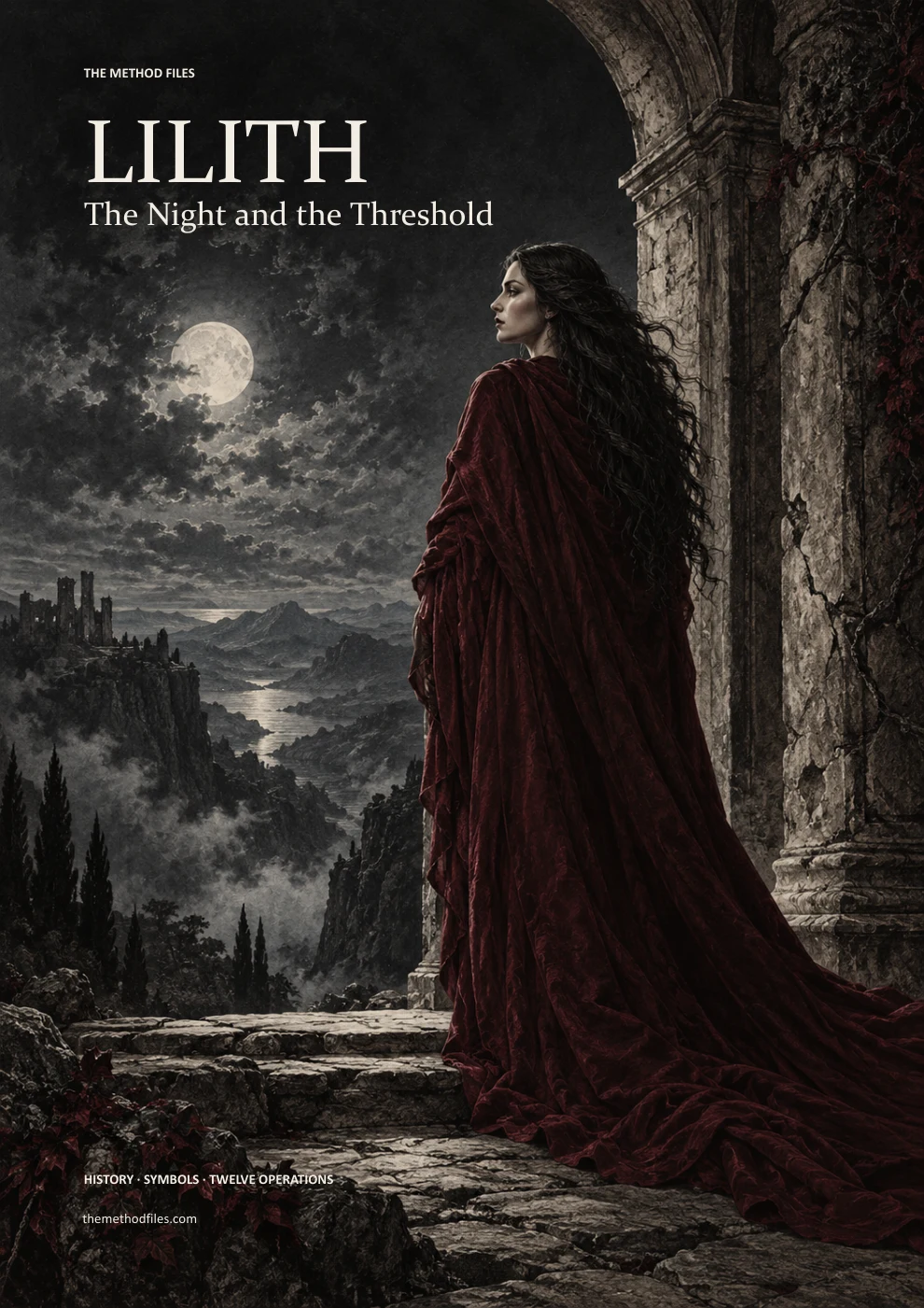
Cover
Read the text on this page
themethodfiles.com THE METHOD FILES LILITH The Night and the Threshold HISTORY ∙ SYMBOLS ∙ TWELVE OPERATIONSAbout this reading sample
Read the text on this page
THE METHOD FILES / READING SAMPLE Lilith The Night and the Threshold A selection of pages from the complete book, with no registration required. We preserve the layout, text and numbering of the full English edition. You will find the introduction, a historical passage, a workshop, a complete practice and references to place your reading in context. Gaps in numbering reflect this selection: they are not missing pages. History A name among the ruins Reading workshop Reading what the verse contains Complete contemporary practice Invocation of the name References to other parts of the volume belong to the complete book. This sample’s pages follow the original reading order. You can use the reader’s bookmarks to move between them. TMF digital books ∙ English ∙ Free sampleL I L I T H · page 6 of the book
Read the text on this page
LILITH THE METHOD FILES themethodfiles.com 006 Lilith THE METHOD FILES · 2026 The Night and the Threshold History and practice This volume brings together a documented history of Lilith and twelve original operations for contemporary practice. Its purpose is to offer a path through reading and practical work, using accessible language and references for further investigation. The nature of the operations The formulas and sequences are contemporary compositions. They are neither translations of a manuscript nor methods of proven effectiveness. Each activity sheet distinguishes the purpose, preparation, expectations, the act and its record. Text and images The interior uses reproductions of works and documents identified by authorship, collection and date. The practical diagrams and monogram are contemporary compositions. The cover art is an editorial interpretation, not historical evidence. Contents and sources The contents and references are interactive. The numbers correspond to the PDF pages. The bibliography and reproduction credits appear at the end.Finding your way into this book · page 7 of the book
Read the text on this page
LILITH THE METHOD FILES themethodfiles.com 007 Finding your way into this book Knowing the history helps us decide what we are doing when we speak a name. Three possible routes If this is your first encounter with Lilith, begin with the history. If you already know her stories, turn to the map of symbols and check where each one comes from. To practise, first read the preparation and method; then choose an operation for its aim. The pact can wait: it is not a condition of approaching the rest of the book. Five guiding terms HISTORICAL indicates a documented text or object. LATER TRADITION indicates a development added in another period. CONTEMPORARY identifies modern authors and movements. ORIGINAL SYNTHESIS distinguishes the compositions in this grimoire. DISPUTED preserves a real uncertainty about attribution or meaning. Giving practice a form Every operation has a purpose, materials, a sequence and a farewell. Durations are indicative; they do not correspond to traditional planetary hours. A short, complete session is more useful than a ceremony prolonged in order to provoke a sensation. Reading experiences Images, associations or dreams may emerge during a practice; nothing special may happen either. Record what you remember without immediately turning it into an instruction, an external fact or a promise. Invocatory language expresses a ritual intention: it does not, by itself, establish the presence of a being. To find your bearings again, use the ritual contents. Preparation and farewell are explained before the twelve operations and recalled within each one.A name among the ruins · page 16 of the book
Read the text on this page
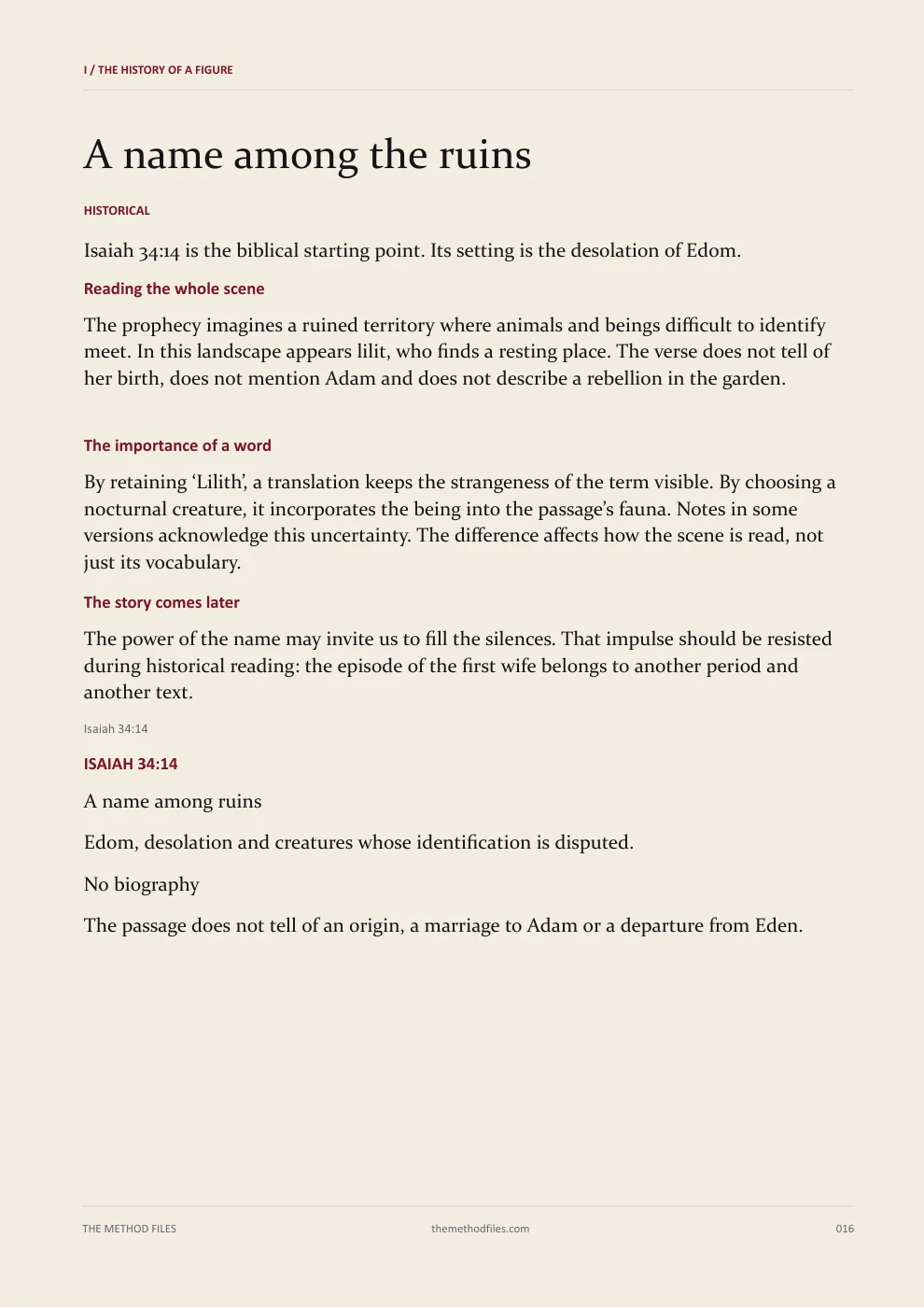
THE METHOD FILES themethodfiles.com 016 I / THE HISTORY OF A FIGURE A name among the ruins HISTORICAL Isaiah 34:14 is the biblical starting point. Its setting is the desolation of Edom. Reading the whole scene The prophecy imagines a ruined territory where animals and beings difficult to identify meet. In this landscape appears lilit, who finds a resting place. The verse does not tell of her birth, does not mention Adam and does not describe a rebellion in the garden. The importance of a word By retaining ‘Lilith’, a translation keeps the strangeness of the term visible. By choosing a nocturnal creature, it incorporates the being into the passage’s fauna. Notes in some versions acknowledge this uncertainty. The difference affects how the scene is read, not just its vocabulary. The story comes later The power of the name may invite us to fill the silences. That impulse should be resisted during historical reading: the episode of the first wife belongs to another period and another text. Isaiah 34:14 ISAIAH 34:14 A name among ruins Edom, desolation and creatures whose identification is disputed. No biography The passage does not tell of an origin, a marriage to Adam or a departure from Eden.Reading what the verse contains · page 17 of the book
Read the text on this page
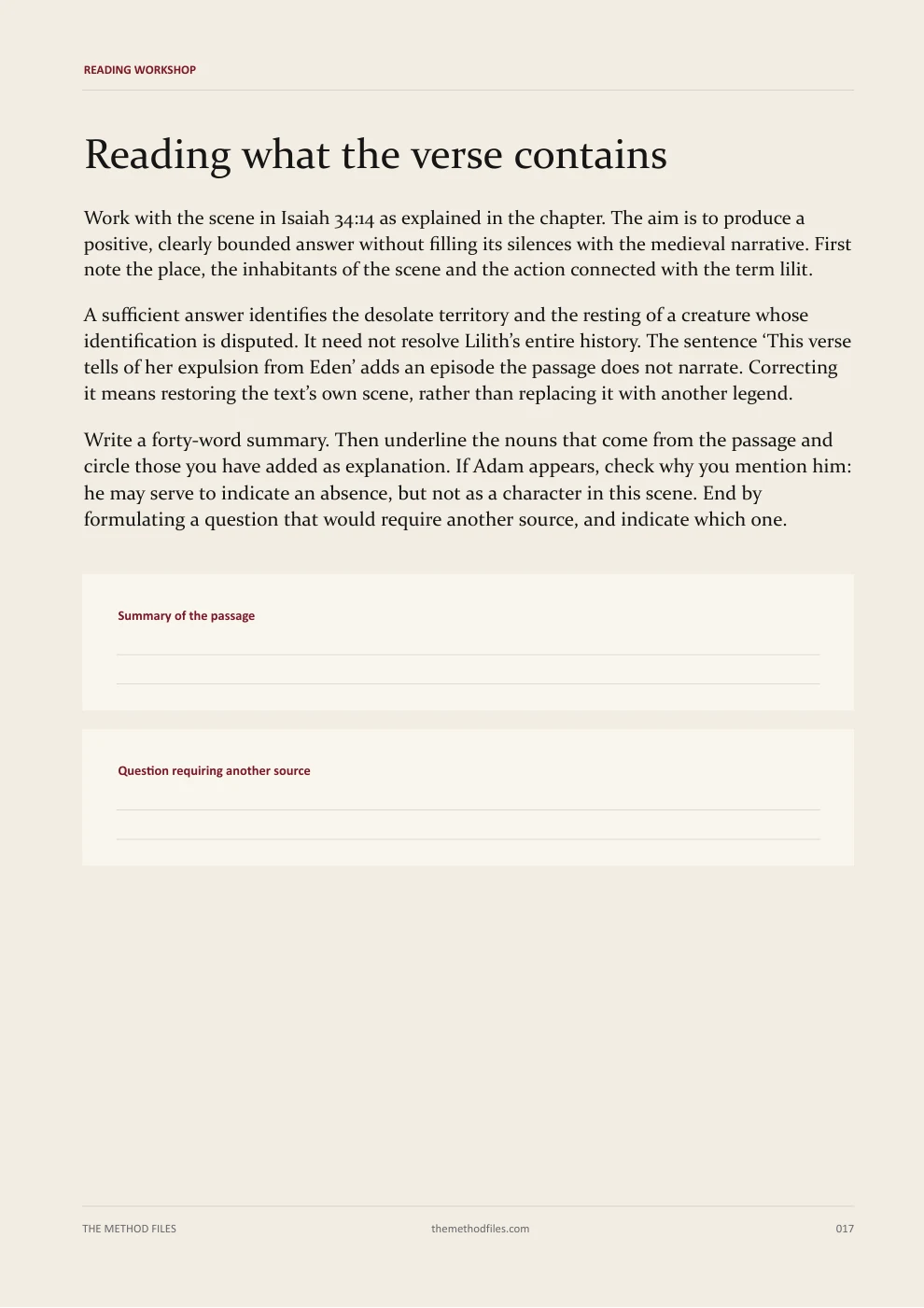
THE METHOD FILES themethodfiles.com 017 READING WORKSHOP Reading what the verse contains Work with the scene in Isaiah 34:14 as explained in the chapter. The aim is to produce a positive, clearly bounded answer without filling its silences with the medieval narrative. First note the place, the inhabitants of the scene and the action connected with the term lilit. A sufficient answer identifies the desolate territory and the resting of a creature whose identification is disputed. It need not resolve Lilith’s entire history. The sentence ‘This verse tells of her expulsion from Eden’ adds an episode the passage does not narrate. Correcting it means restoring the text’s own scene, rather than replacing it with another legend. Write a forty‐word summary. Then underline the nouns that come from the passage and circle those you have added as explanation. If Adam appears, check why you mention him: he may serve to indicate an absence, but not as a character in this scene. End by formulating a question that would require another source, and indicate which one. Summary of the passage Question requiring another sourceOpening and farewell · page 63 of the book

Read the text on this page
THE METHOD FILES themethodfiles.com 063 III / PREPARATION AND METHOD Opening and farewell ORIGINAL SYNTHESIS A common form for this book’s operations. Opening Arrange the table, have the notebook ready and state your purpose in one sentence. Look at Lilith’s image or name. Rest your hands and speak the opening clearly. Leave a short pause before beginning the chosen operation. Opening formula ‘I dedicate this time to Lilith. I enter by my own decision and with a defined purpose: [purpose]. I attend to word and image. I shall retain my judgement and bring this act to an end when the time comes.’ Taking leave When you have finished the steps, say: ‘Lilith, I bring this encounter to a close. The word has been spoken and the work ends here. I put away the signs and return to my tasks.’ Close the book or remove the image. Put the table in order and write your record. COMMON FORM Opening Express a single purpose. Perform Follow the chosen operation. Taking leave Put things away and turn to the notebook.Invocation of the name · page 69 of the book
Read the text on this page
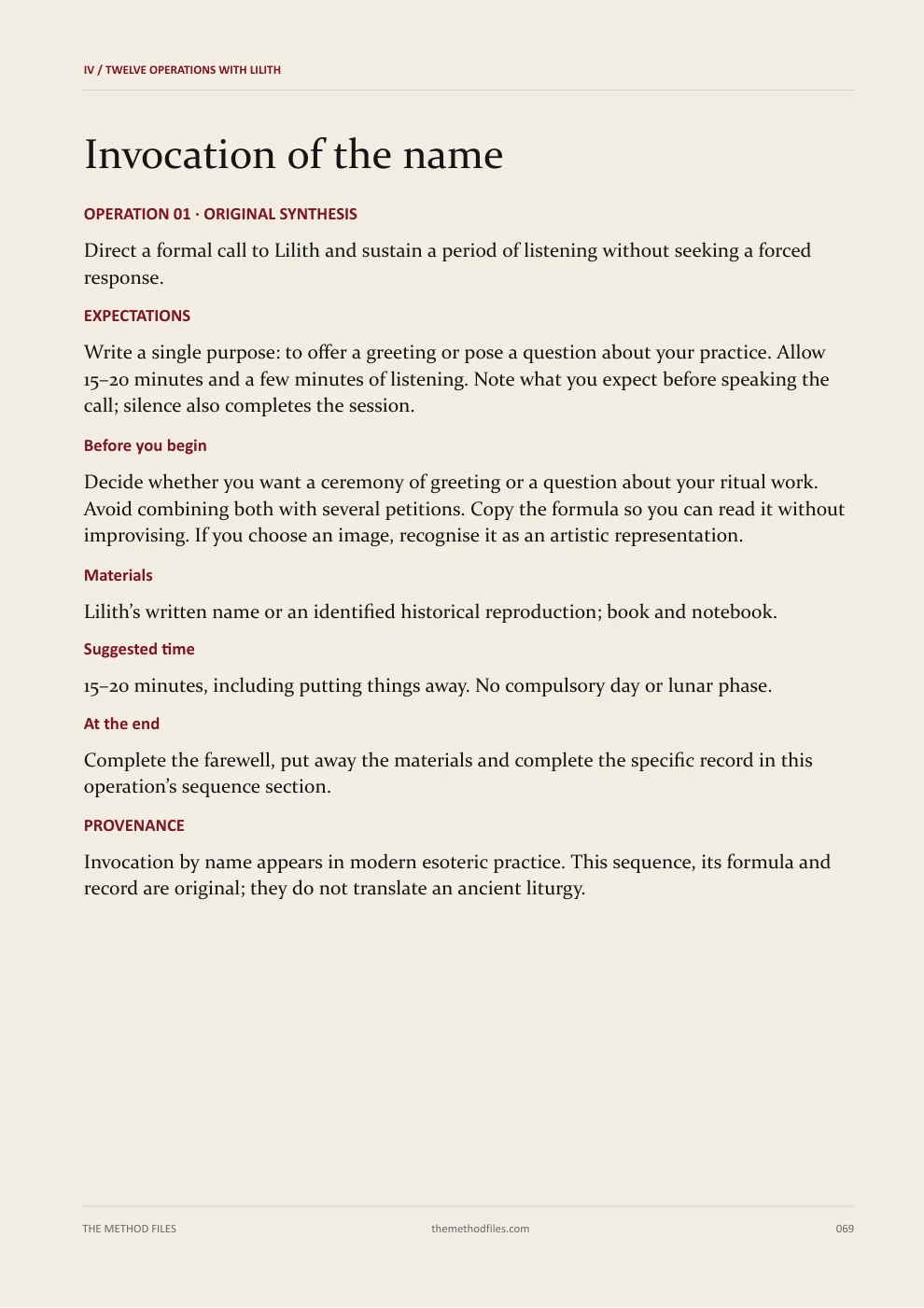
THE METHOD FILES themethodfiles.com 069 IV / TWELVE OPERATIONS WITH LILITH Invocation of the name OPERATION 01 ∙ ORIGINAL SYNTHESIS Direct a formal call to Lilith and sustain a period of listening without seeking a forced response. EXPECTATIONS Write a single purpose: to offer a greeting or pose a question about your practice. Allow 15–20 minutes and a few minutes of listening. Note what you expect before speaking the call; silence also completes the session. Before you begin Decide whether you want a ceremony of greeting or a question about your ritual work. Avoid combining both with several petitions. Copy the formula so you can read it without improvising. If you choose an image, recognise it as an artistic representation. Materials Lilith’s written name or an identified historical reproduction; book and notebook. Suggested time 15–20 minutes, including putting things away. No compulsory day or lunar phase. At the end Complete the farewell, put away the materials and complete the specific record in this operation’s sequence section. PROVENANCE Invocation by name appears in modern esoteric practice. This sequence, its formula and record are original; they do not translate an ancient liturgy.Invocation of the name · page 70 of the book

Read the text on this page
THE METHOD FILES themethodfiles.com 070 IV / TWELVE OPERATIONS WITH LILITH Invocation of the name OPERATION 01 ∙ SEQUENCE 01 ∙ Preparing the call Place the name or image before you. Write: ‘In this session I address Lilith in order to…’. Complete a single intention. Read the common opening and leave a pause. 02 ∙ Speaking the name Say ‘Lilith’ once, at a natural volume. Attend to the sound until it ends. Do not prolong your breathing or speed up repetition to provoke a special state. 03 ∙ Speaking the invocation Read the formula in this section. You may remain seated or standing. Keep the same posture while reading, so that attention rests on the word rather than on a succession of gestures. 04 ∙ Listening Remain silent for a few minutes. If you prepared a question, read it only once. Allow associations to emerge without arguing with them or adding new questions. If none emerges, conclude all the same. 05 ∙ Bringing it to an end Speak the farewell. Remove the name or close the page. Restore your usual light if you dimmed it, and turn to the notebook before doing anything else. WORDS FOR THE ACT ‘Lilith, to you I direct this voice. I name you in this place and at this time. I receive your image attentively and without command. May my word be clear and my listening measured. I remain before your name for the duration of this act.’ Closing Use the common farewell. Closing depends on your decision to finish, not on receiving a sign. Performance record Date, purpose, actual duration and formula used. Describe pauses, changes and impressions; separate facts from interpretation. The next day, compare what happened with your expectations, including silence. Afterwards Do not repeat the call immediately to correct a silent session. The next day, reread the record and decide whether the same purpose still makes sense.Recording a silent session · page 71 of the book

Read the text on this page
THE METHOD FILES themethodfiles.com 071 READING WORKSHOP Recording a silent session A session without notable impressions still has a duration, words spoken and a way of concluding. If a record captures only striking experiences, it loses the ability to describe what actually happened. Fictional case: a question was prepared, the formula was read, there were three minutes of silence and the farewell was spoken. The note ‘nothing happened’ erases four actions. A more precise version retains the question, reading, pause and closing, adding ‘no notable associations’. It need not invent an answer to complete the record. Write that record with an expectation and a result. Then write what you would review the next day: clarity of purpose, ease of reading or the time set aside. Choose a single improvement within your control. Do not turn silence into an obligation to repeat immediately or a sign of rejection. Review works with actions and expectations you can describe. Expectations and performance One specific improvementWhere each operation comes from · page 110 of the book

Read the text on this page
THE METHOD FILES themethodfiles.com 110 V / SOURCES AND READING Where each operation comes from Sources provide motifs and contexts. The sequences, formulas and records are original to The Method Files. OPERATION CONTEXT ORIGINAL CONTRIBUTION 1 ∙ Invocation Name and invocation in modern practice. Five‐step call, formula and listening. 2 ∙ Evocation Evocation and images in Mason. Empty place and distinct representation. 3 ∙ Sign Modern example by owl_clan, 2007. Original monogram and dedication. 4 ∙ Mirror Art, Clm 849 and modern observation. Brief consultation without medieval reconstruction. 5 ∙ Dream Contemporary dream reception. Preparation, closing before sleep and record. 6 ∙ Descent Modern vision; departure in Ben Sira. Scene of entry, threshold and return.Texts and witnesses · page 117 of the book
Read the text on this page
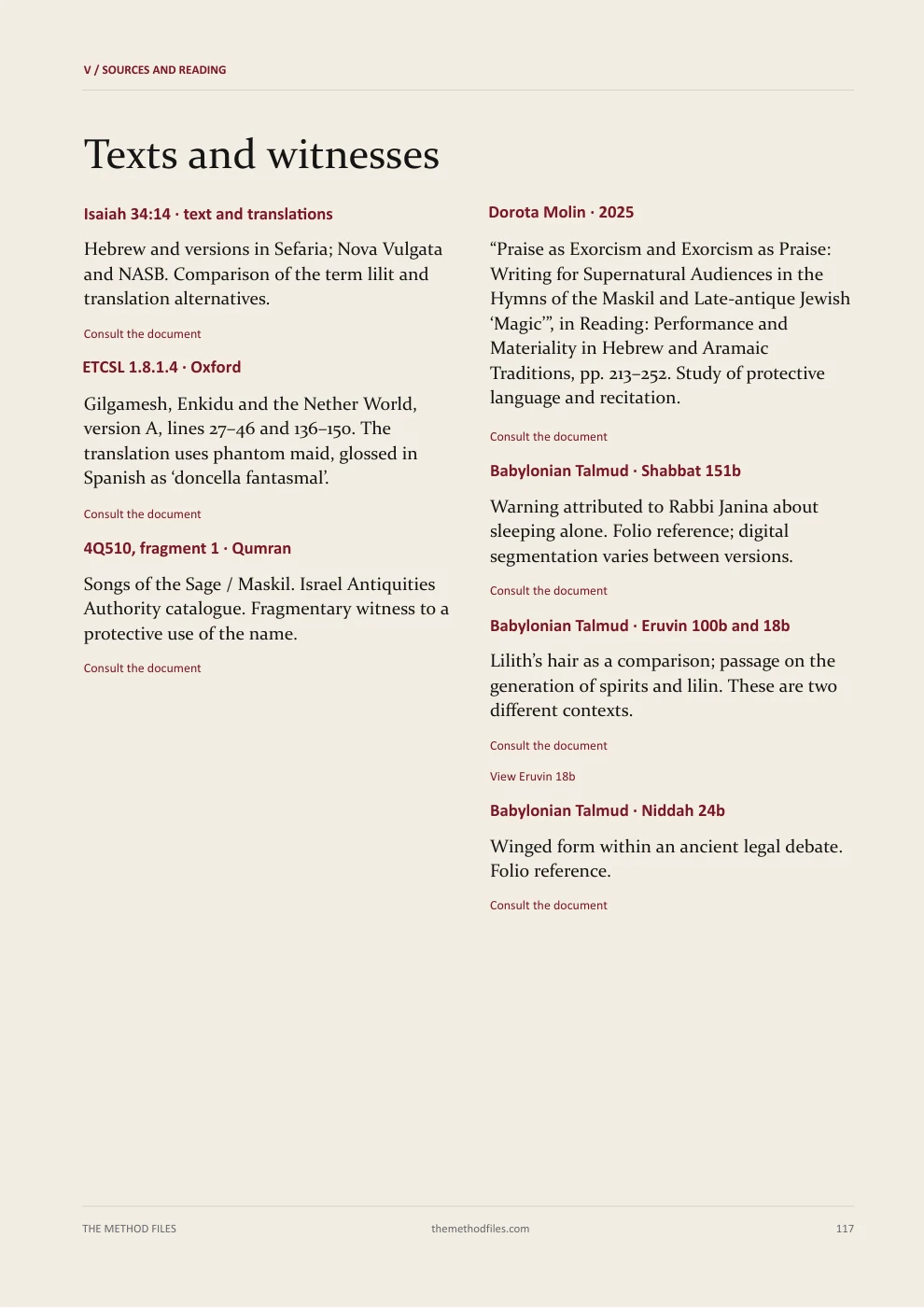
THE METHOD FILES themethodfiles.com 117 ETCSL 1.8.1.4 · Oxford Dorota Molin · 2025 V / SOURCES AND READING Texts and witnesses Isaiah 34:14 ∙ text and translations Hebrew and versions in Sefaria; Nova Vulgata and NASB. Comparison of the term lilit and translation alternatives. Consult the document Gilgamesh, Enkidu and the Nether World, version A, lines 27–46 and 136–150. The translation uses phantom maid, glossed in Spanish as ‘doncella fantasmal’. Consult the document 4Q510, fragment 1 ∙ Qumran Songs of the Sage / Maskil. Israel Antiquities Authority catalogue. Fragmentary witness to a protective use of the name. Consult the document “Praise as Exorcism and Exorcism as Praise: Writing for Supernatural Audiences in the Hymns of the Maskil and Late‐antique Jewish ‘Magic’”, in Reading: Performance and Materiality in Hebrew and Aramaic Traditions, pp. 213–252. Study of protective language and recitation. Consult the document Babylonian Talmud ∙ Shabbat 151b Warning attributed to Rabbi Janina about sleeping alone. Folio reference; digital segmentation varies between versions. Consult the document Babylonian Talmud ∙ Eruvin 100b and 18b Lilith’s hair as a comparison; passage on the generation of spirits and lilin. These are two different contexts. Consult the document View Eruvin 18b Babylonian Talmud ∙ Niddah 24b Winged form within an ancient legal debate. Folio reference. Consult the documentContinue reading
Read the text on this page
THE METHOD FILES / READING SAMPLE Lilith The Night and the Threshold Your reading can continue. The complete book contains 122 pages, reading workshops and 12 contemporary operations, with their sources and references. You can follow the historical journey without performing the practices. If you decide to explore them, you will find contemporary compositions identified as such, with preparation, a central sequence and closing. Digital book in PDF, in English. It does not include tutoring or access to TMF courses. Exercises are completed in a notebook or using the PDF reader’s annotation tools. Explore the complete book themethodfiles.com/libros‐digitales/lilith/ TMF digital books ∙ English ∙ Free sample
Continue whenever you wish