Read before you choose
Set
Strength and Conflict
This 16-page sample includes an introduction, a historical passage, a workshop, one complete practice and references. It retains the original book’s page numbers: the gaps reflect the selection.
Download PDF · 6.3 MBNo registration · Selectable text in the PDF
Cover

Read the text on this page
themethodfiles.com THE METHOD FILES SET Strength and Conflict HISTORY ∙ SYMBOLS ∙ TWELVE OPERATIONSAbout this reading sample
Read the text on this page
THE METHOD FILES / READING SAMPLE Set Strength and Conflict A selection of pages from the complete book, with no registration required. We preserve the layout, text and numbering of the full English edition. You will find the introduction, a historical passage, a workshop, a complete practice and references to place your reading in context. Gaps in numbering reflect this selection: they are not missing pages. History A god within a world Reading workshop A function needs a context Complete contemporary practice Presenting strength References to other parts of the volume belong to the complete book. This sample’s pages follow the original reading order. You can use the reader’s bookmarks to move between them. TMF digital books ∙ English ∙ Free sampleRead the source. Recognise the creation. · page 7 of the book
Read the text on this page
THE METHOD FILES themethodfiles.com 007 NOTE ON METHOD Read the source. Recognise the creation. DOCUMENT A passage, image or object that can be located. When a source attributes powers or recounts apparitions, we set out what that text claims, without turning it into a verified fact. RECEPTION The transformation of a name or figure in another book, period or artistic language. Differences in rank, appearance and function are retained and explained. INTERPRETATION The reading proposed in these pages. It is distinguished from the words of a source and can be revised without altering the document from which it begins. CONTEMPORARY CEREMONY All the operations in this volume are original compositions. Each identifies the motifs it takes from the sources and specifies its own objects, words, closing and record. PRINCIPLE FOR PRACTICE Participation is voluntary and may end at any time. No supernatural result is promised. The operations concern one’s own attention, devotion and conduct; they do not authorise control over other people. The original formulas were written in Spanish; English translations are provided here. Terms from other languages are explained in context or in the glossary.Strength and conflict · page 8 of the book

Read the text on this page
THE METHOD FILES themethodfiles.com 008 INTRODUCTION Strength and conflict The move from history to ceremony is not an automatic translation. A narrated tribunal does not provide instructions for arranging a table; a surviving sceptre does not determine the words to speak before it. Practice begins with a creative decision: choosing a motif, declaring its present function and constructing a sequence that can be performed from beginning to end. In this book, that step remains visible so readers can assess the relationship between document and interpretation. The twelve operations work with different dimensions of strength: presenting it, bounding it, subjecting it to objection, supporting it, directing it and closing a dispute. Some take place before an image; others use cards, a rod or a paper boat. The variety is not a scale of power. Each ceremony has its own purpose and may suffice alone. The corpus offers a possible route from initial attention to review of what was done, without making reading an obligation to complete every act. The final record returns practice to a specific measure. It notes what happened, what was felt, what interpretation is proposed and which subsequent action is within one’s control. Intense emotion does not demonstrate external intervention; a quiet session is not a failure. The work’s seriousness also lies in being able to finish without forcing a sign. Set thus remains the centre of a reading and contemporary practice whose potency is examined through clear commitments, precise limits and consequences the participant agrees to review.A god within a world · page 10 of the book
Read the text on this page
THE METHOD FILES themethodfiles.com 010 HISTORY ∙ 01 A god within a world Set belongs to ancient Egypt’s religious landscape. The objects and stories preserving him do not form a single biography: they show functions, alliances and conflicts changing with context. A Ramesside scarab bearing Seth‐Baal, a narrative about Osiris’s throne and a Greek author’s explanation answer different questions. To bring them together, those differences must be retained. The god’s strength is not a password capable of explaining every witness by itself. This volume’s title proposes studying the relationship between potency and conflict. It is a contemporary reading choice. It does not mean Egyptians possessed this same book or venerated a psychological abstraction called ‘conflict’. Their gods intervened in the king’s life, cult, protection of the deceased and the world’s order. Reducing those relationships to a lesson in self‐esteem would leave much of their religious meaning out. Nor does it help to place Set automatically in a European grimoire’s hierarchy of demons. Sharing a collection with Paimon or Azazel does not make all three members of one tradition. Here unity belongs to the working method: identified sources, located images and present‐day ceremonies with acknowledged authorship. Set’s distinctiveness will lie in how a force capable of disputing an order may also receive a place within it. That tension requires reading before classification. Sources: S1; S2; S3A function needs a context · page 11 of the book

Read the text on this page
THE METHOD FILES themethodfiles.com 011 CASES AND READING WORKSHOPS A function needs a context A description calls Set ‘god of chaos’ and claims to explain every representation through that label. The chapter poses a difficulty for the formula: a figure may intervene in conflicts and receive other functions in different witnesses. Choose two passages in the book that cannot be summarised in the same way. Note what Set does in each, who tells the scene and what result his intervention has. Do not combine the two actions into a continuous biography if the documents do not establish that continuity. Comparison must retain the references allowing a return to each narrative. Write one sentence describing a particular function and another explaining its limit. Check whether your initial label remains sufficient or needs qualification. A shorter description is not always more accurate. Function in context and witness Limit of the initial labelPreparing the table · page 69 of the book
Read the text on this page
THE METHOD FILES themethodfiles.com 069 BEFORE THE CEREMONY Preparing the table Prepare a surface where you can read and move objects without haste. The ceremonies use ordinary materials: paper, a smooth stone, a cloth or a blunt rod. Their function is defined in each sequence; they need no special provenance and do not replace the historical objects reproduced here. Choose a specific matter of your own. Write down which capacity you want to bring into play, what boundary you will accept and what outcome will be recorded. If the matter affects other people, distinguish your individual preparation from agreements that still require their participation. Place the plate or the card bearing Set’s name where you can look at it without obscuring your notes. The image serves as a reference for attention. Before beginning, identify the source that inspires the operation and read its closing as well. Set aside between fifteen and twenty minutes, unless the sequence specifies another duration. You can stop and record the interruption. When you finish, put away the objects and afterwards carry out, as an ordinary task, any consultation, repair or action you have prepared. AN INTENTION AND AN END Before you begin, write down what you will do and how you will know you have finished. Afterwards, complete the record with facts, impressions and decisions in separate fields.The form of the ceremony · page 70 of the book

Read the text on this page
THE METHOD FILES themethodfiles.com 070 WORD ∙ GESTURE ∙ CLOSING The form of the ceremony PRESENTING STRENGTH The opening names a task and a capacity. The stone, rod or paper take defined positions after the purpose can be explained. The gesture introduces attention and leaves a visible trace in the record. MOVING WITH INTENTION The objects are moved deliberately. Their position represents a written decision; a fall or loss of balance is not interpreted as an answer. The sequence allows the decision to be reviewed before it is fixed. SPEAKING AND RESPONDING Each formula is original in Spanish, presented here in English translation. It is read at the indicated moment in a comfortable voice. An action then follows that responds to the purpose: specifying, consulting, repairing or narrowing the scope of a task. BRINGING TO AN END The closing removes the objects and distinguishes the ceremony from the subsequent action. An unresolved emotion does not require the session to remain open. The record preserves what happened and what must be checked outside it. The twelve sequences and their formulas are original compositions. Each operation identifies its documentary motif.01 · PRESENTING STRENGTH · page 72 of the book

Read the text on this page
THE METHOD FILES themethodfiles.com 072 OPERATION 01 ∙ BASIS AND PREPARATION 01 ∙ Presenting strength To open a session devoted to Set and give a specific direction to one’s own strength. The ceremony serves as a first entry into the corpus or as an independent act before a task requiring firmness, attention and the ability to stop. The sources studied show Set in different relationships: rivalry, authority and participation in an order. This operation takes that plurality as its starting point. Presenting strength means recognising a capacity and also the responsibility of choosing where it acts. The god’s image does not decide the purpose for the participant; it requires them to formulate it clearly. The centre of the table is empty at first. That absence prevents the first impulse from occupying the whole space. The name card is placed after the task has been described, so that word, image and action are connected. The sequence is a present‐day composition; it does not reproduce the opening of an Egyptian temple. MATERIALS A plate depicting Set from this book or a card bearing his name, an ordinary smooth stone, a notebook and a pencil. A clear table and sufficient light to read. PREPARATION Set aside fifteen minutes. Choose a task of your own that can be described in one sentence: preparing a conversation, finishing a piece of work or maintaining a decision. Also write down what behaviour will remain outside the session. Place the stone on the left and leave the centre clear. Provenance of the motif: S1; S3: the plurality of Set’s functions and representations.01 · Sequence and closing · page 73 of the book
Read the text on this page
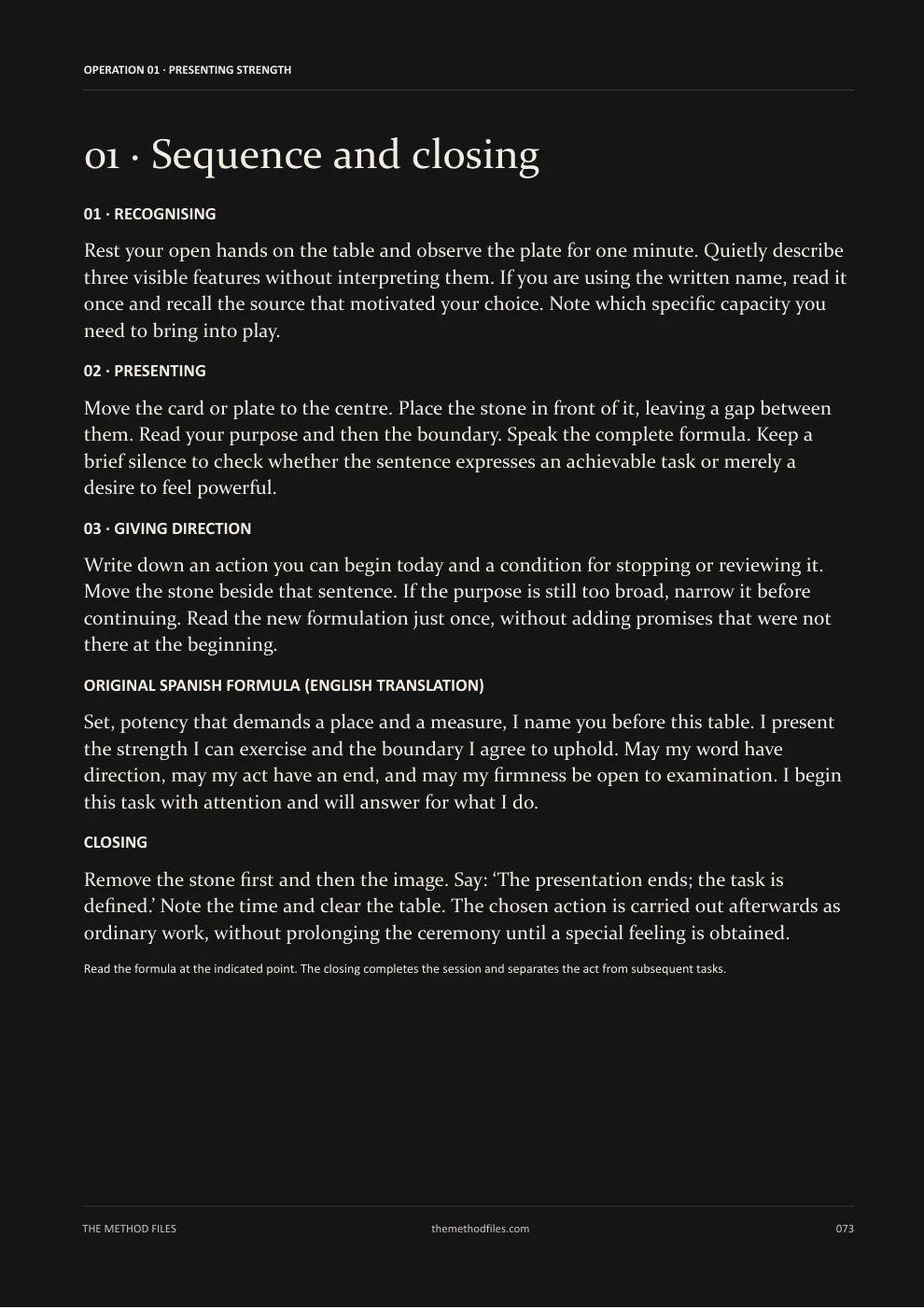
THE METHOD FILES themethodfiles.com 073 OPERATION 01 ∙ PRESENTING STRENGTH 01 ∙ Sequence and closing 01 ∙ RECOGNISING Rest your open hands on the table and observe the plate for one minute. Quietly describe three visible features without interpreting them. If you are using the written name, read it once and recall the source that motivated your choice. Note which specific capacity you need to bring into play. 02 ∙ PRESENTING Move the card or plate to the centre. Place the stone in front of it, leaving a gap between them. Read your purpose and then the boundary. Speak the complete formula. Keep a brief silence to check whether the sentence expresses an achievable task or merely a desire to feel powerful. 03 ∙ GIVING DIRECTION Write down an action you can begin today and a condition for stopping or reviewing it. Move the stone beside that sentence. If the purpose is still too broad, narrow it before continuing. Read the new formulation just once, without adding promises that were not there at the beginning. ORIGINAL SPANISH FORMULA (ENGLISH TRANSLATION) Set, potency that demands a place and a measure, I name you before this table. I present the strength I can exercise and the boundary I agree to uphold. May my word have direction, may my act have an end, and may my firmness be open to examination. I begin this task with attention and will answer for what I do. CLOSING Remove the stone first and then the image. Say: ‘The presentation ends; the task is defined.’ Note the time and clear the table. The chosen action is carried out afterwards as ordinary work, without prolonging the ceremony until a special feeling is obtained. Read the formula at the indicated point. The closing completes the session and separates the act from subsequent tasks.01 · Reading and record · page 74 of the book

Read the text on this page
THE METHOD FILES themethodfiles.com 074 OPERATION 01 ∙ READING AND RECORD 01 ∙ Reading and record MEANING OF THE OPERATION The stone represents readiness, not a reserve of power measured by its weight or rarity. What matters is the change from a general capacity to a bounded act. If the purpose ends up smaller than at the beginning, the session may have gained precision. The boundary is part of the commitment, not a clause to be ignored when enthusiasm arises. EXAMPLE OF APPLICATION Someone wants to ‘assert dominance’ in a meeting. When formulating the task, they change it to presenting two pieces of information and asking for a turn to respond. Their boundary is not raising their voice or attributing intentions. The ceremony does not resolve the meeting: it prepares behaviour they can review afterwards. VARIANT Before manual work, replace the stone with a closed, safe tool you already use. Do not consecrate it as an ancient object: declare its present function and put it away at the closing. The subsequent task may begin the following day if that is what you have specified. QUESTIONS AND FIELDS FOR THE RECORD What capacity did I name? What boundary did I accept? What action did I choose? Add the difference between the initial and final purpose, and a near‐term date for checking what was done. The examples are fictional situations intended to help explain the practice; they are not presented as evidence of efficacy.Sources consulted · 1 · page 126 of the book

Read the text on this page
THE METHOD FILES themethodfiles.com 126 S1 S2 S3 The Met. Scarab with Figure of Seth-Baal on a Lion. Inv.22.1.451. S4 S5 The Met. Head of a was scepter. Inv.25.3.284h. TEXTS AND WITNESSES ∙ 1 Sources consulted ∙ 1 The Metropolitan Museum of Art. Divine Egypt, ‘Introduction’ and ‘Ruling the Cosmos’. Curatorial framework for the plurality of deities’ functions and the relationship between kingship, order and conflict. Its interpretations are distinguished from the ancient objects assembled in the exhibition. View the document Alan H. Gardiner. The Library of A. Chester Beatty… Papyrus No. I, 1931. The Contendings of Horus and Set. Edition consulted for the sequence of the dispute: claims, assembly, Isis’s intervention, trials and conclusion. The volume offers its own paraphrases of the narrative and distinguishes interpretation of its episodes from a reconstruction of worship. View the document Catalogue entry for material evidence of Seth‐ Baal. It allows the object, chronology, provenance and visible attributes to be identified. The relationship between names and forms is studied from that piece, without turning it into proof of a uniform identity in every period. View the document E. A. Wallis Budge. The Gods of the Egyptians, vol.II, 1904, ch.XIV, pp.241‐253. Source for the history of Egyptology and graphic reception. It is consulted critically: its equivalences and naturalistic explanations are not adopted as present‐day consensus. The Horus‐Set plate is a published reproduction from 1904, not a photograph of an ancient object. View the document Identifies a wooden sceptre head and its context. The sign of dominion has shared attributions among deities; its presence is not sufficient to identify a figure as Set. View the document Accessed: September 2026. Paraphrases and commentary are the author’s own. Modern notes are distinguished from historical texts.Sources consulted · 2 · page 127 of the book

Read the text on this page
THE METHOD FILES themethodfiles.com 127 S6 The Met. Wedjat Eye Amulet. Inv.89.2.415. S7 S8 S9 The Met. Motto Clasp. Inv.43.2.3. S10 The Met. Artist’s Painting of a Hippopotamus. Inv.23.3.6. TEXTS AND WITNESSES ∙ 2 Sources consulted ∙ 2 Object used to study the restored eye of Horus and its protective associations. It is included as a relationship between figures and motifs; it is not presented as Set’s personal seal. View the document Plutarch. De Iside et Osiride. Text in F. C. Babbitt’s translation, Loeb, 1936; LacusCurtius digital edition. Graeco‐Roman evidence of the reception of the stories of Isis, Osiris and Typhon. Its philosophical interpretations must be read as part of that context, not as a direct transcription of a single Egyptian doctrine. View the document The Met. Seth‐Baal scarabs. Inv.22.1.425 and 22.1.392. Two distinct pieces allow attributes, materials and conventions of representation to be compared. The second catalogue entry is linked in its plate credits. The comparison preserves each object’s identity. View the document Identifying the formula’s two gods as Horus and Set is presented as a possibility. That reservation is retained in the commentary and the ceremony inspired by the clasp. View the document A piece used to distinguish an animal representation from an automatic divine identification. The hippopotamus has various contexts; this painting does not in itself become a portrait of Set. View the document Accessed: September 2026. Paraphrases and commentary are the author’s own. Modern notes are distinguished from historical texts.Images and rights · 1 · page 128 of the book

Read the text on this page
THE METHOD FILES themethodfiles.com 128 PLATES 01‐04 Images and rights ∙ 1 01 ∙ SETH‐BAAL ON A LION The Metropolitan Museum of Art, New York. Scarab with Figure of Seth‐Baal on a Lion. Inv.22.1.451. Rogers Fund and Edward S. Harkness Gift, 1922. Public‐domain image, Open Access programme (CC0). View the document 02 ∙ ATTRIBUTES ON A VERY SMALL SURFACE The Metropolitan Museum of Art, New York. Scarab with a Representation of Seth‐Baal and Uraeus. Inv.22.1.425. Rogers Fund and Edward S. Harkness Gift, 1922. Public‐domain image, Open Access programme (CC0). View the document 03 ∙ ANOTHER IMAGE OF SETH‐BAAL The Metropolitan Museum of Art, New York. Scarab with Figure of Winged Seth‐Baal. Inv.22.1.392. Rogers Fund and Edward S. Harkness Gift, 1922. Public‐domain image, Open Access programme (CC0). View the document 04 ∙ THE HEAD OF THE UAS SCEPTRE The Metropolitan Museum of Art, New York. Head of a was scepter. Inv.25.3.284h. Rogers Fund, 1925. Public‐domain image, Open Access programme (CC0). View the document PRINCIPLE OF REPRODUCTION Pages and works are preserved in full. Rescaling does not redraw signs or reconstruct missing parts. The links identify the object or copy and allow you to consult its details and conditions of use. CC0 and Public Domain Mark identify the conditions stated by the institutions; they do not attribute authorship of the works to this book.Images and rights · 2 · page 129 of the book

Read the text on this page
THE METHOD FILES themethodfiles.com 129 PLATES 05‐08 Images and rights ∙ 2 05 ∙ HORUS‐SET IN A PLATE FROM 1904 E. A. Wallis Budge, The Gods of the Egyptians, vol.II, Methuen, 1904. Unnumbered plate between pp.242 and 243. Copy digitised in Internet Archive. Historical work in the public domain. View the document 06 ∙ A CLASP AND TWO GODS The Metropolitan Museum of Art, New York. Motto Clasp. Inv.43.2.3. Rogers Fund, 1943. Public‐domain image, Open Access programme (CC0). View the document 07 ∙ THE RESTORED EYE OF HORUS The Metropolitan Museum of Art, New York. Wedjat Eye Amulet. Inv.89.2.415. Gift of Joseph W. Drexel, 1889. Public‐domain image, Open Access programme (CC0). View the document 08 ∙ THE HIPPOPOTAMUS AND ITS CONTEXT The Metropolitan Museum of Art, New York. Artist's Painting of a Hippopotamus. Inv.23.3.6. Rogers Fund, 1923. Public‐domain image, Open Access programme (CC0). View the document COVER Cover: contemporary illustration created with artificial intelligence assistance for The Method Files, 2026. It does not reproduce a historical object. Typefaces: Constantia and Calibri, embedded for digital reading. CC0 and Public Domain Mark identify the conditions stated by the institutions; they do not attribute authorship of the works to this book.Continue reading

Read the text on this page
THE METHOD FILES / READING SAMPLE Set Strength and Conflict Your reading can continue. The complete book contains 131 pages, reading workshops and 12 contemporary operations, with their sources and references. You can follow the historical journey without performing the practices. If you decide to explore them, you will find contemporary compositions identified as such, with preparation, a central sequence and closing. Digital book in PDF, in English. It does not include tutoring or access to TMF courses. Exercises are completed in a notebook or using the PDF reader’s annotation tools. Explore the complete book themethodfiles.com/libros‐digitales/set/ TMF digital books ∙ English ∙ Free sample
Continue whenever you wish