History and symbols
The reliquary of the Holy Crib at São Roque, Lisbon
In Lisbon, a small precious-metal Nativity brings a recognisable scene together with venerated fragments. Its history shows how a reliquary could preserve, display and make a sacred past present.
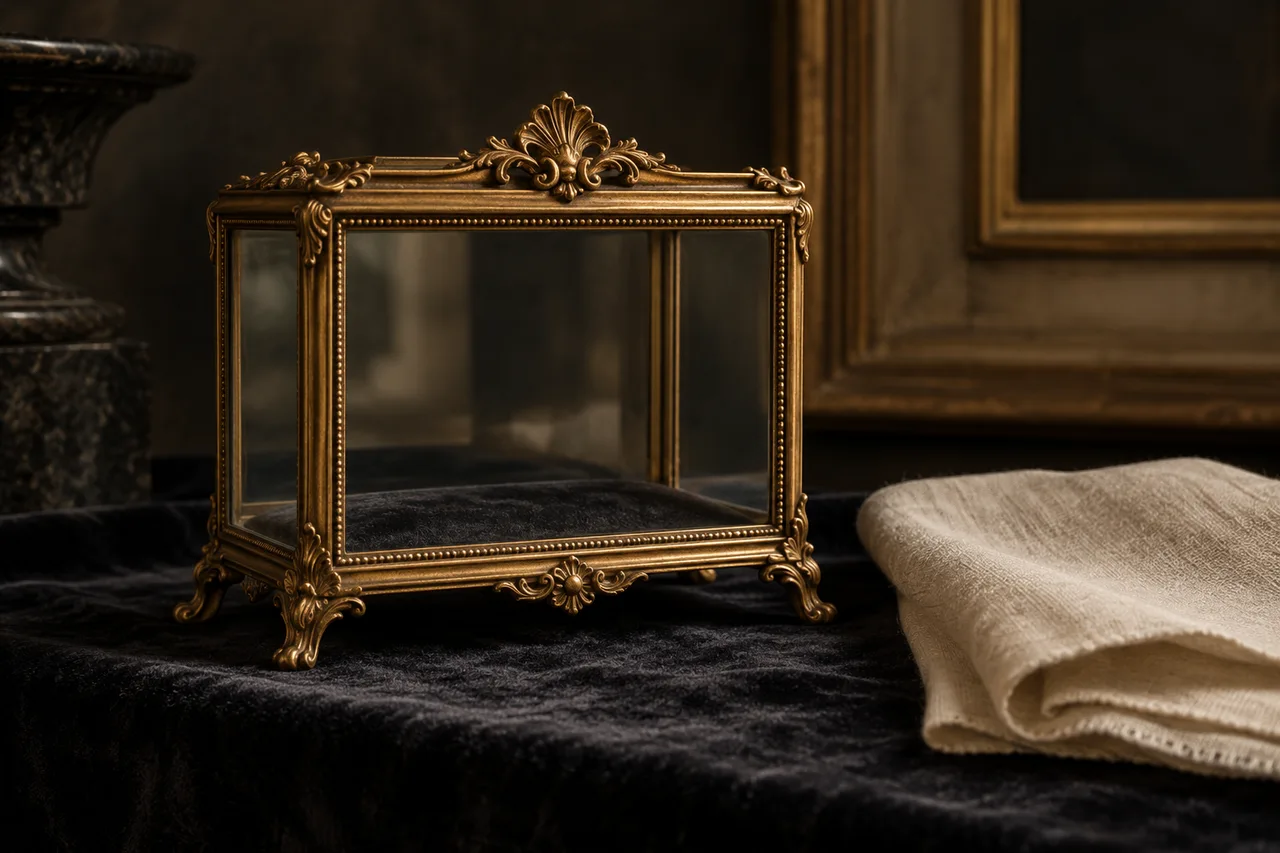
In the Relicário do Presépio at São Roque in Lisbon, silver and gilt bronze surround small wooden fragments. The museum dates the Portuguese object to 1615: inventory RL.048, height 61 centimetres. Its Nativity scene contains Mary, Joseph, the Child and animals; the wood rests in the manger. Reliquary catalogue entry.
The relationship between materials is central. Metal provides an elaborate structure; the fragment supports a claim to proximity with Christ's history. In devotion, the wood matters not for material rarity but for the event to which it is believed connected. The reliquary gives an attributed association a place and a focus of attention.
Represent and contain
A Nativity represents a birth through figures. This object also contains something venerated as a remnant of the physical manger. Representation makes the story recognisable; the relic claims a material relationship with it. The functions coexist without being equivalent.
We can understand this difference without resolving authenticity by looking. No visible wooden form proves its origin. Identification depends on a transmitted history and its preserving institution. The object's force comes from joining what is displayed with what is told about it.
The Nativity also gives the relic an intelligible location. The fragment is not presented as anonymous matter isolated from meaning, but integrated into the place represented. The miniature connects the venerated object to an episode, while the relic invites the miniature to be more than illustration.
A circulation that leads to Lisbon
The museum connects the fragments with the manger venerated at Santa Maria Maggiore in Rome. When Clement VIII gave a portion to Margaret of Austria, Queen of Spain, Jesuit João Álvares also obtained small pieces for São Roque. Initially kept in a velvet-lined chest, they were taken to sick people to be kissed. Devotional origin and first container.
This narrative traces mediation through papal authority, the Spanish court, the Society of Jesus and Lisbon's professed house. The object did not originate solely in a goldsmith's workshop. Before the 1615 structure, there was already a circulating object, a sacred attribution and a practice of contact.
Moving from chest to Nativity changed the presentation. A chest protects contents without depicting their origin; the Nativity explains it. The description cannot tell us every person's reaction. It does reveal two ways of presenting a relic: within a textile-lined container and within a figurative narrative.
The chapel as the second frame
The Capela do Presépio page locates its small altar in the corridor leading to the sacristy. It describes a carved, gilded wooden altarpiece with paired Solomonic columns and a rectangular niche for the Nativity reliquary. One frame sits within another: figures inhabit the metalwork, which in turn occupies a place in the church's architecture. Institutional description of the chapel.
This sequence changes the scale of attention. The building admits the community; the chapel focuses the gaze; the reliquary gathers a scene; the manger holds fragments. Each level leads towards something smaller. Devotional importance need not follow physical size: it may grow as the central quantity of matter diminishes.
The object entry adds that it was displayed at Christmas and a painting covered the niche during the rest of the year. Historical exhibition calendar. The presence therefore had a rhythm. To preserve did not mean to offer a permanent visual availability. The act of showing belonged to a date, and that date linked the birth represented with its celebration.
The body, scene and inscription
Another Portuguese reliquary at São Roque highlights the choice of a Nativity. The late-sixteenth-century arm reliquary of Saint John Chrysostom uses gilt copper, silver and stones. Its entry distinguishes two glazed oval receptacles, one for a relic and one for an inscription, beneath an open hand. The museum notes that today's silver base replaced a pedestal documented in the 1603 inventory. Arm reliquary RL.282.
The comparison does not make the objects interchangeable. An arm invokes a body; a Nativity organises an episode. In one, text explicitly identifies the contents. In the other, a scene explains why wood matters. Their forms construct different relationships between remains, names and history.
The replaced base also gives the container a biography. A relic may be considered ancient while its housing changes appearance, material or location. The times of the venerated contents and the work displaying them need not coincide. Looking at a reliquary requires holding both chronologies together.
Between church and museum
São Roque's collection includes many types of reliquary and owes much to João de Borja's 1588 donation to the Jesuits. This concerns the collection as a whole, not the particular origin of the 1615 Nativity. General history of the collection. The distinction matters because a treasury's apparent unity can conceal different acquisitions, commissions and transformations.
After the expulsion of the Jesuits, the church and the professed house passed with their goods to the Santa Casa da Misericórdia in Lisbon in 1768. The museum opened to the public in 1905. History of São Roque as an institution. Conservation added new languages: inventory, date, materials and artistic study, along with the religious memory of the place.
The Nativity reliquary sustains both forms of attention. It can be studied as Portuguese work from 1615 and understood as a vehicle of sacred presence for its worshippers. Their encounter need not erase their distinction. Within a gleaming structure, a small piece of wood concentrates a history much greater than its size.
Sources and references
- Museu de São Roque. Relicário do Presépio, RL.048.
- Museu de São Roque. Capela do Presépio.
- Museu de São Roque. Braço Relicário de São João Crisóstomo, RL.282.
- Museu de São Roque. Reliquary collection and history of the museum and the church.