A silhouette may look like someone before we know what produces it. Four investigations help to separate form, expectation and explanation, without turning a possibility into a verdict.
A sheet of glass can place a figure where no one stands. The illusion made famous in Victorian London offers a different perspective on shows now called holograms.
A photograph can faithfully record a staged scene. Elsie Wright and Frances Griffiths’s images reveal how a small construction came to be treated as extraordinary evidence.
The famous chess player moved pieces before an audience while concealing whoever chose the moves. Its history helps distinguish a convincing display from an adequate test.
A visitor tries to test Abe no Seimei. His shikigami open a history of invisible servants, rivalry and characters that change as they move onto the screen.
In 1853, Michael Faraday placed an indicator between some hands and a table. The question seemed small: which had moved first? The answer changed how the whole room could be understood.
William Mumler sold photographs in which the living appeared accompanied by figures attributed to the dead. His images allow us to follow a dispute over technique, recognition and comfort that is not resolved by looking only at the paper.
Florence Cook, a figure dressed in white and the chemist William Crookes. During the 1874 séances, the question concerned not only what appeared, but who could see it, from where and under what conditions.
A vanished rectory, a file of press cuttings and an enduring dispute. Borley’s history reveals how a building becomes a ghost story and what we need to read it without confusing evidence with reputation.
A recorded noise can resemble a voice; a voice can resemble a phrase. Between sound and its supposed speaker lie several steps that the history of electronic voice phenomena and two experiments let us examine separately.
First an unauthorised intervention, then an authorised mural: the history of Keith Haring’s work on a New York handball court requires distinctions between message, version and preservation.
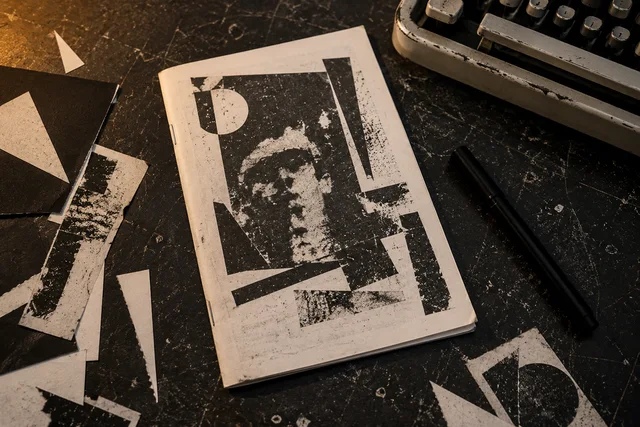
A typewriter, a felt-tip pen and an editorial decision were enough to begin in 1976. The short history of Mark Perry's fanzine shows what limited resources make possible and what they cannot solve.
In a printed version of Punch and Judy, the demon comes to the end and also fails to impose order. The scene makes the little theater a place far less innocent than it seems.
A small shoe from Edinburgh traces the passage from everyday clothing to a possible protective object. The key lies in what is known about its discovery and what cannot yet be claimed.
In 1843 she began a book made with light, specimens and names. Its blue pages invite a question: how does a botanical image become a document while remaining a constructed representation?
The War of the Worlds sounded like news in 1938. Understanding its construction is easier than measuring the fear it caused: broadcast, testimony and headlines require different questions.
A small painting dedicated to Saint James preserves thanks for a recovery. Its strength lies in how it organises experience; its limit lies in what an image alone cannot prove.
In 1835, The Sun published an alleged exploration of lunar life. The episode shows how news can borrow the name of a scientist, the form of a report and the authority of an illustration.
The obsidian associated with John Dee preserves a Mexican history, an English attribution and several ways of imagining what might appear on a dark surface.
A spiral of writing surrounds a demonic figure. British Museum bowl 139524 brings Mesopotamian incantations down to a specific scale: people seeking to protect their health.
A sealed seventeenth-century vessel preserved bodily traces and small metal objects. Its contents place the 'witch bottle' between fear of a curse, the search for a cure and imagined violence against whoever supposedly caused it.
The Paintings for the Temple emerged from a spiritual practice and developed into a project of images, notebooks and spaces. Their history reveals an abstraction that aspired to show more than forms.
In a 1513 engraving, Death raises an hourglass and the Devil accompanies a rider who scarcely seems to notice them. The scene’s tension has sustained differing interpretations for centuries.
A small thirteenth-century shrine preserves two images of the Buddhist universe. Opening it changes our understanding of a mandala: an image also has a scale, a material support and a way of being presented.
In Dewa Sanzan, ascetic practice makes the route through Haguro, Gassan and Yudono a journey between the present, death and rebirth. The mountain contributes distance, seasons, food and effort to the rite.
At Himeji Jinja, ofuda and omamori extend a relationship with the kami in different ways. One is received for veneration at home; the other accompanies the person. The distinction involves space, care and local memory.
A Yoshitsuya print captures Shuten-dōji's final attack. From this scene, oni reveal different roles: heroic enemy, misfortune expelled in a rite and a creature capable of prompting a smile.
Messengers from Inari, New Year's lights and a mother who writes with a brush: three scenes to approach the kitsune without turning them into a single creature.
In Naritasan Shinshōji, a Buddhist rite gathers flames, prayers, and daily worries. Its meaning appears when looking also at what happens before and after the fire.
Between the 1610 process, printed stories and a museum dedicated to victims, a place learns to tell a story that has also become attractive to tourists.
The amulet belt of the Sorolla Museum gathers claw, glass, bell and devotion. Its abundance allows to enter the Iberian history of the evil eye from the care that was placed around a vulnerable body.
The Museo del Traje's higa, CE010092, turns a finger gesture into carved jet. Its history combines craftsmanship, attributed protection and a Compostela provenance that the catalogue itself asks us to qualify.
In Moinho da Devesa 1, in northern Portugal, stone jambs retain a repertoire of signs. Protective marks share a building with dates, initials and traces of the trade: work and belief did not occupy separate worlds.
A Maucci edition traces the legendary book through business addresses, catalogues and libraries, where the saint's name brings together objects that do not always contain the same text.
The descent with falles brings mountain, village and memory together. Its documented history reveals a local festival without treating every Iberian bonfire as a remnant of one origin.
In Lisbon, a small precious-metal Nativity brings a recognisable scene together with venerated fragments. Its history shows how a reliquary could preserve, display and make a sacred past present.
Two small canvases painted for the Dukes of Osuna allow us to enter an uncomfortable area: satire can mock credulity and preserve, at the same time, the strength of a nightmare.
A brooch dedicated to Charles T. Evans preserves hair, a date and news of a death at sea. Mourning jewellery shows how a keepsake could be worn on the body even when its full history can no longer be recovered.
La Luz del Porvenir circulated beliefs, controversies and women's voices. Following Amalia Domingo Soler reveals Spanish Spiritism through its pages and associations, as well as around the séance table.
The Method Files
We noticed you're visiting from . We've updated our prices to for your shopping convenience. Use Euro instead.Dismiss
You choose your cookies
We use cookies that are necessary for the website to work. If you accept, Google Analytics will measure visits, interactions and purchases to help us improve the website. You can refuse and continue browsing.