History and symbols
The War of the Worlds in 1938: was there mass panic?
The War of the Worlds sounded like news in 1938. Understanding its construction is easier than measuring the fear it caused: broadcast, testimony and headlines require different questions.
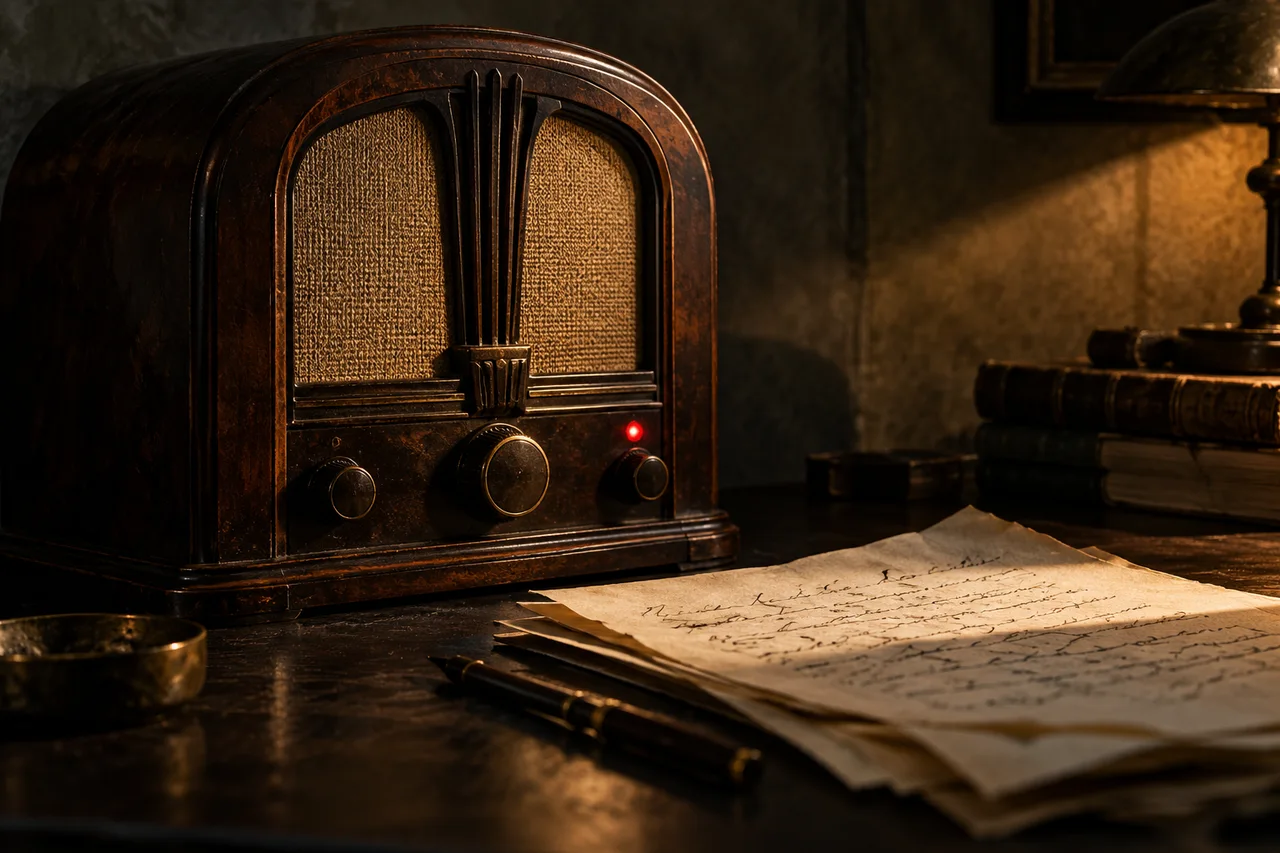
Before the Martians, there is an introduction. The transcript of the 30 October 1938 broadcast identifies Orson Welles, the Mercury Theatre on the Air and H. G. Wells's work. Orchestral music follows, then news interruptions turn listening into an imagined emergency. That beginning matters: the fiction was not presented from its first second as an unnamed, contextless news programme. Broadcast transcript published by Wellesnet.
Two stories are often told about that night, one about a dramatized alien invasion for the radio. The other describes an entire country deceived and terrified. The first can be contrasted with a record and a text. The second requires gathering evidence of reception and justifying its scale. The fame of the broadcast does not make both tasks equivalent.
What a recording preserves
Indiana University offers the broadcast in its collection Orson Welles on the Air, 1938–1946. The file attributes the adaptation to Howard Koch, records the date and details the origin of the copy: it combines transfers of discs with material from a transfer preserved in cassette. It also declares permission for the use of the radio work. Catalogue entry and recording at Indiana University.
These apparently peripheral details help us listen critically. A digital file has not arrived intact simply because we can press 'play'. It has earlier media, transfers and access conditions. The entry distinguishes the historical programme from the specific copy available to us, without demanding automatic distrust.
The recording lets us study the piece's form: who speaks, when circumstances change and how information is distributed. It does not record every listener's response. Finding a moment convincing today and thinking 'I would have believed that' is a present response, not evidence of how many people believed it then.
The authority of an interruption
The transcript reveals a carefully written transition. Music gives way to reports of astronomical observations, followed by links to characters at the locations of the action. The text adopts journalistic voices and conventions to construct fiction. The contrast between ordinary entertainment and urgent news is part of its dramatic form. Transcribed script, opening sequence.
Read as a narrative resource, interrupting changes the hierarchy of what we hear. Something seems important enough to displace what is foreseen. We can recognize that mechanism without asserting that it necessarily produces credulity: the same interruption can be received as performance, alarm, surprise or game. The format offers signs of authority; the reception requires studying what concrete people did with those signals.
It is also important to preserve the difference between a description of the work and an affirmation about its creators. That a scene seems realistic does not in itself demonstrate the intention to deceive an entire audience. To talk about intention would require additional sources. The script proves writing decisions; their social consequences are not automatically deduced from them.
The headline is also a document
The National Archives preserve a Universal newsreel dated 31 October 1938 and its production documentation. Its presentation sheet described the broadcast as causing nationwide terror and mass hysteria. The modern archival note accompanying it warns that little evidence supports many actions and injuries attributed to the panic. It also notes that the surviving newsreel is incomplete. Newsreel and National Archives commentary.
This contrast does not require discarding the old document. It changes our question. The document shows how the episode was publicly presented, but its national claim requires independent verification. Using a headline to prove panic and then that supposed panic to explain the headline creates a circle without adding evidence.
An archive may preserve exaggeration because exaggeration is part of history. Preservation is not endorsement. Institutional provenance establishes where an object is held; it does not make every statement within it a proven fact.
Letters that do not speak with one voice
The University of Michigan Library has digitised and transcribed letters sent after the broadcast. Its project description identifies praise, criticism and personal accounts: more varied responses than the image of a uniformly terrified audience. In 2025 it announced public access to the digital collection. Description of the collection and its diversity; announcement of access to the collection.
These letters open questions a headline cannot resolve. Does the writer describe their own response or something reported by others? Are they congratulating, protesting or requesting action? Do they distinguish hearing the broadcast from learning of the controversy later? A letter documents testimony without independently proving every event it narrates.
Nor does it constitute a representative survey. Those who wrote made a decision that other listeners did not take, and what is preserved depends on an archival history. Counting letters of one kind would allow describing this set under explicit criteria; converting its proportion into a national percentage would be another step, which would need justification.
The size of fear remains a question
A review published by the Library of Congress in 2016 distinguishes the confusion of some listeners from the legend of mass panic and points to the role of journalistic coverage in its dissemination. It also mentions audience measurements and the competition between programs. Here we do not transfer their estimates to a supposed exact number of terrified people: audience, belief, fear and behavior are different categories. Audrey Fischer, The War of the Worlds, page 8.
This distinction avoids two equally convenient stories: 'everyone panicked' and 'nobody believed anything'. The sources support varied responses and challenge a generalised collective catastrophe. Combining them without further study does not produce a complete census of what every listener felt and did.
When a story claims that a message 'fooled everyone', ask separately for the original message, identifiable testimony and evidence of the claimed scale. This cannot resolve every rumour; it helps locate the part of a claim still unsupported.
The 1938 broadcast deserves another hearing for its dramatic construction. Its reception deserves to be read in the plural. Between a voice announcing Martians and a headline announcing hysteria lies another stage: those who recount what happened. Here too, framing determines what attracts our attention.
Sources and references
- Koch, H.; Welles, O. and Mercury Theatre on the Air (1938). Transcription of The War of the Worlds, published by Wellesnet in 2013.
- Indiana University, Lilly Library. The War of the Worlds: catalogue entry and recording.
- National Archives (2014, updated 2022). This Week in Universal News: The War of the Worlds Broadcast, 1938.
- University of Michigan Library (2020). Letters to Orson Welles draw an (online) crowd; (2025). Revisit The War of the Worlds.
- Fischer, A. (2016). The War of the Worlds. Library of Congress Magazine, July–August, p. 8.