History and symbols
Incantation bowls: a demon and four names
A spiral of writing surrounds a demonic figure. British Museum bowl 139524 brings Mesopotamian incantations down to a specific scale: people seeking to protect their health.
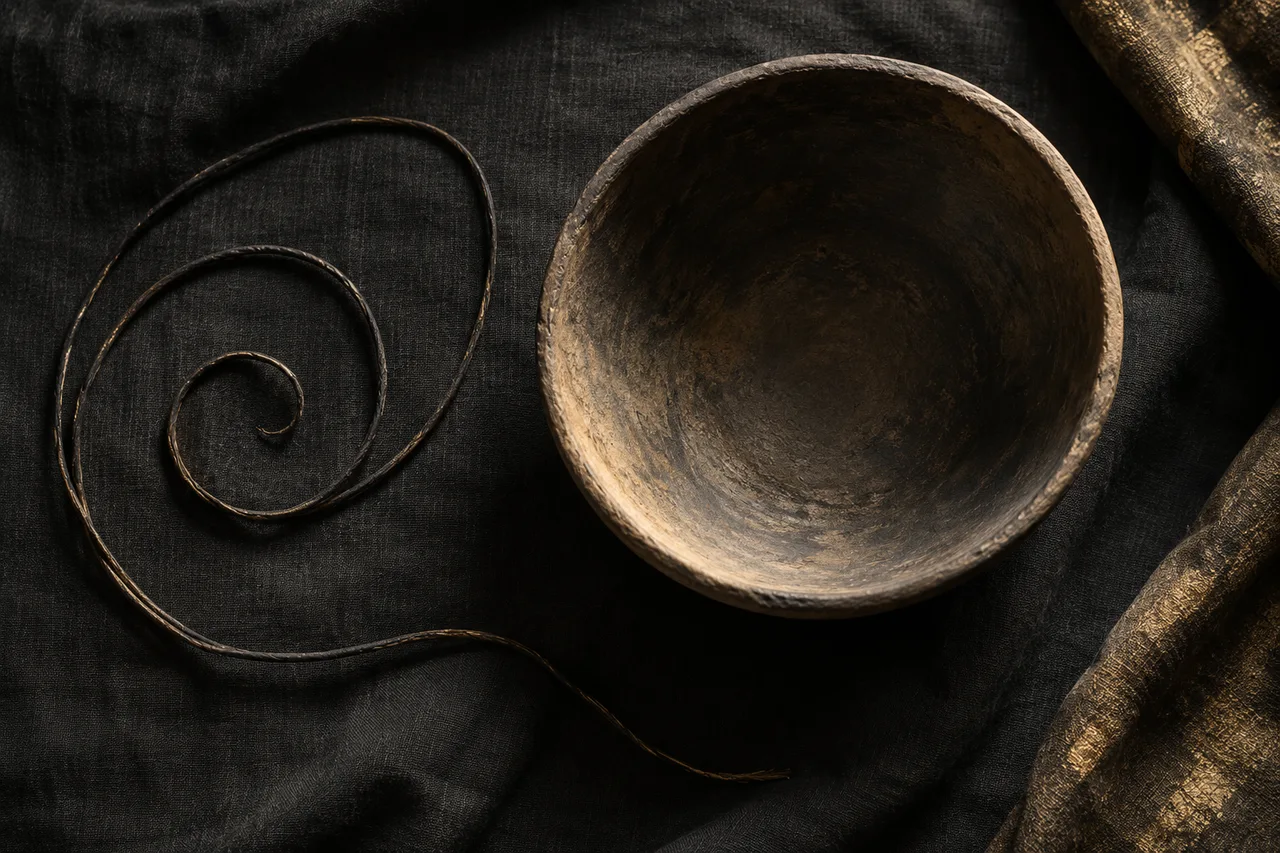
This story fits inside a vessel just over sixteen centimetres across. No night ceremony, hooded officiant or torchlit room need be imagined: none is documented for this object. Begin with its arrangement, a figure at the bottom and words advancing around it. An everyday vessel becomes the support for a written request.
The British Museum retains the bowl with the number 139524, registration 1983,1002.2. Its catalogue places it in Iraq between the sixth and eighth centuries CE. The wheel-thrown ceramic carries an Aramaic text spiralling outwards from the centre. The entry identifies the central drawing as a demon and says the incantation opens with a request for good health. British Museum object entry.
That request changes the image's centre of gravity. The demon may attract us, but the commission concerns someone's life. The threatening figure shares its surface with a less spectacular need: remaining well, staying safe or seeking a remedy for feared harm.
Names beyond the caption
The university database Kyprianos identifies the text as Jewish Aramaic and describes protection for Baboi and three others. It names Abda, Zabina and Hormiz in connection with Gušnazduk, while leaving some gender identifications and exact relationships unresolved. It does not permit an unqualified reconstruction of a whole family. Kyprianos, M3813.
Keep those names visible. 'Ancient magic' can erase the people who made the object necessary. Names suggest obligations, affection and relationships even when these can no longer be described. The bowl does not concern abstract humanity threatened by evil: it names beneficiaries. That distinguishes it from a demon drawn merely for decoration or a story.
Nor do we need to assign to each recipient a domestic role to recognize that particular character. Were they relatives? Who promoted the commission? Did they share housing? They are good questions, but turning them into an invented family scene would take away from the document precisely what makes it interesting: it keeps people while losing much of their circumstances.
Here we follow the published descriptions; we do not offer a translation of Aramaic. A spiral is very photogenic, but its appearance does not replace philological reading. The drawn demon and the written words belong to the same object, although each component requires different tools to study it.
The House as Vulnerable Territory
Other examples help situate this practice. Birmingham Museums explains, about the bowl 1961A316, from Kish, that texts could seek protection for people, homes and possessions. The entry mentions vessels placed in walls, foundations and cemeteries, often inverted, and offers trapping demons as one interpretation of that position. Birmingham Museums, "Incantation Bowl".
It is suggestive to think of the house as something that should be closed also in the face of dangers that a door could not stop. A wall separates spaces; an enchantment intends to intervene in another kind of transit. This is a reading of the relationship between object and architecture, not the explanation recovered from the mouth of its users. It helps, however, to understand why the location can matter as much as the text.
A bowl at a threshold could transform a place without staying visible. For viewers accustomed to museum interiors, this reverses expectations: what is now displayed may have been intended to disappear from sight. Preservation is not exhibition. Ritual importance may lie precisely in withdrawal from ordinary use and circulation.
No comparable architectural deposit is documented for 139524. Its public collection history records purchase in 1983, not an identified domestic excavation. Other finds provide context but cannot supply its missing hiding place.
Draw, write, lock
The publication of the Oriental Institute of Chicago dedicated to a hundred pieces of its collection presents another bowl, A32675, from Nippur. It locates this object type in Sasanian and early Islamic homes and discusses drawings and writing acting together against harmful entities. Its own example bears pseudo-script, reminding us that similar surfaces do not all contain readable text. Oriental Institute, 100 Highlights, p. 51.
Trapping and expelling are different actions. Both appear in modern explanations of bowls, but should not merge into a universal mechanism. Repeated material forms do not require identical imagined operations. Nor does a central figure automatically identify a creature by name.
Writing introduces another tension. An unreadable text may look like failed communication today. In a ritual object, writing's appearance may have held value beyond transmitting information to a person. This possibility does not establish any owner's thoughts. It prevents reducing every incomprehensible sign to a bad copy and every commission to fraud.
Two bowls and one enclosed space
The Kelsey Museum documents a particularly material comparison: example 2018.01.0502, from Seleucia, dated to the sixth–seventh centuries, was associated with another bowl and inscribed eggshell fragments. Bitumen joined the vessels. Its inscription is described as Aramaic-like pseudo-script; the egg's interpretation remains open. Kelsey Museum, Incantation Bowl.
The join makes the vessel part of an assemblage: not only a written surface but an enclosed interior, related pieces and a seal. This does not reconstruct the London bowl's use. It expands questions about how words related to volume, position and surrounding material.
Returning to Baboi restores the demon's proportion. The drawing catches attention; the names sustain it. Instead of an isolated bestiary creature, we encounter fear and care articulated in an object. Survival does not prove supernatural efficacy. What survives is the decision to write a request for wellbeing and give it a lasting form.
Sources and references
- British Museum: 139524, register 1983,1002.2. Collection file; description and dating.
- University of Würzburg, Kyprianos: M3813. Text identification and cautions about the recipients.
- Birmingham Museums: 1961A316. Context of placement and interpretation.
- Oriental Institute: 100 Highlights, p. 51. Bowl A32675.
- Kelsey Museum: 2018.01.0502. Assemblage from Seleucia.