TMF Digital Books
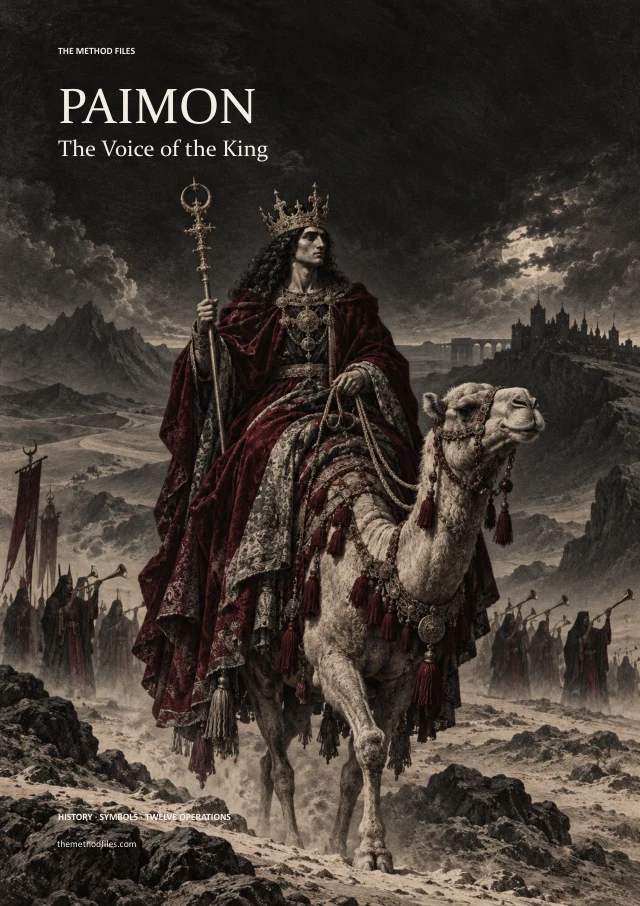
Paimon
The Voice of the King
A powerful voice is not always intelligible speech.
Follow Paimon through catalogues, translations and images. Compare his ranks and attributes, learn to recognise differences between witnesses and explore twelve contemporary ceremonies on voice, listening and learning.
14,90 €One-off payment · Tax included
Read a sampleDigital book in PDF format, in English. Includes the content described on this page. Does not include tutoring or access to TMF courses.
Pages from the book
Open. Read.
Look inside.
A historical reading, a workshop and a practice. Select a page to enlarge it.
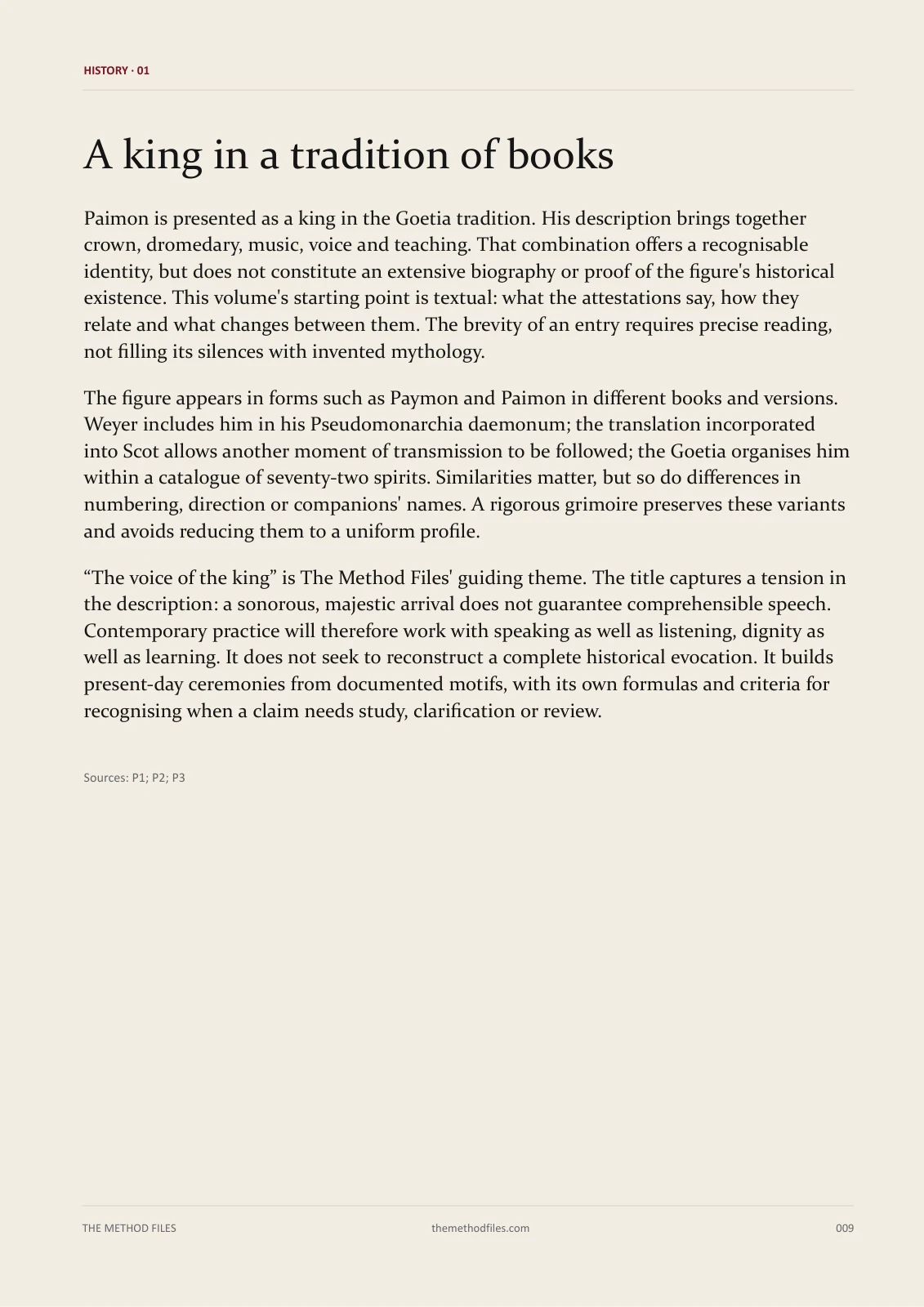
Page 9 of the complete book
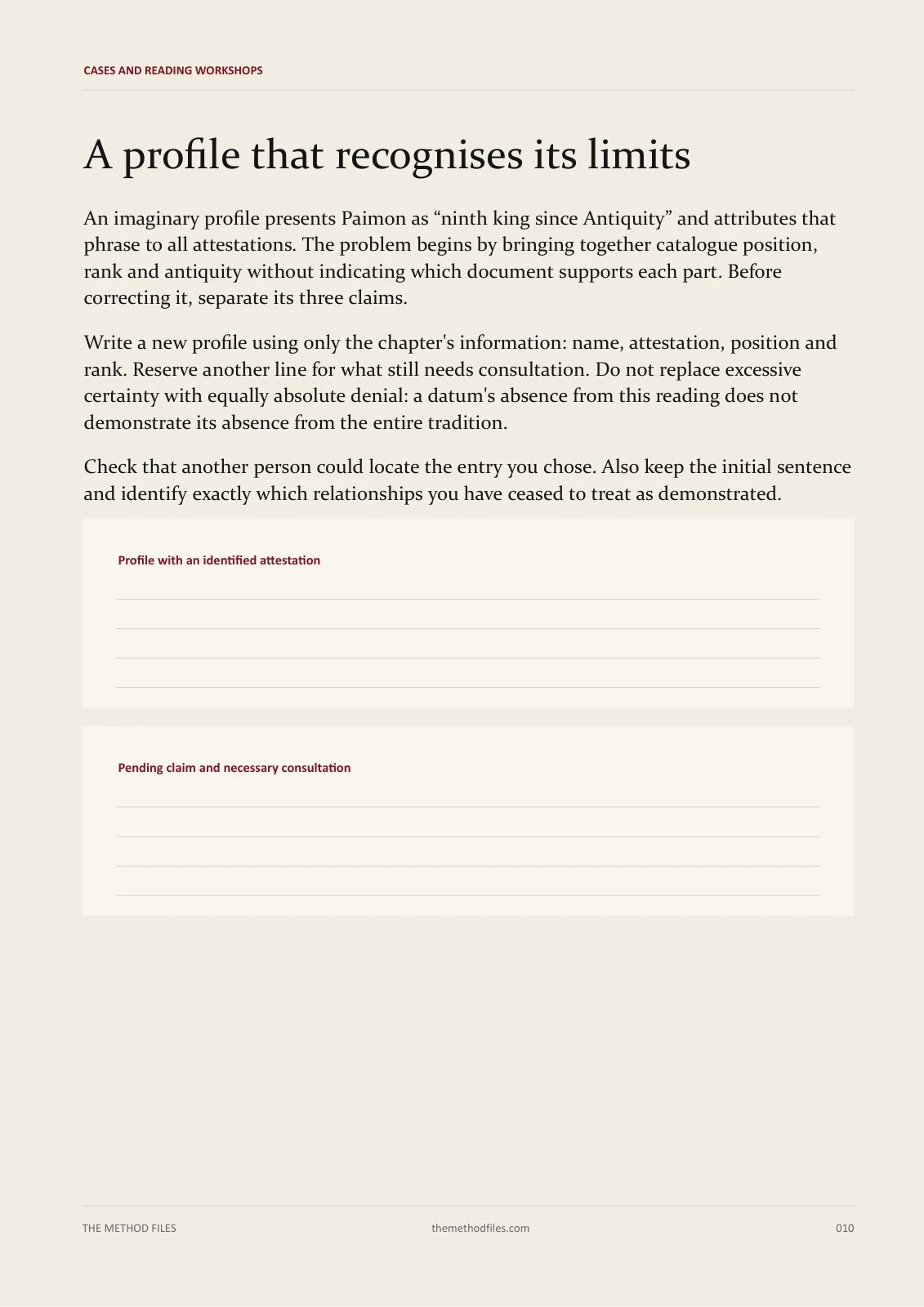
Page 10 of the complete book
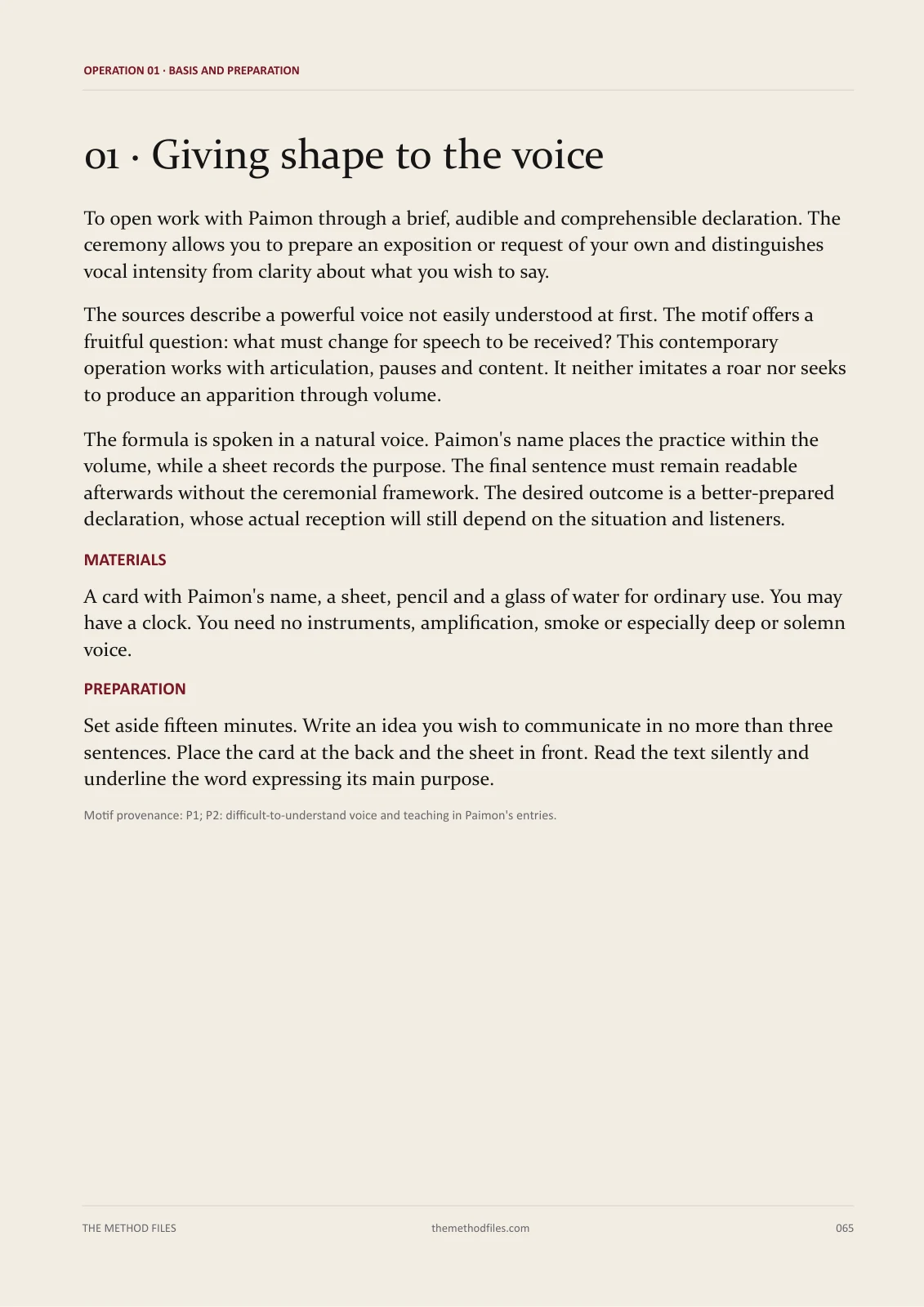
Page 65 of the complete book
What you will find
A journey
with clear provenance.
- Weyer, Scot and the Goetia: names, ranks and differences between witnesses.
- Crown, dromedary, music, seals and directions with their provenance identified.
- Historical plates and workshops for describing and comparing what they show.
- Twelve contemporary ceremonies on voice, listening, teaching and responsibility.
- Preparation, formulas, closing, recording and references for returning to the sources.
You can follow the historical journey without doing the practices. If you choose to explore them, you will find contemporary compositions clearly identified as such, with preparation, practice and closure.
View the complete book’s contents
Contents headings and page numbers for this edition.
- Read the source. Recognise the creation.p. 6
- The voice of the kingp. 7
- A name across witnessesp. 8
- A king in a tradition of booksp. 9
- A profile that recognises its limitsp. 10
- Weyer and the publication of a cataloguep. 11
- The catalogue within an argumentp. 12
- Scot's English mediationp. 13
- Citing the translation you have readp. 14
- The Goetia and its attribution to Solomonp. 15
- Literary authority and actual authorp. 16
- Numbering, rank and scalep. 17
- Two numbers and an identificationp. 18
- Crown, face and dromedaryp. 19
- What is described and what is drawnp. 20
- An arrival preceded by musicp. 21
- A procession without a scorep. 22
- From clamour to comprehensible speechp. 23
- A sentence open to responsep. 24
- Earth, waters, wind and abyssp. 25
- A cosmological question in contextp. 26
- Arts and sciences: the scope of a promisep. 27
- Teaching a step that can be checkedp. 28
- Dignities and power over othersp. 29
- A dignity that accounts for itselfp. 30
- Familiars and the figure of the companionp. 31
- Real help and a represented functionp. 32
- North, north-west and westp. 33
- A map that does not erase differencesp. 34
- Bebal, Abalam and the names of the retinuep. 35
- Names that are not secretly standardisedp. 36
- The graphic character and its provenancep. 37
- The drawing preserves a doubtp. 38
- Circle, triangle and the book's authorityp. 39
- Distinguishing an entry from its surroundingsp. 40
- The Paymon of the 1665 supplementp. 41
- A supplement retains its datep. 42
- From the dictionary to the present-day ceremonyp. 43
- Reading a dictionary pagep. 44
- Paymon in the dictionaryp. 45
- The caption accompanying an imagep. 46
- The ninth entryp. 47
- The ninth entry as a reading unitp. 48
- The entry continuesp. 49
- Continuing without entering another entryp. 50
- The seal within the seriesp. 51
- A numbered sign within a seriesp. 52
- Names and reading orderp. 53
- Spelling, transliteration and translationp. 54
- Circle and trianglep. 55
- A general diagram is not an exclusive emblemp. 56
- The king in a classificationp. 57
- Classifying without manufacturing a scalep. 58
- The authority of a title pagep. 59
- What a title page promisesp. 60
- Symbols with provenancep. 61
- Preparing the tablep. 62
- The form of the ceremonyp. 63
- Twelve ceremoniesp. 64
- 01 · GIVING SHAPE TO THE VOICEp. 65
- 01 · Sequence and closingp. 66
- 01 · Reading and recordp. 67
- From an intention to a concrete requestp. 68
- 02 · LISTENING AMONG THE INSTRUMENTSp. 69
- 02 · Sequence and closingp. 70
- 02 · Reading and recordp. 71
- Listening without completing what is missingp. 72
- 03 · THE CROWN OF THE TASKp. 73
- 03 · Sequence and closingp. 74
- 03 · Reading and recordp. 75
- A crown open to objectionp. 76
- 04 · THE LESSON THAT CAN BE REPEATEDp. 77
- 04 · Sequence and closingp. 78
- 04 · Reading and recordp. 79
- The lesson another person can performp. 80
- 05 · THE MAP OF DIRECTIONSp. 81
- 05 · Sequence and closingp. 82
- 05 · Reading and recordp. 83
- Comparing directions without orienting the roomp. 84
- 06 · THE WORD THAT ASKSp. 85
- 06 · Sequence and closingp. 86
- 06 · Reading and recordp. 87
- Information, assumption and questionp. 88
- 07 · THE SIGN UNDER THE GAZEp. 89
- 07 · Sequence and closingp. 90
- 07 · Reading and recordp. 91
- Looking at the sign before explaining itp. 92
- 08 · THE RETINUE OF FUNCTIONSp. 93
- 08 · Sequence and closingp. 94
- 08 · Reading and recordp. 95
- A retinue of tasks with real people responsiblep. 96
- 09 · DIGNITY WITHOUT DOMINATIONp. 97
- 09 · Sequence and closingp. 98
- 09 · Reading and recordp. 99
- Asking while leaving a real way outp. 100
- 10 · RHYTHM AND PAUSEp. 101
- 10 · Sequence and closingp. 102
- 10 · Reading and recordp. 103
- Rhythm serves meaningp. 104
- 11 · THE COUNCIL OF QUESTIONSp. 105
- 11 · Sequence and closingp. 106
- 11 · Reading and recordp. 107
- Three questions that do not simulate three witnessesp. 108
- 12 · THE KING'S FAREWELLp. 109
- 12 · Sequence and closingp. 110
- 12 · Reading and recordp. 111
- Saying farewell with a bounded taskp. 112
- How to keep a recordp. 113
- Record of a sessionp. 114
- Motif and composition · 1p. 115
- Motif and composition · 2p. 116
- Words for reading · 1p. 117
- Words for reading · 2p. 118
- Sources consulted · 1p. 119
- Sources consulted · 2p. 120
- Images and rights · 1p. 121
- Images and rights · 2p. 122
- Returning to the bookp. 123
The interior pages reproduce the supplied PDF. The covers are contemporary editorial interpretations.
Explore the open-access articles in The ArchiveBefore you choose
Your reading,
clearly explained.
What will I receive?
The complete PDF of Paimon · The Voice of the King: 124 pages in English, in a 17.3 MB file. You can read the sample before buying.
How do I read the book and answer the exercises?
We recommend a computer or tablet to appreciate the images and work with the pages. Write your answers in your notebook or use your PDF reader’s annotation tools. The file does not contain fillable form fields.
Do I have to do the practices?
You can follow the historical journey without doing the practices. If you choose to explore them, you will find contemporary compositions clearly identified as such, with preparation, practice and closure.
Does it include a course or tutoring?
No. It is a standalone digital book, without tutoring or individual feedback. TMF courses are purchased separately.
Can I see some content before deciding?
Yes. The sample includes an introduction, a historical reading, a workshop and one complete practice. You can read and download it without registering.
Open the free sampleWhat are the purchase terms?
Read the digital supply terms and refund policy before placing your order. Once payment is confirmed, you will find the download in your order confirmation and purchase email. If you buy using your account, it will also be available under My account → Downloads.
Ask a questionKeep exploring