Read before you choose
Paimon
The Voice of the King
This 16-page sample includes an introduction, a historical passage, a workshop, one complete practice and references. It retains the original book’s page numbers: the gaps reflect the selection.
Download PDF · 6.6 MBNo registration · Selectable text in the PDF
Cover

Read the text on this page
themethodfiles.com THE METHOD FILES PAIMON The Voice of the King HISTORY ∙ SYMBOLS ∙ TWELVE OPERATIONSAbout this reading sample
Read the text on this page
THE METHOD FILES / READING SAMPLE Paimon The Voice of the King A selection of pages from the complete book, with no registration required. We preserve the layout, text and numbering of the full English edition. You will find the introduction, a historical passage, a workshop, a complete practice and references to place your reading in context. Gaps in numbering reflect this selection: they are not missing pages. History A king in a tradition of books Reading workshop A profile that recognises its limits Complete contemporary practice Giving shape to the voice References to other parts of the volume belong to the complete book. This sample’s pages follow the original reading order. You can use the reader’s bookmarks to move between them. TMF digital books ∙ English ∙ Free sampleRead the source. Recognise the creation. · page 6 of the book
Read the text on this page
THE METHOD FILES themethodfiles.com 006 NOTE ON METHOD Read the source. Recognise the creation. DOCUMENT A passage, image or object that can be located. When a source attributes powers or recounts apparitions, we set out what that text claims, without turning it into a verified fact. RECEPTION The transformation of a name or figure in another book, period or artistic language. Differences in rank, appearance and function are retained and explained. INTERPRETATION The reading proposed in these pages. It is distinguished from the words of a source and can be revised without altering the document from which it begins. CONTEMPORARY CEREMONY All the operations in this volume are original compositions. Each identifies the motifs it takes from the sources and specifies its own objects, words, closing and record. PRINCIPLE FOR PRACTICE Participation is voluntary and may end at any time. No supernatural result is promised. The operations concern one’s own attention, devotion and conduct; they do not authorise control over other people. The original formulas were written in Spanish; English translations are provided here. Terms from other languages are explained in context or in the glossary.The voice of the king · page 7 of the book
Read the text on this page
THE METHOD FILES themethodfiles.com 007 INTRODUCTION The voice of the king Paimon's image is recognisable even to someone who has never read his entry: a crowned figure on a dromedary, surrounded by the expectation of music and authority. This volume begins by asking where that familiarity comes from and which differences remain hidden when the image is repeated without reference. Weyer, the English versions, the Goetia, the materials added to Scot and Collin de Plancy's dictionary do not form a single page. Numbers, ranks, orientations and ways of presenting the figure change. The comparison preserves these variations so readers can know which attestation supports each claim. The plates reproduce complete pages and figures from historical editions. Their function is to enable observation: how the seal appears, where an entry continues, what a classification does and how a title page claims authority. The printed edition's date always accompanies the image. The twelve ceremonies are present‐day compositions centred on speech and learning. Work involves one's own voice, questions that can be investigated and decisions open to response. Each operation develops preparation, sequence, formula, closing and commentary. Studying historical attributions does not oblige their reproduction as practical aims; this book's proposal declares its own purposes and leaves readers an informed choice.A king in a tradition of books · page 9 of the book

Read the text on this page
THE METHOD FILES themethodfiles.com 009 HISTORY ∙ 01 A king in a tradition of books Paimon is presented as a king in the Goetia tradition. His description brings together crown, dromedary, music, voice and teaching. That combination offers a recognisable identity, but does not constitute an extensive biography or proof of the figure's historical existence. This volume's starting point is textual: what the attestations say, how they relate and what changes between them. The brevity of an entry requires precise reading, not filling its silences with invented mythology. The figure appears in forms such as Paymon and Paimon in different books and versions. Weyer includes him in his Pseudomonarchia daemonum; the translation incorporated into Scot allows another moment of transmission to be followed; the Goetia organises him within a catalogue of seventy‐two spirits. Similarities matter, but so do differences in numbering, direction or companions' names. A rigorous grimoire preserves these variants and avoids reducing them to a uniform profile. “The voice of the king” is The Method Files' guiding theme. The title captures a tension in the description: a sonorous, majestic arrival does not guarantee comprehensible speech. Contemporary practice will therefore work with speaking as well as listening, dignity as well as learning. It does not seek to reconstruct a complete historical evocation. It builds present‐day ceremonies from documented motifs, with its own formulas and criteria for recognising when a claim needs study, clarification or review. Sources: P1; P2; P3A profile that recognises its limits · page 10 of the book
Read the text on this page
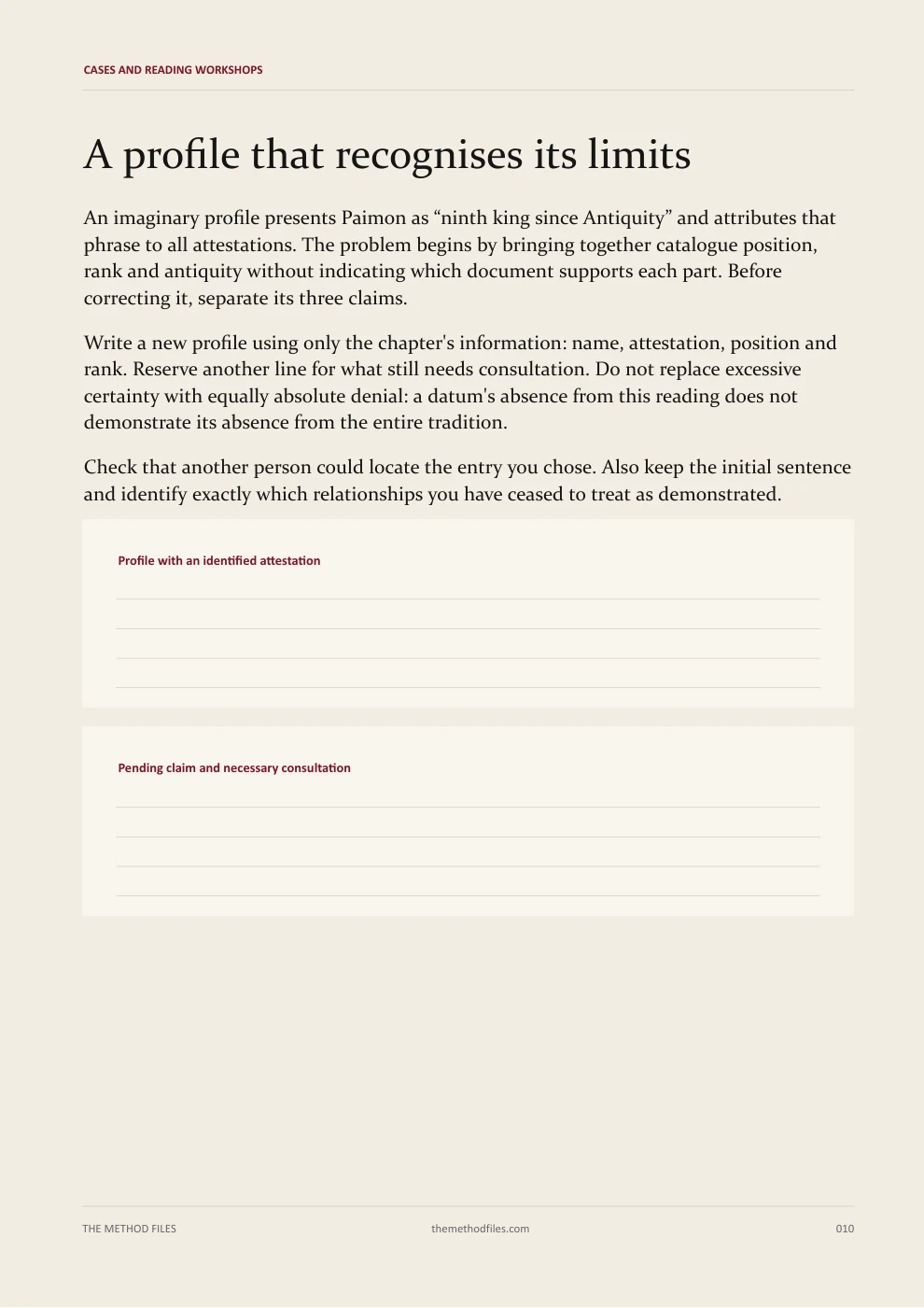
THE METHOD FILES themethodfiles.com 010 CASES AND READING WORKSHOPS A profile that recognises its limits An imaginary profile presents Paimon as “ninth king since Antiquity” and attributes that phrase to all attestations. The problem begins by bringing together catalogue position, rank and antiquity without indicating which document supports each part. Before correcting it, separate its three claims. Write a new profile using only the chapter's information: name, attestation, position and rank. Reserve another line for what still needs consultation. Do not replace excessive certainty with equally absolute denial: a datum's absence from this reading does not demonstrate its absence from the entire tradition. Check that another person could locate the entry you chose. Also keep the initial sentence and identify exactly which relationships you have ceased to treat as demonstrated. Profile with an identified attestation Pending claim and necessary consultationPreparing the table · page 62 of the book

Read the text on this page
THE METHOD FILES themethodfiles.com 062 BEFORE THE CEREMONY Preparing the table Arrange a surface for the text, the card with Paimon's name and the notebook. Most ceremonies use paper and voice. When sounds occur, they are made softly and chosen beforehand; you need no specific instruments or amplification. Read the purpose and sequence before beginning. Prepare a concrete idea, question or task. Small scope allows attentive review: three sentences may suffice to examine clarity, rhythm and response. If using the seal, identify the edition and figure number. A hand‐drawn copy is recorded as contemporary study. Directions are compared in their source and not added as requirements to an operation that does not use them. Reserve a comfortable interval to read without straining your voice. You may use written or silent variants. At the end, keep the text versions and note changes. Any conversation, lesson or publication prepared during the act will later have its own context and interlocutors. AN INTENTION AND AN END Before you begin, write down what you will do and how you will know you have finished. Afterwards, complete the record with facts, impressions and decisions in separate fields.The form of the ceremony · page 63 of the book

Read the text on this page
THE METHOD FILES themethodfiles.com 063 WORD ∙ GESTURE ∙ CLOSING The form of the ceremony NATURAL VOICE The opening names an intention and uses a comfortable voice. Volume does not measure the act's quality. Silent or written reading preserves the structure when speaking is inconvenient. PURPOSEFUL PAUSE Silence separates units of meaning and leaves room for review. No sign is expected from it. Its duration may be adapted to maintain attention without turning the pause into an endurance test. QUESTION AND RESPONSE Each formula leads to an action: reformulating, comparing, explaining or preparing a response. The ceremony works on one's own speech and recognises that others retain their judgement and will. FAREWELL The closing explicitly ends the session. Objects return to their place and outstanding questions move to the record. Study may continue another day without keeping the ceremonial act open. The twelve sequences and their formulas are original compositions. Each operation identifies its documentary motif.01 · GIVING SHAPE TO THE VOICE · page 65 of the book
Read the text on this page
THE METHOD FILES themethodfiles.com 065 OPERATION 01 ∙ BASIS AND PREPARATION 01 ∙ Giving shape to the voice To open work with Paimon through a brief, audible and comprehensible declaration. The ceremony allows you to prepare an exposition or request of your own and distinguishes vocal intensity from clarity about what you wish to say. The sources describe a powerful voice not easily understood at first. The motif offers a fruitful question: what must change for speech to be received? This contemporary operation works with articulation, pauses and content. It neither imitates a roar nor seeks to produce an apparition through volume. The formula is spoken in a natural voice. Paimon's name places the practice within the volume, while a sheet records the purpose. The final sentence must remain readable afterwards without the ceremonial framework. The desired outcome is a better‐prepared declaration, whose actual reception will still depend on the situation and listeners. MATERIALS A card with Paimon's name, a sheet, pencil and a glass of water for ordinary use. You may have a clock. You need no instruments, amplification, smoke or especially deep or solemn voice. PREPARATION Set aside fifteen minutes. Write an idea you wish to communicate in no more than three sentences. Place the card at the back and the sheet in front. Read the text silently and underline the word expressing its main purpose. Motif provenance: P1; P2: difficult‐to‐understand voice and teaching in Paimon's entries.01 · Sequence and closing · page 66 of the book

Read the text on this page
THE METHOD FILES themethodfiles.com 066 OPERATION 01 ∙ GIVING SHAPE TO THE VOICE 01 ∙ Sequence and closing 01 ∙ LISTEN TO THE FIRST VERSION Read the sentences once at a comfortable volume. Pause between them. Note where you ran short of breath, where information accumulated and which word was ambiguous. Do not interpret hesitation as an external sign: use it to revise the text's form. 02 ∙ INVOKE CLARITY Rest your hands on either side of the sheet and speak the formula. Then keep a few moments of silence. Shorten an overlong sentence and replace an imprecise term. If the purpose has changed, write a new version rather than forcing the previous one. 03 ∙ DELIVER THE WORD Read the revised version, looking ahead between sentences. End with a question or concrete request where appropriate. Leave the sheet on the table and write what someone unfamiliar with your prior intention should be able to understand. ORIGINAL SPANISH FORMULA (ENGLISH TRANSLATION) Paimon, king named among voices and instruments, before this table I give shape to my word. May volume not conceal meaning or solemnity replace precision. I present an idea that can be heard, allow it to be revised and leave room for response. I begin with attention and end with clarity. CLOSING Remove the card and say: “The word is prepared; its encounter with others will have its own time.” Note the revised wording and clear the table. Rest your voice if needed. The session ends without repeating the text until its meaning is exhausted. Read the formula at the indicated point. The closing completes the session and separates the act from subsequent tasks.01 · Reading and record · page 67 of the book
Read the text on this page
THE METHOD FILES themethodfiles.com 067 OPERATION 01 ∙ READING AND RECORD 01 ∙ Reading and record MEANING OF THE OPERATION A clear voice can be soft and a brief sentence may require preparation. The ceremony does not assess accents, timbres or personal ways of speaking. It examines whether content has a form that can be followed. Writing preserves changes so improvement does not depend solely on an impression of confidence. EXAMPLE OF APPLICATION Someone prepares a collaboration proposal. The first version mixes background, wishes and conditions. The second presents a task, a deadline and a question. The ceremony does not obtain acceptance: it leaves a proposal easier to answer. VARIANT If you do not wish or are unable to speak, read silently and use pauses marked on paper. You may also prepare a written communication, retaining the same review of purpose and clarity. QUESTIONS AND FIELDS FOR THE RECORD What did I want to say? What changed between versions? What should the recipient understand? Keep both readings and note later which real response you obtained, if you used it. The examples are fictional situations intended to help explain the practice; they are not presented as evidence of efficacy.Sources consulted · 1 · page 119 of the book
Read the text on this page
THE METHOD FILES themethodfiles.com 119 P1 P2 P3 TEXTS AND WITNESSES ∙ 1 Sources consulted ∙ 1 Goetia, spirit 9 and licence to depart. Sloane MS 3825, transcription by Joseph H. Peterson. The witness transcription is consulted, with identified variants. The modern introduction and notes are distinguished from the historical text. The seal images reproduced in this book come from a 1916 edition, not the site's modern drawings. View the document Johann Weyer. Pseudomonarchia daemonum, Paymon, entry 22. Latin and English version at Esoteric Archives. Comparison retains differences of appearance, rank and orientation. The English version transmitted by Scot is not treated as a variant‐free substitute for the Latin. Number 22 belongs to this catalogue, not to the Goetia's order. View the document The Lesser Key of Solomon: Goetia. Edition by L. W. de Laurence, Chicago, 1916. Historical copy consulted for pages, seals, names and classification. The 1916 printed edition is a modern editorial attestation relative to the manuscripts; its labels and attributions do not turn every element into a Solomonic original. View the document Accessed: September 2026. Paraphrases and commentary are the author’s own. Modern notes are distinguished from historical texts.Sources consulted · 2 · page 120 of the book

Read the text on this page
THE METHOD FILES themethodfiles.com 120 P4 P5 P6 Heinrich Cornelius Agrippa. De occulta philosophia, III,24. TEXTS AND WITNESSES ∙ 2 Sources consulted ∙ 2 The Discoverie of Witchcraft: additional material in the 1665 edition, ch.III. Transcription at Esoteric Archives. Added material is distinguished from Reginald Scot's original 1584 work and critical stance. Paymon appears in a different system; attribution of these passages to Scot himself is avoided. View the document J. Collin de Plancy. Dictionnaire infernal, 6th ed., Paris, H. Plon, 1863, p.521, “Paymon”. The page allows text and image to be studied in a nineteenth‐century reception. Louis Le Breton's drawing, engraved by Jarrault, forms part of that edition; it is not a portrait from Antiquity. View the document Paymon features in a cardinal distribution. This classificatory function is distinguished from the operator's orientation in other texts. Comparison keeps sources separate instead of constructing a composite instruction. View the document Accessed: September 2026. Paraphrases and commentary are the author’s own. Modern notes are distinguished from historical texts.Images and rights · 1 · page 121 of the book
Read the text on this page
THE METHOD FILES themethodfiles.com 121 PLATES 01‐04 Images and rights ∙ 1 01 ∙ PAYMON IN THE DICTIONARY J. Collin de Plancy, Dictionnaire infernal, 6th ed., H. Plon, Paris, 1863, p.521. Drawing by Louis Le Breton; engraving signed Jarrault. Library of Congress copy at Internet Archive. Public domain. View the document 02 ∙ THE NINTH ENTRY The Lesser Key of Solomon: Goetia, edition by L. W. de Laurence, Chicago, 1916, p.24. Copy digitised at Internet Archive. Public domain. View the document 03 ∙ THE ENTRY CONTINUES The Lesser Key of Solomon: Goetia, L. W. de Laurence, 1916, p.25. Copy digitised at Internet Archive. Public domain. View the document 04 ∙ THE SEAL WITHIN THE SERIES The Lesser Key of Solomon: Goetia, L. W. de Laurence, 1916. Preliminary plate of seals 1‐24. Reproduction of the historical edition distributed by Project Gutenberg, no.72679. Public domain. View the document PRINCIPLE OF REPRODUCTION Pages and works are preserved in full. Rescaling does not redraw signs or reconstruct missing parts. The links identify the object or copy and allow you to consult its details and conditions of use. CC0 and Public Domain Mark identify the conditions stated by the institutions; they do not attribute authorship of the works to this book.Images and rights · 2 · page 122 of the book
Read the text on this page
THE METHOD FILES themethodfiles.com 122 PLATES 05‐08 Images and rights ∙ 2 05 ∙ NAMES AND READING ORDER The Lesser Key of Solomon: Goetia, L. W. de Laurence, 1916. Preliminary name plate. Project Gutenberg no.72679. Historical edition in the public domain. View the document 06 ∙ CIRCLE AND TRIANGLE The Lesser Key of Solomon: Goetia, L. W. de Laurence, 1916. Preliminary plate with circle and triangle, figures 153‐154. Project Gutenberg no.72679. Public domain. View the document 07 ∙ THE KING IN A CLASSIFICATION The Lesser Key of Solomon: Goetia, L. W. de Laurence, 1916, p.47. Copy digitised at Internet Archive. Public domain. View the document 08 ∙ THE AUTHORITY OF A TITLE PAGE The Lesser Key of Solomon: Goetia, edition by L. W. de Laurence, Chicago, 1916. Interior title page. Copy digitised at Internet Archive. Public domain. View the document COVER Cover: contemporary illustration created with artificial intelligence assistance for The Method Files, 2026. It does not reproduce a historical object. Typefaces: Constantia and Calibri, embedded for digital reading. CC0 and Public Domain Mark identify the conditions stated by the institutions; they do not attribute authorship of the works to this book.Continue reading

Read the text on this page
THE METHOD FILES / READING SAMPLE Paimon The Voice of the King Your reading can continue. The complete book contains 124 pages, reading workshops and 12 contemporary operations, with their sources and references. You can follow the historical journey without performing the practices. If you decide to explore them, you will find contemporary compositions identified as such, with preparation, a central sequence and closing. Digital book in PDF, in English. It does not include tutoring or access to TMF courses. Exercises are completed in a notebook or using the PDF reader’s annotation tools. Explore the complete book themethodfiles.com/libros‐digitales/paimon/ TMF digital books ∙ English ∙ Free sample
Continue whenever you wish