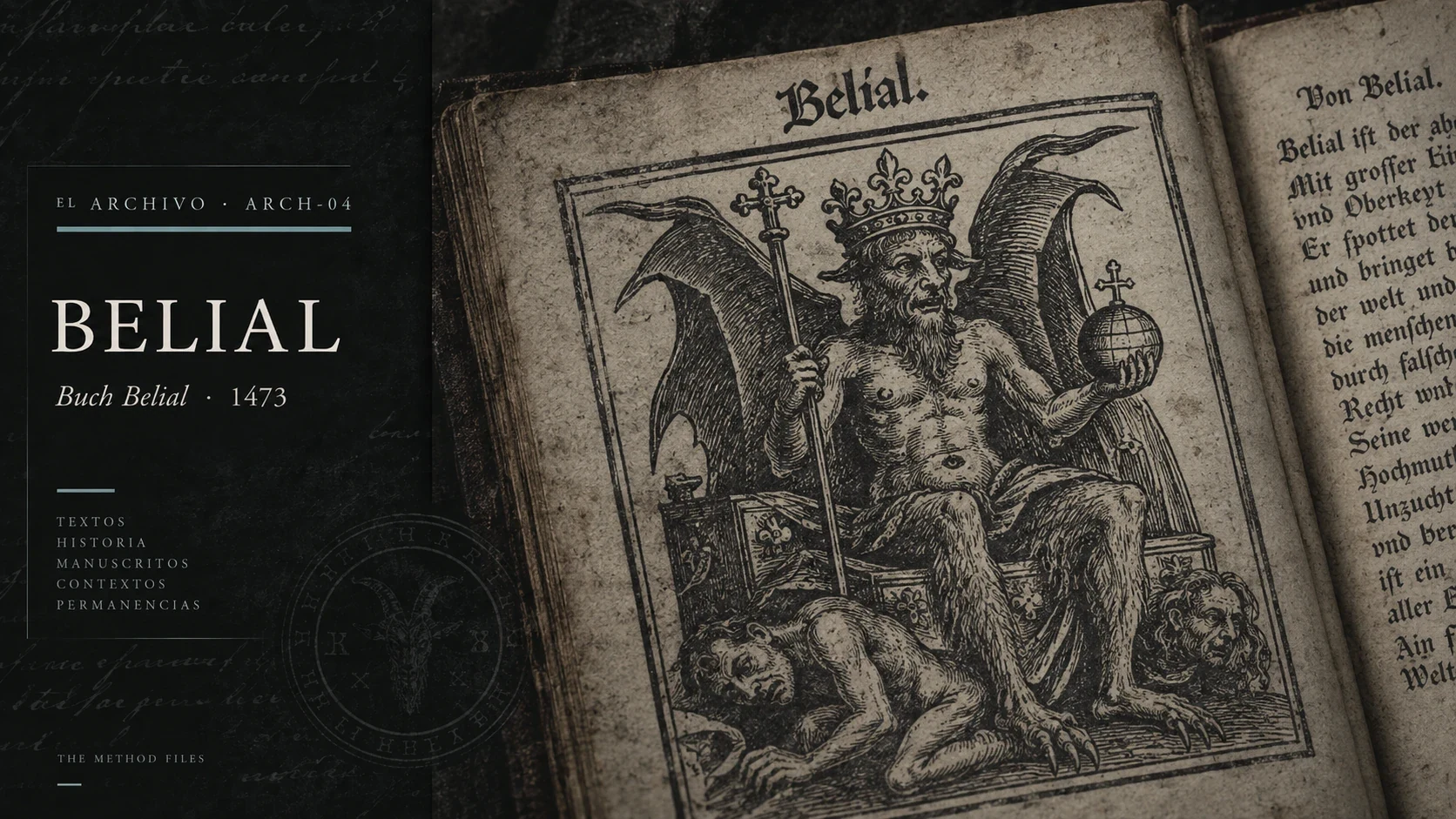
THE ARCHIVE · ARCH-04
BELIAL
Buch Belial · 1473
THE METHOD FILES
THE ARCHIVE
From beliyyaʿal to the hierarchies of Hell.
Today, Belial seems to be a clearly defined figure. He appears in demonologies and grimoires with a proper name, a rank, functions, legions and a place within particular infernal hierarchies.
But the story begins somewhere very different.
In the Hebrew Bible, beliyyaʿal is repeatedly applied to people considered wicked, rebellious or ‘worthless’. Expressions such as ‘sons of beliyyaʿal’ do not yet describe the followers of a demonic king. The term condemns certain people and behaviours. Deuteronomy 13:14, for example, speaks of bene beliyyaʿal in reference to men who lead a town into idolatry.
Then something much more interesting happens: the word begins to become a figure.
During Second Temple Judaism, Belial acquires an increasingly individual and hostile identity. Centuries later, European demonological catalogues will present him as an actual king, with an appearance, powers and legions under his command. In the Pseudomonarchia Daemonum, Weyer explicitly speaks of ‘King Belial’.
This article traces that transformation.
How did a word used to denote wickedness or worthlessness become the name of a king of Hell?
THE HEBREW BIBLE · BEFORE BELIAL WAS SOMEONE
A word is not yet a demon
In the texts of the Hebrew Bible, beliyyaʿal appears long before Belial becomes an individual demonological figure.
The term describes people considered wicked, destructive, rebellious or lacking in moral worth. Expressions such as ‘sons of beliyyaʿal’ or ‘men of beliyyaʿal’ are terms of condemnation, not descriptions of members of a cult devoted to a demon named Belial.
In 1 Samuel 2:12, for example, Eli’s sons are described with this expression because of their corrupt behaviour. In Judges 19:22, a similar formula is applied to the men responsible for a brutal assault.
Here, Belial has no face, rank, legions or biography yet.
He is not yet someone. It is a word denoting a form of corruption or wickedness.
This stage is essential because it lets us see the later change clearly: when Belial appears as a personal adversary and leader of dark forces, we are witnessing a real transformation within the tradition, not simply the same figure remaining unchanged from the beginning.
THE SECOND TEMPLE PERIOD · WHEN BELIAL BECOMES AN ADVERSARY
The word begins to function as a name
During Second Temple Judaism, the decisive change occurs.
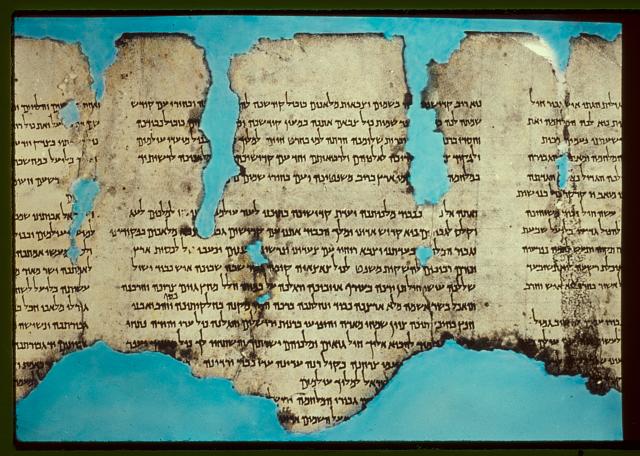
In several texts among the Dead Sea Scrolls, Belial is no longer merely a word applied to wicked people. He begins to function as an individual figure, associated with the forces of darkness and opposed to God’s order.
In the Community Rule, Belial is associated with a domain of his own and with those who belong to his lot. The opposition is no longer only moral: the world begins to divide between those who walk in the light and those under Belial’s power.
The War Scroll takes that opposition further. Belial is associated with the forces fighting the Sons of Light in a conflict of apocalyptic proportions.
This changes the history of the term completely.
Belial no longer merely describes wickedness. He begins to embody it.
Once a word acquires a will, followers, enemies and a place in a cosmic struggle, we are much closer to the demonological figure who will appear in grimoires centuries later.
But one more step remains.
Belial is not yet the king with legions found in later demonology. That will come afterwards.
SIXTEENTH CENTURY · BELIAL RECEIVES A CROWN
Weyer presents the adversary as a king
More than a thousand years after Qumran, Belial appears in a completely different context.
In the Pseudomonarchia Daemonum of Johann Weyer, published with the expanded edition of De praestigiis daemonum in 1577, we explicitly encounter ‘King Belial’.
Here, the transformation is unmistakable.
Belial is neither simply a word describing wickedness nor only the leader of a dark faction. He now has rank, appearance, functions and legions.
Weyer records a tradition in which Belial was supposedly created immediately after Lucifer and was among the first beings to fall. He describes him taking the form of an exceedingly beautiful angel seated in a chariot of fire, speaking softly and able to grant dignities, favours and good servants. Under his command, Weyer places eighty legions.
All this belongs to a much more developed demonological system.
The word has become a fully realised figure. And that figure now wears a crown.
But we must keep the same rule we have followed from the start: what Weyer says about Belial belongs to Weyer and the tradition he transmits. We should not project that king with eighty legions back onto biblical texts written many centuries earlier.
SEVENTEENTH CENTURY · ARS GOETIA
The king enters the catalogue of 72 spirits
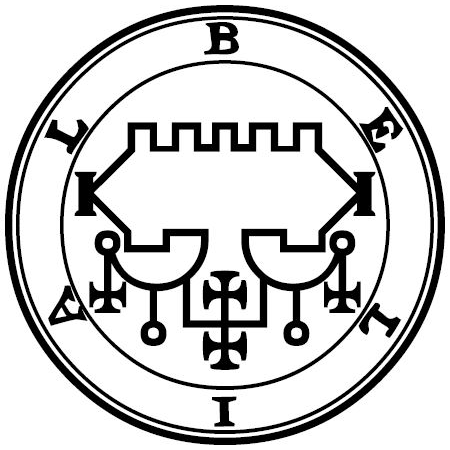
In the Ars Goetia, Belial appears as spirit number 68 in the catalogue of seventy-two entities.
The text presents him as a powerful king and states that he was created after Lucifer. It also retains the image of a being of great beauty associated with a chariot of fire, along with functions involving offices, favours and familiar spirits.
The version based on the manuscript Sloane MS 3825 attributes to him rule over eighty legions. Later printed editions offer variants, even in details such as the number of legions, showing again that these catalogues did not circulate in a completely fixed form.
By this point, Belial has travelled an enormous historical distance.
In the Hebrew Bible, it was a term applied to wickedness or contemptible people.
At Qumran, he becomes an adversary and leader of the forces of darkness.
In Weyer, he receives the rank of king.
And in the Goetia, he takes his place in an organised hierarchy of spirits, with a number, seal, functions and position within the catalogue.
Belial is no longer a word describing evil. He is one of the names that rule it.
WHAT THE SOURCE ACTUALLY SAYS
Four stages that should not be confused
Belial’s history changes completely when we put the sources in order.
In the Hebrew Bible, beliyyaʿal functions primarily as a term applied to wicked, corrupt or contemptible people. In 1 Samuel 2:12, for example, Eli’s sons are described as men of beliyyaʿal, an expression rendered by various modern translations as ‘wicked’, ‘unworthy’ or ‘worthless’.
In the texts from Qumran, the term has already changed. Belial appears as an individual figure associated with the forces of darkness and the army opposing the Sons of Light. The War Scroll even refers to the army of Belial within the final conflict.
In the Pseudomonarchia Daemonum, centuries later, Weyer presents Belial as a king, gives him a specific appearance and places eighty legions under his command.
And in the Ars Goetia, Belial is incorporated as spirit number 68 within an organised catalogue of seventy-two entities.
We are therefore not looking at four identical descriptions of the same figure.
We are looking at a transformation:
word → adversary → king → catalogued spirit.
That sequence is the key to understanding Belial without projecting a demonology that emerges many centuries later back onto the Bible.
WHAT CHANGED LATER
Belial ceases to be a word and begins to acquire an identity
Belial’s transformation did not end at Qumran.
In 2 Corinthians 6:15, the New Testament directly contrasts Christ with Beliar, a variant of the name Belial. Here, we are no longer dealing with a simple expression for a corrupt person: Belial functions as a personal figure placed in opposition to Christ.
That personification will be fundamental to the later history.
As Jewish and Christian traditions develop their conceptions of evil, Belial may be associated with the adversary, Satan or the powers of darkness. But here, too, there is no single stable hierarchy.
Early modern grimoires will take another step. Rather than merely identifying Belial with the forces of evil, they begin to give him rank, appearance, abilities, subordinates and a place within specific catalogues.
Weyer presents him as a king.
The Ars Goetia makes him spirit number 68.
Later editions help establish his seal and an increasingly recognisable image.
The result matters: a word once used to characterise wickedness becomes an entity with an identity of its own within Western demonology.
But that Belial was not waiting, fully formed, inside the biblical texts.
He was constructed in layers.
MYTH VS SOURCE
‘Belial was always a King of Hell’
No.
In the earliest texts, Belial does not appear as a demonic king with legions and functions of his own.
In the Hebrew Bible, beliyyaʿal is used primarily to describe wickedness, corruption or people considered unworthy. We do not find the crowned Belial of the grimoires there.
In the texts of the Second Temple period, especially at Qumran, the change is already substantial: Belial appears personified as the leader of the forces of darkness and the adversary of the Sons of Light.
But even that Belial is not yet exactly the king described centuries later by Johann Weyer.
It is in the Pseudomonarchia Daemonum that we clearly find Belial with the rank of king, his own appearance, specific abilities and legions under his command.
The Ars Goetia then retains that demonological identity and incorporates him as spirit number 68.
So:
ANCIENT SOURCES: a word associated with wickedness that subsequently begins to be personified.
LATER TRADITION: an individual adversary associated with the forces of darkness.
EARLY MODERN GRIMOIRES: a demonological king with a rank, seal, functions and legions.
Saying that ‘Belial was always one of the Kings of Hell’ turns the endpoint of a historical transformation into its starting point.
This article shows precisely the opposite:
Belial had to become a king.
THE ARGUMENT
Belial was not born a king: he was made one
Belial’s story does not begin with a crown.
It begins with beliyyaʿal, a word used in the Hebrew Bible to denote wickedness, corruption or a lack of moral worth.
In the texts of the Second Temple period, that word begins to acquire an identity of its own. Belial ceases to be only a quality and appears as an adversary, leader of dark forces and enemy of the divine order.
Later, Christian tradition reinforces that personification.
The final major change occurs in early modern grimoires: Belial receives rank, functions, appearance, a seal and legions.
Weyer calls him a king.
The Ars Goetia includes him among its seventy-two spirits.
What began as a word becomes a fully developed figure.
That is why the question ‘Who is Belial really?’ is less useful historically than another:
which source is speaking, and which version of Belial does it construct?
That is the argument of this article:
Belial was not always a King of Hell. He became one through centuries of personification, reinterpretation and demonological reorganisation.
ARCHIVE CONNECTIONS
Tracing Belial’s transformation
Who built Hell?
Belial demonstrates in a single figure what ‘Who built Hell?’ examines on a larger scale: demonological hierarchies did not emerge fully formed. Names changed function, catalogues reorganised earlier material and each period added new layers.
Who decided what demons look like?
When Belial enters the grimoires, he has more than a name and rank. Physical descriptions, seals and images appear, helping establish a visual identity. ‘Who decided what demons look like?’ examines how much of that appearance actually comes from the texts and how much was added later by copyists, editors and illustrators.
GRIMOIRE OF BELIAL
This article reconstructs how Belial moved from word to adversary, and from adversary to king. The Grimoire of Belial continues from there, organising his tradition in a dedicated volume and distinguishing ancient sources from later demonological constructions.
CONTINUE
From the ancient name to the Grimoire of Belial
This article has traced Belial’s transformation from beliyyaʿal, a word used in biblical texts, to a personified figure who finally becomes a king in the grimoires.
The Public Edition of the Grimoire of Belial continues from there, bringing together his tradition, functions, symbols and development in a dedicated volume.
The Illustrated Edition extends that exploration with more comprehensive visual, documentary and ritual treatment.
SOURCES CONSULTED
Documents and editions used
- Hebrew Bible. Deuteronomy 13:14, Judges 19:22 and 1 Samuel 2:12. Passages used to document beliyyaʿal before its demonological personification and its application to people considered wicked, unworthy or rebellious.
- Community Rule (1QS). A Qumran text in which Belial’s domain and ‘lot’ appear within a dualistic conception opposing light and darkness.
- War Scroll (1QM). A Qumran manuscript from the first century BCE, presenting Belial as leader of the forces of darkness opposed to the Sons of Light.
- 2 Corinthians 6:15. A New Testament passage contrasting Christ with Beliar, a Greek variant of Belial, showing an already established personification of the name.
- Johann Weyer. Pseudomonarchia Daemonum, incorporated into the expanded fifth edition of De praestigiis daemonum, Basel, 1577. It presents Belial as a king, describes him as a beautiful angel seated in a chariot of fire and attributes eighty legions to him.
- Lemegeton Clavicula Salomonis · Ars Goetia. Belial appears as spirit number 68, described as a powerful king and included within the catalogue of seventy-two spirits.
- S. L. MacGregor Mathers and Aleister Crowley. The Book of the Goetia of Solomon the King, 1904. Edition used as the reference for the modern reproduction of Belial’s seal included in this article.
Source records
Explore the references, their limitations and their uses in other readings. The article’s full bibliography is retained in the text above.
Sloane MS 3825 ↗Community Rule (1QS) ↗War Scroll (1QM) ↗Deuteronomy 13:14; Judges 19:22; 1 Samuel 2:12 ↗2 Corinthians 6:15 ↗Johann Weyer — De praestigiis daemonum / Pseudomonarchia Daemonum ↗The Book of the Goetia of Solomon the King ↗Study this subject further
These related lessons let you explore the article’s questions through activities and study resources.
Cite this article
Published in The Method Files’ Archive.
BELIAL: WHEN A WORD BECAME A KING. The Archive · The Method Files. https://themethodfiles.com/en/estudios/archivo/belial-cuando-una-palabra-se-convirtio-en-rey/
Include your access date; the copy button adds it automatically. To cite a historical source, use its own reference in the article’s bibliography.
Explore the six free lessons · Explore the Studies programme
From article to book
Would you like to explore Belial further?
Broaden your reading of the name with documents, images, comparative workshops and fourteen contemporary operations with their provenance indicated.
129 pages · PDF in English · Book independent of the course
Explore the book and read a sample