
THE ARCHIVE · ARCH-01
HIERARCHIES
Weyer · Goetia · Dictionnaire Infernal
THE METHOD FILES
THE ARCHIVE
From Weyer to the Goetia and the Dictionnaire Infernal.
A hierarchy that now seems ancient and stable was built over centuries by catalogues, manuscripts, editors and engravers. To understand the Hell of the grimoires, we first need to discover who put its names in order.
The Hell we encounter today in books, websites and occult manuals looks surprisingly orderly. Kings, dukes, presidents, marquises; names, roles, legions, appearances and, in many cases, a recognisable portrait. That organisation can give the impression that someone established it all at once and it was then simply passed down.
That is not what happened.
What we now call Western demonology is, to a considerable extent, the result of centuries of editorial accumulation. A name changes position. A description moves from one book to another. A list expands. A copyist reorganises earlier material. A nineteenth-century engraver turns a few lines of text into an image that eventually comes to look ancient.
So the important question is not ‘What is the true hierarchy of Hell?’
It is something else:
who wrote it, when, drawing on which sources, and what did each period add?
That is the investigation that opens THE ARCHIVE.
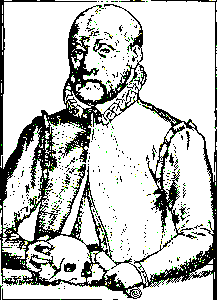
1577 · JOHANN WEYER
When demons enter a printed list
In 1577, the fifth, expanded edition of Johann Weyer’s De praestigiis daemonum was published in Basel. The edition’s title itself states that it incorporates the Pseudomonarchia daemonum, a catalogue of spirits added to a work first published years earlier. The 1577 copy is bibliographically documented and also survives in digitised reproductions.
The point here is not to present Weyer as the man who ‘invented’ an infernal hierarchy. His significance for our investigation lies in the way the material is organised: names, ranks, roles and descriptions are brought together in a catalogue that allows one figure to be compared with another.
This distinction will be fundamental throughout THE ARCHIVE. A classification printed in a particular book is not a universal hierarchy of Hell. The approach taken here requires us to identify which text, edition or tradition assigns a particular rank to each figure.
SEVENTEENTH CENTURY · ARS GOETIA
The list does not stand still
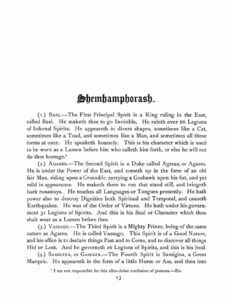
During the seventeenth century, manuscripts circulated of what we now know as the Lemegeton or The Lesser Key of Solomon. One of the principal witnesses is Sloane MS 3825, held by the British Library and dated to the seventeenth century. Joseph H. Peterson’s comparative edition uses this manuscript as its base text for much of the work.
The first part of the Lemegeton, the Ars Goetia, contains a catalogue of 72 spirits. Its relationship to earlier material is particularly important: Peterson notes that this catalogue draws on a tradition associated with Weyer’s Pseudomonarchia daemonum, also transmitted through the English translation published by Reginald Scot.
But the list is no longer identical. Names and spellings change, entries are reorganised and visual elements take on much greater importance, particularly the seals associated with the spirits. Comparison between manuscripts shows that this material was copied, corrected and transformed, rather than simply reproduced unchanged.
This makes the process clear: Weyer is not the end of the story. He represents one stage in a textual tradition that continues to be reorganised.
1818–1863 · COLLIN DE PLANCY
Hell becomes a dictionary
In 1818, Jacques-Albin-Simon Collin de Plancy published the first edition of his Dictionnaire Infernal in Paris. The work did more than list demons: it brought together superstitions, magic, apparitions, spirits, witchcraft, divination and numerous supernatural traditions within a much broader reference work. The 1818 edition is documented as a publication of P. Mongie aîné, Paris.
This structure changes how demonology is read. A figure no longer appears only as an entry in a ritual list. It can become a dictionary entry, surrounded by references, stories, variants and connections with other beliefs.
The book continued to change over the following decades. The edition of 1863, published in Paris by H. Plon, runs to 723 illustrated pages. The Library of Congress holds a complete digitised copy and explicitly identifies it as public-domain material.
Here we find another important shift: the text does more than organise names and traditions. It also begins to establish images. That will have far-reaching consequences for how many demons are subsequently recognised.
1863 · LOUIS LE BRETON
When a description acquires a face
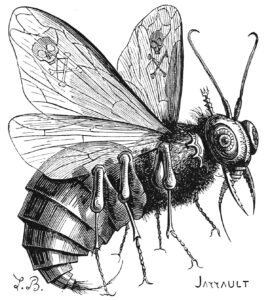
In the sixth edition of the Dictionnaire Infernal, published in Paris in 1863, illustrations take on decisive importance. The Bibliothèque nationale de France identifies it as the sixth edition, published by H. Plon and comprising 723 illustrated pages; the Library of Congress also holds a complete digitised copy.
Many of this edition’s illustrations are the work of Louis Le Breton. The reproductions preserved and catalogued today allow their authorship, date and publication history to be identified precisely.
This brings us to one of the most important sources of confusion in modern demonology. A textual description may circulate for centuries without producing a single definitive image. Then an artist interprets it and creates a particular figure. If that illustration is reproduced repeatedly, it can come to seem much older than it actually is.
We therefore need to distinguish three layers: what the text says, what the illustrator interprets and what later culture turns into a ‘traditional’ image.
The engraving of Belzebuth shown above belongs to that third stage of the process: it is neither a biblical nor a medieval portrait. It is a documented visual interpretation from 1863.
MYTH VS SOURCE
‘Demons have always looked the way we see them today’
No. The historical sources do not present a single, continuous iconography.
In texts such as Weyer’s Pseudomonarchia daemonum, we find names, ranks, roles and descriptions, but that does not mean that a fixed visual portrait existed for each figure from that point onwards. The 1577 edition explicitly identifies the Pseudomonarchia daemonum as an addition to De praestigiis daemonum.
Centuries later, printed editions and illustrators turned many of those descriptions into specific images. The 1863 edition of the Dictionnaire Infernal used here has 723 illustrated pages and is clearly identified by the Library of Congress as a Paris publication from that year.
A nineteenth-century engraving may therefore come to look ‘ancient’ simply because it has been reproduced for generations. But a familiar image does not prove that this appearance was present in medieval or biblical sources, or in the earliest demonological catalogues.
Throughout THE ARCHIVE, we will keep three things distinct: the textual description, the illustrator’s interpretation and the image that later culture comes to treat as canonical.
THE ARGUMENT
The Hell we know took shape through successive editorial layers
No one ‘built Hell’ all at once.
Johann Weyer helped establish a demonological catalogue in print in the sixteenth century. The later tradition of the Lemegeton and the Ars Goetia reorganised and expanded material of this kind. In the nineteenth century, the Dictionnaire Infernal turned demonology, superstition and occultism into an extensive illustrated reference work. The 1863 edition held by the Library of Congress has 723 illustrated pages and shows how closely text and image came to work together.
Many hierarchies and appearances that now seem to form an ancient system are therefore the result of distinct documentary layers, produced in different periods for different purposes.
Reading demonology carefully means learning to distinguish those layers: which text introduces a figure, which edition changes its position, which tradition adds new elements and which illustrator finally gives a recognisable visual form to an earlier description.
That is the central argument of this article: the Hell of the grimoires is not a single map handed down intact, but an archive built, copied, reorganised and illustrated over centuries.
ARCHIVE CONNECTIONS
Following the archival trail
Lucifer before he became the Devil
The next question takes us back before the hierarchies of the grimoires: when did lucifer, the morning star, begin to be identified with Satan? The article distinguishes the Latin term, its biblical context and later interpretations.
Belial: when a word became a king
Belial lets us examine the same process from another angle. Before occupying particular ranks in demonological catalogues, the term had a much older textual history. Following its development shows how a word can become an individual figure.
Who decided what demons look like?
Louis Le Breton’s engravings open up another investigation: how much of the modern image of demons actually comes from the texts, and how much was decided by illustrators and editors centuries later?
CONTINUE
From archive to grimoire
This article explains how some of the hierarchies later found in demonological literature were constructed and transformed. The following articles trace that history figure by figure, examining what changes when we move from a general catalogue to a particular entity.
The Public Editions continue that exploration in book form: each volume brings together the context, sources and distinctive structure of its figure. The Illustrated Editions then expand on that foundation with more extensive visual and documentary treatment.
SOURCES CONSULTED
Documents and editions used
- Johann Weyer. De praestigiis daemonum, 1577 edition, Officina Oporiniana. This edition explicitly identifies the inclusion of the Pseudomonarchia daemonum.
- British Library. Sloane MS 3825, a manuscript in the Sloane collection containing seventeenth-century magical material and Solomonic texts.
- Joseph H. Peterson. Lemegeton Clavicula Salomonis / Ars Goetia. A comparative edition based chiefly on Sloane MS 3825, with variants from other manuscripts. Peterson also documents the relationship between the catalogue of the Goetia and Weyer, and its transmission through Reginald Scot.
- Jacques-Albin-Simon Collin de Plancy. Dictionnaire Infernal, Paris, H. Plon, 1863. Complete copy digitised by the Library of Congress: 723 illustrated pages, identified as public-domain material.
- Collin de Plancy, Jacques-Albin-Simon. Dictionnaire infernal, ou Recherches et anecdotes... Paris: P. Mongie aîné, 1818. First edition, published in two volumes.
Source records
Explore the references, their limitations and their uses in other readings. The article’s full bibliography is retained in the text above.
Sloane MS 3825 ↗Johann Weyer — De praestigiis daemonum / Pseudomonarchia Daemonum ↗Dictionnaire infernal, ou Recherches et anecdotes… ↗Dictionnaire Infernal, sixth edition ↗The Book of the Goetia of Solomon the King ↗Joseph H. Peterson — Lemegeton Clavicula Salomonis / Ars Goetia ↗Study this subject further
These related lessons let you explore the article’s questions through activities and study resources.
Cite this article
Published in The Method Files’ Archive.
WHO BUILT HELL?. The Archive · The Method Files. https://themethodfiles.com/en/estudios/archivo/quien-construyo-el-infierno/
Include your access date; the copy button adds it automatically. To cite a historical source, use its own reference in the article’s bibliography.
Explore the six free lessons · Explore the Studies programme