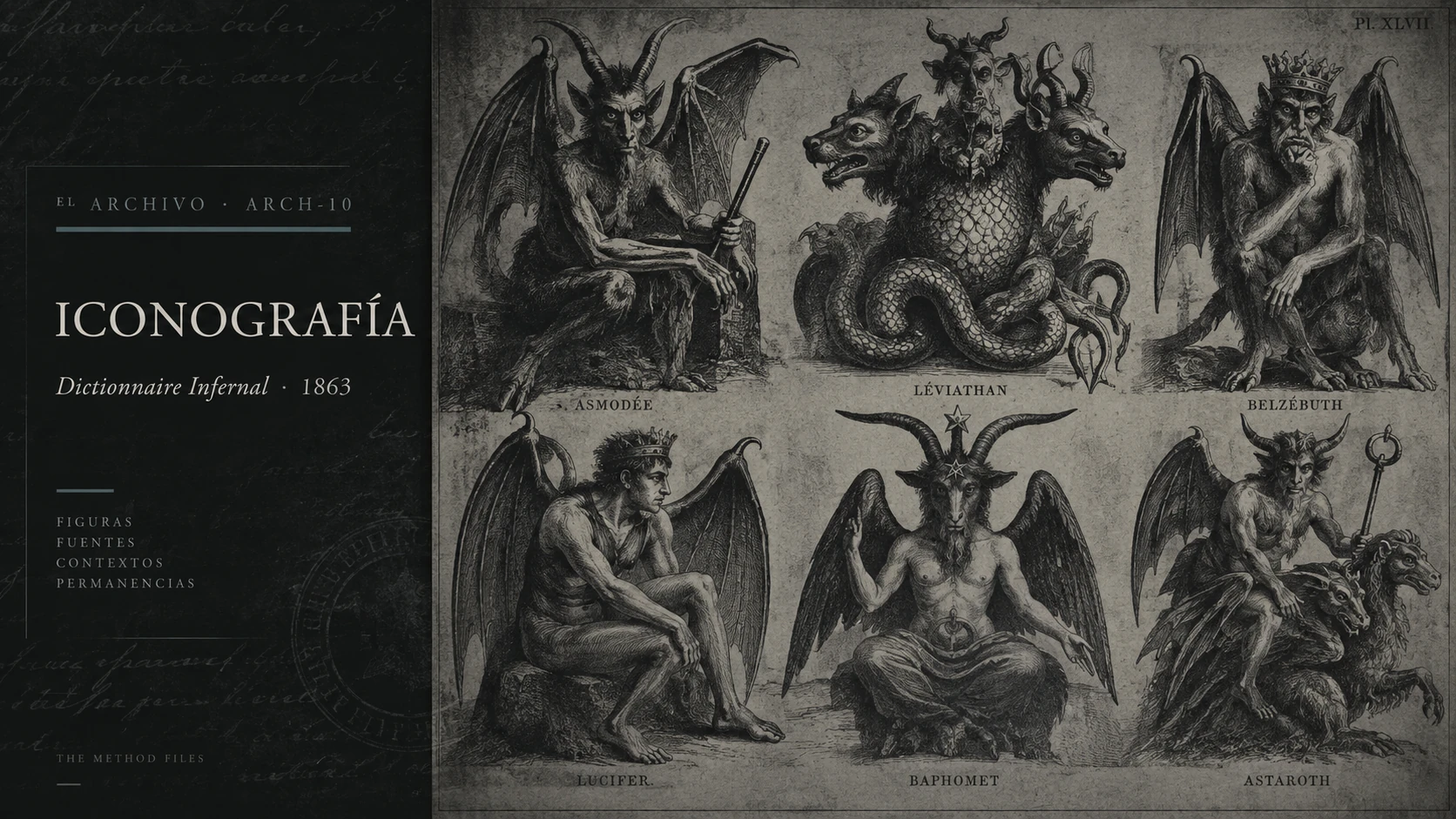
THE ARCHIVE · ARCH-10
ICONOGRAPHY
Dictionnaire Infernal · 1863
THE METHOD FILES
THE ARCHIVE
From texts to nineteenth-century engravings
Search for demonology today and something curious happens: the same demons always seem to have the same faces.
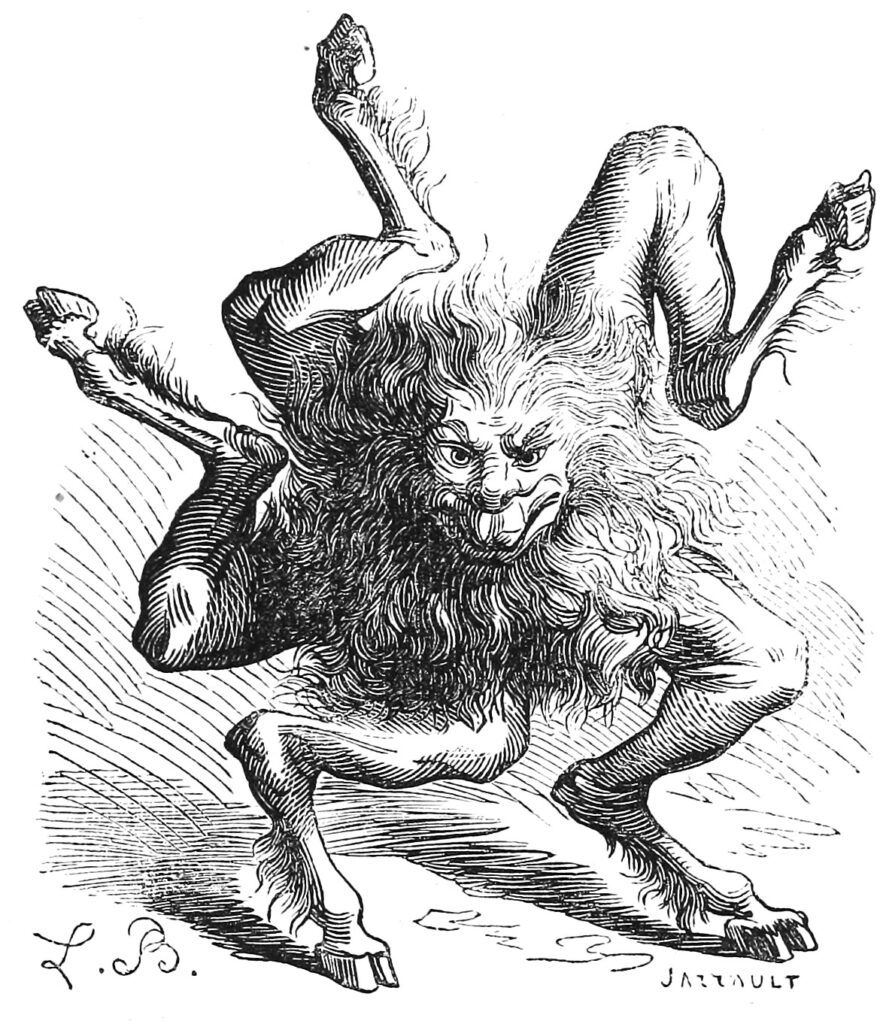
Beelzebub appears as an enormous fly. Bael combines several faces. Buer takes an impossible form with radially arranged legs. Astaroth, Asmodeus, Paimon and dozens of other names have images repeated again and again in books, websites, tattoos and modern editions.
It is easy to assume that these appearances come directly from medieval manuscripts.
Many do not.
A decisive part of modern demonological iconography took its familiar form in 1863, when the sixth edition of Collin de Plancy’s Dictionnaire Infernal appeared with 550 engravings, including portraits of 72 demons drawn by Louis Le Breton. French bibliographic cataloguing explicitly records those details.
But Le Breton was not working from nothing either.
Before him, there were textual descriptions, catalogues, manuscripts, seals and traditions describing how an entity might manifest. The illustrator did something different, and enormously influential:
he turned words into specific images.
Then came the crucial development.
The images outlived the edition that had produced them. They were reproduced so often that some came to seem older than the book itself.
This article examines that process:
how much of the appearance we now attribute to demons was actually in the sources, and how much originated at an illustrator’s desk?
BEFORE THE ENGRAVING · FIRST CAME THE DESCRIPTION
A text can describe a demon without deciding exactly how it looks
Demonological catalogues before the nineteenth century could be highly precise while leaving enormous scope for the imagination.
The Pseudomonarchia Daemonum of Johann Weyer and, later, the Ars Goetia describe spirits through combinations of rank, behaviour, powers and appearance.
A spirit may appear as a human, animal, hybrid or impossible creature. It may ride a beast, wear a crown, speak in a particular voice or change shape after appearing.
But a written description is not a fully determined portrait.
Saying that an entity has three heads does not automatically determine each head’s size or expression, the body’s precise position, the scene’s background or the exact form of its limbs.
That is where the artist comes in.
Whenever an illustrator turns those sentences into an image, they must make decisions the source leaves unresolved.
What to exaggerate. What to omit. What to put in the foreground. What to turn into a symbol.
Two artists can therefore begin with the same description and produce very different creatures without either necessarily ‘misreading’ the text.
This distinction is fundamental to the article:
the source supplies attributes; the illustrator constructs an appearance.
When one of those appearances is reproduced for generations, it can come to seem the only possible one.
1863 · LOUIS LE BRETON MAKES CHOICES
When an artistic interpretation begins to look like tradition
In 1863, the sixth edition of the Dictionnaire Infernal gave visual form to this problem.
Louis Le Breton took names and descriptions that had circulated for centuries and had to resolve what the text left open.
How large is the creature?
How are its limbs arranged?
What expression does it have?
Which feature dominates when several animal forms appear in a single description?
Those decisions belong to the illustrator.
Some were extraordinarily powerful.
Buer is a good example. Le Breton’s illustration turns him into a creature of almost impossible symmetry: a lion-like head surrounded by five radially arranged limbs. The image is so recognisable that it recurs almost unchanged in countless modern representations. The historical Wikimedia record credits Le Breton with the image for the 1863 edition of the Dictionnaire Infernal.
But an image’s later popularity does not automatically make every visual choice in it information derived from the earliest source.
That is the crucial point.
Le Breton did more than copy demons that already had official portraits. He interpreted descriptions and turned them into particular visual compositions.
Reproduction did the rest.
The more often the same engraving appeared, the less it seemed an interpretation from 1863 and the more it seemed to show ‘what Buer looks like’.
The artist had made a choice.
Later culture turned it into a canon.
FROM BOOK TO VISUAL MEMORY
The image survives better than the footnote
A description may require reading. An image can be recognised in an instant.
That difference explains much of the success of the engravings based on Le Breton’s illustrations.
Once published, they could easily be separated from the context that had produced them. Readers no longer needed to consult the complete entry in the Dictionnaire Infernal: reproducing the figure was enough.
With each new copy, some information was lost.
The edition disappeared.
The date disappeared.
The illustrator’s name disappeared.
Eventually, all that might remain was the demon and its face.
Here begins one of the major problems of modern demonological iconography.
An illustration with a known date and artist can circulate for so long that it comes to be presented simply as a ‘traditional representation’.
But traditional does not necessarily mean old.
An image can become a tradition precisely because it has been reproduced so successfully over the past century and a half.
The process is straightforward:
one description allows many images; a frequently reproduced image eventually displaces the others.
When that happens, the illustrator’s work ceases to look like interpretation.
It begins to look like memory.
THE SEAL IS NOT THE PORTRAIT
A sign identifies; it does not necessarily describe
Seals introduce another visual problem.
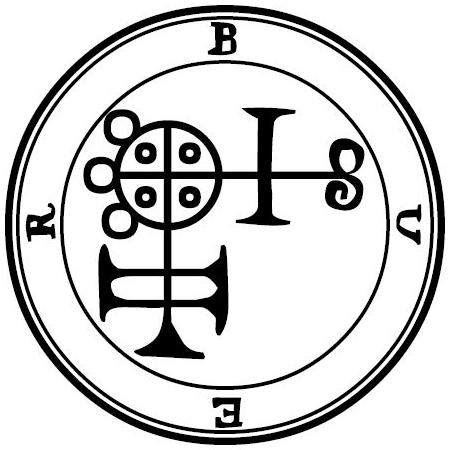
In grimoires such as the Ars Goetia, many entities are associated with distinctive graphic signs.
These signs can function as identifying marks within the text’s system.
But a seal does not necessarily tell us what an entity’s face, body or overall appearance should look like.
A sign and a portrait serve different purposes.
Later visual culture has nevertheless often combined them.
A seal may be placed beside an illustration.
The illustration may recur beside the same name.
Over time, the two elements may begin to be perceived as though they originated together.
That was not always the case.
A manuscript may preserve a seal without providing a portrait.
Another text may describe an appearance without including an image.
Centuries later, an illustrator may combine the two traditions and produce something that looks like an old, firmly established whole.
This article therefore keeps three things distinct:
name, seal and appearance.
They may belong to the same entity within a tradition.
But they do not necessarily come from the same period or source.
COPYING ALSO CREATES A CANON
Each reproduction makes an image seem older than it is
An image need not be medieval to end up looking as though it is. It only needs to circulate long enough and be reproduced repeatedly without always retaining its original context.
That happened to many nineteenth-century demonological engravings. They passed into new editions, manuals, encyclopaedias, web pages and digital archives. Each copy increased their familiarity, creating a simple illusion: if an entity always has the same appearance, we tend to assume it was always depicted that way.
But repetition does not mean antiquity. It means that an image worked, was remembered and was copied more often than others. Some of Louis Le Breton’s illustrations achieved precisely that success. Later artists could reproduce, simplify or reinterpret them; those new versions circulated in turn, taking the image ever further from its original context.
A visual canon can thus form without any authority decreeing it. One representation simply survives better than its alternatives and comes to dominate collective memory.
In THE ARCHIVE, it is therefore not enough to ask which demon we are looking at. We must also ask who drew it, when the image appeared and what the earlier source actually said.
An illustration can recur for generations and still represent an artistic choice made at a particular moment. Copying can turn an image into tradition, but cannot make it older.
WHAT THE SOURCE ACTUALLY SAYS
Description, seal and illustration do not tell the same story
To establish where a demon’s appearance comes from, we must distinguish three kinds of evidence often presented together today: the written description, the seal and the illustration. They may refer to the same entity, but they serve different purposes and do not necessarily belong to the same period.
Catalogues such as the Pseudomonarchia Daemonum contain descriptions of forms, animals, attributes and ways of appearing. The Ars Goetia preserves and reorganises part of that tradition and gives seals a prominent visual role. Yet none of these elements dictates a single graphic composition.
The shift occurs when an illustrator turns those indications into a finished scene. Louis Le Breton had to decide how to arrange bodies, heads, limbs, crowns, mounts and animal features. Some choices could draw directly on the text; others were necessary simply because drawing requires precision where a sentence can leave possibilities open.
When we now encounter a name, a seal from the Goetia and an engraving from the Dictionnaire Infernal together, we should not assume that all three originated as a unit. They may be distinct documentary layers brought together by later reproduction.
This distinction changes how we read a demonological image. Before calling it ‘traditional’, we need to ask which parts the source actually describes, which belong to the system of seals and which were decided by the artist.
An image can faithfully represent a text and still be an interpretation.
WHAT CHANGED LATER
The engraving ceased to belong to the book and began to belong to the demon
The most important change occurred when illustrations began circulating separately from the edition that had produced them. Within the Dictionnaire Infernal, an engraving had context: an artist, a date, a corresponding entry and a particular page. Outside the book, it could be reduced to a name and an image.
That loss of context had consequences. As nineteenth-century figures were reproduced in new publications and, much later, in digital archives and web pages, they began to function as independent visual references. Readers could recognise Buer, Bael or Beelzebub without knowing who had drawn them or when.
From that point, the direction of influence changes too. Later artists no longer necessarily have to return to the old description. They can begin with an earlier image. Each new version retains some features, changes others and reinforces what the public already expects to recognise.
This creates a visual chain. The text inspires an engraving; the engraving inspires new illustrations; those illustrations become models; and finally the model comes to seem more stable than the description that gave rise to it.
The internet has accelerated this process further. An image may appear thousands of times without its date, source edition or Le Breton’s name. When that information disappears, so does the boundary between historical document and artistic interpretation.
The problem is therefore not using these engravings. They are a fundamental part of demonology’s history. The problem begins when we stop identifying where they come from.
The nineteenth century did more than illustrate demons. It helped determine how later generations would learn to recognise them.
MYTH VS SOURCE
A ‘traditional’ image can have a date, an artist and an edition
The most common mistake is to look at a familiar demonological engraving and assume it has been transmitted from the Middle Ages. Familiarity is deceptive: the more often a figure appears, the older it seems.
Yet many representations we now recognise instantly can be located quite precisely. The engravings based on Louis Le Breton’s illustrations belong to the sixth edition of the Dictionnaire Infernal, published in 1863. They have an artist, a publishing context and a specific date. They are neither medieval illustrations recovered by Collin de Plancy nor portraits preserved unchanged from the earliest grimoires.
That does not mean Le Breton invented all their attributes. Some features came from earlier descriptions and could be traced to Weyer, the tradition of the Goetia or other sources. What the artist did was turn those written elements into a definite visual form, necessarily making choices where the text did not specify every detail.
Saying ‘this is the demon’s traditional appearance’ is therefore insufficient. A more precise question is: traditional since when, and because of which image?
An old seal, a textual description and an engraving from 1863 can end up together on a modern page, creating the impression that they always formed a unit. Historical research shows that they may have originated centuries apart.
Recognising a demon does not mean knowing where its face came from.
THE ARGUMENT
The face has a history too
Visual demonology cannot be studied as though every entity had always possessed a fixed appearance. Before the engravings, there were names, descriptions, attributes and seals; turning these into an image, however, required choices that belonged to the illustrator.
Louis Le Breton was decisive because many of his visual solutions proved memorable. Published in the 1863 edition of the Dictionnaire Infernal, these images ceased to be mere accompaniments to the text and began to serve as references for later readers, editors and artists.
Over time, repetition erased some of the context. An engraving with a known artist and date could come to circulate simply as a demon’s ‘traditional image’. A particular interpretation thus passed from one edition to another until it acquired the appearance of antiquity.
This does not diminish the engravings’ value. On the contrary, it makes them essential documents. But it requires careful reading: we must distinguish attributes derived from an earlier description, elements belonging to a seal and visual choices actually made in the nineteenth century.
That is the argument of this article: demons have more than a textual history. They also have a visual history, and knowing who drew each face can matter as much as knowing who wrote its name.
ARCHIVE CONNECTIONS
Returning to the text after looking at the image
Who built Hell?
‘Who built Hell?’ explains how catalogues, copyists, editors and illustrators constructed a demonological system that now seems much more stable than it was. This article complements that investigation from the visual perspective: establishing when a name appears is not enough; we also need to discover when it acquired the face we now associate with it.
Belial: when a word became a king
Belial is a particularly useful example because his textual transformation can be compared with his visual development. A word from the Hebrew Bible becomes an entity with rank, functions and a seal. Following that sequence shows how a figure first acquires an identity in the documentary record and then an increasingly recognisable appearance.
Beelzebub was not born in Hell
Beelzebub’s history shows how much a name can change in meaning before even acquiring a stable image. When nineteenth-century illustrators depict him, they are not drawing Ekron’s Baal-Zebub neutrally: they are working with centuries of prior demonisation, translation and reinterpretation.
Together, these articles reconstruct the whole process: first the text changes, then the figure’s position changes, and finally an image can capture that entire development in a single face.
The history of images lets us return to names, texts and hierarchies with another question:
when we think we recognise a demon at a glance, are we remembering an old source or an illustration we have learnt to treat as old?
CONTINUE
After looking at the face, return to the source
This article has traced the process that turns a description into an image and an image into tradition. The engravings of 1863 do not replace earlier sources, but they decisively changed how later generations learnt to recognise many entities.
From here, THE ARCHIVE can be read differently. Whenever a seal, description or portrait appears, we should ask which parts belong to the original text, which to a particular edition and which were added by later visual tradition.
This distinction matters particularly when returning to the articles on Lucifer, Lilith, Belial, Leviathan, Beelzebub, Satan and Lucifuge Rofocale: each accumulated images that do not all belong to the same period.
An image can be a source. But only when we know where it comes from.
SOURCES CONSULTED
Documents and editions used
- Collin de Plancy, Jacques-Albin-Simon. Dictionnaire infernal. Sixth edition. Paris: Henri Plon, 1863. Illustrated edition used to study how numerous demonological figures acquired familiar visual forms in the nineteenth century. The Bibliothèque nationale de France preserves and digitises this edition.
- Le Breton, Louis. Illustrations for the Dictionnaire infernal, sixth edition, 1863. The engravings based on his illustrations are among the main visual sources examined in this article. The illustration of Buer used here belongs to this edition.
- Weyer, Johann. Pseudomonarchia Daemonum. A demonological catalogue included in editions of De praestigiis daemonum and an essential source for comparing earlier written descriptions with later visual representations. The tradition of the Goetia is closely related to this catalogue.
- Lemegeton Clavicula Salomonis · Book I: Ars Goetia. Consulted to compare descriptions, names and seals with images popularised later. Joseph H. Peterson’s digital edition is based chiefly on the manuscript British Library, Sloane MS 3825.
- Mathers, S. L. MacGregor; Crowley, Aleister. The Book of the Goetia of Solomon the King. 1904. Edition used as the reference for modern reproductions of the spirit seals of the Goetia.
- Catalogue collectif de France / Bibliothèque nationale de France. Dictionnaire infernal, sixth edition, Paris, H. Plon, 1863. The bibliographic record documents 723 pages, 550 engravings and 72 portraits of demons drawn by Louis Le Breton.
- Wikimedia Commons. ‘Buer’, Louis Le Breton, 1863. Digital reproduction of the illustration of Buer from the sixth edition of the Dictionnaire Infernal.
Source records
Explore the references, their limitations and their uses in other readings. The article’s full bibliography is retained in the text above.
Sloane MS 3825 ↗Johann Weyer — De praestigiis daemonum / Pseudomonarchia Daemonum ↗Dictionnaire Infernal, sixth edition ↗The Book of the Goetia of Solomon the King ↗Joseph H. Peterson — Lemegeton Clavicula Salomonis / Ars Goetia ↗“Buer” · Dictionnaire Infernal ↗Study this subject further
These related lessons let you explore the article’s questions through activities and study resources.
Cite this article
Published in The Method Files’ Archive.
WHO DECIDED WHAT DEMONS LOOK LIKE?. The Archive · The Method Files. https://themethodfiles.com/en/estudios/archivo/quien-decidio-el-aspecto-de-los-demonios/
Include your access date; the copy button adds it automatically. To cite a historical source, use its own reference in the article’s bibliography.
Explore the six free lessons · Explore the Studies programme