THE ARCHIVE · ARCH-20
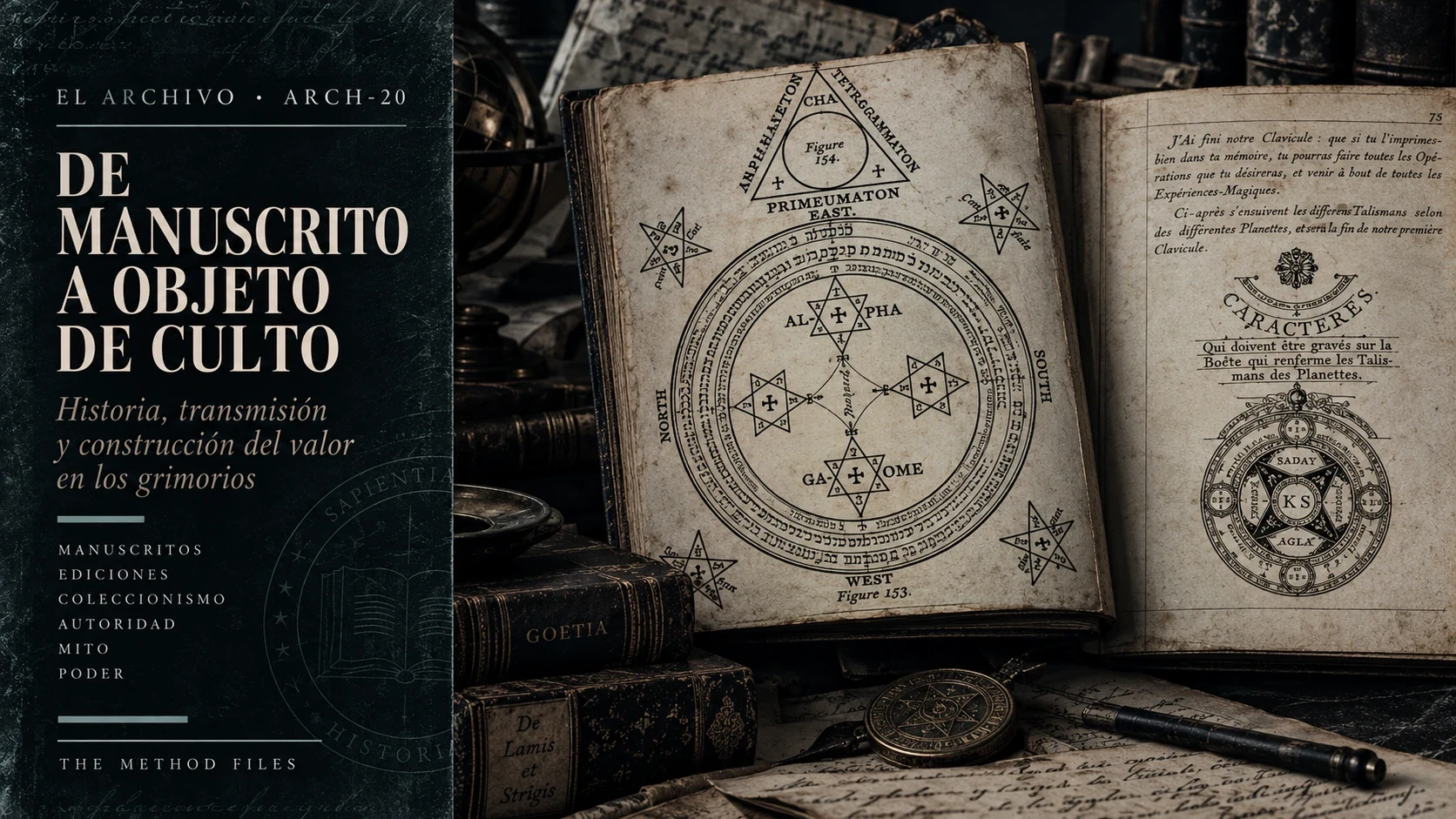
FROM MANUSCRIPT TO CULT BOOK
History, transmission and the construction of value in grimoires
THE METHOD FILES
THE ARCHIVE
How printing, collecting and republication changed the reception of grimoires.
INTRODUCTION
The book we now call ‘a grimoire’ rarely reached us intact. Before becoming a catalogue title, a bookshop edition or a downloadable PDF, it may have existed as a manuscript copy, a notebook in several hands, a cheap printed book, a rebound volume, a collector’s copy or a new edition combining material from different witnesses.
That journey matters because every transformation leaves traces. Print may establish a title. An editor may select one textual branch and discard another. A collector adds provenance. A library gives the copy a stable shelfmark. A reissue may add images that eventually seem inseparable from the text. And a digital facsimile may reproduce a page until it becomes the version everyone recognises.
This article asks a simple question: what happens when we stop treating the grimoire as an idea and start following it as an object?
THE ARGUMENT
The reception of physical books shapes a canon
A grimoire’s history does not end when its last line is copied. It continues through the form it takes, who owns it, which edition reproduces it and which audience learns to recognise it.
This article argues that manuscript, print, collection, occultist edition and facsimile are not neutral wrappers around identical content. They are stages that select, organise and reinterpret. One version may prevail not because it is the oldest, but because it was printed, translated, illustrated or republished most successfully.
We must therefore abandon an overly simple picture: first ‘the original’, then copies, then editions. The sources reveal something more complex. Manuscripts and printed books coexisted, copied each other and travelled through different networks. The canon formed while the material was still changing.
MANUSCRIPT AND PRINT
Print did not kill the manuscript
In a 2023 study of printed grimoires and the transmission of learned magic, Owen Davies shows that manuscript and print were intertwined rather than one replacing the other. Medieval texts continued to be copied in the early modern period even when printed books with similar material existed. Conversely, a later manuscript might copy a printed book, reorganise it or combine it with other texts.
This explains many peculiarities of grimoires. A text may preserve an old formula within a late compilation. A printed book may give a stable form to material previously circulating in separate notebooks. A manuscript copy may look ‘older’ yet postdate the book it copies.
The medium alone therefore does not settle the chronology. The manuscript is one witness; the printed book another. Comparison allows us to reconstruct transmission.
COLLECTING
When owning a manuscript changes its history
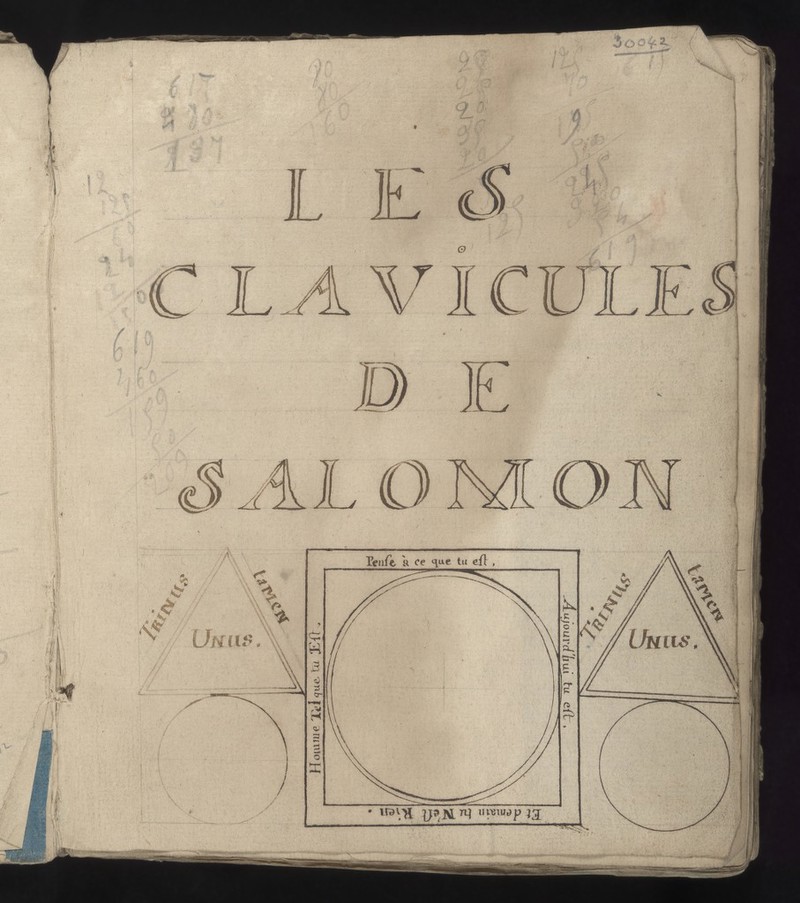
Grimoires also survived because they were owned, sold, inherited and collected. Institutional records allow that material history to be traced.
Sloane MS 3825, now in the British Library, preserves a chain of ownership predating its incorporation into the Sloane Collection. The catalogue mentions John Somers and Sir Joseph Jekyll and records the purchase of manuscripts at Jekyll’s sale in 1739/40. This does not tell us who composed each text in the volume, but does show how a private object entered a collection that would become publicly accessible.
The distinction is decisive. Once a manuscript has a shelfmark, catalogue record and provenance, it can be cited precisely. Modern editors can identify it as ‘Sloane 3825’, compare variants and make that library reference part of an edition’s authority.
Collecting does not create the text. It may, however, determine which witnesses survive, which can be compared and which influence future editions.
MATHERS 1889
The Key of Solomon becomes a Victorian book
S. L. MacGregor Mathers’s 1889 edition perfectly illustrates how a manuscript tradition acquires a modern published form.
Cambridge describes it as the edition that introduced an important work of Renaissance esotericism to the Victorian English public. Mathers worked with manuscripts in the British Museum, translated and organised material, and presented the result as a coherent book. The edition does not reproduce a single witness page by page. It constructs a readable Key of Solomon for a new audience.
That does not make it false. It makes it what it actually is: a historical editorial intervention. Its later reception shows how an edition can become the gateway to a much more complex tradition.
In modern reception, Mathers’s edition helped establish a recognisable structure: two books, ordered chapters, pentacles, introductions and a presentation giving the whole the appearance of a stable work. A diverse manuscript tradition thus acquired one particular published form.
GOETIA 1904
When part of a manuscript takes on a life of its own
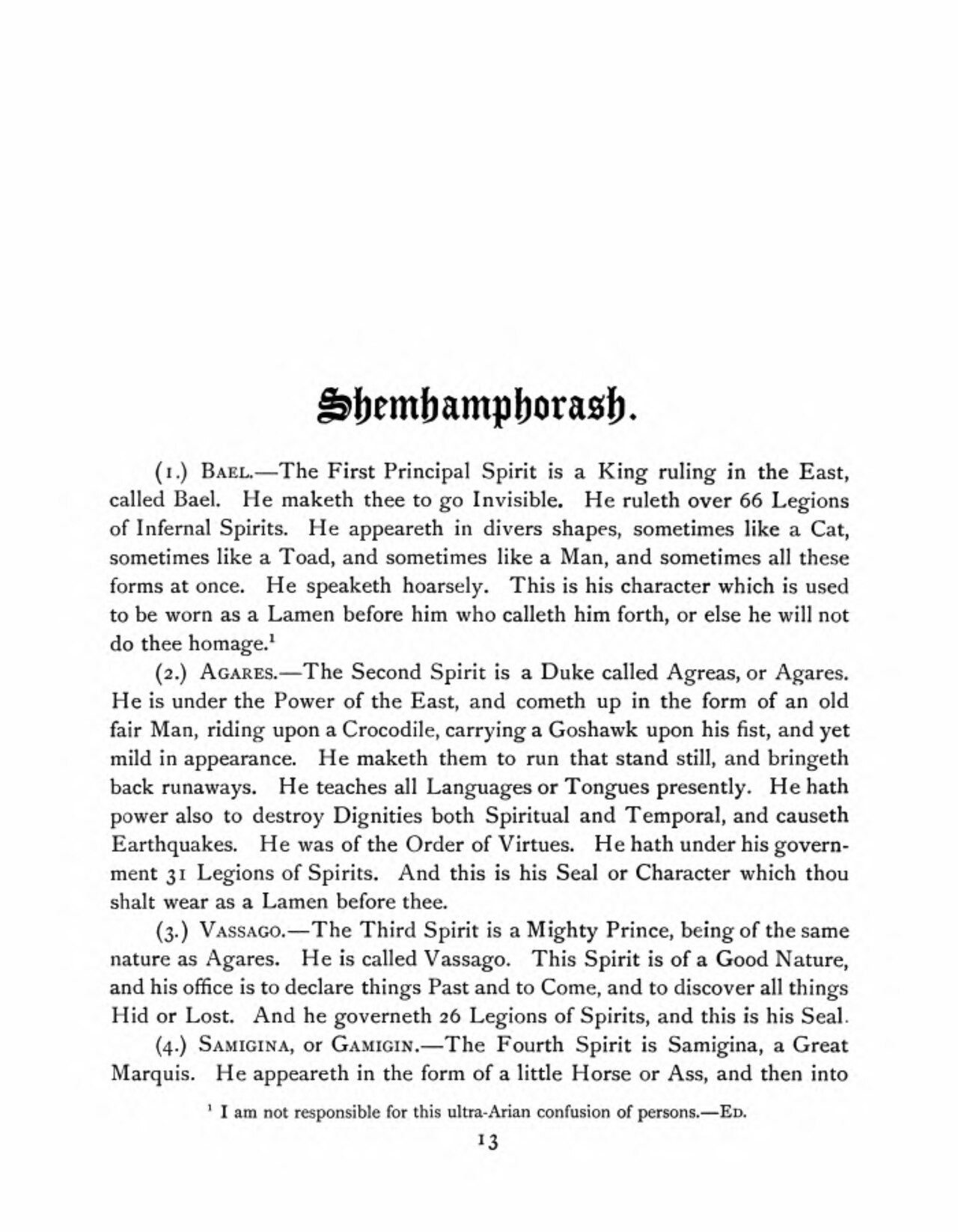
Something similar happens with the Goetia. Within the Lemegeton manuscript tradition, it forms part of a larger compilation. The Mathers–Crowley edition of 1904 turns it into an independent volume with its own title, title page, apparatus and circulation.
That editorial decision has consequences. A section previously situated among other books of the Lemegeton can begin to be read as an autonomous work. Its seventy-two spirits, seals and order circulate separately from the rest.
The edition’s popularity does not prove it is ‘the original’. It demonstrates something else: a clearly identified printed form can become a cultural reference point. The publication selects part of a tradition and makes it more visible than the whole from which it came.
DRAGON ROUGE
A grimoire can become a product too
The Grand Grimoire / Dragon Rouge takes another route: a problematic, cheap and repeatedly published printed book surrounded by publication dates and places that are difficult to substantiate.
Mélanie Papot-Libéral’s research documents a tradition of varying titles, undated printings and fictitious dates. That instability did not prevent its success. It may instead have helped create a reputation for antiquity, secrecy and danger.
Here the market’s material conditions matter as much as the contents. A title page may promise a prestigious place of publication, a remote date or an antiquity difficult to substantiate. A reissue may retain that claim because it forms part of the book’s commercial identity. Over time, the publishing legend becomes part of reception.
The question becomes not only ‘what does the text say?’ but ‘what does this object want us to believe about its own antiquity?’
REPUBLICATION
1863: when republication means transformation
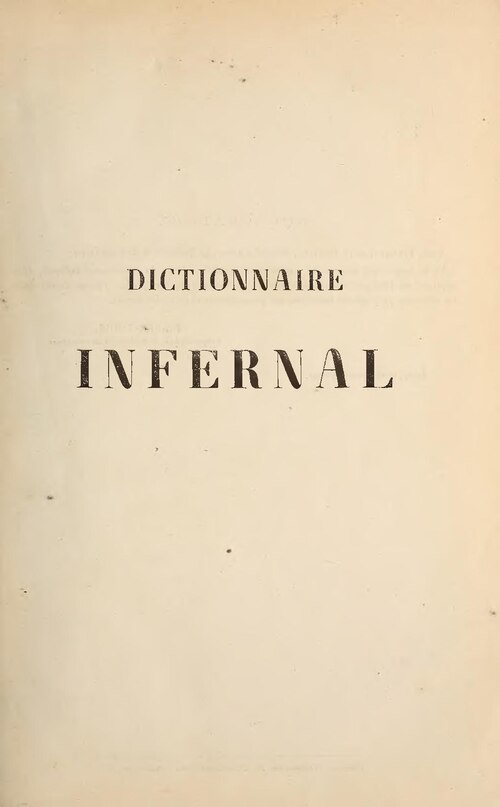
The Dictionnaire Infernal demonstrates how a new edition can radically change a work’s reception.
The Catalogue collectif de France describes the sixth edition of 1863 as expanded with eight hundred new entries and illustrated with five hundred and fifty engravings, including portraits of seventy-two demons attributed to L. Breton. This is no simple reprinting of the same pages. Extent, content and visual experience change.
On the portrait count: the edition’s bibliographic record states 72 portraits. The advertised figure is not treated here as a fully verified count. ‘Le Breton’s 72 portraits’ examines four particular cases, distinguishing the book’s claim from what that comparison establishes.
‘Le Breton’s 72 portraits’ showed their impact. This article adds the material dimension: many demons’ canonical appearance depends on one particular edition. Reproduced over generations, that edition’s intervention comes to seem as though it had ‘always’ belonged to the work.
A new edition can thus become a vehicle for collective memory. It determines what is seen, what is repeated and which version survives in the collective imagination.
FACSIMILE
The facsimile multiplies the object but does not replace it
Digitisation has brought a further transformation. Today we can open in seconds a manuscript, an 1889 edition or a 1904 volume that once required a journey to a library.
That access is extraordinary, but limited. A PDF reproduces pages; it does not automatically reproduce the binding, paper, physical sequence, added leaves, actual size, smell, traces of use or complete provenance. An isolated image may even lose its relationship to the volume it came from.
‘How to read an old grimoire’ therefore insisted on identifying the object we are reading. This article adds a consequence: the easier a page is to reproduce, the easier it is for one edition to become ‘the version’ visible online.
The facsimile is no less useful. It simply needs to be identified accurately.
MYTH VS SOURCE
‘The famous edition is the original’
One persistent simplification confuses publishing fame with historical priority.
Mathers’s Key of Solomon is influential, but not a Renaissance manuscript. The Goetia of 1904 is decisive for modern reception, but does not encompass the Lemegeton’s entire manuscript tradition. The Dictionnaire Infernal’s sixth edition is fundamental to iconography, but its engravings belong to 1863. A library copy may be old and valuable without being the archetype of the whole work.
Accurate wording is more precise: ‘this edition established’, ‘this manuscript preserves’, ‘this editor selected’, ‘this copy belonged to’, ‘this reissue added’.
Each verb restores the object’s actual place in history.
ARCHIVE CONNECTIONS
A network of objects, not a list of titles
FROM THE PSEUDOMONARCHIA TO THE GOETIA: THE LIST CHANGED
Transmission does not preserve unchanging lists: names, order and content may change when a manuscript or printed branch is reorganised.
THE PROBLEM OF IMPOSSIBLE DATES
A title page or imprint belongs to the object, but its stated date does not automatically establish a defensible date of composition or printing.
HOW TO READ AN OLD GRIMOIRE
Establishes a method for distinguishing manuscript, edition, translation, copy and provenance before drawing historical conclusions.
LE BRETON’S 72 PORTRAITS
Shows how a particular edition can add a visual layer that later seems inseparable from the tradition.
RENVOI AND RITUAL DISMISSAL
Formulae also change between witnesses and editions; the material object helps locate those differences rather than erase them.
This article brings those pieces together. If the text changes, the date is debated, the image is added and the formula reorganised, the material object cannot be treated as a neutral container. It is one of the forces producing the tradition.
Material history therefore broadens the question: alongside what grimoires say, we should ask how they became the books we know today.
CONCLUSION
The canon has a binding too
A manuscript is more than handwritten text. A printed book is more than the same text multiplied. A collection is not a neutral storehouse. An edition is not a transparent window. A reissue is not always a copy.
Every stage selects and transforms. Some differences are small: spelling, order, titles. Others change reception for centuries: a new image, a dominant translation, a title page with an impossible date, an edition that becomes standard.
Studying a grimoire therefore requires following two histories at once. The first is textual: which words, names, formulae and chapters it transmits. The second is material: which object carried them, who owned, edited and printed it, and which version achieved the greatest circulation and visibility.
When those histories meet, the ‘cult book’ ceases to be an empty metaphor. It means something more precise: a published form that, through repetition, prestige, rarity or circulation, comes to stand for an entire tradition.
CONTINUE
Continue exploring The Archive
Continue this enquiry through the articles on transmission, dates, images and ritual formulae. Each explores a different transformation of the book and its reading.
As you move between articles, always identify the copy or edition being analysed. You can then distinguish what the document preserves from what editors and interpreters add.
The rule remains: source first, object next, interpretation last.
FURTHER READING
Following the collection’s material history
LESSONS AND SOURCES
Following a grimoire as a transmitted object
This article shows what happens as a tradition passes through manuscripts, collections, editions and reissues. Studies provides a method for separating the surviving object, editorial mediation and what each piece of evidence can actually establish.
- MANUSCRIPTS, EDITIONS AND TRANSMISSION: distinguish manuscript witness, transcription, edition, translation, reproduction and digitisation.
- PROVENANCE, DATE AND CONTEXT: read owners, shelfmarks, dates and custody chains without turning a copy’s provenance into authorship of its text.
- WHAT A SOURCE CAN ACTUALLY ESTABLISH: keep every claim within what the catalogue, manuscript, edition or study can substantiate.
Consult the Source records and final bibliography to locate the manuscripts, printed books and studies used throughout this exploration.
- Owen Davies · Grimoires: A History of Magic Books · 2009: general context for the circulation, printing and reception of magic books.
- British Library · Sloane MS 3825: manuscript object and documented institutional provenance.
- Joseph H. Peterson · Lemegeton / Ars Goetia: modern editorial mediation and comparison of witnesses.
- Mathers–Crowley · The Book of the Goetia of Solomon the King · 1904: printed publication documenting modern reception.
- Grand Grimoire / Le Dragon Rouge: printed tradition with problems of dating and publishing identity.
- Dictionnaire Infernal · sixth edition · 1863: expanded, illustrated edition that transforms visual reception.
SOURCES CONSULTED
Bibliography and repositories used
- Owen Davies · Print Grimoires and the Democratization of Learned Magic in the Later Early Modern Period
- Owen Davies · Grimoires: A History of Magic Books
- British Library · Sloane MS 3825
- Cambridge University Press · The Key of Solomon the King (Mathers, 1889)
- Wikimedia Commons · The Book of the Goetia (Mathers–Crowley, 1904)
- Mélanie Papot-Libéral · Le Dragon Rouge
- CCFr / BnF · Dictionnaire Infernal, sixth ed., 1863
Source records
Explore the references, their limitations and their uses in other readings. The article’s full bibliography is retained in the text above.
Grimoires: A History of Magic Books ↗Sloane MS 3825 ↗Joseph H. Peterson — Lemegeton Clavicula Salomonis / Ars Goetia ↗The Book of the Goetia of Solomon the King ↗Le Grand Grimoire — Paris, 1845 ↗Dictionnaire Infernal, sixth edition ↗Owen Davies · Print Grimoires and the Democratization of Learned Magic ↗Cambridge University Press · The Key of Solomon the King (Mathers, 1889) ↗Wikimedia Commons · The Book of the Goetia (Mathers-Crowley, 1904) ↗Mélanie Papot-Libéral · Le Dragon Rouge : éditions et réception d’un grimoire à l’époque contemporaine ↗Dictionnaire Infernal · 1863 · CCFr ↗Study this subject further
These related lessons let you explore the article’s questions through activities and study resources.
Cite this article
Published in The Method Files’ Archive.
FROM MANUSCRIPT TO CULT BOOK. The Archive · The Method Files. https://themethodfiles.com/en/estudios/archivo/de-manuscrito-a-objeto-de-culto/
Include your access date; the copy button adds it automatically. To cite a historical source, use its own reference in the article’s bibliography.
Explore the six free lessons · Explore the Studies programme