
THE ARCHIVE · ARCH-19
RENVOI AND RITUAL DISMISSAL
The history and function of the closing or licence to depart
THE METHOD FILES
THE ARCHIVE
The history and function of closure or licence to depart in different texts.
In many modern manuals, the ‘licence to depart’ appears as the fixed final step of a universal ceremony. Historical sources tell a different story. The Heptameron may close with a short, liturgical line; the Ars Goetia expands the ending through safety, thanksgiving and waiting within the circle; the Grimorium Verum preserves an almost formulaic renvoi; and the Grand Grimoire places dismissal within a relationship of pact, threat and obligation.
A common function exists: the operation does not simply end when the practitioner receives an answer. The text must mark that the summoned presence is no longer required. But how it does so varies with the text, language, tradition and understanding of authority underpinning each work.
This article studies that ending as a document. It asks not which formula is ‘correct’, but what each dismissal reveals about its grimoire’s system.
THE ARGUMENT
Ending the operation also defines the relationship
The renvoi is not a decorative appendix. In these texts, it acts as a boundary between the time of evocation and the return to ordinary order. That boundary, however, is not expressed identically in every work.
In some sources, dismissal authorises a return ‘in peace’ while leaving a future summons possible. Others insist that the practitioner remain protected until the departure is confirmed. In the Grand Grimoire, the dismissal continues to invoke the pact and retains a threat of coercion. The ending thus reveals how each text understands obedience, safety, reciprocity and authority.
VOCABULARY
Licentia, license to depart and renvoi are not exactly the same
Latin expresses the idea of granting leave to depart; ‘license to depart’ becomes customary in English tradition; in French, renvoi may mean dismissal, return or sending back. These terms are functional equivalents, but do not require an identical formula.
The vocabulary prevents us from treating later translations as one single textual unit. Two grimoires can perform the same ritual function through different phrases, gestures and tones. Comparison must respect those differences.
HEPTAMERON
The briefest dismissal
In the Heptameron, after the desired commands, the licence is exceptionally concise. The formula asks the spirits to go in peace to their places, for peace to remain between both parties and for them to be ready to return when called.
Its structure is almost liturgical: the Trinitarian name, peace, return to the proper place and future availability. It contains neither extensive negotiation nor a catalogue of threats. This brevity is a useful point of comparison: formal dismissal can exist without the lengthy rhetoric found in other works.
KEY OF SOLOMON
An ending shaped by the operation
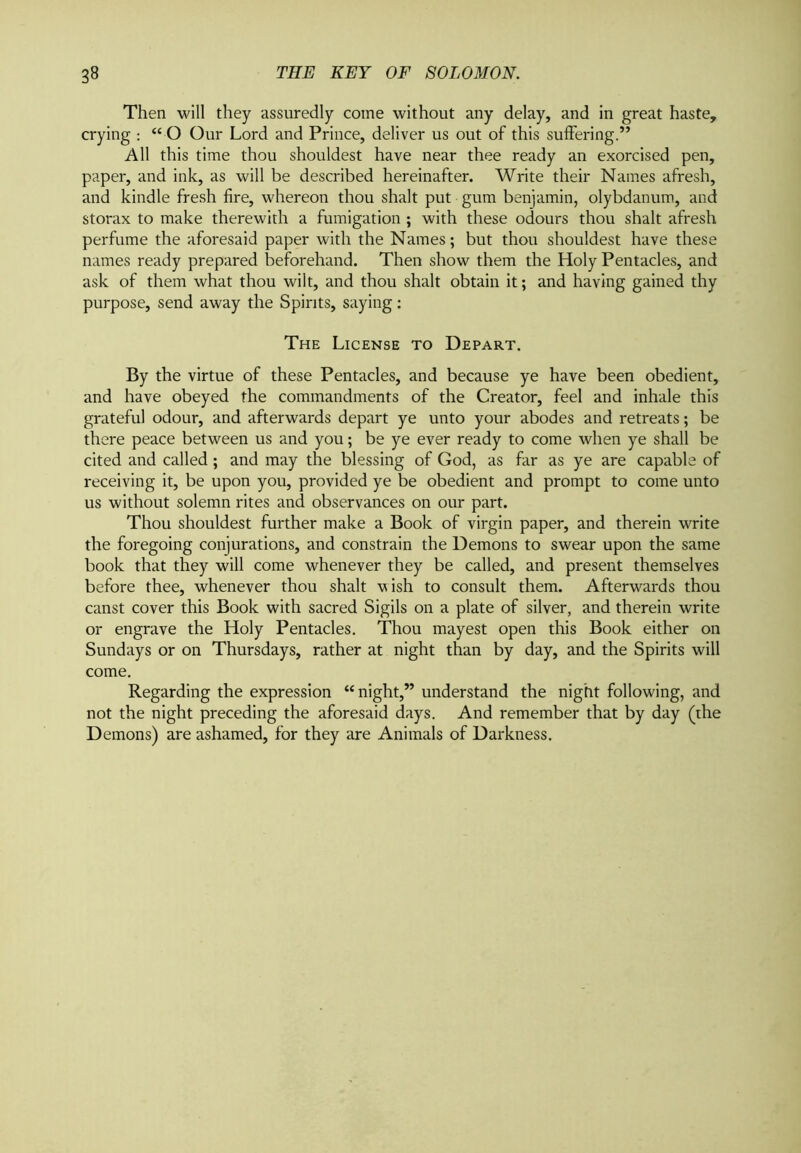
Mathers’s 1889 edition preserves more than one licence to depart. One operation closes briefly: the spirits are to return to their place, peace is to remain, and they are to come when called again. Elsewhere, the licence relates to the pentacles, obedience, the perfume offered and divine blessing.
This challenges another simplification: even within one printed work, the ending need not always have a single form. The function remains, but the operational context changes the wording and what immediately follows.
ARS GOETIA
Courtesy does not remove command
The Ars Goetia published by Mathers and Crowley in 1904 preserves a more elaborate licence. Having answered the demands, the spirit is dismissed and ordered to return to its place without causing harm. The dismissal combines acknowledgement of cooperation with explicit authority.
The text adds a significant precaution: the practitioner must not leave the circle until the spirit has withdrawn and prayers of thanksgiving have been made. The ending is therefore more than one phrase. It includes verification, remaining in the protected space and devotional closure.
This combination of courtesy, command and safety explains why reducing the renvoi to ‘say thank you and finish’ impoverishes the document.
GRIMORIUM VERUM
A brief formula divides again
The Grimorium Verum provides a renvoi for superior spirits, returning to the sequence of peace, return to their proper place and readiness to come when called. The verbal similarity to the Heptameron family is evident, although this article does not treat that similarity alone as straightforward proof of direct copying.
The text introduces another dismissal for inferior spirits. This includes a subsequent action: certain characters are burned because they serve only once. Closure can therefore involve the material destruction or cancellation of elements used in the operation, not merely a verbal command.
GRAND GRIMOIRE
When the renvoi retains the pact’s threat
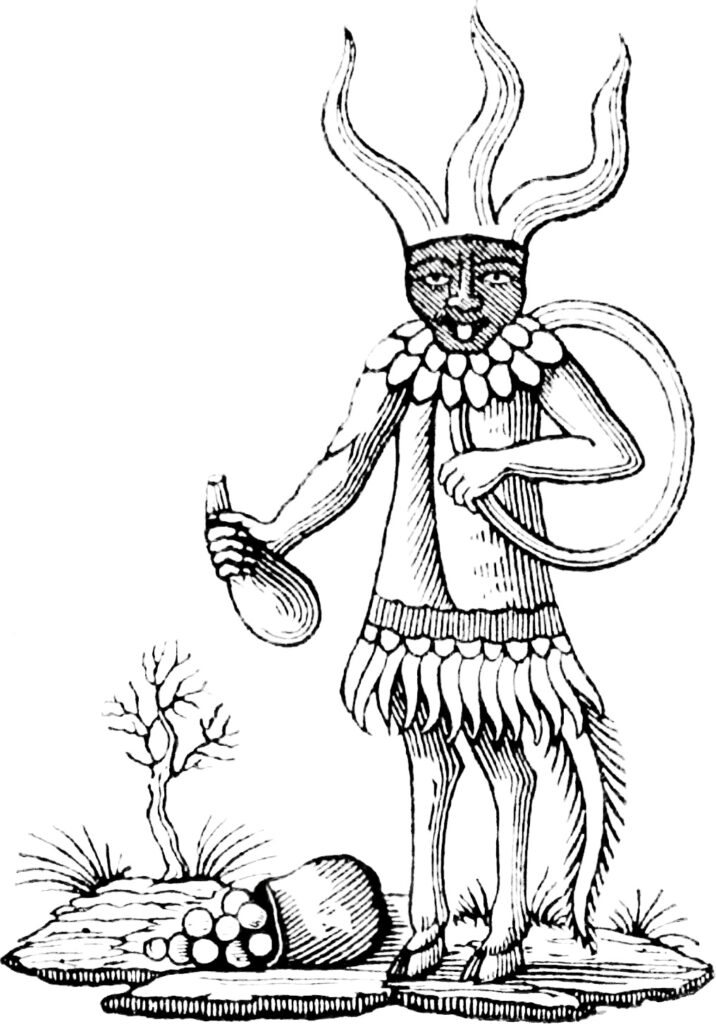
The Grand Grimoire changes the tone radically. Its ‘conjuration et renvoi’ allows the spirit to leave, but recalls its undertaking and retains a threat if that undertaking is broken. Dismissal does not dissolve the relationship: it reorganises it under the pact’s conditions.
In the sequence concerning Lucifuge, the practitioner returns to the triangle and reads the renvoi after the treasure is delivered. Closure remains tied to a system of obligation: service performed, departure authorised, pact still binding.
This case shows why there is no universal psychology of closure. The Goetia formula may emphasise peace and safety; here, peace coexists with the reminder of a coercive threat.
PAPE HONORIUS
The pantacle as a closing gesture
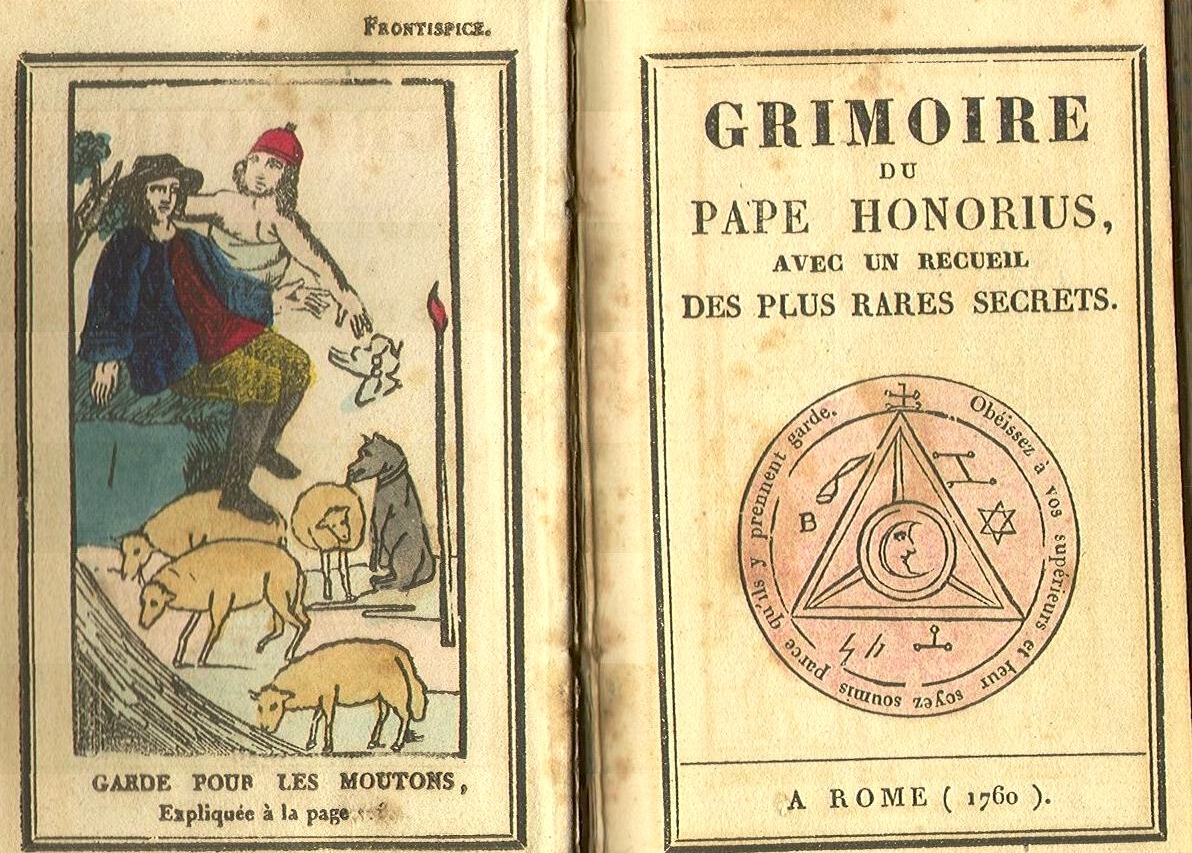
The Grimoire du Pape Honorius offers another variation. For dismissal, it instructs the practitioner to display Solomon’s pantacle and recite a formula ordering the spirits back to their dwellings, maintaining peace and readiness to return when called.
The documentary interest lies in the combination of word and object. Closure depends on more than a phrase: displaying the pantacle forms part of the dismissal. This links renvoi to the rite’s material aspects and the authority attributed to signs.
COMPARISON
Five elements that vary between texts
These endings can be compared through five elements: permission or command to withdraw; destination or ‘proper place’; peace or absence of harm; availability for a future summons; and a further action confirming closure — waiting, praying, giving thanks, burning characters, displaying a pantacle or recalling the pact.
Not every text contains all five. Absence is information too. The Heptameron compresses nearly everything into a short formula. The Goetia expands the subsequent safeguards. The Grimorium Verum distinguishes types of spirits and materials. The Grand Grimoire keeps the contractual logic active. Honorius incorporates the pantacle as an instrument of dismissal.
MYTH VS SOURCE
‘There is one traditional licence to depart’
The phrase sounds plausible because many modern editions reproduce similar formulae. Surviving sources, however, do not support one universal wording. They preserve families of expressions, borrowings, liturgical echoes, translations and rewritings.
Always cite the particular text: ‘the Goetia says’, ‘the Heptameron formulates’, ‘the Grimorium Verum dismisses’, ‘the Grand Grimoire threatens within the pact’. Difference is not an error to correct: it belongs to textual history.
ARCHIVE CONNECTIONS
Read the dismissal alongside the pact and hierarchy
THE PACT HAS A NAME: LUCIFUGE ROFOCALE
The Grand Grimoire’s renvoi is fully understood only alongside its pact and the figure administering that negotiation.
THE GRAND GRIMOIRE, BEYOND THE LEGEND
This article takes one component of that structure and shows how the ending reflects the book’s internal logic.
THE PACT IN GRIMOIRES
There we showed that ‘pact’ is not a single formula. Here the same rule applies to the operation’s ending: ‘dismissal’ is not a universal component either.
HOW TO READ AN OLD GRIMOIRE
The method in ‘How to read an old grimoire’ shows why a closing formula can only be understood within the particular witness, edition and tradition transmitting it.
LESSONS AND SOURCES
From ritual closure to textual traceability
The Studies lessons and Source records help compare dismissal formulae in context. For the Heptameron, the attribution to Pietro d’Abano is treated as a historical attribution, not established authorship.
- HOW TO READ A GRIMOIRE: identify witness, edition and transmission before comparing formulae.
- MANUSCRIPTS, EDITIONS AND TRANSMISSION: distinguish manuscript, transcription and edition of the Goetia.
- WHAT A SOURCE CAN ACTUALLY ESTABLISH: do not turn a recurring function into a universal formula.
- TEXTUAL RELATIONSHIPS AND CONTAMINATION: examine variants and relationships within the Grimorium Verum.
- CHECKING A PSEUDEPIGRAPHIC ATTRIBUTION: the Heptameron attributed to Pietro d’Abano; a name on the title page is not the same as authorship.
Consult the Source records linked below. The Key of Solomon of 1889 and the Grimoire du Pape Honorius are documented in the article’s final bibliography.
- Heptameron / Elementa Magica · 1559: an early printed witness to the attribution to Pietro d’Abano.
- Joseph H. Peterson · Elucidation of Necromancy · 2021: edition and comparative study of the tradition related to the Heptameron.
- Joseph H. Peterson · Lemegeton / Ars Goetia: comparative transcription of the licence to depart.
- Mathers–Crowley · The Book of the Goetia · 1904: a reference for checking the Goetia’s modern printed form.
- Joseph H. Peterson · Grimorium Verum: modern critical edition for renvois and variants of closure.
- Grand Grimoire / Le Dragon Rouge: edition or catalogue record situating the tradition of Lucifuge and his renvoi.
CONCLUSION
The operation ends when the text permits it to end
Comparing these dismissals reveals continuity of function and diversity of text. The Heptameron, Key of Solomon, Goetia, Grimorium Verum, Grand Grimoire and Honorius recognise in different ways that an operation involving a summons requires a formal ending.
That ending may involve peace, command, thanksgiving, waiting, destruction of characters, display of a sign or reminder of a pact. The chosen form is not neutral: it encapsulates the relationship the grimoire has constructed from the start.
The renvoi therefore deserves to be read as a historical source. A few lines can reveal how a text understands authority, obedience, danger and reciprocity.
CONTINUE
From ritual closure to the grimoire’s structure
This article neither proposes a modern dismissal nor blends historical formulae. It shows that even an operation’s final moment preserves information about the tradition that produced it.
The natural next step is through the articles on pacts, hierarchies and transmission in THE ARCHIVE. Afterwards, the Public Editions and the Library allow each text to be studied within its own system.
FURTHER READING
Following the whole operation
Continue through THE ARCHIVE to compare how each tradition summons, commands, negotiates and finally dismisses. The Public Editions then provide an introduction to the collection, while the Library brings the illustrated volumes together.
SOURCES CONSULTED
Texts and editions compared
- Heptameron / Elementa Magica · Marburg, 1559: Digitised printed book consulted as early evidence of the attribution to Pietro d’Abano. The philosopher’s historical authorship is not treated as established.
- Joseph H. Peterson · Heptameron: Transcription used to locate the licence to depart and compare it with other ritual texts.
- The Key of Solomon the King · Mathers · 1889 · Wellcome Collection: Public-domain printed edition used to compare more than one licence to depart.
- Joseph H. Peterson · Lemegeton / Ars Goetia: Comparative transcription used to check the licence to depart and its ritual context.
- The Book of the Goetia of Solomon the King · 1904: Mathers–Crowley printed edition used as a historical publication and visual source.
- Joseph H. Peterson · Grimorium Verum: Modern comparative edition used for the renvoi of superior and inferior spirits.
- Joseph H. Peterson · Le Grand Grimoire: Comparative electronic edition used for the ‘conjuration et renvoi’ and its relationship with the pact.
- Thomas Frognall Dibdin · A Bibliographical, Antiquarian and Picturesque Tour in France and Germany · 1821: Source for an early historical image of Le Dragon Rouge / Grand Grimoire.
- Joseph H. Peterson · Grimoire du Pape Honorius: Transcription used for dismissal through a pantacle and a formula of return.
- Grimoire du Pape Honorius · historical frontispiece: Digital reproduction identified as public domain.
Source records
Explore the references, their limitations and their uses in other readings. The article’s full bibliography is retained in the text above.
Henrici Cornelii Agrippae Liber Quartus… Cui accesserunt, Elementa Magica Petri de Abano ↗Joseph H. Peterson · Elucidation of Necromancy: Lucidarium Artis Nigromantice Attributed to Peter of Abano ↗Joseph H. Peterson — Lemegeton Clavicula Salomonis / Ars Goetia ↗The Book of the Goetia of Solomon the King ↗Joseph H. Peterson · Grimorium Verum: A Handbook of Black Magic ↗Le Grand Grimoire — Paris, 1845 ↗Heptameron / Elementa Magica · Marburg, 1559 ↗Peterson — Heptameron: digital edition ↗The Key of Solomon the King · Mathers · 1889 · Wellcome Collection ↗Goetia — Peterson’s digital edition ↗Wikimedia Commons · The Book of the Goetia (Mathers-Crowley, 1904) ↗Grimorium Verum — Joseph H. Peterson’s French digital edition ↗A Bibliographical, Antiquarian and Picturesque Tour in France and Germany ↗Joseph H. Peterson · Grimoire du Pape Honorius ↗Grimoire du Pape Honorius · historical frontispiece ↗Study this subject further
These related lessons let you explore the article’s questions through activities and study resources.
Cite this article
Published in The Method Files’ Archive.
RENVOI AND RITUAL DISMISSAL. The Archive · The Method Files. https://themethodfiles.com/en/estudios/archivo/renvoi-despedida-ritual-grimorios/
Include your access date; the copy button adds it automatically. To cite a historical source, use its own reference in the article’s bibliography.
Explore the six free lessons · Explore the Studies programme