THE ARCHIVE · ARCH-09
GRAND GRIMOIRE
Le Véritable Dragon Rouge
THE METHOD FILES
THE ARCHIVE
Anatomy of a feared book
Few grimoires carry a reputation as formidable as the Grand Grimoire.
It is associated with pacts, treasures, infernal hierarchies and an almost legendary authority. Its name often comes surrounded by claims about ancient manuscripts, forbidden formulas and knowledge transmitted from distant ages.
But when we set that reputation aside and examine the book as a historical object, a more interesting story emerges.
The editions we can document belong to a print tradition of the modern period. The text constructs its own authority through attributions, imposing names and claims to antiquity that cannot always be independently verified.
Its pages contain Lucifer, Lucifuge Rofocale and Beelzebub, hierarchies, negotiation, treasures and one of the best-known pacts in grimoire literature.
But this article’s central question is not whether the book is ‘cursed’ or ‘authentic’.
It is to establish what we can demonstrate about it.
When was it actually circulating?
Which versions do we know?
What hierarchy does it construct?
How much of its reputation comes from the text, and how much was added by later readers, editors and occultists?
Before fearing the Grand Grimoire, we need to examine how it was put together.
THE FIRST PROBLEM · THE DATE
The book says one thing; surviving editions tell another story
The Grand Grimoire constructs part of its authority by presenting itself as a very ancient text.
But the bibliographic evidence calls for greater caution.
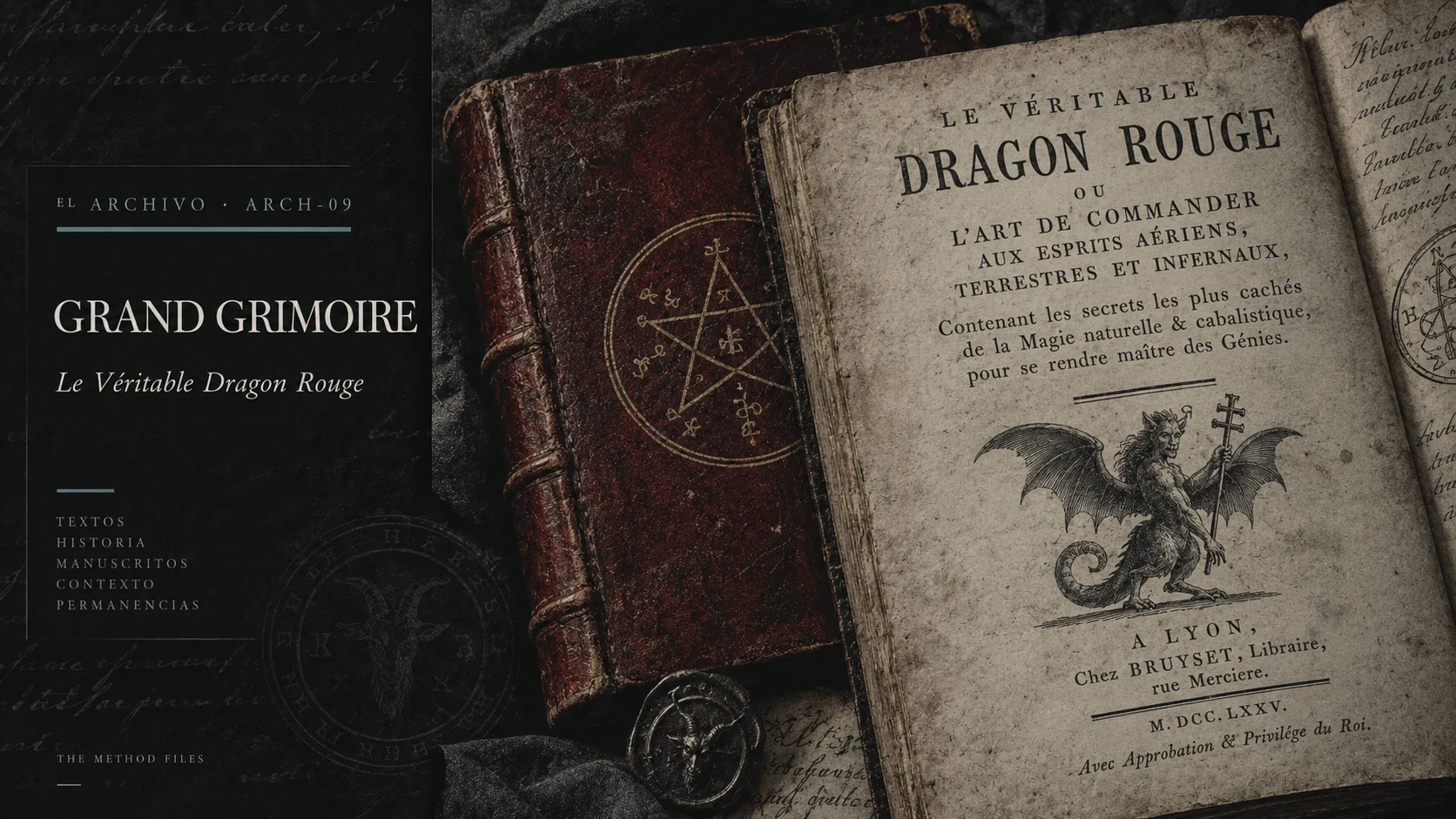
The Bibliothèque nationale de France catalogues a copy of Le grand grimoire avec la grande clavicule de Salomon… with a publication date of 1702, comprising 84 pages. The record also notes that the same text appears to have circulated under the title Le Dragon rouge.
That date does not, on its own, settle the work’s history. The historian Owen Davies notes that, although the first edition has traditionally been dated to 1702, the book’s absence from early eighteenth-century sources suggests that a Bibliothèque bleue edition published around 1750 may have been the first, or at least the most influential.
We can securely document other eighteenth- and nineteenth-century witnesses. The Bayerische Staatsbibliothek holds a copy bibliographically dated to around 1775, and the British Library holds an edition of 1845, with 107 pages.
The more cautious formulation is therefore not that we know of a first edition from 1702 with absolute certainty, but that the Grand Grimoire belongs to an eighteenth-century print tradition whose earliest chronology still poses bibliographic problems.
That evidence is much more useful than uncritically repeating the legendary dates found in particular editions.
In this literature, a printed date can itself help construct the text’s authority.
This article therefore begins with a simple rule:
first, verify the edition; then consider what the book says about itself.

TWO TITLES, ONE TRADITION
When the Grand Grimoire also circulates as the Dragon Rouge
The transmission of the Grand Grimoire is further complicated by the fact that the text does not always circulate under the same name.
The Bibliothèque nationale de France holds an edition dated 1702 and explicitly notes that the same text appears to have circulated under the title Le Dragon rouge, ou L’art de commander les esprits célestes.
This cautions against a hasty conclusion: two different titles do not necessarily mean two entirely independent works.
In this case, Grand Grimoire and Dragon Rouge belong to the same closely connected textual tradition, although later editions may differ in presentation, length, attribution and organisation.
Those editorial variations matter.
A reader may encounter the same core material under different names and believe they are looking at different books.
Or they may make the opposite mistake: assuming that all editions called Grand Grimoire or Dragon Rouge are identical.
Neither should be taken for granted.
We need to compare date, edition, content, printer and structure.
The BnF itself now also uses the title ‘Le grand grimoire ou Dragon rouge’, reflecting the historical relationship between the two titles.
The title changes. The tradition continues.
This makes the Grand Grimoire harder to study than its reputation might suggest.
WHO IS IN CHARGE HERE?
The Hell of the Grand Grimoire has its own chain of command
The Grand Grimoire does not present Hell as a disorganised multitude of spirits.
It organises it.
In the hierarchy associated with the text, Lucifer holds the rank of emperor, Beelzebub that of prince and Astaroth that of grand duke.
Below them are six senior officers, whose titles vary somewhat across the tradition: Lucifuge Rofocale, prime minister; Satanachia, grand general; Agaliarept, general or grand seneschal; Fleurety, lieutenant general; Sargatanas, brigadier; and Nebiros, field marshal and inspector general.
That choice of titles is more than decoration.
The book turns the infernal world into a structure of authority.
There are superiors and subordinates.
There are distinct areas of responsibility.
Rank determines who can command whom.
This organisation also explains the role of Lucifuge Rofocale. He does not rule above Lucifer: he acts as a minister within a system that delegates authority to him.
We should therefore be wary of taking this hierarchy and presenting it as ‘the hierarchy of Hell’.
More precisely, it is the hierarchy constructed by this grimoire tradition.
Other texts arrange the same names differently.
The Grand Grimoire does not discover a universal chain of command. It writes its own.
THE BOOK’S CORE · A PACT, NOT A LIST
Here, demons do more than hold rank: they negotiate
The Grand Grimoire does more than present names and offices.
Its most famous episode centres on a negotiation.
The practitioner seeks wealth and power. Lucifuge Rofocale is the counterpart in the exchange because, within this hierarchy, he controls access to riches and treasures.
From there, the text constructs an exchange of conditions.
The person entering the pact makes demands.
Lucifuge answers.
The conditions change.
Finally, an agreement emerges that seeks to establish in writing what each party must provide.
This distinguishes the Grand Grimoire from a simple demonological list.
Here, the hierarchy has a practical purpose within the narrative: it determines who the negotiation is with, and why.
Lucifer stands at the top.
Lucifuge administers part of that power.
The person entering the pact seeks to obtain something specific from the system.
The pact therefore matters more than the book’s sensational reputation.
The Grand Grimoire imagines more than an organised Hell. It imagines a Hell with contracts.
THE DOCUMENT · THE PACT IS WRITTEN DOWN
A promise only carries weight when it is recorded
In the Grand Grimoire, the negotiation does not end with a conversation.
The agreement must be put in writing.
That decision changes the book’s tone completely.
The pact ceases to be a vague promise and begins to function as a document: it establishes obligations, conditions and commitments intended to endure beyond the moment of invocation.
The practitioner wants to be certain of receiving the promised wealth.
Lucifuge wants to be certain that the price, too, is defined.
Writing provides a guarantee between them.
This logic makes the Grand Grimoire feel strangely administrative.
Commands are not enough.
Threats are not enough.
Promises are not enough.
A record must be made.
The pact is thus one of the book’s most recognisable elements: it turns a supernatural relationship into something like a contract between parties who distrust each other.
Treasure may be the visible goal.
But the signature is what turns desire into obligation.
THE TREASURE · WHAT IS REALLY BEING BOUGHT?
Wealth attracts; the conditions tell the real story
The Grand Grimoire promises something remarkably specific: access to riches and treasures.
That promise explains much of its fame.
But if we look only at the gold, we miss what is most interesting about the text.
Wealth supplies the motive that sets the whole negotiation in motion. The practitioner wants something immediate and material. Lucifuge, however, turns that desire into a chain of conditions, obligations and commitments.
The treasure is not presented as a free reward.
It has a price.
It has clauses.
It has consequences.
As the exchange progresses, it becomes clearer that the episode’s real concern is not discovering where a fortune is hidden.
It is determining what someone is willing to accept to obtain it.
The Grand Grimoire therefore also functions as a story about power.
The person seeking wealth tries to dominate the spirit through formulas and threats.
The spirit responds by trying to impose its own conditions.
Neither party trusts the other completely.
Treasure is the goal. Negotiation reveals who actually controls the agreement.
WHAT THE BOOK ACTUALLY SAYS
The reputation of the Grand Grimoire extends beyond its pages
The Grand Grimoire often reaches readers accompanied by an immense reputation.
It is discussed as though it were an ancient manual, a universal authority on Hell or the definitive book for making pacts with demons.
But when we return to the documented text, we find something more specific.
The edition dated 1702 held by the Bibliothèque nationale de France has 84 pages and presents itself as a work for commanding spirits and discovering hidden treasures. Its bibliographic record also notes its relationship to the title Le Dragon rouge.
Within that tradition, the book constructs its own hierarchy and places Lucifuge Rofocale at the centre of a negotiation involving riches and treasures.
The pact is fundamental, but not because the book offers a complete doctrine covering the entire demonological world.
It tells a particular story of authority, desire, negotiation and obligation.
Many elements later presented as ‘universal tradition’ actually belong to the particular system this grimoire organises.
These include offices, relationships between infernal figures and particular functions attributed to each.
Its later reputation expanded the book’s aura further still.
But reputation and content are not the same.
To understand the Grand Grimoire, we must first read what it actually contains, and only then study everything that came to be said about it.
WHAT CHANGED LATER
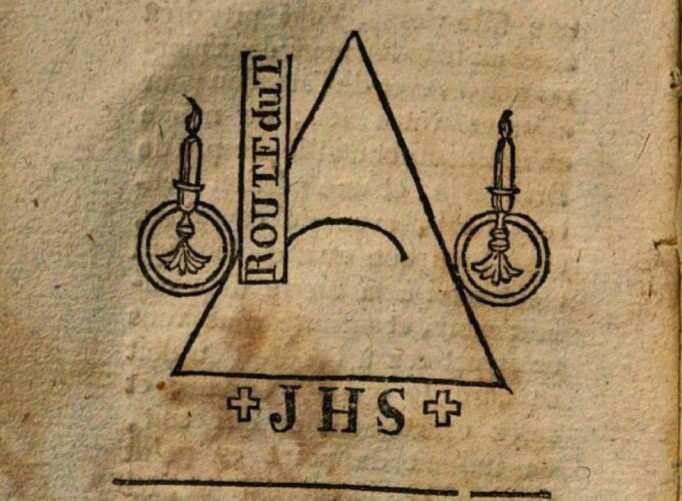
Reputation came to write another version of the book
Over time, the Grand Grimoire ceased to be merely a text and became a publishing legend.
Later reissues, translations and compilations kept names such as Grand Grimoire and Dragon Rouge in circulation, while the fame of the pact with Lucifuge grew beyond the pages that had given rise to it.
Each new mention added something.
An earlier date.
A more imposing attribution.
A more dangerous reputation.
A claim to greater authority over the infernal world.
Particular elements of the book—the pact, the treasure, Lucifuge and the hierarchy—thus came to stand for a far larger tradition.
Even its infernal offices began to be repeated out of context, until they appeared to form part of a universal organisation of Hell.
But the process is exactly what we have found in other documents in THE ARCHIVE:
a classification belonging to a particular text is repeated so often that it comes to seem an eternal tradition.
The Grand Grimoire became known not only for what it contained, but also for everything later readers and authors said it contained.
Once that second history grows large enough, it becomes difficult to distinguish it from the first.
The book generated a legend. Then the legend began to explain the book.
MYTH VS SOURCE
An early date printed in a grimoire does not prove its antiquity
The Grand Grimoire has circulated amid dates, attributions and claims of great antiquity.
But a book can claim to come from a distant age without proving it.
In this literature, antiquity also functions as a form of authority.
The older a text appears, the easier it is to present it as the repository of exceptional knowledge.
A date printed on the title page, an attribution to Solomon or a reference to a lost manuscript is therefore not enough on its own.
We need to establish which copies actually exist, when they were printed, which libraries hold them and how their contents change between editions.
In the case of the Grand Grimoire, we have a print tradition of the modern period that can be documented and compared.
That evidence is worth more than a spectacular date repeated without support.
The problem is not that the grimoire constructs a story about its own origins.
The problem arises when that publishing narrative is repeated as though it were independent historical evidence.
An edition can claim an antiquity that does not match the date we can establish bibliographically.
It can also exaggerate it.
That is precisely why THE ARCHIVE does not first ask how old it claims to be.
It asks what age we can demonstrate.
THE ARGUMENT
The Grand Grimoire does not need a legend to be unsettling
The real interest of the Grand Grimoire does not lie in proving that it is ancient, forbidden or unique.
It lies in examining how it is constructed.
The book organises an infernal hierarchy.
It assigns offices.
It positions Lucifuge Rofocale as intermediary.
It makes wealth the motive for negotiation.
And it turns that negotiation into a written pact.
Everything follows the same logic:
authority, desire, price and obligation.
That structure explains its fame better than any legendary date.
Later editions, translations and occult culture expanded its reputation until it became one of the most recognisable grimoires.
But separating that reputation from the text does not make it less interesting.
It does exactly the opposite.
It shows how a relatively short book managed to generate a tradition far larger than its own pages.
That is the argument of this article:
the Grand Grimoire did not become powerful because it was necessarily as old as it claimed. It became powerful because its pact, hierarchy and promise of wealth could outlive individual editions.
ARCHIVE CONNECTIONS
One book, several paths to follow
The pact has a name: Lucifuge Rofocale
While this article examines how the book was put together, ‘The pact has a name: Lucifuge Rofocale’ follows its most distinctive participant. There, Lucifuge ceases to be merely a name within a hierarchy and appears as minister, administrator of wealth and central figure in the negotiation.
Lucifer before he became the Devil
The Grand Grimoire uses Lucifer as supreme authority within its own system. ‘Lucifer before he became the Devil’ takes us back many centuries and shows that this infernal position belongs to a tradition much later than the name’s historical origins.
Beelzebub was not born in Hell
Beelzebub also holds a prominent place in the hierarchies associated with the Grand Grimoire. His article shows how a figure can arrive in a grimoire already carrying centuries of earlier transformations.
Who built Hell?
This article provides a concrete example of the question that opened THE ARCHIVE: each book can reorganise the same names and reassign their ranks. The Grand Grimoire does not simply inherit Hell. It constructs its own version.
CONTINUE
From the Grand Grimoire to the Grimoire of Lucifuge Rofocale
This article has examined part of the legend surrounding the Grand Grimoire: its dating problems, titles, infernal hierarchy and the structure of the pact that made Lucifuge Rofocale one of its central figures.
The Public Edition of the Grimoire of Lucifuge Rofocale continues from there, organising the figure of the infernal prime minister, his relationship to riches, the pact and the tradition that developed around his name.
The Illustrated Edition then extends that exploration with more comprehensive documentary, historical and visual treatment.
SOURCES CONSULTED
Editions and documents used
- Bibliothèque nationale de France. Le grand grimoire avec la grande clavicule de Salomon, et la magie noire…, publication catalogued as 1702, 84 pages. The first chapter is signed Antonio Venitiana del Rabina; the record notes that the same text appears to have circulated under the title Le Dragon rouge.
- Owen Davies. Grimoires: A History of Magic Books. Oxford University Press, 2009. An essential study for the publication history of the Grand Grimoire. Davies notes that, although its first edition has commonly been dated to 1702, its absence from early eighteenth-century sources makes an edition of the Bibliothèque bleue from around 1750 plausible as the first or a particularly influential edition.
- Bayerische Staatsbibliothek. Le grand Grimoire avec la grande clavicule de Salomon…, copy dated c. 1775, 81 pages, shelfmark Res/Phys.m. 94.
- Le grand Grimoire; ou l’art de commander les esprits célestes, aériens, terrestres, infernaux, 1845, 107 pages. Copy from the British Library, digitised by Google Books; the introductory chapter is attributed to or signed by Antonio Venitiana del Rabbina.
- Jacques-Albin-Simon Collin de Plancy. Dictionnaire Infernal, sixth edition, Paris, H. Plon, 1863, entry ‘Pacte’. Reproduces a hierarchy comprising Lucifer, Beelzebub, Astaroth, Lucifuge Rofocale and the subordinate officers.
- Jacques-Albin-Simon Collin de Plancy. Dictionnaire Infernal, sixth edition, entry ‘Hiérarchie’. Useful for comparing different demonological classifications and showing that there was no single universal chain of command in Hell.
Source records
Explore the references, their limitations and their uses in other readings. The article’s full bibliography is retained in the text above.
Dictionnaire Infernal, sixth edition ↗Le Grand Grimoire — Paris, 1845 ↗Le grand grimoire — BnF record ↗Le Grand Grimoire / l’art de commander les esprits… ↗Le grand Grimoire avec la grande clavicule de Salomon… ↗Grimoires: A History of Magic Books ↗Study this subject further
These related lessons let you explore the article’s questions through activities and study resources.
Cite this article
Published in The Method Files’ Archive.
THE GRAND GRIMOIRE, BEYOND THE LEGEND. The Archive · The Method Files. https://themethodfiles.com/en/estudios/archivo/el-grand-grimoire-sin-leyenda/
Include your access date; the copy button adds it automatically. To cite a historical source, use its own reference in the article’s bibliography.
Explore the six free lessons · Explore the Studies programme