THE ARCHIVE · ARCH-12
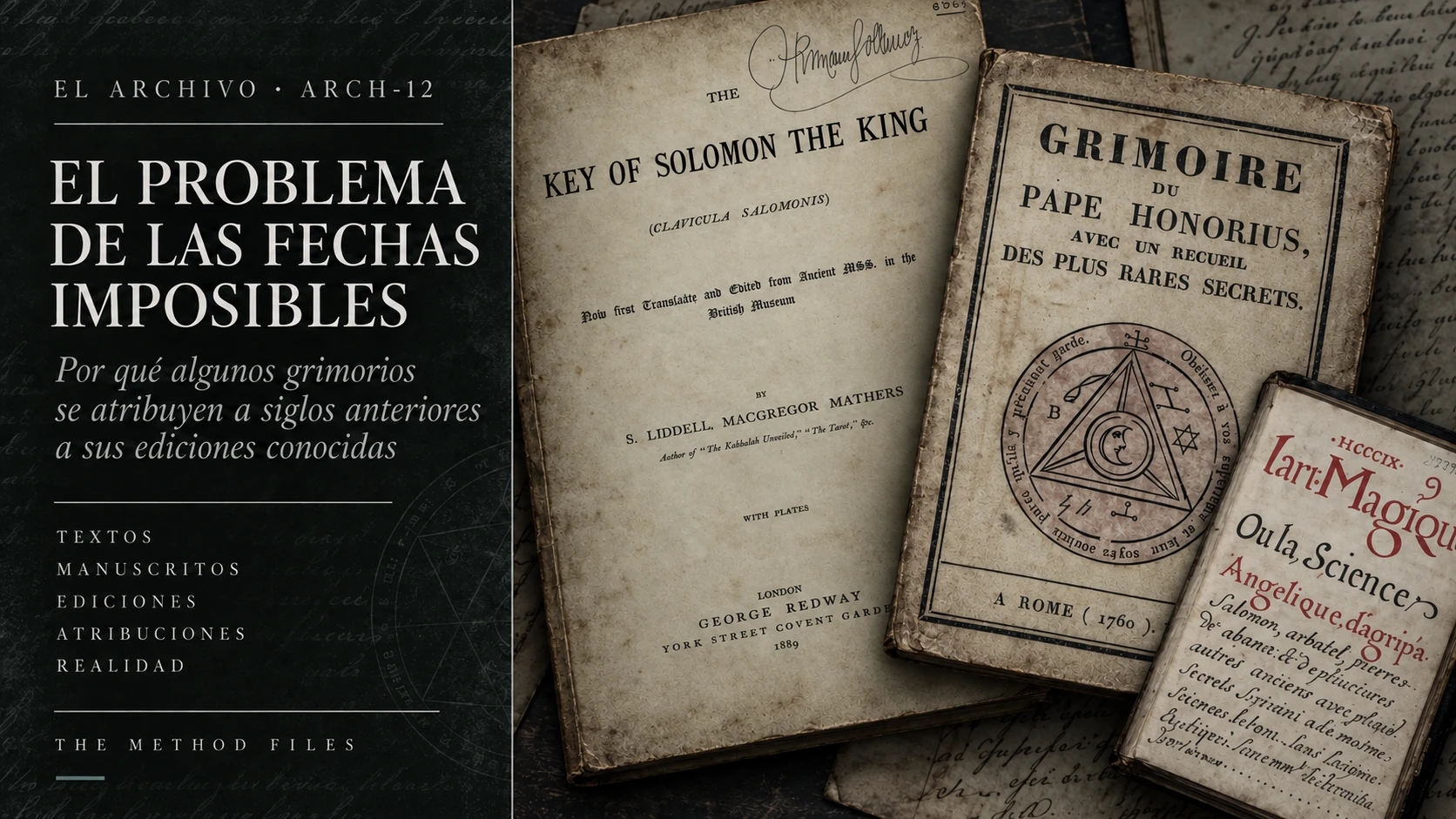
THE PROBLEM OF IMPOSSIBLE DATES
Why some grimoires are attributed to centuries earlier than their known editions
THE METHOD FILES
THE ARCHIVE
Why the date a grimoire claims is not always the date historical evidence can support.
Open an old grimoire, and its title page seems to answer the first question before we can ask it. A year. A city. Sometimes a prestigious name. 1517. 1521. Rome. Memphis. Solomon. The problem begins when we treat these details as a birth certificate.
The material history of these books is less straightforward. A date may belong to the surviving copy, to the printing someone wished to claim for it, to an earlier composition or to an even older tradition reused by the text. These levels are not interchangeable.
This article examines four documented cases —Grand Grimoire / Dragon Rouge, Grimorium Verum, Clavicula Salomonis and Grimoire du Pape Honorius— to apply a simple rule: first identify the object before us; then consider what the book says about its own antiquity.
THE FIRST RULE
A printed date is not yet a historical date
When a library, catalogue or title page supplies a year, the right question is not merely ‘what date does it give?’. We must ask what kind of date we are reading.
The claimed date is the one the book itself prints, copies or states. It may agree with the copy’s material history, but it may also be approximate, symbolic or fictitious. The date of the copy is the date assigned to the object held by an institution. A probable printing date may emerge from bibliographical analysis of paper, type, printer, provenance or other evidence. The composition date seeks to establish when a particular form of the text was written or compiled. Finally, the date of the antecedent tradition refers to earlier material or motifs reused by a later work.
Confusing these five levels creates artificial antiquity. A manuscript from 1709 containing material related to a later grimoire does not automatically become ‘the original’. A title page stating 1517 does not prove that the entire work originated in 1517. And a text bearing Solomon’s name does not place its physical copy in biblical times.
This article therefore follows a strict distinction: ‘this copy says X’ does not mean ‘the work was composed in X’.
CASE I · GRAND GRIMOIRE / DRAGON ROUGE
When a title page claims greater antiquity than we can demonstrate
The Grand Grimoire is a good starting point because its publishing history forces us to question overly neat chronologies.
The Bibliothèque nationale de France catalogues a copy of Le grand grimoire with publication stated as 1702, no identified place of publication, 84 pages and shelfmark Arsenal 8-S-1628. The same record notes that the text appears also to have circulated under the title Le Dragon rouge.
This record matters because it establishes the existence of a copy catalogued with that date. But a bibliographic record is not a time machine. On its own, it does not prove that the text was composed in 1702 or first circulated that year.
Mélanie Papot-Libéral’s bibliographical research further complicates the picture. Her study of Le Dragon Rouge explicitly documents the use of the fictitious date 1521 and gathers evidence for an early edition around 1800, alongside a secure mention before 1818. This is enough to demonstrate the article’s central problem: a printed date can form part of a book’s publishing identity without automatically equating to its historical date of composition.
In the case of the Grand Grimoire, caution does not mean removing 1702 from the record. It means stating the evidence precisely: the BnF holds a copy whose publication is given as 1702. That is what the record establishes. Dating the entire tradition requires further witnesses.
The same applies to the copy held by the Bayerische Staatsbibliothek and catalogued to approximately 1775. Its existence broadens the range of witnesses, but does not authorise us to make 1775 the universal date of the text or construct a linear genealogy linking 1702, 1775 and the nineteenth-century editions.
CASE II · GRIMORIUM VERUM
Memphis 1517: when the imprint is part of the problem
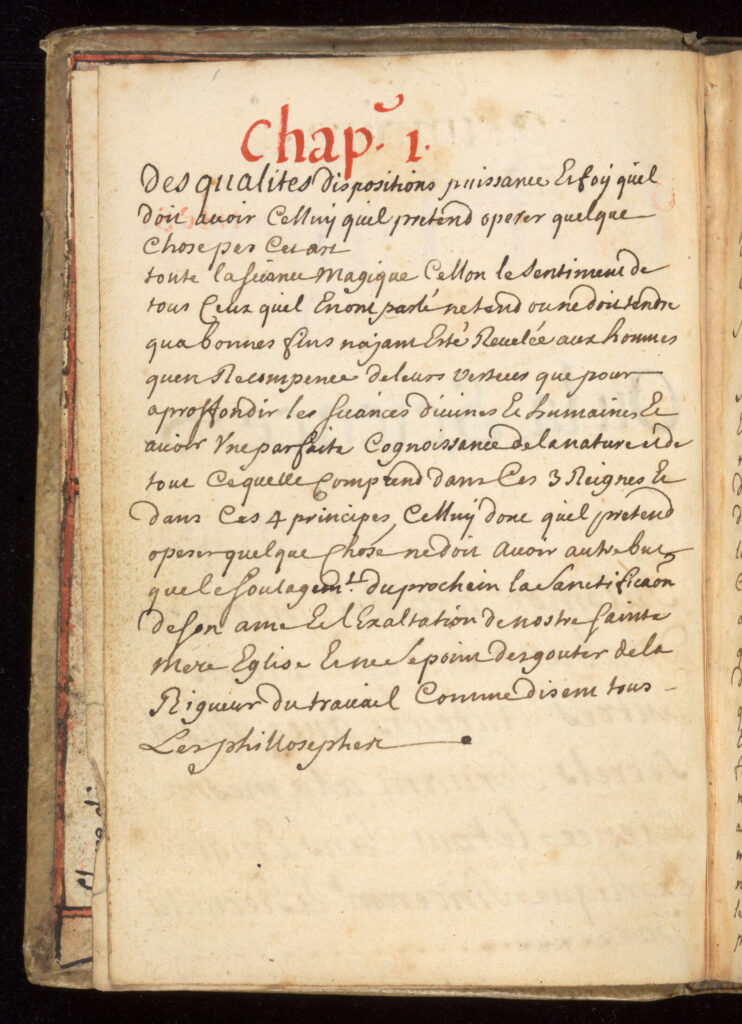
The Grimorium Verum takes the problem a step further because some editions transmit an apparently very precise imprint: ‘Memphis, Alibeck, 1517’.
That wording can be transcribed. It exists in the printed tradition. But it should not be presented as an established historical date. Joseph H. Peterson records one witness as ‘1517 [1817]’, visibly separating the stated date from the proposed bibliographic dating. The Grimorium Verum record in Sources preserves this distinction.
The context calls for further caution. The term ‘Jésuite’ on the title page attributed to 1517 conflicts with a basic external chronology: the Society of Jesus received papal approval in 1540. That anachronism does not by itself date the copy, but it shows that the title page cannot be accepted literally as a document produced in 1517.
Related manuscripts offer no easy solution either. Wellcome MS.983, L’Art Magique, is catalogued to around 1709 and preserves pseudo-Solomonic material useful for comparing figures, formulae and structures related to the tradition of the Grimorium Verum. Its record includes an explicit qualification: the manuscript’s title page gives ‘MCCCIX’, which Wellcome considers may be an error for 1709. The manuscript documents an early textual context; it does not prove that it is ‘the original Grimorium Verum’ or a direct source for the Alibeck printing.
Later printed branches — Blocquel, Bestetti 1868 and Muzzi 1880 — allow us to study transmission, dependence, additions and reorganisation. What emerges is not one simple founding date, but a family of witnesses that must be collated.
The right question is therefore not ‘what year is the Grimorium Verum from?’, as though a single answer could settle its manuscripts, composition and printing. It is: which witness are we dating, and with what evidence?
CASE III · CLAVICULA SALOMONIS
Attribution to Solomon does not make a manuscript biblical
The Clavicula Salomonis introduces another form of antiquity: the authority of a name.
A manuscript or edition’s attribution to Solomon is a textual fact. The attribution exists and should be preserved. But attribution is not historical authorship. A manuscript may present itself as a ‘book of Solomon’ while having been copied many centuries after the biblical period.
British Library Add MS 36674 offers a useful test case. The catalogue identifies within the volume a text beginning ‘Here begynneth the booke of Kynge Solomon called the Kay of Knowledge’ and dates that hand to the late sixteenth century. The same record describes a much more complex material history, involving papers associated with later astrologers, compilers and owners.
The attribution to Solomon shows how the text presents itself. Palaeographic dating and provenance describe the surviving object. These are two different layers.
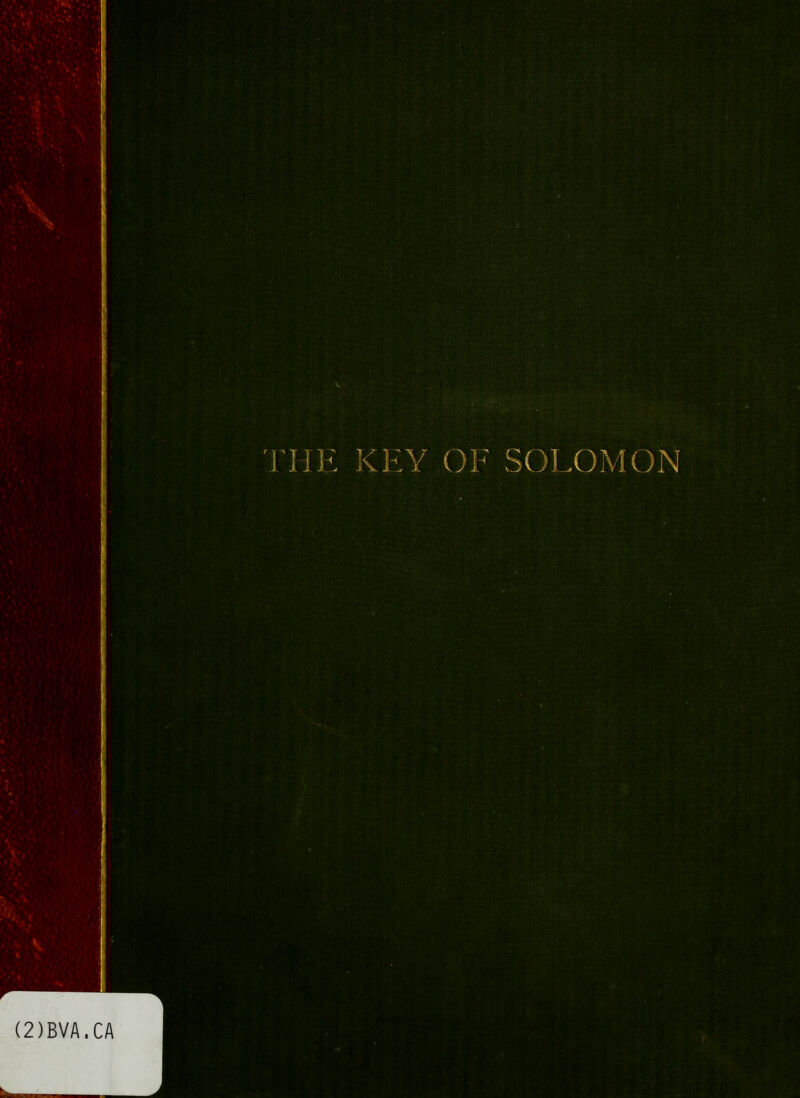
Mathers’s 1889 edition adds a third layer. The Key of Solomon the King presents itself as a translation and edition based on manuscripts in the British Museum. It is a modern editorial intervention that helped establish an influential form of the Solomonic tradition. It should not be projected back onto every earlier manuscript as though it were the original text.
CASE IV · GRIMOIRE DU PAPE HONORIUS
‘A Rome 1760’: the stated date and the catalogued copy
The Grimoire du Pape Honorius probably provides the most visually striking case in this article. A copy held by Wellcome has ‘A Rome 1760’ on its title page. The institution, however, catalogues it approximately as [1850?] and attributes its publication to Avignon / Offray.
These two pieces of information should not be merged. The title page establishes that the copy states ‘Rome 1760’. The institutional catalogue expresses a later, cautious bibliographical assessment of the object it holds.
A second record, at the Bayerische Staatsbibliothek, gives another publication date: Rome 1670. Again, this shows that a tradition can accumulate dates and places that must be treated as information stated by particular witnesses, rather than as a simple chronology of composition.
In such a case, ‘1760 edition’ can mislead if the reader understands it to mean that the physical copy must have been printed that year. A more precise formulation is ‘a copy bearing the date 1760, catalogued by Wellcome to around 1850’.
That small change in wording captures the point of this article.
WHAT THE EVIDENCE DOES — AND DOES NOT — ESTABLISH
A date can be evidence without being a conclusion
WHAT IT ESTABLISHES. A title page, colophon or record may document that a witness states a date, place, author or edition. Institutional catalogues can document a particular copy’s existence, custody, shelfmark and bibliographical assessment. Comparing several witnesses may show that a tradition circulated under more than one title, incorporated variants or was reorganised over time.
WHAT IT DOES NOT ESTABLISH. A visible date does not automatically establish the composition date. An early related manuscript does not prove that it is the original of a later tradition. Attribution to Solomon or a pope does not establish historical authorship. And a sequence of catalogue dates does not by itself establish direct dependence between copies.
COMMON MISTAKES
Five ways to create antiquity by mistake
1. Treating the title page as a certificate. The object may state a date or author. That statement is evidence about the object, not external validation.
2. Treating the witness’s date as the composition date. A manuscript from 1709 may copy earlier material; a printed book from 1817 may preserve an older tradition. The dates of the physical object and the text are not necessarily the same.
3. Calling the earliest known witness the original. ‘Earliest surviving’ and ‘original’ are not equivalent. A witness may depend on lost antecedents.
4. Projecting a famous edition backwards. A nineteenth-century translation or edition may standardise a title, structure or reading. That form should not automatically be projected onto earlier manuscripts.
5. Explaining every problematic date through censorship. Clandestine publication may be one cause. Commercial strategy, a desire for authority, typographical errors or publishing conventions may also play a part. The specific cause must be demonstrated.
A REUSABLE METHOD
Five dates, five questions
STATED DATE. Which year, city or authority does the object print or copy?
DATE OF THE COPY. How does the institution holding this particular witness catalogue it?
PROBABLE PRINTING DATE. What bibliographical arguments support dating it differently from the title page?
COMPOSITION DATE. What evidence allows us to date the form of the text we are studying?
ANTECEDENT TRADITION. What earlier material does the witness incorporate or transform?
If these five questions yield five different answers, we do not have a problem to simplify away. We have the actual history of transmission.
ARCHIVE CONNECTIONS
Dates have a genealogy too
THE GRAND GRIMOIRE, BEYOND THE LEGEND introduces this problem directly. This article develops a question that necessarily received only a brief treatment there: how to distinguish the date displayed by a copy from the date we can substantiate for the tradition.
HOW TO READ AN OLD GRIMOIRE turns this problem into a complete protocol: identify the object, witness, edition, date, provenance and transmission before drawing a historical conclusion.
WHO DECIDED WHAT DEMONS LOOK LIKE? offers a parallel from publishing history. Just as a later engraving should not be projected back onto an earlier source, a later date or attribution cannot travel backwards without evidence.
WHO BUILT HELL? connects with the broader question of authority: names, catalogues, ranks and books reach us through historical editions and reorganisations, rather than as unchanging objects.
CONTINUING IN STUDIES
From documentary example to method
HOW TO READ A GRIMOIRE addresses this very problem in the Grimorium Verum, including the ‘Memphis 1517’ imprint and the distinction between stated information, bibliographic dating and transmission. This article provides the documentary account; the lesson ‘How to read a grimoire’ turns that case into a reusable procedure.
HISTORICAL SOURCE OR MODERN RECONSTRUCTION applies the same checks to the Grand Grimoire / Le Dragon Rouge and the date 1702. This connection moves from a particular case to a rule for reading: identify which object exists, what it claims and what conclusion it actually supports.
CONCLUSION
Do not discard a date: classify it
This article does not aim to declare every problematic date in grimoires false. Its aim is to help us state precisely what kind of information we have before us.
1517 may be a date claimed by a title page. 1702 may be a publication date given in an institutional catalogue. 1709 may be a bibliographical proposal for a manuscript whose title page offers a different reading. 1760 may appear in a copy that a library dates to around 1850.
None of these dates should disappear. What should disappear is the habit of treating them as though they all meant the same thing.
Documentary history begins precisely when we stop choosing one number and start explaining what each one demonstrates.
CONTINUE
From the problem of the date to the problem of the text
This article does not belong to a single volume. It teaches a method of reading relevant to the entire collection: distinguish what an edition states from what its material history can support.
The natural next step is through the related articles in THE ARCHIVE, then Studies — where the method becomes an explicit procedure — and afterwards the Public Editions and the Library.
FURTHER READING
Applying the method to the collection
Continue through the articles in THE ARCHIVE and Studies to see how the same approach applies to particular manuscripts, editions and lines of transmission. The Public Editions then provide an introduction to the collection, while the Library brings the illustrated volumes together.
DOCUMENTS AND EDITIONS
Sources for checking the dates
The Source records linked below allow you to check the Grand Grimoire and Grimorium Verum witnesses, their stated dates and their proposed dating.
- BnF · Le grand grimoire… · 1702
- Bayerische Staatsbibliothek · c.1775
- Owen Davies · Grimoires · 2009
- Grimorium Verum · Alibeck / BL 8632.aa.5
- Wellcome MS.983 · L’Art Magique · VERIFIED WITH QUALIFICATIONS
- Blocquel tradition
- Bestetti · 1868
- Muzzi · 1880
- Joseph H. Peterson · Grimorium Verum · critical edition
- DCRM · bibliographic dating
SOURCES CONSULTED
Bibliography and repositories used
- Bibliothèque nationale de France · Le grand grimoire, Arsenal 8-S-1628
- Bayerische Staatsbibliothek · Le grand Grimoire, Res/Phys.m. 94
- Mélanie Papot-Libéral · Le Dragon Rouge : éditions et réception d’un grimoire à l’époque contemporaine
- Owen Davies · Grimoires: A History of Magic Books
- Wellcome Collection · L’art Magique, MS.983
- Joseph H. Peterson · Grimorium Verum
- Matteo Cova · Un manuale di negromanzia a Trento
- British Library · Add MS 36674
- Joseph H. Peterson · The Key of Solomon
- Bayerische Staatsbibliothek · Grimoire du Pape Honorius, Rome 1670
- Wellcome Collection · Grimoire du Pape Honorius, ‘A Rome 1760’
Source records
Explore the references, their limitations and their uses in other readings. The article’s full bibliography is retained in the text above.
Le grand grimoire — BnF record ↗Le grand Grimoire avec la grande clavicule de Salomon… ↗Grimoires: A History of Magic Books ↗Grimorium Verum ↗Wellcome MS.983 — L'Art Magique ↗Les véritables clavicules de Salomon · Blocquel tradition ↗Bestetti · La Vera Clavicola del Re Salomone ↗La vera Clavicola del Re Salomone — Muzzi (1880) ↗Joseph H. Peterson · Grimorium Verum: A Handbook of Black Magic ↗DCRM (RDA Edition) · Date of publication ↗Mélanie Papot-Libéral · Le Dragon Rouge : éditions et réception d’un grimoire à l’époque contemporaine ↗Grimorium Verum — Joseph H. Peterson’s French digital edition ↗Matteo Cova · Un manuale di negromanzia a Trento ↗British Library · Add MS 36674 ↗The Key of Solomon — Mathers and Peterson ↗Bayerische Staatsbibliothek · Grimoire du Pape Honorius, Rome 1670 ↗Wellcome Collection · Grimoire du Pape Honorius, ‘A Rome 1760’ ↗Study this subject further
These related lessons let you explore the article’s questions through activities and study resources.
Cite this article
Published in The Method Files’ Archive.
THE PROBLEM OF IMPOSSIBLE DATES. The Archive · The Method Files. https://themethodfiles.com/en/estudios/archivo/fechas-imposibles-grimorios/
Include your access date; the copy button adds it automatically. To cite a historical source, use its own reference in the article’s bibliography.
Explore the six free lessons · Explore the Studies programme