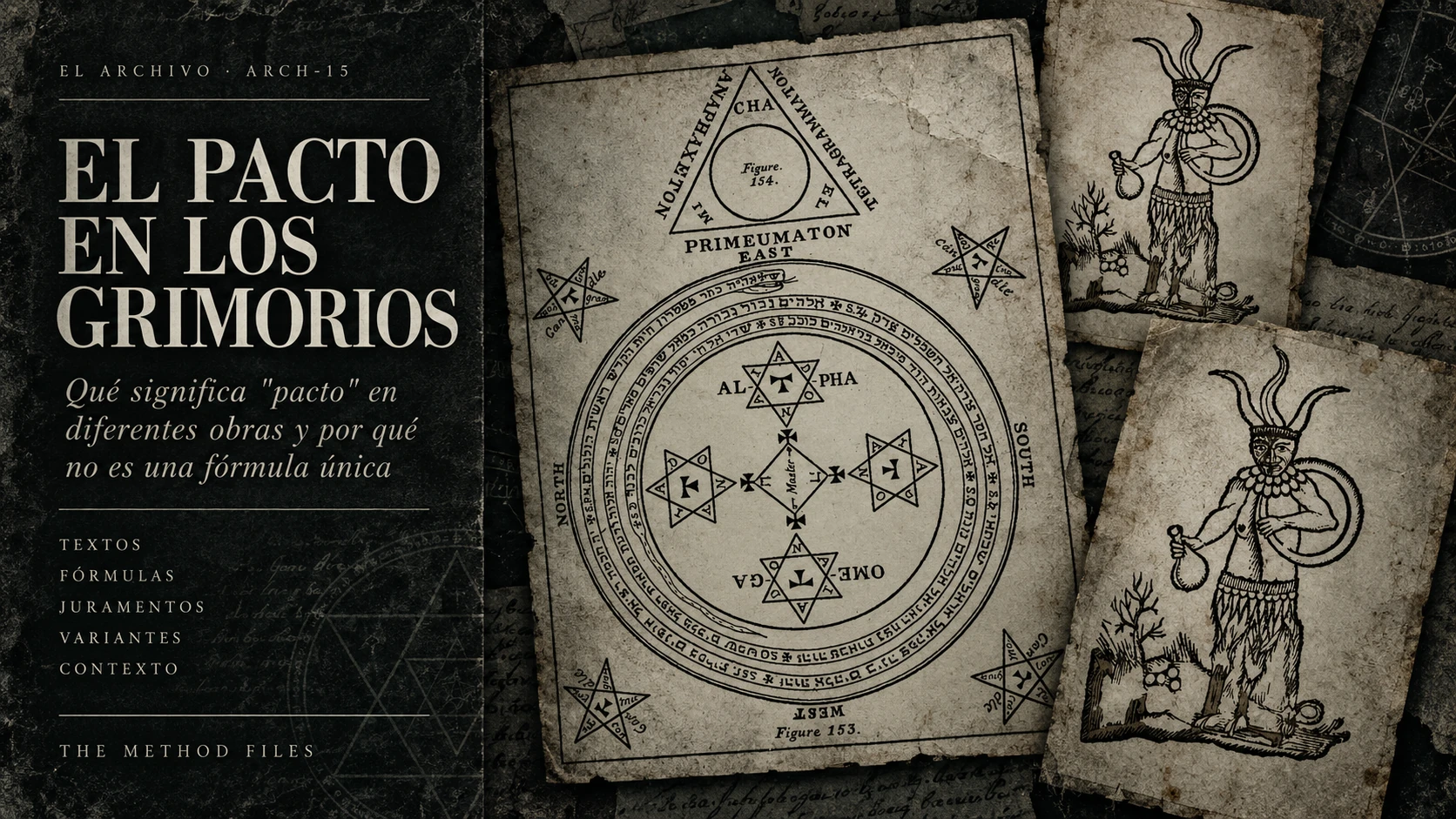
THE ARCHIVE · ARCH-15
THE PACT IN GRIMOIRES
What “pact” means in different works and why it is not a single formula
THE METHOD FILES
THE ARCHIVE
What ‘pact’ means in different works, and why it is not a single formula.
Popular culture has reduced the demonic pact to one scene: a contract, a signature, a promise of wealth and a final price. That image exists in European history, but it is too narrow for reading grimoires. Some texts formulate an agreement explicitly; others speak of commitments, obligations or relationships of trust; others organise the operation through conjuration, command and constraint without calling it a pact.
The distinction matters because one word can erase entire systems. If we call every ritual relationship with a spirit a ‘pact’, the Grand Grimoire, Grimorium Verum and Ars Goetia start to look like versions of the same operation. They are not. Each work distributes authority, risk, obedience, negotiation and the ending of the operation differently.
This article compares those structures without making any one of them a universal rule. The question is not whether grimoires ‘believe in pacts’ in the abstract, but what each text calls a pact, which obligations it describes, who commands whom and what Christian demonology subsequently adds when interpreting such practices.
THE ARGUMENT
There is no single ‘pact’ shared by all grimoires
Pact is a historical category, not a master key. The Grand Grimoire / Dragon Rouge presents an explicit, dramatised agreement within a system of obligations. The Grimorium Verum distinguishes more than one kind of pact and differentiates spirits that bind the practitioner from those that do not. The Ars Goetia, by contrast, organises evocation through conjuration, command, constraint, binding and licence to depart: its principal language concerns coercion and jurisdiction, rather than contract.
Another layer overlays this textual diversity: the Christian theory of the demonic pact. Theologians, demonologists and courts could interpret as a pact a practice that the practitioner did not describe that way. This article therefore separates two questions: what structure the grimoire prescribes, and how religious or judicial authorities conceptualised magic. Mixing them produces a history that is too neat and, for that very reason, false.
THE FIRST DISTINCTION
Four things commonly called a ‘pact’
We should distinguish at least four levels. First, the textual pact: an agreement the document itself calls a pacte, convention, engagement or equivalent term. Second, obligation or exchange: promises, services, limits and reciprocal undertakings within a relationship that need not take the form of a single contract. Third, ritual command: conjuring, ordering, constraining, binding or dismissing a spirit. Fourth, the demonological or judicial pact: the category theologians and judges used to explain why a magical practice supposedly involved cooperation with demons.
These levels may overlap, but they are not synonyms. A text may combine agreement and coercion. A demonologist may claim an implicit pact exists where the practitioner believes they are controlling the spirit. And a modern translation may turn engagement, binding or convention into ‘pact’, erasing a distinction preserved by the original witness.
The rule follows ‘How to read an old grimoire’ on dates and attributions: first identify the term and the witness; then interpret.
CASE I · GRAND GRIMOIRE / DRAGON ROUGE
An explicit pact, but not a simple surrender
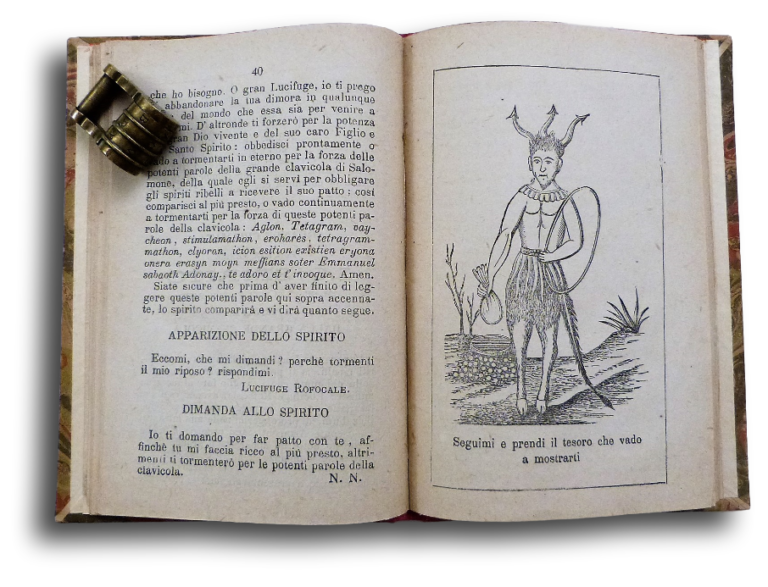
The Grand Grimoire is the most conspicuous case because it places the pact at the text’s dramatic centre. The Dragon Rouge tradition structures a sequence in which Lucifuge Rofocale becomes the other party to an agreement. Mélanie Papot-Libéral’s bibliographical research identifies the Sanctum Regnum section as a decisive part of this construction and shows the pact operating through negotiation, promise and obligation.
Even here, however, the popular image of passive surrender is inadequate. The same system combines negotiation with mechanisms of ritual compulsion. The practitioner does more than plead: they seek obedience through names, formulae of authority and ritual threats. Lucifuge may resist, and the agreement emerges from tension between commitment and constraint.
That combination matters. Calling only the final document a ‘pact’ loses the structure that makes it possible. Describing it as simple domination of the spirit loses the reciprocal obligation. The Grand Grimoire does not demonstrate that every grimoire works this way: it shows that one particular tradition could turn a relationship with a spirit into a negotiation set down in a text.
Chronological caution remains necessary. Dates stated in different copies and editions of the Grand Grimoire must not automatically become composition dates. ‘The problem of impossible dates’ and ‘How to read an old grimoire’ established this rule. What matters here is comparing the pact’s structure in identified witnesses, rather than manufacturing a convenient antiquity from a title page.
CASE II · GRIMORIUM VERUM
The text itself divides pacts into categories
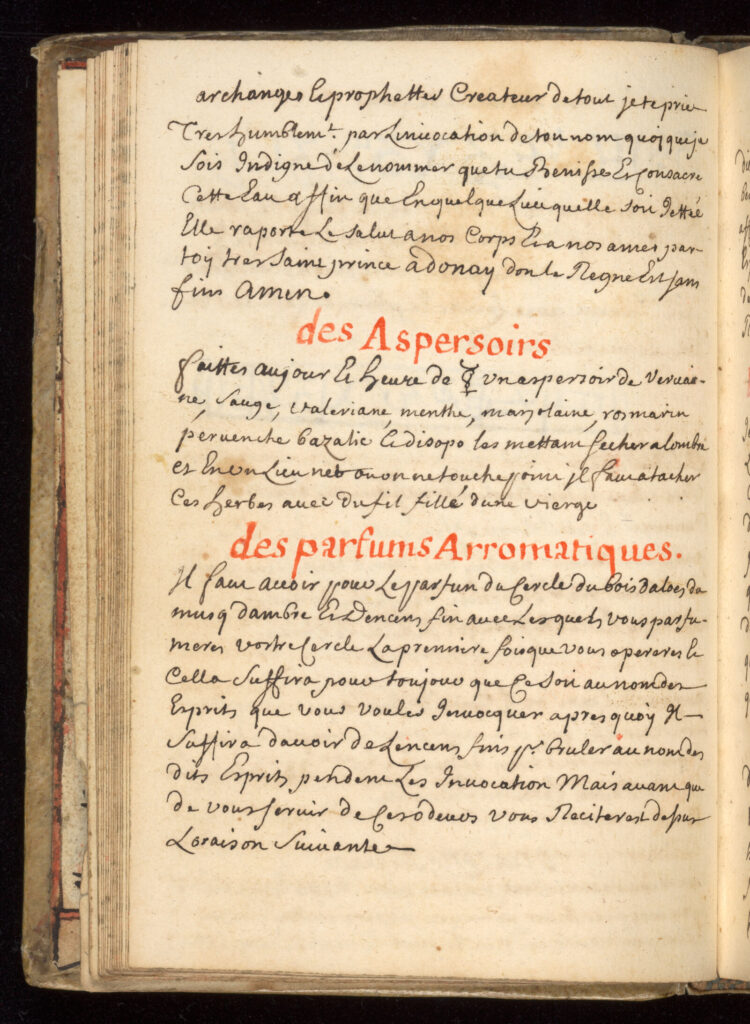
The Grimorium Verum is even more useful for challenging the idea of a single formula. Joseph H. Peterson’s comparative edition preserves an explicit distinction between two kinds of pact: tacit and apparent. The text also distinguishes engageants from non engageants spirits. Put simply, not every spirit creates the same obligations, and not every relationship follows a single contractual template.
This distinction accompanies other relevant vocabulary. The text speaks of spirits serving confidants and close friends, of pacts made or yet to be made, and of procedures for calling, conjuring and constraining. Again, pact and command are not mutually exclusive. One corpus may envisage intimacy, commitment, obligation and coercion within the same structure.
Translation therefore demands precision. ‘Engageant’ may suggest commitment, binding or obligation; it should not automatically become the modern image of a signed contract. The same applies to ‘tacit’ and ‘apparent’: these are categories within that text and tradition, not a universal dictionary for every grimoire.
The lesson is methodological: before asking what a pact requires, ask what the document calls a pact. The Grimorium Verum already offers more than one answer.
A CONTROL CASE · ARS GOETIA
Conjuring and constraining are not the same as making a pact
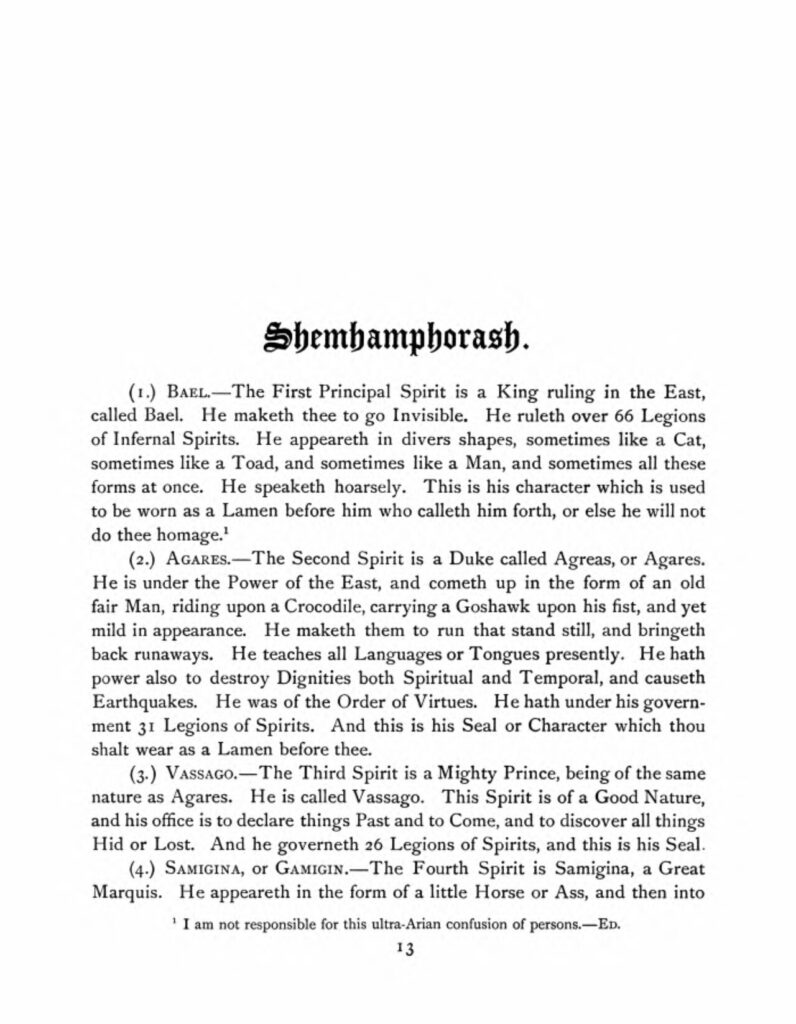
The Ars Goetia provides the necessary contrast. In Peterson’s comparative transcription, based principally on Sloane MS 3825 and checked against other witnesses, the ritual relationship operates through invocation, conjuration, commands, constraint, binding and threats of punishment. If the spirit appears, obedience is demanded; if it does not, further coercive formulae follow; when the operation ends, there is a licence to depart.
This vocabulary is not incidental. It defines who claims authority and on what basis. The practitioner presents the exchange not as negotiation between equals, but as ritual jurisdiction grounded in divine names and Solomonic tradition. The spirit must appear, answer and remain until given leave.
The absence of ‘pact’ from the consulted text does not prove that no historical reader interpreted the operation in those terms. A theologian might do so. A polemicist might consider every demonic invocation to involve cooperation with the Devil. But that is another interpretive layer. Read through its own vocabulary, the Goetia witness need not be transformed into a contract to be understood.
This control case matters because it prevents the article becoming a history of pacts based solely on texts already using that word. It also shows the limits of a modern label: two systems may summon spirits yet structure the relationship differently.
DEMONOLOGY AND WITCHCRAFT
When a pact exists even if the practitioner does not acknowledge it
Outside grimoires, the idea of the pact developed a history of its own. Medieval and early modern theology developed models to explain practices deemed superstitious or magical. Within that framework came a crucial distinction between explicit and implicit pacts. An explicit pact entails consciously seeking demonic help; an implicit pact allows a relationship with demons to be asserted even when the practitioner does not intend one or believes another kind of power is at work.
This theory had enormous consequences. It allowed practices whose own vocabulary contained no contract to be interpreted as demonic cooperation. Studies of the development of witchcraft show how direct or indirect dealings with the Devil became part of clerical models of magic, superstition and heresy. In the early modern period, authors such as Martín del Río could maintain that magical operations rested on an express or tacit agreement with the Devil.
Here lies the main risk: using a demonological theory to describe a grimoire’s contents. A theologian’s view that a conjuration entails a pact does not mean the operative text structures it as one. The category an authority uses to interpret magic is distinct from the magical document’s vocabulary and structure.
This article retains both layers because both are historical. It refuses to merge them.
MYTH VS SOURCE
‘They all sell their souls’
The phrase works well in fiction because it compresses a complex problem into a recognisable scene. As a general historical description, it fails. Some narratives and demonological texts do imagine pacts affecting an individual’s spiritual fate. The Faust tradition made this one of Europe’s most influential cultural models. But not every grimoire, nor even every demonological grimoire, describes the relationship that way.
The Grand Grimoire has an explicit agreement; the Grimorium Verum has more than one category of pact; the Goetia is governed primarily by conjuration and constraint. Summarising all three as ‘selling one’s soul’ obscures exactly what distinguishes them.
Another distinction is lost too: a pact does not always mean equality between the parties. It may be a negotiated obligation, a commitment the text considers dangerous, a theological interpretation imposed from outside or a relationship coexisting with ritual threats. The word describes a family of problems, not a universal scene.
METHOD
How to read a pact without inventing a single tradition
To compare pacts in grimoires, follow a short sequence. First, identify the witness, language and edition. Second, locate the exact term being translated. Third, describe what each party promises or commands without filling gaps with popular legend. Fourth, distinguish the agreement from the rest of the ritual apparatus — conjuration, constraint, licence, protection. Fifth, distinguish the grimoire’s description from later demonological interpretation.
This method avoids two opposite simplifications: that every contact with spirits is a pact, and that pact and coercion are incompatible systems. The documents reveal less comfortable combinations: one text may negotiate and threaten; another may speak of friendship and commitment; another may construct a hierarchy in which the practitioner claims the right to command.
Disagreement between sources is not a problem to erase. It is the subject of this article.
ARCHIVE CONNECTIONS
Comparing the pact with other texts
THE PACT HAS A NAME: LUCIFUGE ROFOCALE
This article develops the question raised there in relation to one entity into a comparison between systems.
THE GRAND GRIMOIRE, BEYOND THE LEGEND
There the book is studied as a historical object; here one of its best-known structures is isolated and compared with other traditions.
RENVOI AND RITUAL DISMISSAL
Shows that even the ending varies between systems: command, pact and licence to depart do not have a universal relationship.
HOW TO READ AN OLD GRIMOIRE
Its methodological rule — object, witness, edition, variant and context before assertion — directly underpins this article.
LESSONS AND SOURCES
Checking how each pact is described
The Studies lessons and Source records continue the comparison: identify the text, check its date and distinguish what each work understands by a pact.
- HOW TO READ A GRIMOIRE: identify witness, edition, imprint and transmission before interpreting.
- MANUSCRIPTS, EDITIONS AND TRANSMISSION: examine the mediation between manuscript, transcription and edition.
- WHAT A SOURCE CAN ACTUALLY ESTABLISH: distinguish documented vocabulary from doctrinal extrapolation.
- TRADITION, INTERPRETATION AND CONTEMPORARY PRACTICE: distinguish historical practice, later reception and reinterpretation.
Alongside the Source records linked below, the final bibliography includes Wellcome MS.4666 and studies by Papot-Libéral, Broedel and Raúl Madrid.
- Grand Grimoire / Le Dragon Rouge: an edition or catalogue record situating the tradition, used to check the pact’s text.
- Joseph H. Peterson · Grimorium Verum: modern critical edition for the pact’s variants and vocabulary.
- Joseph H. Peterson · Lemegeton / Ars Goetia: comparative transcription for conjuration and constraint.
- Mathers–Crowley · The Book of the Goetia · 1904: a historical printed form of the Goetia.
- Wellcome MS.983 · L’Art Magique: a comparative pseudo-Solomonic witness, with qualified dating.
- Owen Davies · Grimoires: scholarly context for the diversity and circulation of grimoires.
CONCLUSION
An agreement becomes a historical claim only when we know who calls it an agreement
The image of the pact survived because it is powerful: it promises a clear relationship between desire, power and price. Grimoires are less straightforward. Some negotiate, some constrain, some classify different commitments, and some barely need the category to organise their relationship with spirits.
This does not make the history of the demonic pact irrelevant. It makes it more precise. We can study when a text genuinely speaks of a pact, when a religious authority interprets a practice as one, and when later tradition merges both levels into a single scene.
The useful question becomes not ‘how is a pact made?’ but ‘what relationship does this document construct, using which vocabulary, under whose authority and at which stage of transmission?’. Only then does pact regain a historically specific meaning.
CONTINUE
From the pact to the wider archive
This article does not close the subject of pacts: it organises it. The natural next steps are ‘The Grand Grimoire, beyond the legend’ for the Grand Grimoire, ‘The pact has a name: Lucifuge Rofocale’ for Lucifuge Rofocale, and the articles on transmission in THE ARCHIVE showing why a word or structure should not automatically be extended to every text.
Afterwards, the Public Editions and the Library allow you to follow each tradition in its own context. The rule remains the same: source first, structure next, interpretation last.
FURTHER READING
Following the pact’s documentary trail
Continue through THE ARCHIVE to compare texts and entities. The Public Editions then provide an introduction to the collection, while the Library brings the illustrated volumes together.
SOURCES CONSULTED
Bibliography and repositories used
- Owen Davies · Grimoires: A History of Magic Books: Oxford University Press, 2009. General context for the history, circulation and diversity of grimoires.
- Mélanie Papot-Libéral · Le Dragon Rouge: éditions et réception d’un grimoire à l’époque contemporaine: ENSSIB / Université de Lyon, 2017. Study of the Dragon Rouge publishing tradition and the Sanctum Regnum section.
- Wellcome Collection · Pseudo-Solomon, MS.4666: Mid-eighteenth-century manuscript. Includes ‘Lumière sortie des tenèbres… Grand Grimoire’ on pp. 133–155. Public Domain Mark.
- Joseph H. Peterson (ed.) · Grimorium Verum: Comparative digital edition. Documents ‘pacte fait ou à faire’, the distinction between tacit and apparent pacts, and engageants/non engageants spirits.
- Joseph H. Peterson (ed.) · Lemegeton, Part 1: Goetia: Comparative transcription based principally on Sloane MS 3825. A reference for checking conjuration, constraint and licence to depart.
- Hans Peter Broedel · The Malleus Maleficarum and the Construction of Witchcraft: Study of the late medieval construction of categories of witchcraft and direct or indirect dealings with the Devil.
- Raúl Madrid · El delito de brujería en las Disquisitionum Magicarum de Martín del Río: Scholarly analysis of the express or tacit pact in Del Río’s demonology.
- Wikimedia Commons · The Book of the Goetia (Mathers-Crowley, 1904): Digitisation of the 1904 edition. Work identified as public domain.
- Wellcome Collection · L’Art Magique, MS.983: Manuscript of c.1709 used as a comparative witness for pseudo-Solomonic material; Public Domain Mark. It should not be presented as ‘the original Grimorium Verum’.
Source records
Explore the references, their limitations and their uses in other readings. The article’s full bibliography is retained in the text above.
Le Grand Grimoire — Paris, 1845 ↗Joseph H. Peterson · Grimorium Verum: A Handbook of Black Magic ↗Joseph H. Peterson — Lemegeton Clavicula Salomonis / Ars Goetia ↗The Book of the Goetia of Solomon the King ↗Wellcome MS.983 — L'Art Magique ↗Grimoires: A History of Magic Books ↗Mélanie Papot-Libéral · Le Dragon Rouge : éditions et réception d’un grimoire à l’époque contemporaine ↗Wellcome Collection · Pseudo-Solomon, MS.4666 ↗Grimorium Verum — Joseph H. Peterson’s French digital edition ↗Goetia — Peterson’s digital edition ↗Hans Peter Broedel · The Malleus Maleficarum and the Construction of Witchcraft ↗Raúl Madrid · El delito de brujería en las Disquisitionum Magicarum de Martín del Río ↗Wikimedia Commons · The Book of the Goetia (Mathers-Crowley, 1904) ↗Study this subject further
These related lessons let you explore the article’s questions through activities and study resources.
Cite this article
Published in The Method Files’ Archive.
THE PACT IN GRIMOIRES. The Archive · The Method Files. https://themethodfiles.com/en/estudios/archivo/pacto-en-los-grimorios/
Include your access date; the copy button adds it automatically. To cite a historical source, use its own reference in the article’s bibliography.
Explore the six free lessons · Explore the Studies programme