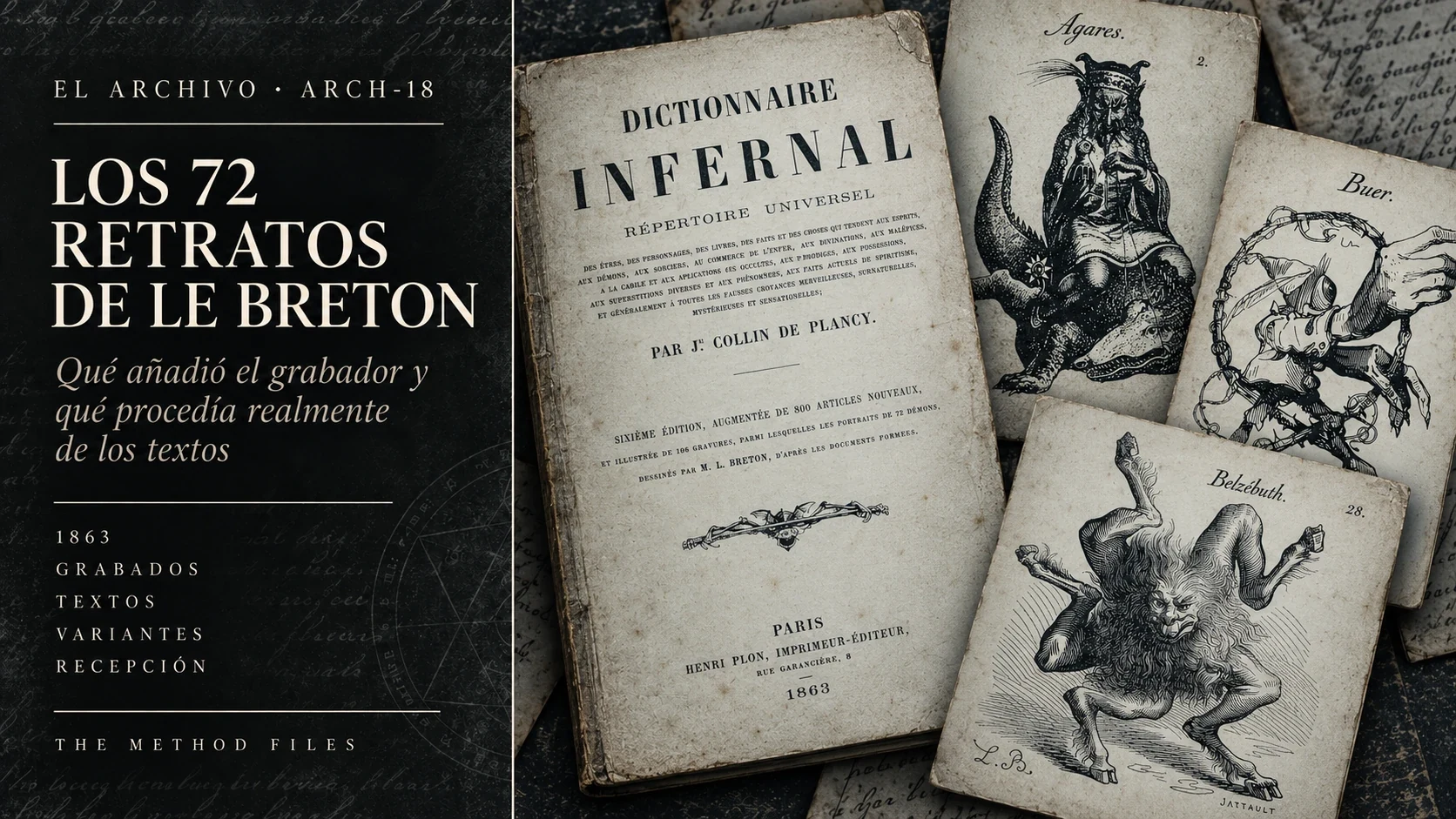
THE ARCHIVE · ARCH-18
LE BRETON’S 72 PORTRAITS
What the engraver added and what actually came from the texts
THE METHOD FILES
THE ARCHIVE
‘72 portraits’ is the number announced by the sixth edition of the Dictionnaire infernal (1863). It is not presented here as a fully verified count. This analysis focuses on four cases: what the text described and what decisions can be identified in the depiction.
The Method Files · Sources reviewed:
What the illustrator added and what actually came from the texts.
The 1863 Dictionnaire Infernal turned dozens of demonological descriptions into images that still circulate today as though they had always accompanied those names. The sixth edition advertised 550 engravings, including portraits of 72 demons drawn by ‘M. L. Breton’. This makes the volume more than a dictionary: it is also an event in visual history.
But an image does not emerge from a vacuum. Agares had already been described as an old man on a crocodile with a bird of prey. Astaroth was associated with a dragon and a viper. Buer, by contrast, was a five-pointed star or wheel: the text left open the question of how to give it a body. Belzébuth reached 1863 surrounded by incompatible depictions.
This article compares text and image to distinguish three layers: what an earlier source had already established, what Collin de Plancy’s edition brought together and what the drawing had to decide. The question is not whether Louis Le Breton ‘invented’ the demons, but what he inherited, what he selected and what he turned into a specific visual form.
THE ARGUMENT
The 1863 engravings are a historical layer, not timeless portraits
The portraits associated with the sixth edition of the Dictionnaire Infernal should not be presented as ancient images of biblical or medieval origin. They are compositions that can be dated to 1863. This does not make them less important: it makes them precise documents of the visual reception of demonology in the nineteenth century.
It would be equally inaccurate to describe them as fantasies entirely disconnected from the sources. In several cases, an earlier text determines a considerable part of the scene: age, mount, animal, general posture or attributes. In others, the description offers only a geometric form or a list of features, leaving the artist to resolve anatomy, proportion, movement and framing.
The argument of this article is therefore twofold. Le Breton works with inherited material, but turning words into a reproducible figure requires decisions. The result belongs both to the history of those sources and to the visual history of 1863.
1863 · THE SIXTH EDITION
When the book itself announces 72 portraits
The Bibliothèque nationale de France catalogues the sixth edition of the Dictionnaire Infernal as published in Paris by Henri Plon in 1863, with 723 pages and illustrations. Its title page also announces 800 new entries and 550 engravings, as recorded in the Catalogue collectif de France record.
Among those engravings, the printed volume itself singles out ‘portraits of 72 demons’ drawn by ‘M. L. Breton’ from earlier documents. The Catalogue collectif de France reproduces the same editorial statement. This is why the article’s title retains the number 72: it is the figure declared by the 1863 primary source.
The number printed on the title page is an editorial claim. Verifying the actual total would require defining what counts as a portrait, identifying each image and publishing an inventory. This article does not carry out that census or replace the advertised 72 with another unsubstantiated total.
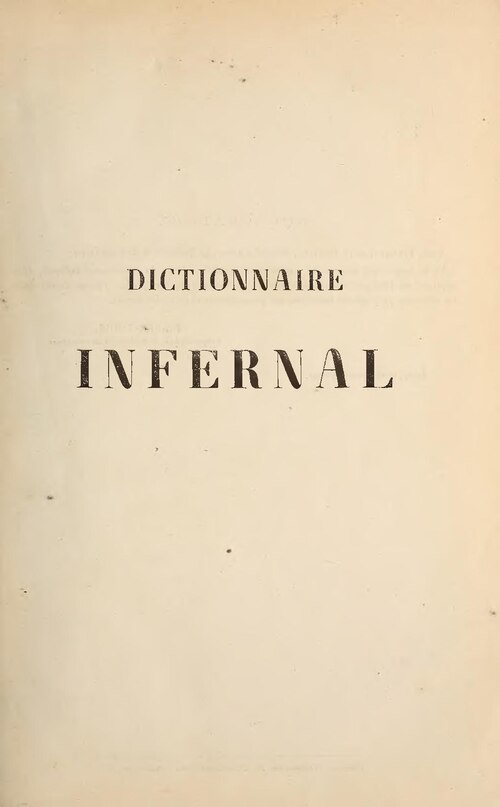
M. L. BRETON
From the printed credit to Louis Le Breton
Drawing and engraving are not the same work. The record for Buer at Old Book Illustrations attributes the drawing to Louis Le Breton and the wood engraving to A. Jarrault. That credit appears in Buer’s caption here; it is not automatically extended to every print without checking.
The 1863 edition credits the portraits to ‘M. L. Breton’. Modern illustration catalogues identify the artist as Louis Le Breton, born in 1818 and deceased in 1866. The BnF authority record describes him as a painter, watercolourist, draughtsman and engraver whose work was particularly associated with maritime subjects.
This precision matters. This article does not turn Le Breton into an ancient demonologist or use a modern identification to rewrite what appears on the 1863 page. We retain both layers: the historical editorial credit, ‘M. L. Breton’, and the modern identification of the artist as Louis Le Breton.
The date also changes how we read the image. When an 1863 engraving is reproduced thousands of times outside its context, it can come to look like the timeless depiction of an entity. Returning to its artist, edition and date restores the image’s history.
METHOD
Three questions to ask before calling an image ‘traditional’
We use the same procedure for each case in this article. First: what had an earlier source already described? Second: which version does the Dictionnaire Infernal record in 1863? Third: what did the drawing have to resolve to transform those words into a visible figure?
This method avoids two opposing errors. The first is to attribute to the artist everything that had already been written. The second is to project the visual solution of 1863 backwards and claim that a demon ‘always’ had that anatomy or face.
The title-page phrase ‘d’après les documents formels’ should be read within that framework. It does not prove that an ancient gallery of portraits existed which Le Breton merely copied. It indicates that the edition presents its drawings as based on earlier documents or descriptions. A specific comparison is what allows us to assess how much was already given and how much was resolved visually.
CASE 1 · AGARES
Agares: when the text already contains almost the whole scene
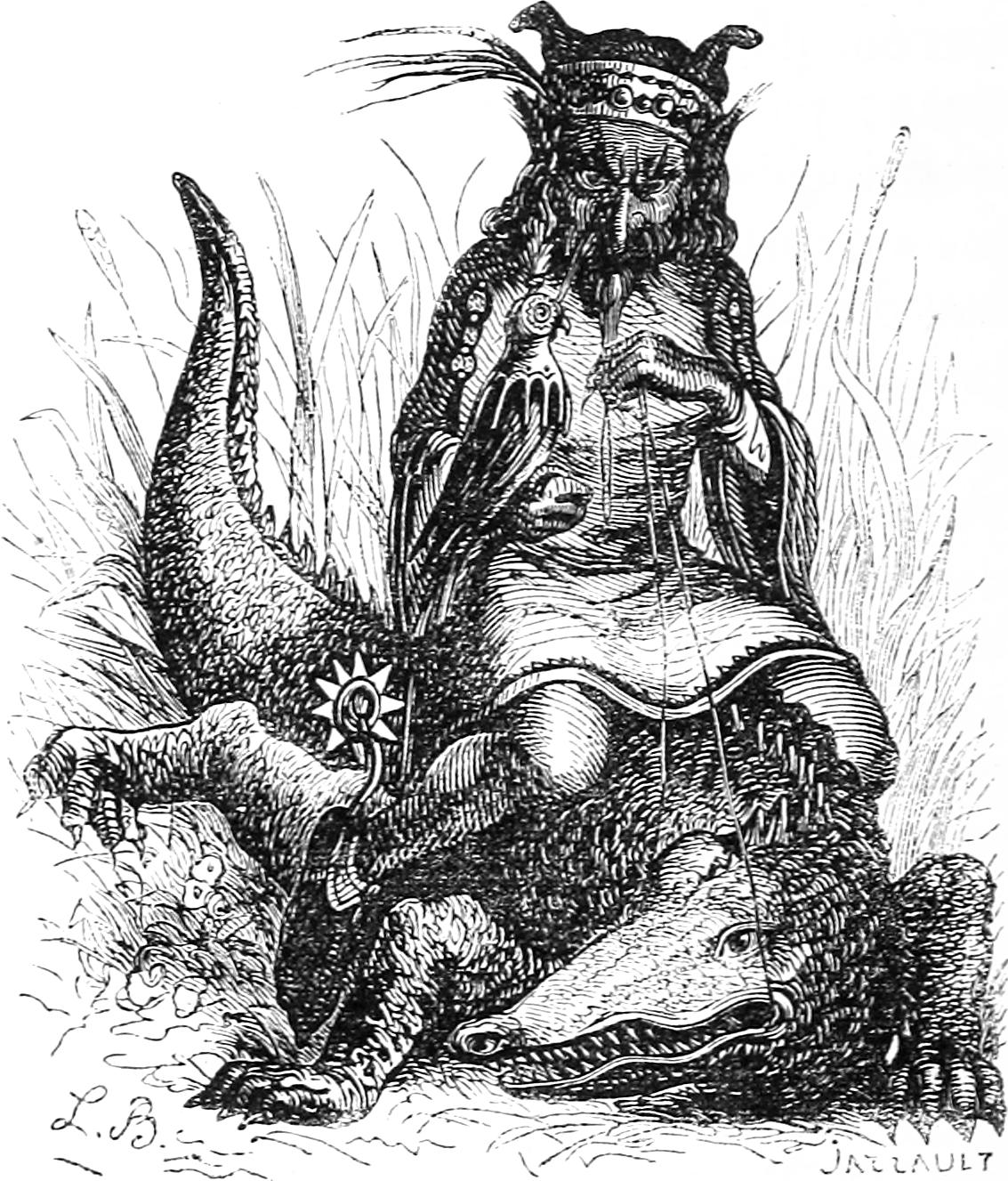
Agares provides the clearest case of dependence on a text. In Weyer’s tradition, he appears as an old man riding a crocodile and holding a hawk. Before seeing the 1863 engraving, we already have an approximate age, a mount and a bird. The image does not need to invent the scene’s basic structure.
What it must decide is everything the sentence leaves unspecified: the old man’s face, his clothing, the relative scale of rider and crocodile, the angle of the mount, the bird’s position, the expression, the ground and the framing. These decisions turn a description into a particular composition.
Agares therefore resists an oversimplified account. Saying ‘Le Breton invented Agares’ would be false; so would saying ‘Le Breton simply copied his traditional appearance’. The description and the image belong to different stages of the same process of transmission.
CASE 2 · ASTAROTH
Astaroth: a detailed description still needs a body
Astaroth is another case in which the text leaves limited room for manoeuvre. The 1863 entry, referring to Wierus, describes a very ugly angel riding an infernal dragon and holding a viper in his left hand. The scene’s structure is already established before the drawing appears.
Yet that structure does not define a complete portrait. What does ‘a very ugly angel’ mean visually? What kind of dragon? How large is the viper? What posture does the figure adopt? How are wings, clothing, gesture and mount arranged within the frame? Each answer belongs to the work of representation.
Astaroth shows that a detailed description can strongly constrain an image without determining it completely. Between text and engraving, there remains a space for decisions that the historian needs to recognise.

CASE 3 · BUER
Buer: from star to radial anatomy
Buer makes the opposite problem visible. Weyer describes him in the form of a star. The 1863 Dictionnaire Infernal speaks of a five-pointed star or wheel and of movement by rolling. This determines the general geometry, but does not provide an ordinary anatomy that can be drawn without interpretation.
The famous Buer of 1863 turns that geometry into a bodily creature: a central head with limbs arranged radially, producing a figure that can be read as both a wheel and a living being. This is a remarkably effective solution, transforming an abstract indication into a recognisable body.
Here we can clearly identify a particular contribution made by the image. The star or wheel comes from the text; the exact way head and limbs are combined in that arrangement belongs to the visual solution of 1863. Projecting this anatomy back into earlier periods would erase the very historical work we are trying to reconstruct.
CASE 4 · BELZÉBUTH
Belzébuth: when the source offers several images
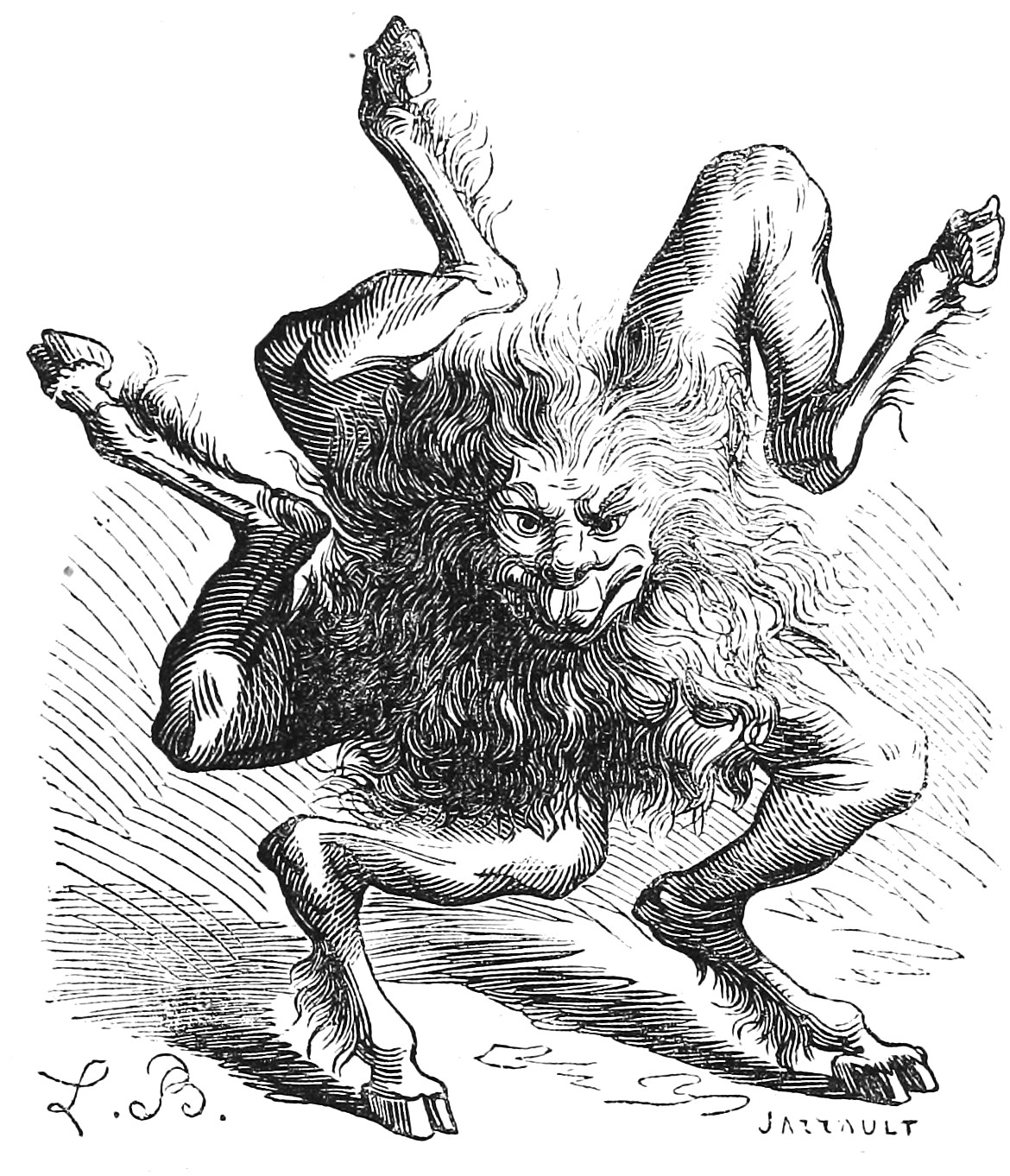
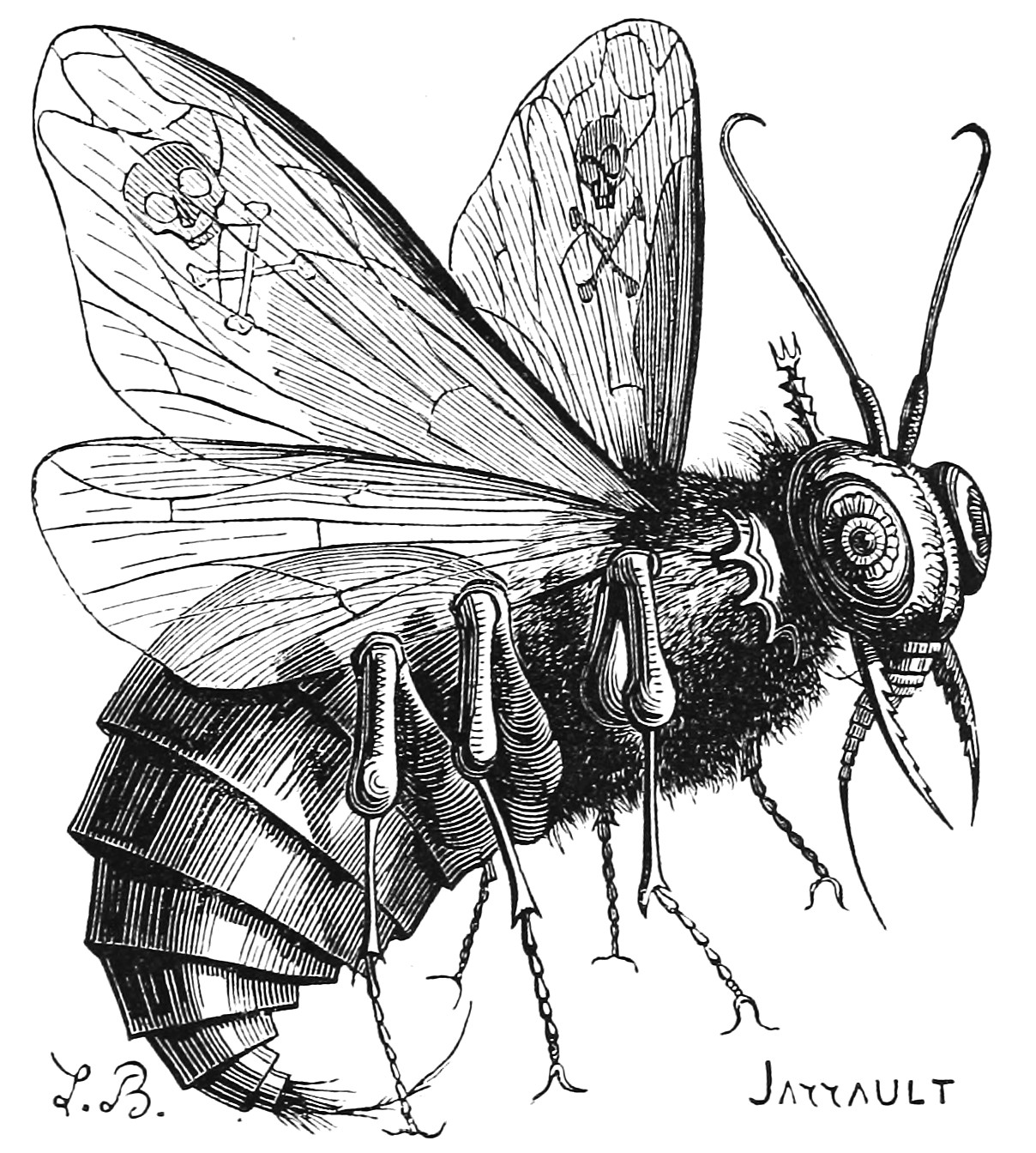
Belzébuth raises a different problem. Collin de Plancy’s entry brings together incompatible depictions: a fly, a serpent, a woman, a giant and other figures with horns, wings or a tail. In practice, the tradition compiled in the dictionary itself acknowledges that there is no single stable form.
Under these conditions, any individual illustration necessarily makes a selection. The 1863 drawing cannot be a neutral reproduction of a previous, universal portrait, because the text itself presents a conflicting range of possibilities.
That is precisely why the engraving matters. It fixes one possibility among several and makes it reproducible. Once separated from the entry that documented the contradictions, the image may circulate as ‘the’ appearance of Belzébuth. ‘Beelzebub, Beelzebul, Baal-Zebub’ has already shown that the name changes through transmission; this article adds that an image can also fix one of those layers and make it appear definitive.
FOUR VISUAL OPERATIONS
Four comparisons you can check
The references below identify printed page numbers in the book, not image numbers in the digital viewer. The links open each entry’s transcription alongside its reproduction. The final column is our comparative reading: it does not attribute an undocumented intention to the artist.
Scroll the table horizontally to see all columns ↔
| Case | What the text records | What the image makes specific |
|---|---|---|
| Agares / Aguarès | p. 10: a lord on a crocodile, holding a bird of prey. Weyer describes him as an old man. | The drawing determines clothing, scale and arrangement. It does not invent the combination of rider, mount and bird. |
| Astaroth | p. 56: an ugly-looking angel, a dragon and a viper. | The anatomy, gesture and relationship between figure and mount are visual decisions. |
| Buer | p. 123: a five-pointed star or wheel that moves by rolling. | The head and five limbs give bodily form to a geometric description. |
| Belzébuth | pp. 89–90: several depictions brought together in a single entry. | The print selects an insect form; it does not exhaust the text’s alternatives. |
In the comparative edition of Weyer prepared by Joseph H. Peterson, you can find Agares (no. 2), Buer (no. 7) and Astaroth (no. 28). These numbers refer to that list and should not be confused with Collin de Plancy’s pagination.
MYTH VS SOURCE
‘This is how they had long been depicted’
An isolated reproduction of Buer, Agares or Belzébuth often loses three pieces of information: who drew it, which edition it appeared in and what its accompanying text said. Without them, the engraving floats free as a supposedly traditional image.
The documentary correction is straightforward: ‘This depiction comes from the sixth edition of the Dictionnaire Infernal, published in 1863, and is attributed by modern sources to Louis Le Breton.’ It can then be compared with the earlier description. Only then can we say which elements are inherited and which belong to the nineteenth-century visual realisation.
The aim is not to diminish the engravings’ value, but to strengthen their value as evidence. An image with a date, an attribution and a place in its edition tells us more than the same image turned into an icon without a history.
ARCHIVE CONNECTIONS
Connecting the portraits to their sources
WHO DECIDED WHAT DEMONS LOOK LIKE? ‘Who decided what demons look like?’ raised the general problem: a later illustration can come to seem like an entity’s traditional appearance. This article looks more closely, comparing four cases from 1863.
FROM THE PSEUDOMONARCHIA TO THE GOETIA: THE LIST CHANGED. There we saw that catalogues do not remain unchanged. This article shows that transmission does more than reorganise names and ranks: it can also crystallise a visual appearance.
BEELZEBUB, BEELZEBUL, BAAL-ZEBUB. Beelzebub’s name changes in form and function depending on the source. The 1863 engraving of Belzébuth adds another question: when does one of those stages acquire a face that dominates later reproductions?
INCOMPATIBLE HIERARCHIES. Ranks depend on the text; images also depend on an edition. In both cases, the rule is the same: do not turn a particular historical layer into a universal truth.
CONCLUSION
Return to the text before trusting the portrait
The 72 portraits advertised by the 1863 edition mark one of the decisive moments in modern demonological iconography. Their power does not come from being ancient, but from giving visible form to material that could previously circulate as descriptions, catalogues and incompatible traditions.
Agares demonstrates continuity; Buer, design; Belzébuth, selection; Astaroth, the giving of concrete form. None of these cases can be properly understood if we isolate the engraving from its source. The complete document comprises text, edition, artistic credit and later reception.
The article’s final rule is simple: whenever an image looks like a demon’s ‘traditional form’, first ask when that image appeared. Then ask what the earlier source said. Only then can we assess what the artist inherited and what was added when words became a face.
FURTHER READING
Continue reading images and sources
In Studies you can explore the programme and its free readings. The related lessons examine the provenance of images and the difference between a text, an edition and a reproduction.
For the broader question, continue with Who decided what demons look like? To explore other subjects, return to The Archive.
LESSONS AND SOURCES
Consult the edition and its reproductions
The central source is the sixth edition of the Dictionnaire infernal, published in Paris by H. Plon in 1863. The links for each case allow the description to be compared with its reproduction. Wikisource transcriptions make reading easier; if you find a discrepancy, consult the facsimile.
The Library of Congress record for the volume offers another route to the digitised copy. When citing an image, retain the entry title, edition, page and verified credits. Someone encountering it outside this article will then be able to return to its context.
SOURCES CONSULTED
Sources, pages and credits
- BnF: Dictionnaire infernal, sixth edition — Paris, H. Plon, 1863; 723 illustrated pages.
- Catalogue collectif de France — The edition statement retains the announcement of 72 portraits.
- BnF: Louis Le Breton (1818–1866) — Authority record identifying the artist.
- Aguarès, p. 10 — Entry and reproduction from the 1863 edition.
- Astaroth, p. 56 — Entry and reproduction.
- Buer, p. 123 — Description of a star or wheel, and reproduction.
- Belzébuth, pp. 89–90 — Range of appearances and print.
- Old Book Illustrations: Buer — Separate credits: Louis Le Breton, illustrator; A. Jarrault, engraver.
- Weyer, Joseph H. Peterson’s comparative edition — Entries 2, 7 and 28. Its introduction, notes and modern translations have their own copyright protection.
- Library of Congress: Dictionnaire infernal (1863) — Digitised volume and copy record.
Source records
Explore the references, their limitations and their uses in other readings. The article’s full bibliography is retained in the text above.
Dictionnaire Infernal, sixth edition ↗Johann Weyer — De praestigiis daemonum / Pseudomonarchia Daemonum ↗Dictionnaire Infernal · sixth ed., 1863 ↗Dictionnaire Infernal · 1863 · CCFr ↗Wikisource · Dictionnaire Infernal · sixth ed. · full text ↗BnF · Louis Le Breton (1818–1866) ↗Wikisource · Astaroth · Dictionnaire Infernal 1863 ↗Wikisource · Buer · Dictionnaire Infernal 1863 ↗Wikisource · Belzébuth · Dictionnaire Infernal 1863 ↗Library of Congress · Dictionnaire Infernal · 1863 ↗Study this subject further
These related lessons let you explore the article’s questions through activities and study resources.
Cite this article
Published in The Method Files’ Archive.
LE BRETON’S 72 PORTRAITS. The Archive · The Method Files. https://themethodfiles.com/en/estudios/archivo/72-retratos-louis-le-breton-dictionnaire-infernal/
Include your access date; the copy button adds it automatically. To cite a historical source, use its own reference in the article’s bibliography.
Explore the six free lessons · Explore the Studies programme