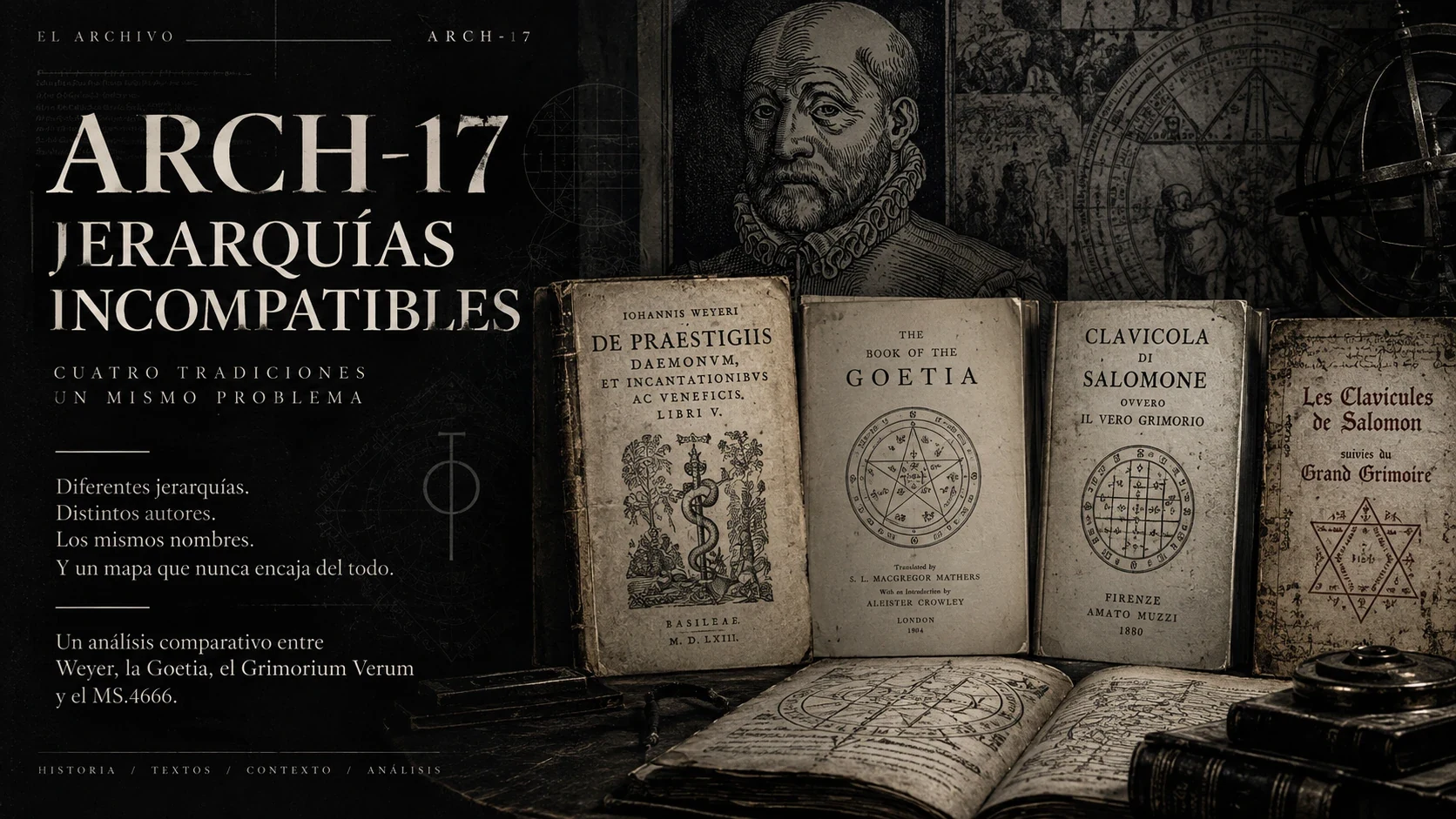
THE ARCHIVE · ARCH-17
INCOMPATIBLE HIERARCHIES
Four traditions, one problem
Different hierarchies. Different authors. The same names. And a map that never quite fits together.
A comparative analysis of Weyer, the Goetia, the Grimorium Verum and MS 4666.
THE METHOD FILES
THE ARCHIVE
Why different grimoires give the same entities different ranks and functions.
King, duke, president, count, prince, prime minister. Grimoire demonology seems to offer a precise chain of command, but comparing just four texts disrupts that certainty. Astaroth is a great duke in Weyer’s Pseudomonarchia Daemonum and remains a duke in the Ars Goetia. In the Grimorium Verum, he appears among the three superior powers with the title of count. The Grand Grimoire’s hierarchy table presents him as grand duke. The name remains; the office does not.
This is not a decorative detail. Ranks organise a text’s distribution of authority, subordination and function. Change the book, and the whole structure may change: a list of spirits with legions, a court of kings and dukes, three superior powers with territorial subordinates, or an infernal administration with emperor, prince, prime minister, generals and field marshal.
This article starts with a simple rule: before saying an entity ‘is’ a king, duke or prince, ask who calls it that, in which work and edition, and within which system. Contradiction is not something to erase. It belongs to the text’s history.
THE ARGUMENT
There is no single infernal hierarchy
Grimoires do not describe a universal administration that each author simply copies. They construct systems. Sometimes those systems are related and preserve names, ranks or functions; sometimes they reorganise authority through different categories. Even within one tradition, layers may coexist without fitting together perfectly.
THE ARCHIVE therefore does not ask which hierarchy is ‘the true one’. It asks which hierarchy each source documents. This prevents a particular classification becoming general theology. A title may remain stable within a textual family and change completely in another.
Comparing Weyer, the Ars Goetia, Grimorium Verum and Grand Grimoire demonstrates this through particular names. Astaroth is our principal thread, but Buer, Belial, Lucifer, Beelzebuth and Lucifuge show that the issue affects the entire structure.
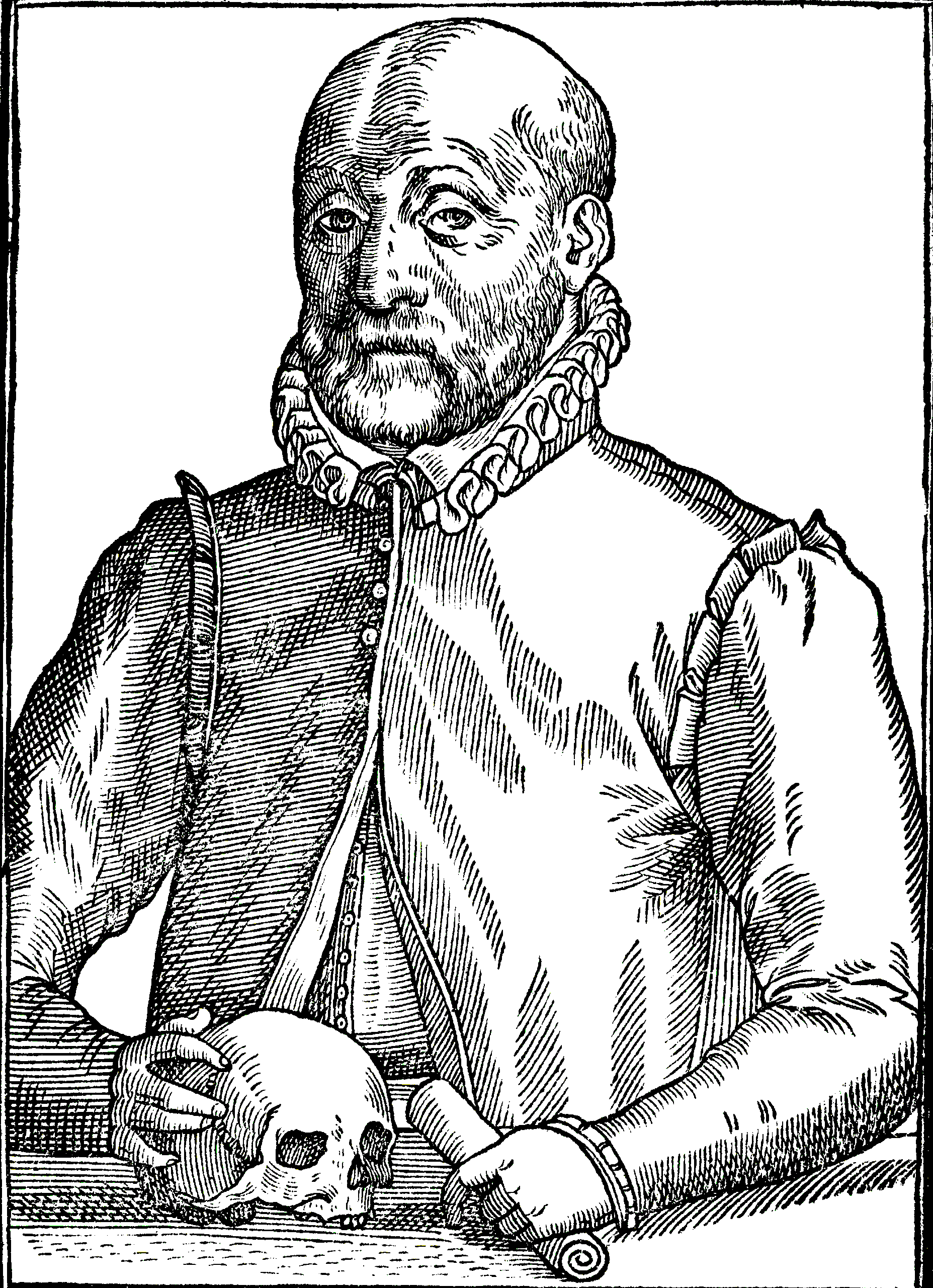
1577 · JOHANN WEYER
The Pseudomonarchia organises a list, not a single empire
Johann Weyer added the Pseudomonarchia daemonum to the fifth edition of De praestigiis daemonum in 1577. Joseph H. Peterson’s comparative edition notes that Weyer claimed to draw on a Liber officiorum spirituum and that the catalogue tradition has earlier manuscript antecedents. The surviving text is not an abstract table of grades: each entry combines name, rank, appearance, functions and number of legions.
Weyer, for example, describes Buer as a great president ruling fifty legions. Astaroth is a great and powerful duke with forty legions. Belial appears as a king ruling eighty legions. Courtly categories — king, duke, count, president — help organise the catalogue, but do not by themselves form a complete pyramid with a single overarching chart.
Weyer’s use of ‘duke’ therefore does not establish Astaroth’s rank throughout Western demonology. It establishes that this entry, within this textual tradition, classifies him that way. The distinction seems small until we compare other books.
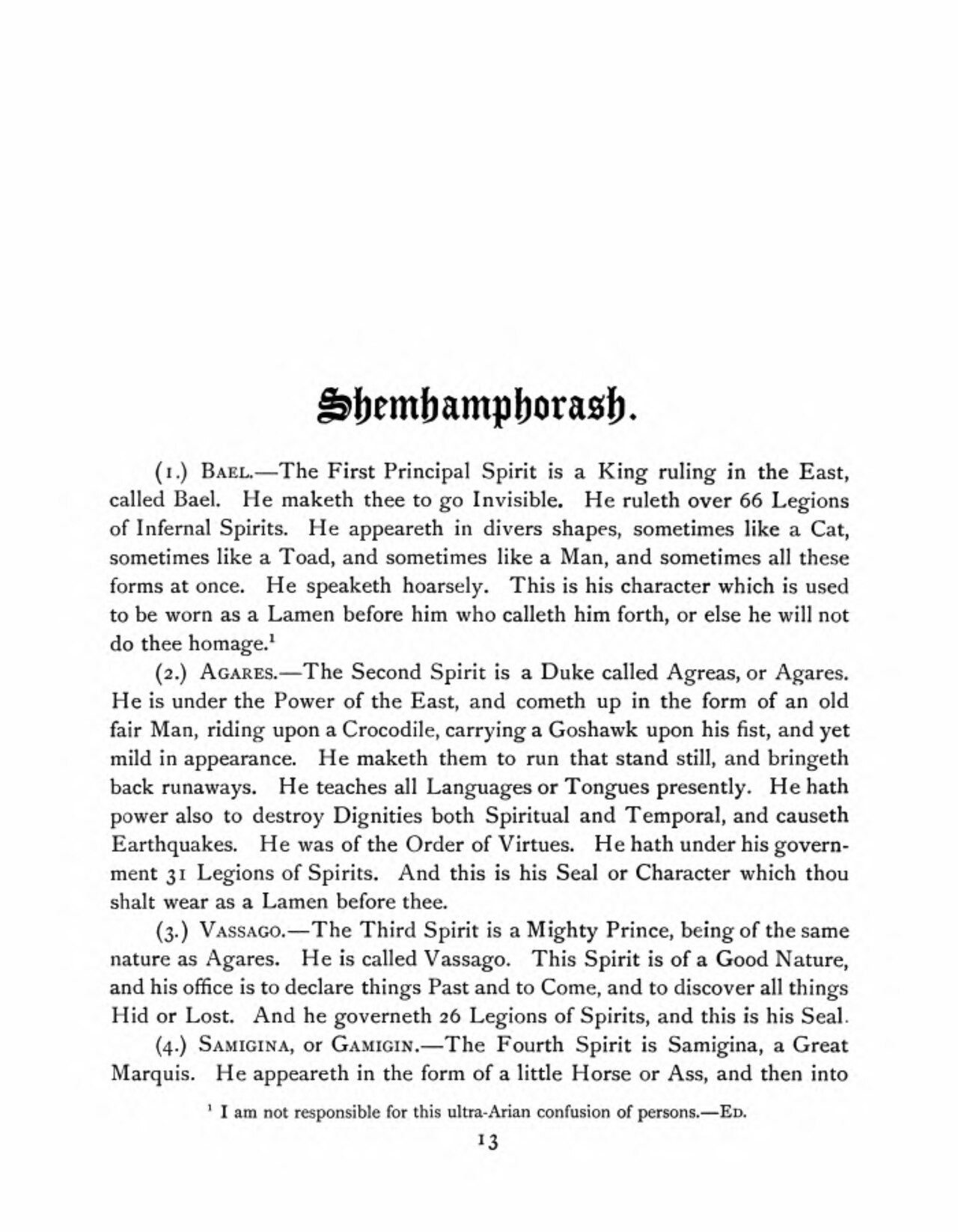
SEVENTEENTH CENTURY · ARS GOETIA
The list changes even when many ranks survive
The Ars Goetia is closely related to Weyer’s transmitted catalogue, but does not copy it unchanged. Peterson’s comparison reveals a markedly different order: Buer moves from number 7 in Weyer to 10 in the Goetia; Astaroth from 28 to 29; Belial from 23 to 68. Pruflas disappears, while Vassago, Seere, Dantalion and Andromalius appear.
Despite this reordering, some rank vocabulary remains. The Goetia still uses kings, dukes, marquises, counts, princes, presidents and even a knight. Buer remains a president, Astaroth a duke and Belial a king. Two things are established simultaneously: genuine textual continuity exists, and that continuity does not prevent transformation of the catalogue.
‘From the Pseudomonarchia to the Goetia: the list changed’ showed that the Goetia is not simply ‘Weyer plus three names’. This article adds another layer: even when a rank matches, relative position and the network of relationships may have changed. A shared title does not make two systems identical.
GRIMORIUM VERUM
Three superiors and a different chain of command
The Grimorium Verum organises authority differently. Peterson’s edition presents three superior spirits: Lucifer, Beelzebuth and Astaroth. The Latin sequence of titles is conventionally read as emperor, prince and count. Beneath them are pairs of subordinates: Satanachia and Agalierapt under Lucifer; Tarchimache and Fleruty under Beelzebuth; Sagatana and Nesbiros under Astaroth. The text also adds Duke Syrach and eighteen spirits under his authority.
This no longer resembles a catalogue of seventy spirits distributed across courtly ranks. It is a tiered structure with three superior powers and groups of subordinates. Astaroth is particularly revealing: the same name Weyer and the Goetia call a duke appears here as a count.
There is no need to decide that one source is ‘wrong’. We have different systems before us. Historical work preserves the discrepancy and asks which tradition is speaking in each case.
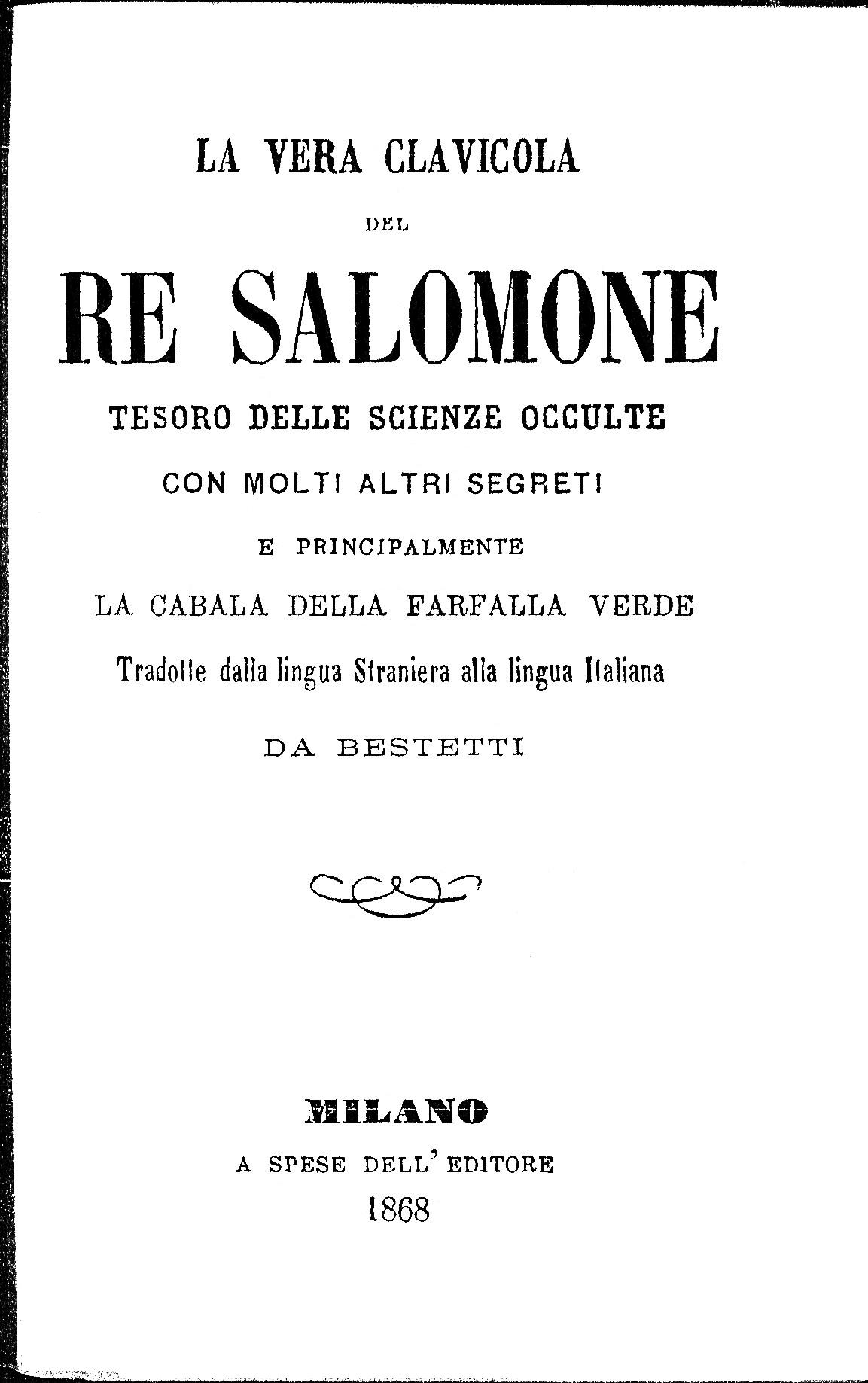
GRAND GRIMOIRE
From a court to an infernal administration
The Grand Grimoire reorganises the chain again. Its table presents Lucifer as emperor, Belzebuth as prince and Astarot as grand duke. It then introduces a second layer with titles recalling a political and military administration: Lucifuge as prime minister, Satanachia as grand general, Fleurety as lieutenant general and Nebiros as field marshal.
The difference from the Grimorium Verum is immediately visible. Lucifer and Beelzebuth retain similar superior titles, but Astaroth changes from count to grand duke. Lucifuge, absent from the superior structure described in Peterson’s Grimorium Verum, becomes the Grand Grimoire’s infernal prime minister, with authority over Baël, Agares and Marbas.
The Grand Grimoire itself also preserves an internal tension useful to our enquiry: its hierarchy table calls Astarot ‘Grand-Duc’, whereas a later conjuration addresses him as ‘comte Astarot’. Rather than correcting one form with the other, record both. A work may transmit layers or formulae that were never fully harmonised.
THE CENTRAL CASE · ASTAROTH
The same name moves to a different office
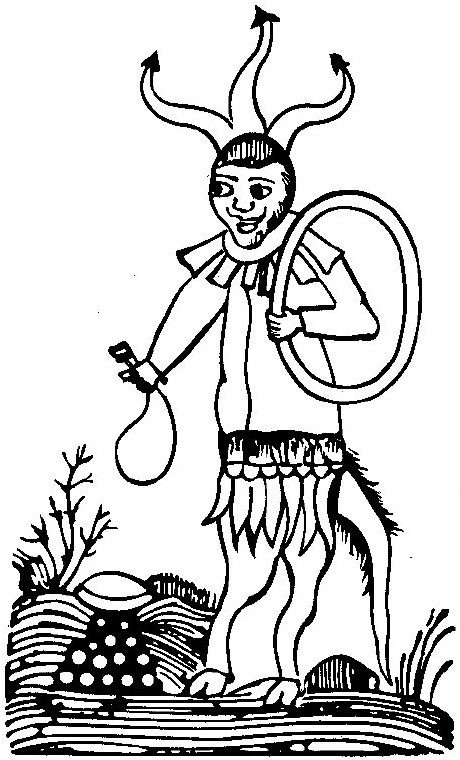
Astaroth reveals the whole problem in one comparison. Weyer: duke. Ars Goetia: duke. Grimorium Verum: count. Grand Grimoire: grand duke in the table, count in a later formula. Removing these differences to produce a tidy profile would lose precisely the most interesting historical information.
Rank is not the entity’s essence. It is a textual claim. Such a claim must be dated, located and related to its tradition. ‘What rank does Astaroth hold?’ can only be answered with another question: ‘in which source?’
The method applies to any other name. Belial is a king in Weyer and the Goetia, yet his position shifts radically. Buer retains the title of president while changing number. Lucifuge acquires a central ministerial role in the Grand Grimoire. What looks like a stable bureaucracy is actually a history of transmission.
WHY THEY CHANGE
Copying does not mean preserving unchanged
Differences may arise through manuscript transmission, editorial reorganisation, translation, combined sources or material introduced from another family. Not every discrepancy has the same cause, and we must not invent one where the documents cannot establish it.
Jean-Patrice Boudet has studied these catalogues as demonological ‘who’s whos’ with medieval antecedents: lists in which name, title, function and number of legions belong to a textual tradition that changes over time. Owen Davies’s history of grimoires likewise stresses that manuscript and print are not separate worlds: texts are copied, recombined and circulated again.
The editorial consequence is clear. When grimoires disagree, do not resolve the discrepancy by finding a modern table that averages their information. Return to the sources and preserve each system.
MYTH VS SOURCE
‘Astaroth is a duke’
The phrase seems correct because it appears in important sources. Weyer calls him a great duke, and the Ars Goetia also classifies him as a duke. Without context, however, the phrase turns a textual classification into a universal identity.
The Grimorium Verum provides a direct counterexample, placing him among the three superiors as a count. The Grand Grimoire elevates him to grand duke in its table and calls him count again elsewhere. Rigorous wording is not ‘Astaroth is a duke’, but ‘Weyer and the Goetia present him as a duke; other traditions assign different titles’.
The qualification does not weaken the information. It makes it verifiable. It also shows that particular texts constructed demonological hierarchies, rather than discovering an immutable administrative structure.
ARCHIVE CONNECTIONS
Comparing ranks, texts and editions
WHO BUILT HELL?
There we trace how catalogues, scribes and editors shaped a demonological structure. This article takes one component — rank — and demonstrates how it changes with the source.
THE GRAND GRIMOIRE, BEYOND THE LEGEND
The Grand Grimoire offers a particularly clear hierarchy of its own: emperor, prince, grand duke and a second layer of administrative and military offices.
FROM THE PSEUDOMONARCHIA TO THE GOETIA: THE LIST CHANGED
Comparing Weyer and the Goetia shows how transmission can preserve names and titles while reordering positions, omitting figures and adding others.
THE PACT IN GRIMOIRES
Understanding the pact requires knowing each spirit’s authority within the text describing it. This article provides a comparison of those authorities.
RENVOI AND RITUAL DISMISSAL
Closing formulae also depend on the system transmitting them. ‘Renvoi and ritual dismissal’ shows why a ritual function, like a rank, should not be universalised.
CONCLUSION
Ask about the source before the rank
Incompatible hierarchies are not a defect to correct. They are evidence. Weyer, the Ars Goetia, Grimorium Verum and Grand Grimoire do not describe exactly the same system, despite shared names and vocabulary. Each selects, orders and distributes authority in a particular way.
Astaroth encapsulates the problem: duke, duke, count, grand duke. Lucifuge extends it: absent from one system, prime minister in another. Buer and Belial show how even a retained classification may change position within the list.
The final rule is simple: never write a demonological rank without keeping four questions in mind. Which text states it? Which edition are we reading? What does the title do within that system? Which other sources disagree? Only then does a hierarchy become documentary history rather than a decorative table.
FURTHER READING
Compare before imposing an order
Continue through THE ARCHIVE’s related articles. The Public Editions and Library then let you apply the same method to each volume: first identify which source assigns each rank and function.
LESSONS AND SOURCES
Comparing a hierarchy as a historical system
This article presents the documentary findings; Studies provides the method for comparing presence, absence, position, rank, function and transmission without turning a local classification into a universal hierarchy.
- FROM LIST TO SYSTEM: HOW TO COMPARE A DEMONOLOGICAL HIERARCHY: a direct method for aligning catalogues, ranks, omissions, additions and reorderings.
- TEXTUAL RELATIONSHIPS AND CONTAMINATION: examine relationships, dependence and mixing between branches before explaining a discrepancy.
- WHAT A SOURCE CAN ACTUALLY ESTABLISH: restrict each rank and function to the witness that actually assigns it.
The Source records and final bibliography identify the compared works and allow you to check the ranks and functions each text assigns to its figures.
- Johann Weyer · Pseudomonarchia Daemonum
- Grimorium Verum · Alibeck / printed tradition
- Grand Grimoire / Le Dragon Rouge
- Joseph H. Peterson · Lemegeton / Ars Goetia
- British Library · Sloane MS 3825
- Reginald Scot · The Discoverie of Witchcraft · 1584
- Jean-Patrice Boudet · Renaissance demonological catalogues
SOURCES CONSULTED
Bibliography and repositories used
- Johann Weyer · Pseudomonarchia Daemonum · Joseph H. Peterson’s digital edition: Text and comparative apparatus with the Ars Goetia; fifth edition of De praestigiis (1577), ranks, functions, legions and changes of order.
- Lemegeton · Ars Goetia · Joseph H. Peterson’s digital edition: Catalogue of 72 spirits distributed among kings, dukes, marquises, counts, princes, presidents and other ranks.
- Grimorium Verum · Joseph H. Peterson’s digital edition: Three superior powers — Lucifer, Beelzebuth and Astaroth — and a chain of subordinates; edition updated in 2025.
- Le Grand Grimoire · Joseph H. Peterson’s digital edition: Lucifer as emperor, Belzebuth as prince, Astarot as grand duke; Lucifuge as prime minister and subordinate military offices.
- Jean-Patrice Boudet · Les who’s who démonologiques de la Renaissance et leurs ancêtres médiévaux: Academic study of Renaissance demonological catalogues and their medieval antecedents. Médiévales 44, 2003.
- Owen Davies · Grimoires: A History of Magic Books: Reference study of the circulation, manuscript and printed transmission, and transformation of magic books. Oxford University Press, 2009.
- The Book of the Goetia of Solomon the King · Mathers/Crowley · 1904: Digitised historical edition, 84 pages, public domain / Public Domain Mark.
- Lucifuge Rofocale · The Grand Grimoire · nineteenth century: Historical reproduction of Lucifuge Rofocale associated with the Grand Grimoire; public domain.
Source records
Explore the references, their limitations and their uses in other readings. The article’s full bibliography is retained in the text above.
Johann Weyer — De praestigiis daemonum / Pseudomonarchia Daemonum ↗Grimorium Verum ↗Le Grand Grimoire — Paris, 1845 ↗Joseph H. Peterson — Lemegeton Clavicula Salomonis / Ars Goetia ↗Sloane MS 3825 ↗Scot — The Discoverie of Witchcraft ↗Boudet — Renaissance and medieval demonological repertoires ↗Goetia — Peterson’s digital edition ↗Grimorium Verum — Joseph H. Peterson’s French digital edition ↗Grimoires: A History of Magic Books ↗Wikimedia Commons · The Book of the Goetia (Mathers-Crowley, 1904) ↗Lucifuge Rofocale · The Grand Grimoire · nineteenth century ↗Study this subject further
These related lessons let you explore the article’s questions through activities and study resources.
Cite this article
Published in The Method Files’ Archive.
INCOMPATIBLE HIERARCHIES. The Archive · The Method Files. https://themethodfiles.com/en/estudios/archivo/jerarquias-incompatibles-grimorios/
Include your access date; the copy button adds it automatically. To cite a historical source, use its own reference in the article’s bibliography.
Explore the six free lessons · Explore the Studies programme