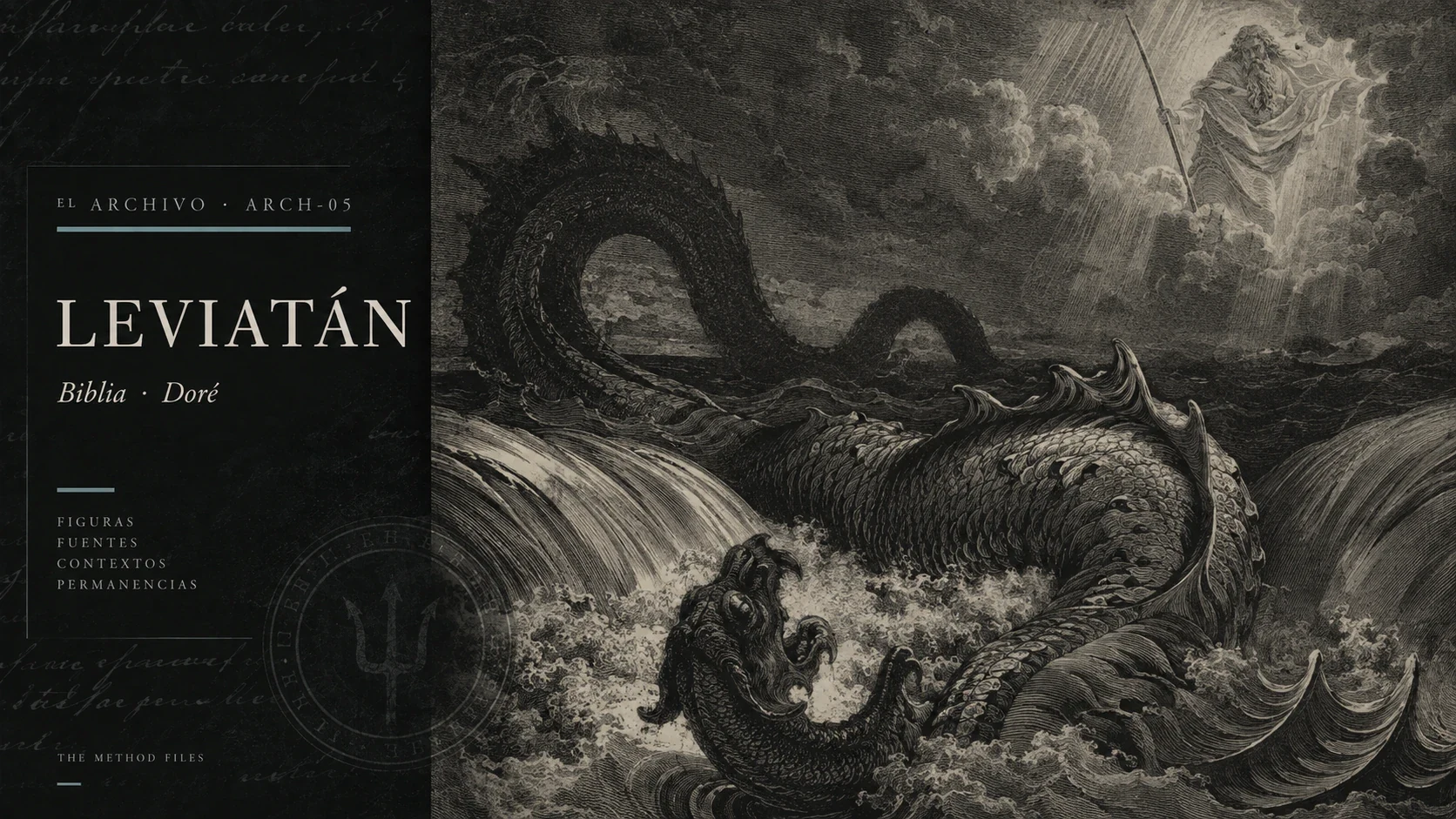
THE ARCHIVE · ARCH-05
LEVIATHAN
Bible · Doré
THE METHOD FILES
THE ARCHIVE
Before Hell, there was the sea
Today, Leviathan often appears in demonologies, infernal hierarchies and occult systems as though it had always been a clearly defined demonic entity.
But its story begins much earlier, in an entirely different setting.
In the Hebrew Bible, Leviathan first belongs to the imagery of the sea, serpents, monsters and chaos. In Job, it appears as a creature beyond human control. In Psalm 74, God crushes its heads in a scene of combat against the forces of the sea. And in Isaiah 27:1, it is described as a fleeing, twisting serpent, associated with the dragon that dwells in the sea.
This is not yet the Leviathan of later demonological hierarchies.
It has no office in Hell.
It commands no legion.
It does not yet represent one of the deadly sins.
First, it is something else: a monstrous image of untameable power, of the sea and of whatever threatens to escape the bounds of order.
The transformation will come later.
This article follows that development:
how did a creature of marine chaos become one of the great names of Western demonology?
JOB · THE MONSTER NO ONE CAN MASTER
Leviathan before becoming a demon
In the Book of Job, Leviathan appears as a creature no human being can control.
Chapter 41 builds the scene through a series of questions: can anyone catch it with a hook, tie its tongue with a cord, tame it or make it a submissive animal? The implied answer is always the same: no.
Here, Leviathan represents a power beyond human capacity.
Its body is described as protected by closely fitted scales. Its strength inspires fear. Its breath is associated with images of fire and smoke. Its passage through the water leaves a wake that makes the deep appear covered in foam.
The passage’s purpose is not to construct a demonological hierarchy.
It presents a creature whose strength marks a radical difference between human and divine power.
Human beings cannot master Leviathan. God can.
That detail will become essential later, as subsequent tradition gives this untameable creature an increasingly religious and demonological significance.
PSALMS AND ISAIAH · CHAOS TAKES SHAPE
Leviathan is no longer just a creature: it is an enemy of order
In other biblical texts, Leviathan appears within imagery even more clearly associated with primordial chaos and divine combat.
In Psalm 74:13–14, God breaks the power of the sea, crushes the heads of the water monsters and destroys the heads of Leviathan. The image no longer presents only an extraordinary creature: Leviathan is part of a scene in which divine order overcomes the chaotic forces of the sea.
Isaiah 27:1 reinforces that idea. Leviathan is described as a fleeing serpent, a twisting serpent and associated with the dragon that dwells in the sea. The passage announces that God will punish and destroy it.
Here, an important transformation emerges.
Leviathan still belongs to the sea, but also begins to function as an image of the forces opposing order.
We are not yet dealing with a demon from a grimoire.
But we are much closer to a figure that can be reinterpreted as a cosmic enemy.
The sea monster begins to become a symbol.
RABBINIC TRADITION · AFTER DEFEAT
From the monster of chaos to the banquet at the end of time
Leviathan does not disappear at the end of the biblical text. Later Jewish tradition continues its story and gives it an ultimate fate.
In the Babylonian Talmud, Bava Batra 74b–75a, Leviathan is associated with the world to come. The account says that God will prepare its flesh as a banquet for the righteous. Even its skin acquires an extraordinary purpose: it will cover and honour the righteous and, according to the account, part of it will adorn Jerusalem.
The creature that seemed impossible to master in Job now has a defined ending.
Chaos does not prevail. It is subdued and becomes a sign of divine victory.
This matters because Leviathan has not yet become a king or prince of Hell.
It still belongs to a tradition in which God ultimately masters what human beings cannot control.
Later demonology will take that name and transform it again.
Before entering Hell, Leviathan had to leave the sea.
MEDIEVAL CHRISTIANITY · THE MONSTER DRAWS CLOSER TO THE DEVIL
When Leviathan begins to represent more than the sea
Christian interpretation added another layer to Leviathan: the sea monster also began to be read as an image of the Devil.
One of the most influential examples appears in Moralia in Job, the extensive commentary by Gregory the Great on the Book of Job, written between the late sixth and early seventh centuries.
When discussing Leviathan, Gregory does more than describe an extraordinary creature. He interprets it as a representation of the ancient enemy, Satan. Even the image of God catching Leviathan with a hook acquires a Christological meaning for him: the Devil tries to seize Christ and is defeated by what he thought he could devour.
This change is decisive.
Leviathan retains its biblical monstrosity, but begins to acquire a demonological identity.
The sea, serpents and chaos remain part of its imagery, but can now be read as symbols of the spiritual enemy.
This is not yet a Leviathan with a specific office in a modern infernal hierarchy.
But the necessary step towards that point has taken place:
the monster of chaos has begun to become a figure of the Devil.
DEMONOLOGY · LEVIATHAN ENTERS HELL
When the monster receives an office
In the early modern period, Leviathan makes another leap.
The biblical monster is no longer merely interpreted as a symbol of the Devil. Some authors begin to place it within specific demonological systems.
In 1589, Peter Binsfeld publishes his Tractatus de confessionibus maleficorum et sagarum. Within the demonological classification transmitted by this work, several demonic names are associated with specific vices, and Leviathan is linked to envy.
This classification matters precisely because it does not come from Job, Psalms or Isaiah.
It is a later demonological construction.
Leviathan has moved from sea creature to symbol of the enemy, and now takes a place within an organisation of evil.
The transformation continues in the nineteenth century. In the 1863 edition of the Dictionnaire Infernal, Collin de Plancy presents Leviathan as ‘grand admiral of Hell’ and records other traditions about its character and relationship to the gigantic sea monster of rabbinic literature.
Here we can see the full trajectory:
sea → chaos → enemy → demon → infernal hierarchy.
But each stage belongs to a different source and period.
The admiral of Hell was not in Job. It was added centuries later.
WHAT THE SOURCE ACTUALLY SAYS
Five stages that should not be collapsed into one
Leviathan’s history changes completely when we put the sources in order.
In Job, Leviathan is a monstrous creature beyond human control.
In Psalms and Isaiah, its imagery moves towards the language of chaos, serpents and the enemy subdued by God.
In rabbinic tradition, Leviathan acquires an eschatological destiny: it will ultimately be defeated and its flesh will form part of the banquet for the righteous.
In medieval Christian interpretation, authors such as Gregory the Great also begin to read it as a figure of the Devil.
And in the demonology of the early modern period and the nineteenth century, Leviathan receives specific associations, functions and even offices within infernal hierarchies.
We are therefore not looking at five identical descriptions of the same figure.
We are looking at a transformation:
sea monster → symbol of chaos → subdued enemy → diabolical figure → demonological entity.
That sequence matters because it prevents ideas that emerge centuries later from being projected back onto Job or Isaiah.
Leviathan did not begin in Hell. It began in the sea.
WHAT CHANGED LATER
From biblical monster to occult symbol
Once Leviathan enters demonology, its meaning no longer depends solely on the biblical texts.
Later authors begin to use its name within different systems, and those systems do not always agree.
In the classification of Peter Binsfeld, published in 1589, Leviathan is associated with envy. That relationship belongs to an early modern demonological construction; it does not come from Job or Isaiah.
In the Dictionnaire Infernal of 1863, Collin de Plancy records another tradition and presents it as grand admiral of Hell. At the same time, he preserves the memory of the gigantic sea monster of rabbinic tradition.
In modern occultism, the name changes again. In The Satanic Bible by Anton LaVey, published in 1969, one of the four major sections is called The Book of Leviathan and is associated with water and the sea.
The same name has thus passed through very different contexts: biblical creature, image of chaos, diabolical figure, member of infernal hierarchies and symbol reused by modern occult systems.
That does not mean all those traditions describe exactly the same Leviathan.
Each period takes the name and reorganises it within its own map of the world.
This is why there is no single ‘true hierarchy’ in which Leviathan has always held the same place.
MYTH VS SOURCE
‘Leviathan was always a demon of Hell’.
No.
In the biblical texts, Leviathan is associated with the sea, serpents, monsters and chaos. In Isaiah 27:1, it is a fleeing, twisting serpent, while in Psalm 74 God destroys its heads in a scene of mastery over the forces of the sea.
That is not yet an office in Hell.
Identification with the Devil emerges in later Christian interpretations. Demonological hierarchies arrive later still.
In the Dictionnaire Infernal of 1863, for example, Collin de Plancy already presents Leviathan as ‘grand admiral of Hell’. That formulation belongs to a demonological tradition much later than the biblical text.
So:
BIBLICAL SOURCE: sea creature, serpent and symbol of a chaotic force subdued by God.
LATER INTERPRETATION: a figure associated with the Devil and the spiritual enemy.
MODERN DEMONOLOGY: an entity with functions and rank within specific infernal systems.
Saying that ‘Leviathan was always a demon of Hell’ conflates these stages and projects a classification that emerges centuries later back onto ancient texts.
Leviathan was not born an admiral of Hell. It had to become one.
THE ARGUMENT
Leviathan did not begin in Hell
Leviathan’s history is a history of transformation.
In Job, it appears as a creature beyond human control.
In Psalms and Isaiah, it becomes an image of marine chaos defeated by God.
In rabbinic tradition, it acquires an eschatological destiny and ultimately becomes part of the banquet for the righteous.
In medieval Christian interpretation, it also begins to be read as a figure of the Devil.
And in later demonology, it receives associations, functions and offices within specific infernal hierarchies.
Each stage adds something different.
We should therefore ask more than:
‘Who is Leviathan?’
The question to ask of the documents is:
which source is speaking, and which version of Leviathan is it constructing?
That is the argument of this article:
Leviathan was not born a demon. It gradually became one through centuries of interpretation and symbolic reorganisation.
ARCHIVE CONNECTIONS
Following Leviathan’s trail
Who built Hell?
Leviathan shows, in a single figure, how hierarchies and identities change when later texts reorganise older material. The sea monster of biblical sources comes to perform roles those sources never assigned to it.
Who decided what demons look like?
Leviathan also raises a particularly clear visual question: how much of its modern image actually comes from Job, Psalms or Isaiah, and how much was added later by artists, editors and occultists?
GRIMOIRE OF LEVIATHAN
This article reconstructs its historical transformation. The Grimoire of Leviathan continues from there, organising its tradition in a dedicated volume and distinguishing the biblical monster from later demonological and occult reinterpretations.
CONTINUE
From biblical monster to the Grimoire of Leviathan
This article has traced Leviathan’s transformation from the biblical sources, where it appears as a sea creature and symbol of chaos, through the rabbinic, Christian and demonological interpretations that added new functions to its name.
The Public Edition of the Grimoire of Leviathan continues from there, organising its tradition in a dedicated volume and distinguishing ancient sources from later reinterpretations.
The Illustrated Edition extends that exploration with more comprehensive visual, documentary and ritual treatment.
SOURCES CONSULTED
Documents and studies used
- Job 41. Description of Leviathan as a creature beyond human control, associated with strength, scales, fire, smoke and mastery of the sea.
- Psalm 74:13–14 and Isaiah 27:1. Passages associating Leviathan with the sea, serpents, the dragon and God’s defeat of chaotic forces.
- Babylonian Talmud · Bava Batra 74b–75a. Rabbinic development of Leviathan, including its ultimate defeat and its relationship to the banquet for the righteous.
- Gregory the Great. Moralia in Job, books XXXIII–XXXIV. Christian interpretation of Leviathan as a figure of the ancient enemy and diabolical power.
- Peter Binsfeld. Tractatus de confessionibus maleficorum et sagarum, 1589. A demonological work in which Leviathan is associated with envy within the classification of the deadly sins.
- Jacques-Albin-Simon Collin de Plancy. Dictionnaire Infernal, sixth edition, Paris, H. Plon, 1863. It presents Leviathan as grand admiral of Hell and also preserves traditions about the sea monster.
- Anton Szandor LaVey. The Satanic Bible, 1969. Includes The Book of Leviathan · The Raging Sea, associated with water and the modern symbolism of Leviathan.
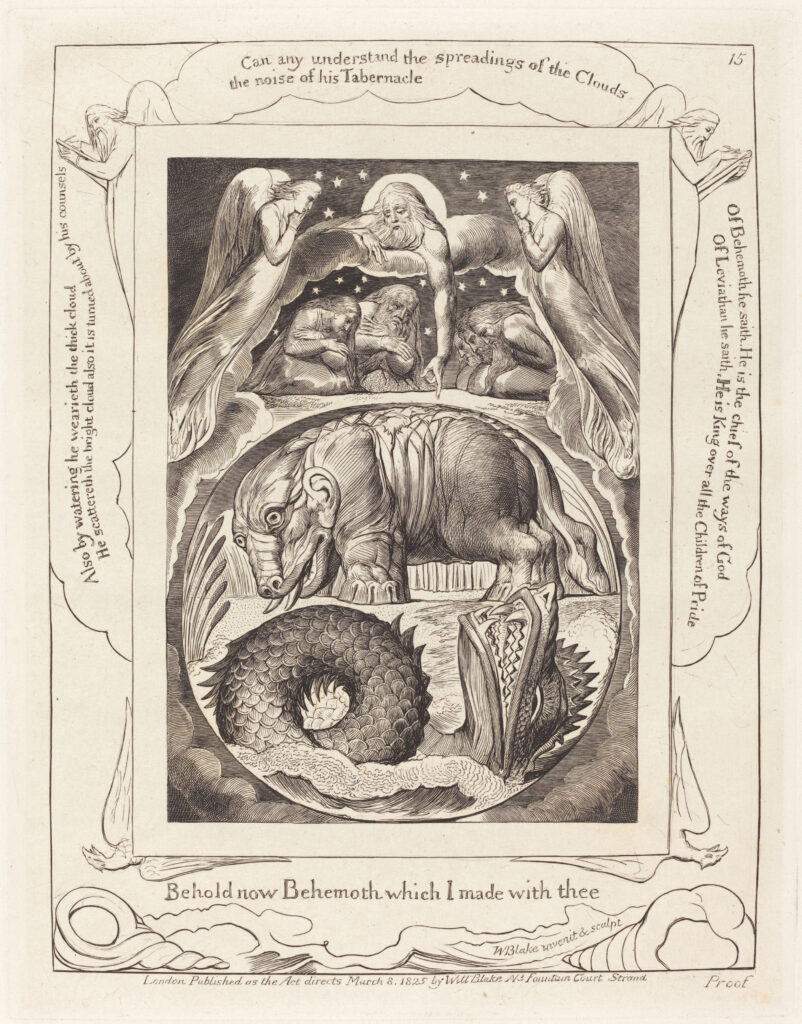
- William Blake. Behemoth and Leviathan, 1825. Engraving from the series Illustrations of the Book of Job, National Gallery of Art, Washington. Used to illustrate the modern visual reception of the biblical Leviathan.
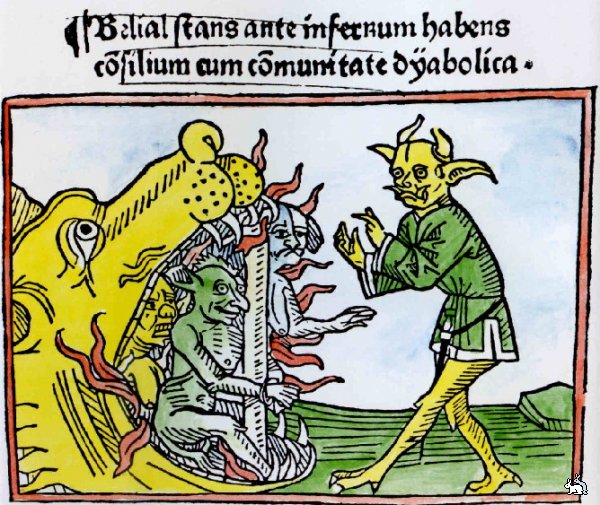
- Jacobus de Teramo. Processus Belial, 1473. Woodcut depicting the gates of Hell as the jaws of Leviathan. Used to document Leviathan’s incorporation into Christian infernal iconography.
Source records
Explore the references, their limitations and their uses in other readings. The article’s full bibliography is retained in the text above.
Job 41 ↗Psalm 74:13–14 and Isaiah 27:1 ↗Bava Batra 74b–75a ↗Dictionnaire Infernal, sixth edition ↗Moralia in Job ↗Tractatus de confessionibus maleficorum et sagarum ↗The Satanic Bible ↗Behemoth and Leviathan ↗Processus Belial · woodcut of the mouth of Hell ↗Study this subject further
These related lessons let you explore the article’s questions through activities and study resources.
Cite this article
Published in The Method Files’ Archive.
LEVIATHAN: WHEN CHAOS HAD SCALES. The Archive · The Method Files. https://themethodfiles.com/en/estudios/archivo/leviatan-cuando-el-caos-tenia-escamas/
Include your access date; the copy button adds it automatically. To cite a historical source, use its own reference in the article’s bibliography.
Explore the six free lessons · Explore the Studies programme