
THE ARCHIVE · ARCH-07
SATAN
Milton · Doré
THE METHOD FILES
THE ARCHIVE
From adversary to cosmic enemy
Today, Satan seems an unmistakable proper name: the great enemy of God, tempter of humanity, chief of demons and central figure of Hell.
But that identity is not fully formed from the beginning.
In Hebrew, śāṭān essentially means adversary or opponent. In some texts, it can even refer to human adversaries. And when we reach the Book of Job, we encounter a figure very different from the fully independent Devil who will dominate later tradition.
Job 1 speaks of ha-satan — ‘the adversary’. He appears among the divine beings who present themselves before God, speaks with him and can act against Job only within the limits God permits. The Hebrew text retains the definite article: we find not simply ‘Satan’, but ‘the adversary’.
But something begins to change.
In 1 Chronicles 21:1, satan appears without the definite article and incites David to take a census of Israel. The parallel is particularly revealing because 2 Samuel 24:1 attributes that same incitement to God. Two versions of a similar episode show that the language used for the adversarial agent was changing.
Further layers would follow: accuser, tempter, eschatological enemy, chief of demons and cosmic adversary.
This article examines that change:
when did satan cease to denote a role or an adversary and begin to become Satan?
BEFORE THE NAME · SATAN WAS A ROLE
An adversary need not be the Devil
Before becoming a proper name, satan was a word.
In Hebrew, śāṭān can denote an adversary, an opponent or someone who stands in another’s way.
The biblical texts themselves show that the word was not originally reserved for a single demonic figure.
In Numbers 22:22, the angel of YHWH stands in Balaam’s path as a satan, meaning an adversary. This example matters because it shows that the term could describe a role involving opposition without yet denoting the Devil.
In 1 Samuel 29:4, the Philistine rulers fear that David might become a satan against them during battle.
And in 1 Kings 11, Hadad the Edomite and Rezon appear as adversaries raised up against Solomon.
None of them is ‘Satan’ in the later sense.
That changes our perspective from the outset.
The word existed before the figure.
At first, it described opposition.
Then, in certain texts, that opposition begins to centre on a particular figure.
Only over time will that figure become the great cosmic enemy of later tradition.
JOB · THE ADVERSARY ENTERS THE DIVINE COURT
He does not rule Hell yet
The Book of Job marks an important step, but does not yet present the Satan of later tradition.
In Job 1, the divine beings present themselves before God, and among them appears ha-satan, literally ‘the adversary’.
His role is to question Job’s integrity. He argues that the man is faithful only because he has been protected and favoured, and proposes putting that faithfulness to the test.
But there is a fundamental limit.
Ha-satan does not act on his own authority.
God authorises the test and sets its limits. First, he permits action against Job’s possessions and family, but forbids any harm to Job himself. Later, he authorises a further physical trial, but requires that Job’s life be spared.
This scene is far removed from the later image of an independent enemy ruling a kingdom opposed to God.
Here, instead, we find a figure who accuses, examines and tests within an order that remains under divine authority.
Even the Hebrew definite article matters: the text repeatedly speaks of ha-satan, ‘the adversary’, as though describing a role or title.
The figure is already beginning to acquire a distinct identity.
But he has no horns, army, throne or Hell yet.
In Job, Satan is not yet the sovereign of evil. He is the adversary who has permission to put someone to the test.
ZECHARIAH 3 · THE ACCUSER IN THE HEAVENLY COURT
The role of accuser still belongs within the divine court
Zechariah 3:1–2 provides another essential scene for tracing the term’s transformation. The high priest Joshua appears before the angel of YHWH and, at his right, stands ha-satan, ‘the adversary’ or ‘the accuser’, ready to accuse him.
The Hebrew retains the definite article, as in Job. The figure acts as accuser in a heavenly setting and is rebuked by YHWH.
We are not yet dealing with an independent sovereign of evil. Opposition and accusation still operate within an order subject to divine authority.
Zechariah thus helps bridge the gap between the adversary defined by a role in earlier texts and the individual figure who will develop later.
1 CHRONICLES · THE DEFINITE ARTICLE DISAPPEARS
When ‘the adversary’ begins to look like a proper name
In 1 Chronicles 21:1, we find a small change in the wording, but a momentous one in Satan’s history.
Here, we no longer find ha-satan — ‘the adversary’ as in Job. The Hebrew simply uses satan, without the definite article, and states that he rose against Israel and incited David to take a census.
The scene becomes more interesting still when compared with 2 Samuel 24:1, where a parallel episode attributes to God the incitement for David to take that same census.
Chronicles thus introduces an adversarial agent where Samuel had described the cause differently.
This does not allow us to claim that the fully developed Satan of later Christianity has suddenly appeared. Scholars debate whether satan already functions fully as a proper name here or still retains the meaning ‘adversary’.
But something has changed.
The figure begins to move beyond the simple role we saw in Job.
He no longer appears in a divine court, asking permission to test someone. Now he acts against Israel and prompts an action that will lead to catastrophe.
The adversary begins to acquire an increasingly sinister identity.
He does not rule Hell yet, but it is already much easier to recognise in him the figure who will follow.
THE SECOND TEMPLE PERIOD · THE ENEMY GROWS
Evil begins to take shape around individual figures
Between the final centuries BCE and the first centuries CE, the landscape changes.
Jewish literature of the Second Temple period develops far more strongly the idea of hostile beings, rebellious angels, accusers and powers associated with evil.
But we must avoid an oversimplification here: not all these texts call their great adversary Satan.
In the Book of Jubilees we find Mastema, a figure whose name is associated with enmity and whose functions resemble those of Job’s adversary. He acts as accuser and enforcer, but still operates within limits permitted by God. Some studies even suggest that Jubilees may identify Mastema with Satan in certain passages, although his role is not yet that of an enemy entirely independent of God.
In the texts from Qumran, by contrast, the great leader of the forces of darkness is usually Belial, not Satan. That distinction matters: Judaism in this period does not transmit a single universal biography of the enemy. Different names and models circulate.
Something more fundamental is nevertheless taking place.
Evil begins to acquire agents, hierarchies and individual adversaries.
The role of satan in Job is no longer enough to explain this new landscape.
The adversary is ceasing to be merely someone who accuses or tests. The religious imagination begins to conceive of enemies capable of directing entire forces against the divine order.
THE NEW TESTAMENT · SATAN LEAVES THE COURT
Now he acts as an enemy
In the New Testament, Satan has a much more clearly defined identity than in Job.
He is no longer merely a figure who accuses or tests within a divine court. Now he appears as a tempter, adversary and active enemy.
In the accounts of Jesus’s temptation, Satan tries to divert him from his mission by offering him power and testing his faithfulness.
Other passages attribute to him the capacity to deceive, tempt and oppose God’s work.
The change is clear.
Satan now functions as a recognisable individual figure.
The Gospels also associate him with a kingdom of his own. When Jesus answers the accusation that he casts out demons through Beelzebul, he speaks of Satan and his kingdom, reinforcing the idea of a structure of demonic power.
Here we are much closer to the Satan who will dominate later Christian tradition.
But another important step remains.
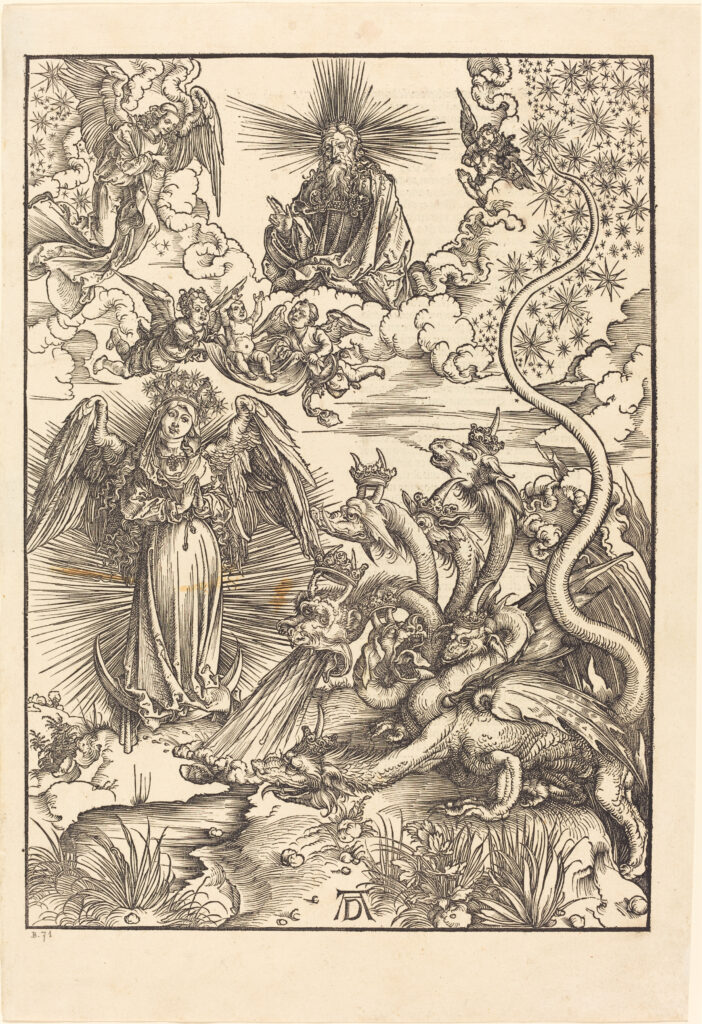
The great cosmic enemy, confronting God in a final battle and definitively associated with the Dragon and the Serpent, will emerge in full force in Revelation.
REVELATION · THE ADVERSARY BECOMES A DRAGON
The accuser now has an army, a war and a fall
In Revelation 12, the figure of Satan takes on an entirely different scale.
The text describes a war in heaven: Michael and his angels fight a great dragon and the angels accompanying it.
Here, the identification is explicit.
The dragon is called ‘the ancient serpent’, ‘the Devil’ and ‘Satan’. He also appears as the accuser who deceives the whole world and is finally cast down to earth with his angels.
We are no longer dealing with Job’s adversary, who acts within limits imposed by God.
Now Satan appears as a cosmic enemy, with followers of his own and directly confronting the heavenly forces.
The change is enormous.
The role of accuser does not disappear, but becomes part of a much larger figure: serpent, dragon, Devil, Satan and leader of an opposing side.
Here, many previously separate strands begin to converge.
The adversary no longer merely accuses. Now he fights.
WHAT THE SOURCE ACTUALLY SAYS
Satan does not emerge fully formed in a single text
If we try to find the modern Satan within a single page of the Bible, we end up conflating different periods.
In Job, ha-satan appears among the divine beings and acts as accuser or adversary within limits imposed by God. The Hebrew text preserves precisely that form with the definite article: ‘the adversary’.
In 1 Chronicles 21:1, satan appears without the definite article and incites David to take a census. The passage allows a much more individualised reading of the adversary, although scholars still debate whether the term already functions fully as a proper name here.
In the literature of the Second Temple period, different names appear for agents of evil and leaders of hostile forces: Satan does not yet occupy that entire field.
In the New Testament, we find a much more clearly defined adversary: tempter, enemy and ruler of a demonic kingdom.
And in Revelation 12, several strands explicitly converge: the dragon is identified with the ancient serpent, the Devil and Satan, and appears with his own angels.
We should therefore avoid turning all these stages into a single continuous biography.
Job is not yet describing the same fully developed Satan that we find in Revelation.
What we see is a figure accumulating roles, names and enemies until he becomes the great cosmic adversary of later tradition.
WHAT CHANGED LATER
When the adversary acquired a biography
After the New Testament, the figure of Satan continued to accumulate elements drawn from different texts.
The serpent of Genesis, the adversary in Job, the tempter of the Gospels, the Devil and the dragon of Revelation increasingly came to be read as parts of a single story.
Another decisive tradition was incorporated: the fall of the proud heavenly being. Christian interpretation of Isaiah 14 eventually linked the fall of lucifer with Satan, while other passages about rebellious heavenly beings helped construct a broader account of his origins.
This produced a biography that no biblical text tells in full on its own:
an exalted heavenly being;
a rebellion against God;
a fall from heaven;
transformation into an adversary;
and finally leadership of the demonic forces.
During the Middle Ages and the early modern period, theology, preaching, art and literature reinforced that synthesis.
Over time, Satan ceased to be merely a role within particular texts and became a figure with a past, a fall, enemies, a kingdom and an ultimate fate.
That biography was so influential that its different components are now difficult to separate.
But that is precisely what THE ARCHIVE does:
it examines the figure’s component parts to discover when each entered the story.
MYTH VS SOURCE
The Bible never tells ‘the complete story of Satan’
The Satan who now seems so familiar takes shape through reading together texts that did not originally tell a single biography.
Genesis presents the serpent of Eden, but does not call it Satan.
Job presents ha-satan, ‘the adversary’, within the divine court, acting within limits established by God.
1 Chronicles shows a more individualised figure who incites David.
The Gospels already present Satan as tempter, enemy and head of a kingdom opposing Jesus’s work.
Finally, Revelation 12 explicitly identifies the great dragon with ‘the ancient serpent’, ‘the Devil’ and ‘Satan’.
Later Christian tradition connected these scenes and added demonological readings of other passages, including the fall of lucifer in Isaiah 14.
That combination produces a familiar story: a heavenly being rebels, falls, becomes Satan, tempts humanity and directs the forces of evil.
An extensive tradition stands behind that story.
But no single chapter of the Bible narrates it in full, from beginning to end.
The mistake is not connecting these texts. Centuries of Christian interpretation have done so.
The mistake comes when we forget that the relationship between them also has a history.
Satan does not enter the sources with a finished biography.
The biography is constructed by joining the pieces.
THE ARGUMENT
The enemy gradually took shape
Satan does not appear in the earliest sources as a fully defined figure.
First, we find a role: the adversary, someone who opposes, accuses or tests.
In Job, that role begins to centre on ha-satan, still subject to limits established by God.
In 1 Chronicles, the use of satan without the definite article allows a more individualised reading, although the figure’s precise identity remains disputed.
During the Second Temple period, the realm of evil fills with adversaries, rebellious angels and hostile powers bearing different names and roles.
In the New Testament, Satan already acts as tempter, enemy and leader of demonic forces.
And in Revelation, the adversary assumes a cosmic scale: dragon, ancient serpent, Devil, accuser and enemy accompanied by his own angels.
Centuries of interpretation will then join these layers to other traditions concerning fall, rebellion and Lucifer.
The result is the Satan we recognise today.
But the documentary record of his history shows something different from what we often assume:
he did not emerge fully formed. His identity accumulated over time.
That is the argument of this article:
Satan developed from a word for an adversary into the great cosmic enemy through a long process of textual construction and interpretation.
ARCHIVE CONNECTIONS
The pieces that eventually formed the enemy
Lucifer before he became the Devil
Satan and Lucifer became closely connected in Christian tradition, but they did not begin as the same name. ‘Lucifer before he became the Devil’ reconstructs how the image of lucifer in Isaiah 14 became part of the later story of Satan’s fall.
Who built Hell?
Satan’s development shows why there is no single architecture of Hell passed down unchanged from antiquity. Different texts, interpreters and periods brought together adversaries, demons, falls and hierarchies to produce much more complex systems.
GRIMOIRE OF SATAN
This article examines the figure’s component parts to show where each layer comes from. The Grimoire of Satan continues from there, organising his traditions, symbols and later developments in a dedicated volume.
CONTINUE
From adversary to the Grimoire of Satan
This article has traced the transformation of satan from a word that could mean adversary into an increasingly individual, hostile and ultimately cosmic figure.
The Public Edition of the Grimoire of Satan continues from there, organising the figure’s principal traditions, symbols and later developments in a dedicated volume.
The Illustrated Edition extends that exploration with more comprehensive visual, documentary and ritual treatment.
SOURCES CONSULTED
Texts and studies used
- Numbers 22:22; 1 Samuel 29:4; 1 Kings 11:14–25. Passages in which satan functions as adversary or opponent rather than as a name exclusive to the Devil.
- Job 1–2. The appearance of ha-satan, ‘the adversary/the accuser’, among the heavenly beings, tasked with testing Job only within the limits established by God.
- Zechariah 3:1–2. A vision of the high priest Joshua in which ha-satan appears as accuser in a heavenly court and is rebuked by YHWH.
- 1 Chronicles 21:1 and 2 Samuel 24:1. Parallel accounts of David’s census. Essential for studying the change in how the agent prompting the census is represented and the debate over the meaning of satan in Chronicles.
- Book of Jubilees. A Second Temple tradition in which Mastema performs roles involving accusation, opposition and the direction of hostile spirits.
- Community Rule (1QS) and War Scroll (1QM). Qumran texts in which Belial represents the great adversary and leads the forces of darkness.
- Synoptic Gospels. Matthew 4:1–11; Mark 3:22–26; Luke 4:1–13 and 11:15–18. Satan appears as tempter, enemy and a figure associated with a demonic kingdom.
- Revelation 12:7–12. The great dragon is explicitly identified with the ancient serpent, the Devil and Satan, and appears with his angels.
- Origen. De Principiis. An early Christian source used to trace the later connection between Isaiah 14 and the Devil’s fall.
- Augustine of Hippo. The City of God, book XI. Development of the Christian reading that interprets the king of Babylon’s fall as a figure of the Devil’s fall.
- Albrecht Dürer. The Apocalyptic Woman, 1498. Woodcut from The Apocalypse of Saint John used as evidence of the visual reception of Revelation 12.
Source records
Explore the references, their limitations and their uses in other readings. The article’s full bibliography is retained in the text above.
Community Rule (1QS) ↗War Scroll (1QM) ↗Mark 3:22–26; Matthew 12:24–27; Luke 11:15–18 ↗Numbers 22:22; 1 Samuel 29:4; 1 Kings 11:14–25 ↗Job 1–2 ↗Zechariah 3:1–2 ↗1 Chronicles 21:1 and 2 Samuel 24:1 ↗Book of Jubilees ↗Matthew 4:1–11; Mark 3:22–26; Luke 4:1–13 and 11:15–18 ↗Revelation 12:7–12 ↗De Principiis ↗The City of God ↗The Apocalyptic Woman ↗Study this subject further
These related lessons let you explore the article’s questions through activities and study resources.
Cite this article
Published in The Method Files’ Archive.
SATAN WAS NOT ALWAYS “SATAN”. The Archive · The Method Files. https://themethodfiles.com/en/estudios/archivo/satanas-no-siempre-fue-satanas/
Include your access date; the copy button adds it automatically. To cite a historical source, use its own reference in the article’s bibliography.
Explore the six free lessons · Explore the Studies programme
From article to book
Would you like to explore Satan further?
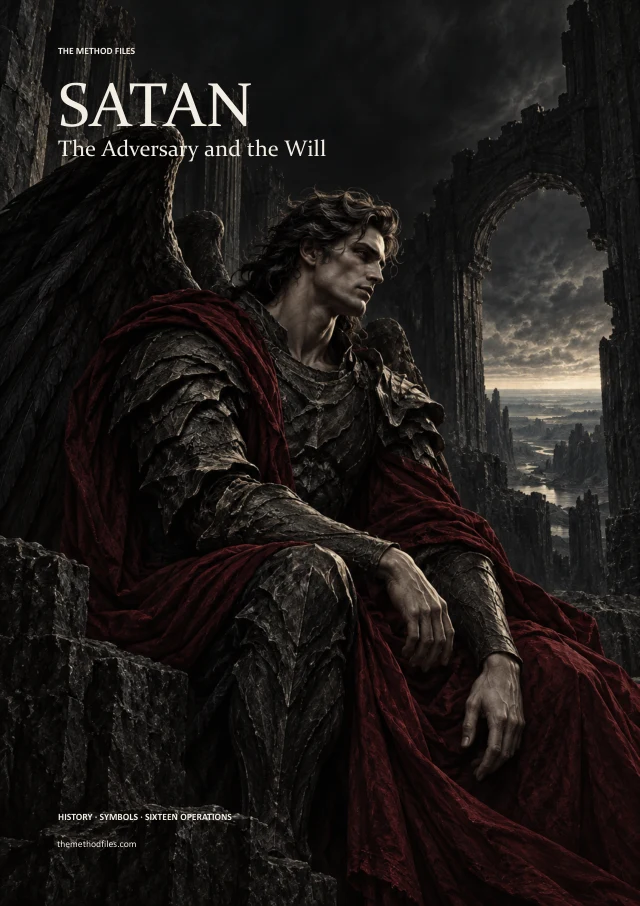
Follow the adversary’s journey through texts and images, with reading workshops and sixteen contemporary operations identified as such.
126 pages · PDF in English · Book independent of the course
Explore the book and read a sample