Was Lilith Adam’s first wife? That story appears in the Alphabet of Ben Sira, a medieval work, not in Genesis. Isaiah 34:14 contains the Hebrew term lilit, but does not tell that story. To understand the difference, we need to distinguish the ancient evidence from the narrative that develops later.
The Method Files · Sources reviewed:
From Isaiah to Ben Sira: a changing figure
Hair, wings, danger at night, Adam’s first wife and Samael’s consort: these features do not appear together in a single document. This article compares texts and objects, asking what each attests, when it is documented and what it does not allow us to conclude.
The sources discussed here belong to different contexts. Their relationship should not be turned into a continuous biography or an account of what all Jewish communities believed.
ISAIAH 34 · THE NAME AMONG THE RUINS
The Bible does not tell the story of Adam’s first wife
The key biblical reference is Isaiah 34:14. The chapter describes the devastation of Edom through an abandoned landscape inhabited by animals and unsettling beings. Among them appears the Hebrew term לִילִית — lilit.
What matters here is what the passage does not say.
Isaiah does not speak of Adam. It does not speak of Eve. It does not describe a sexual dispute. It does not introduce a woman created before Eve or explain a flight from Eden.
We find a name or term within a scene of desolation.
Historical translations also show that its interpretation was not uniform. The Latin Vulgate, for example, does not retain Lilith as a name, using lamia instead. Other translations have used expressions referring to nocturnal creatures or beings.
Centuries later, Jewish commentators interpreted the term in explicitly demonological terms. Rashi, in his commentary on Isaiah 34:14, explains it as the name of a female demon. But Rashi belongs to a medieval layer of interpretation: we should not automatically treat his explanation as the full meaning of the term when Isaiah was composed.
Our first conclusion: the Bible contains lilit. Lilith’s biography is not there yet.
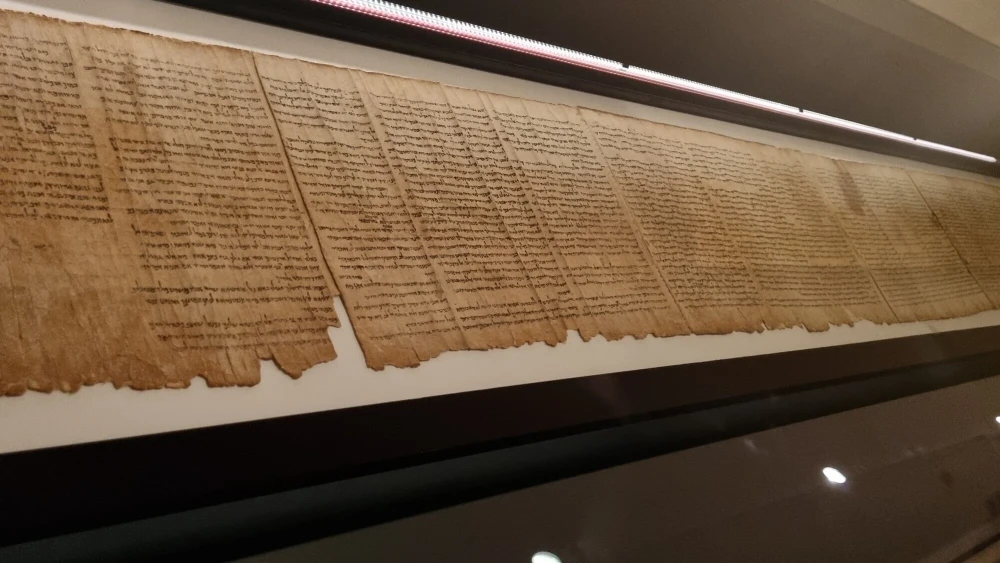
The Great Isaiah Scroll (1QIsaᵃ), c. 125 BCE. An ancient witness to the transmission of the Book of Isaiah. The reproduction illustrates the manuscript; it is not presented as an image of verse 34:14 or as a transcription of its variants.
QUMRAN · LILITH AMONG THE SPIRITS
Here the identification as a demon is much clearer
The next piece of evidence changes the context. Among the Dead Sea Scrolls is 4Q510, Songs of the Maskil, a non-biblical Hebrew composition found in Cave 4 at Qumran. The Israel Antiquities Authority holds the record and images of the manuscript; the precise textual reference used here comes from the Qumran Digital Lexicon.
Fragment 1, line 5 explicitly includes לילית — lilit in a list of spirits and evil beings. The Qumran Digital Lexicon classifies the term here as a female demon.
This takes us an important step further. In Isaiah 34, we had a term within a ruined landscape. In 4Q510, Lilith appears in a context openly associated with harmful spirits and demonic forces.
But something essential is still missing.
She is still not Adam’s first wife.
Qumran shows that Lilith’s demonological dimension is ancient. It does not, however, show that the famous story of her marriage to Adam already existed at that time.
RABBINIC TRADITION · LILITH TAKES SHAPE
Hair, wings and danger at night
In the Babylonian Talmud, several references show Lilith acquiring more specific features.
In Eruvin 100b, the text compares long hair to Lilith’s. In Niddah 24b, it describes a creature resembling Lilith and notes that it has wings. And in Shabbat 151b, a much more direct warning appears: anyone who sleeps alone in a house may be seized by Lilith.
These references already present a recognisable demonological figure: female, associated with hair, wings and danger at night.
But we need to keep the chronology in view.
None of these passages says that Lilith was Adam’s first wife.
Rabbinic tradition knows Lilith as a dangerous entity long before the medieval narrative that makes her Adam’s original companion.
This distinction is essential: the demonological Lilith of the Talmud is one thing; the later biography of Lilith as Adam’s first wife is another.
LATE ANTIQUITY · PROTECTIVE OBJECTS
People did more than speak of her: they tried to keep her out
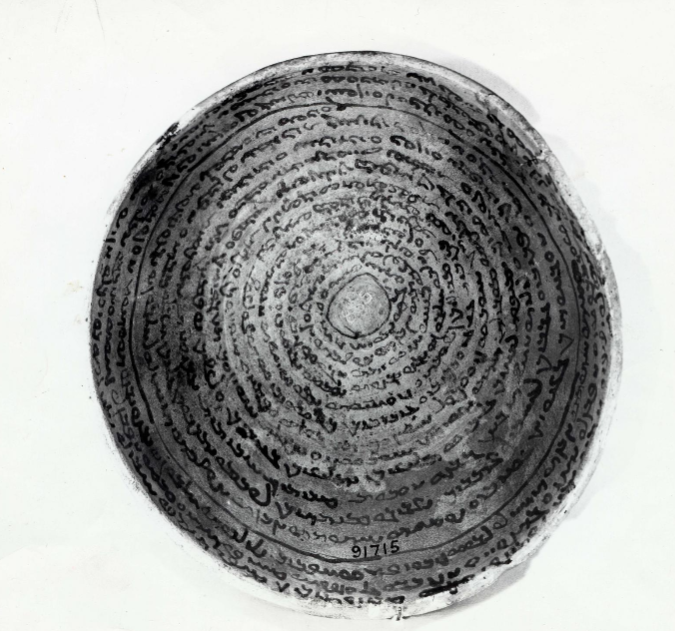
The incantation bowls of Mesopotamia document practices intended to protect people, homes and families. The sixth-to-eighth-century range applies to the two British Museum examples cited here; it should not be used to date the beginning of this entire tradition. Several surviving bowls explicitly mention liliths. The record for British Museum, 1881,0714.3 (BM 91715) identifies a Mandaic inscription describing the subjugation of a lilith. This should be distinguished from other bowls written in Jewish Aramaic: they do not all come from the same linguistic or religious context.
Another British Museum bowl, registered as 117881 (1980,0415.28), explicitly lists the names of several liliths. This matters because it shows that, in certain magical contexts, lilith was not only the name of an individual figure: it could also designate a category of demonic beings.
The evidence from Nippur points in the same direction. The Penn Museum holds bowl B9013, described as an amulet protecting a man and a woman against Liliths. A demon is also depicted at its centre, and the catalogue itself notes that the inscription takes the form of a divorce document.
These objects change our perspective. Lilith is no longer only a figure mentioned in religious or rabbinic texts: she appears in material practices of protection, inscribed on objects intended to counter specific dangers.
But the chronology remains the same:
the dangerous Lilith of domestic magic existed before the famous story of Adam’s first wife.
Incantation bowl, southern Iraq, sixth–eighth centuries. The inscription includes the subjugation of a lilith. The object documents a protective practice and a context distinct from the Adam narrative in the Alphabet of Ben Sira.
THE MIDDLE AGES · ALPHABET OF BEN SIRA
The Alphabet of Ben Sira: the story and its dating
The identifiable account appears in Otzar Midrashim, Alphabet of Ben Sira, alternative version, §34. God creates a woman from the earth, as he did Adam, and calls her Lilith. They argue about their position and equality; she pronounces the divine Name and leaves. Her encounter with three angels ultimately connects the story to amulets for protecting children.
The work’s dating is approximate and disputed. The overviews consulted differ: Rebecca Lesses proposes the eighth century, while Jill Hammer, in My Jewish Learning, proposes the ninth or tenth. The eighth-to-tenth-century range summarises these suggestions; it is not an exact date on which scholars agree. Rebecca Lesses’s overview in the Jewish Women’s Archive helps to place the issue in context; different editions and versions need to be examined individually. An estimated composition date is not the same as the date of a surviving manuscript, nor does it establish when a story began to circulate orally.
Nor should this medieval Alphabet be confused with the ancient Book of Ben Sira, or Ecclesiasticus. The shared name does not make them the same text. What we can verify here is a particular medieval narrative, not a biography hidden in Genesis.
WHAT THE SOURCE ACTUALLY SAYS
A chronology of the sources: what we know and how certain it is
This chronology distinguishes a securely identified passage from approximate dates of composition or copying. The periods may overlap: placing sources in order does not show that one depends directly on another.
Scroll the table horizontally to see all columns ↔
Lilith: evidence, dates and limitations
Source
Date and qualification
What it allows us to verify
Isaiah 34:14
A biblical text predating the medieval sources. Scroll 1QIsaᵃ is an ancient copy, not the date of composition.
The figure thus acquires a cosmological role absent from the passage in Isaiah. There is no need to claim that the treatise invented all its motifs from scratch: Dan identifies chronological problems in its relationship to other texts. What can be verified is the configuration this medieval source presents.
MYTH VS SOURCE
Was Lilith removed from Genesis?
The documents compared here do not substantiate that claim. Genesis does not tell the story of a first wife named Lilith who leaves Adam; the Alphabet of Ben Sira develops it centuries later. A later work expanding an earlier account does not show that its additions had been erased from the ancient text.
Contemporary interpretations of Lilith are a legitimate subject of study. Presenting them as ancient history, however, requires ancient evidence that supports that attribution.
THE ARGUMENT
How to read the different Lilith traditions without conflating them
What emerges is not a single identity hidden behind all the documents, but a series of uses and transformations. A name, a class of harmful beings, a story about a couple and a Kabbalistic figure raise different questions.
Reading carefully means keeping two questions together: what does the source claim, and what are we adding through our interpretation? This allows us to recognise the richness of the traditions without attributing a medieval work’s narrative to Isaiah.
ARCHIVE CONNECTIONS
Tracing the transformation
Who built Hell? Lilith’s history shows, on a small scale, the same process explored more broadly in ‘Who built Hell?’: names, roles and images change as they pass from one source to another. What looks like a single tradition often consists of documents from different periods.
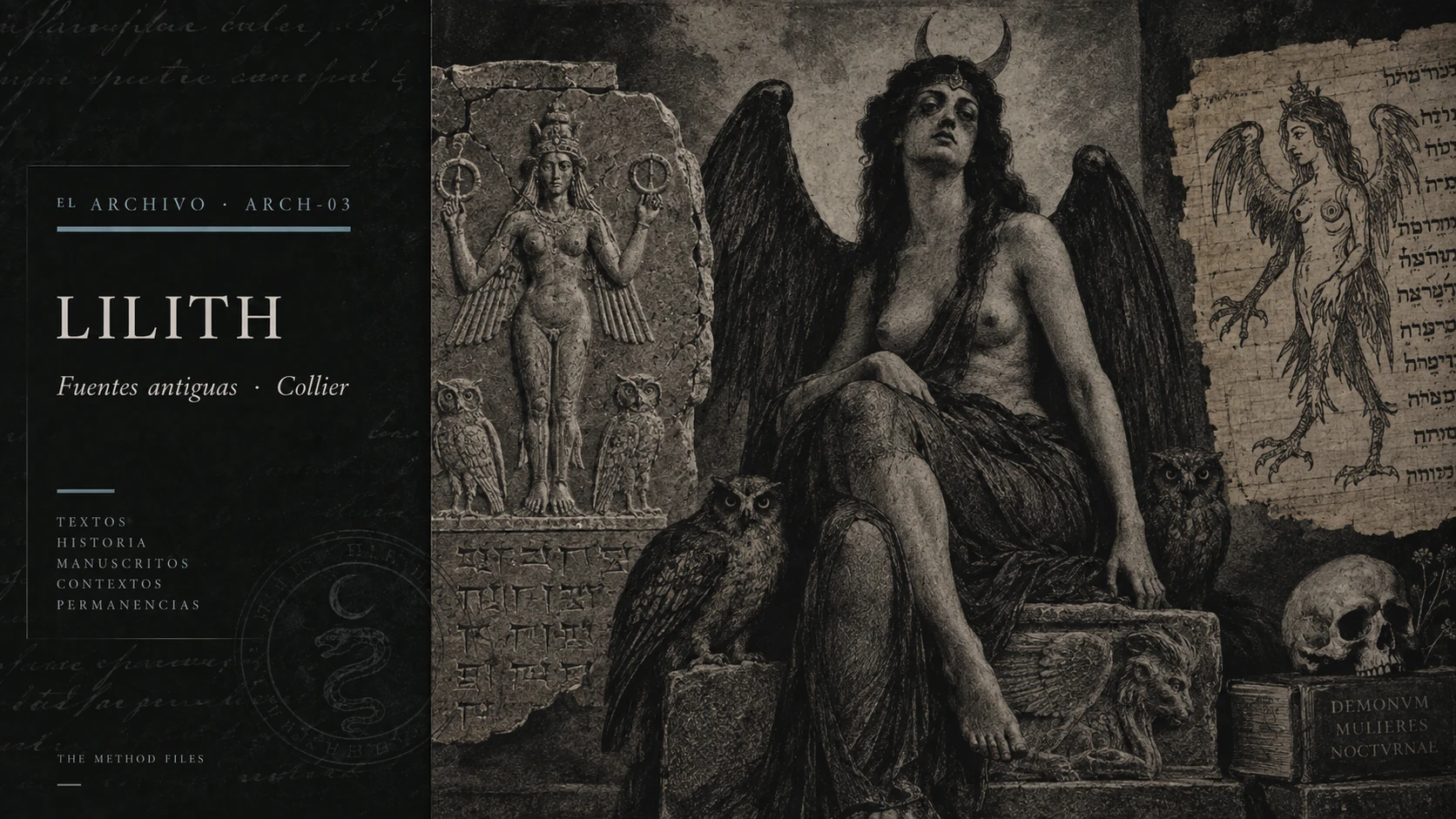
Who decided what demons look like? Lilith also raises a particularly important visual question. Many modern images are presented as ancient depictions of the figure, even when their identification is later or disputed. ‘Who decided what demons look like?’ examines how illustrators, editors and readers established appearances that subsequently came to seem traditional.
GRIMOIRE OF LILITH This article distinguishes the main stages in Lilith’s history. The Grimoire of Lilith takes that exploration further in a dedicated volume, distinguishing ancient sources from later interpretations and developments.
CONTINUE
Continue with Studies
In the Studies overview you can explore the programme, its free lessons and access options. The related lessons at the end of this page offer practice in tracing a figure across sources and checking an identification.